Mathematics · Ch 10 — Vector Algebra
Multiplication of a Vector by a Scalar
Multiplication of a Vector by a Scalar
Concept: Scaling a Vector
Multiplying a vector by a number (a scalar) scales it: the vector's direction either stays the same or flips, and its length changes by a factor equal to the absolute value of that number.
Let be any vector and a real scalar. The product is a new vector that is collinear with , with:
- Direction: if , points in the same direction as ; if , in the opposite direction.
- Magnitude: .
The scalar can be any real number — positive, negative, zero, or a fraction. The vector is always collinear with .
Special Cases of Scalar Multiplication
The Zero Scalar
If , then for any vector — the zero vector, with zero magnitude and undefined direction.
The Scalar
When , we get the negative (or additive inverse) of :
This vector has the same magnitude as () but points in the exactly opposite direction, and:
The negative of a vector is its additive inverse. Adding a vector and its negative always yields the zero vector.
The Scalar
Provided , take . The magnitude of the resulting vector is:
…
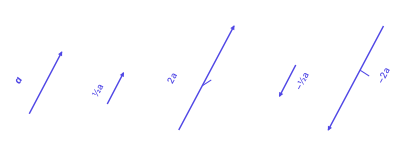
Drawn by us to help you understand the concept clearly, and verified to make sure it's accurate. For exams, practice from your NCERT textbook's own diagram.
Fig 10.12 is a simple but powerful geometric picture. It shows a single vector a drawn as an arrow pointing up and to the right. Around it, on the same line through the origin, are four other arrows: ½a (half the length of a, same direction), 2a (twice the length, same direction), −½a (half the length but pointing opposite to a), and −2a (twice the length, opposite direction). The figure has no axes or grid — it is just a straight line with these five arrows placed along it, all collinear.
The core idea is that multiplying a vector by a scalar stretches or shrinks the vector’s length by , and flips its direction if is negative. The vector always lies on the same line as — it is collinear with . The figure makes this visually obvious: all five arrows lie on one straight line, with the positive multiples pointing the same way as and the negative multiples pointing exactly opposite.
The textbook uses this figure to develop two key formulas. First, the magnitude relation:
Here is the length of the scaled vector, is the absolute value of the scalar (so length is always non-negative), and is the original length. In the figure, is some fixed length; is twice that, is half, and is also twice — the minus sign only affects direction, not magnitude.
Second, the figure leads directly to the definition of a unit vector in the direction of :
The symbol (read “a-hat”) is a vector of length 1 pointing exactly along . The formula says: take , multiply it by the scalar , and you get a vector of unit length. In the figure, if you imagine shrinking down to a length of 1 (keeping its direction), that arrow would be . The textbook also notes that when , the vector is the negative or additive inverse of , satisfying . …