Business Mathematics and Statistics · Ch 5 — Differential Calculus (Functions & Graphs, Limits & Derivatives, Differentiation Techniques)
Types of Functions and Their Graphs
Types of Functions and Their Graphs
Several families of functions recur constantly in business mathematics, and it helps to recognise both their algebraic form and the shape of their graph.
Constant function: for a fixed number . Its graph is a horizontal straight line at height — it produces the same output no matter what is.
Identity function: . Its graph is the straight line through the origin at to both axes, i.e. .
Polynomial functions: . The simplest non-trivial cases are:
- Linear (), e.g. — graph is a straight line.
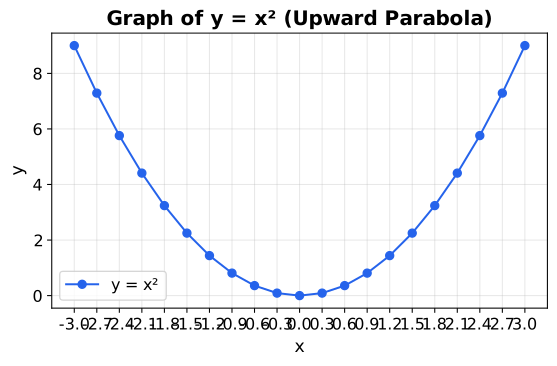
- Quadratic (), e.g. — graph is a parabola, symmetric about a vertical line through its vertex, opening upward if the leading coefficient is positive and downward if negative.
Rational functions: a ratio of two polynomials, , e.g. . Its graph typically has a vertical asymptote (a value of the graph approaches but never touches, where ) and often a horizontal asymptote describing its behaviour as .
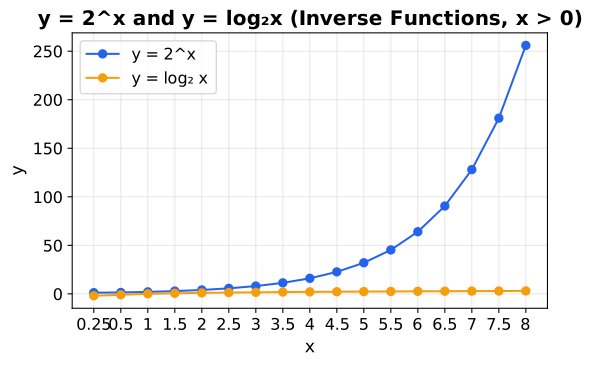
Exponential functions: for a fixed base (in higher work, often ). For the graph rises steeply to the right, passes through , stays always positive, and flattens toward the -axis (but never touches it) as .
Logarithmic functions: , defined only for . It is the inverse of the exponential function with the same base — its graph is the mirror image of in the line : it passes through , rises slowly, and has a vertical asymptote at .
| Function type | Typical form | Domain | Graph shape |
|---|---|---|---|
| Constant | horizontal line |
A function of the form , where is a non-negative integer and the are real constants with . is call …
A function of the form , where and are polynomials and . Its domain excludes every value o …
An exponential function () has the variable in the exponent; its inverse, the logarithmic function (), asks 'to what power mu …