Economics · Ch 1 — Introduction to Micro Economics
Production Possibility Curve
Production Possibility Curve
The Production Possibility Curve (PPC), also called the Production Possibility Frontier (PPF), is a graphical device that shows the maximum possible combinations of two goods (or two categories of goods) an economy can produce, given its available resources and technology, when those resources are used FULLY and EFFICIENTLY. It is one of the most useful ways to visualise the central problems of scarcity, choice, and opportunity cost together in a single diagram.
Assumptions behind the PPC: (i) the economy produces only two goods; (ii) the total quantity of resources available is fixed; (iii) the technology of production does not change during the period considered; (iv) resources are fully and efficiently employed — none are idle or wasted; and (v) resources can be shifted between the two goods, though not always with equal ease.
Consider an economy that can produce only two goods — Guns (a capital/defence good) and Butter (a consumer good) — using its entire stock of resources. The table below shows six possible combinations it could produce if its resources were fully and efficiently employed:
| Combination | Guns (units) | Butter (units) |
|---|---|---|
| A | 0 | 50 |
| B | 1 | 47 |
| C | 2 | 42 |
| D | 3 | 34 |
| E | 4 | 24 |
| F | 5 | 0 |
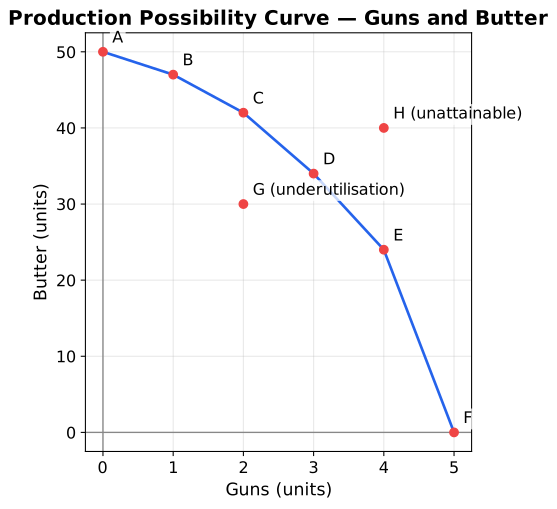
Moving from combination A to F, the economy must give up some units of Butter to gain each additional unit of Guns — this is the opportunity cost of Guns, measured in units of Butter forgone, and it is also called the Marginal Rate of Transformation (MRT). Computing it step by step: moving from A to B costs 3 units of Butter for the 1st Gun; B to C costs 5 units for the 2nd Gun; C to D costs 8 units for the 3rd Gun; D to E costs 10 units for the 4th Gun; and E to F costs 24 units for the 5th Gun. Notice that this opportunity cost keeps RISING as more Guns are produced — 3, then 5, then 8, then 10, then 24 units of Butter given up for each successive Gun.
This rising pattern is known as the Law of Increasing Marginal Opportunity Cost, and it is the very reason the PPC is drawn CONCAVE to the origin (bowed outward) rather than as a straight line. The economic reason behind it is that resources are not perfectly suited to producing every good equally well — as more and more resources are shifted from Butter production into Gun production, the resources being shifted become progressively LESS suited to making Guns (and were progressively better suited to making Butter), so each additional Gun costs more and more Butter to produce. …