Computer Science · Ch 1 — Computer System
Microcontrollers
Microcontrollers
A microcontroller is a small computing device that has a CPU, a fixed amount of RAM, ROM and other peripherals all embedded on a single chip. This is the crucial contrast with a microprocessor, which has only a CPU on the chip — a microcontroller is effectively a complete miniature computer on one chip.
Structure
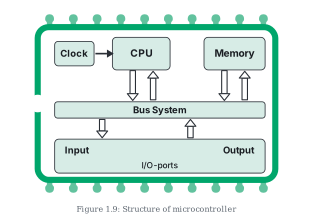
The structure of a microcontroller (Figure 1.9) shows all the parts of a computer system squeezed onto one chip: a clock driving the CPU, on-chip memory, an internal bus system connecting them, and I/O ports providing the input and output connections to the outside world.
Where microcontrollers are found
Because everything needed is on one chip, microcontrollers live inside everyday devices. Examples include:
- keyboard and mouse,
- washing machine,
- digital camera,
- pendrive,
- remote controller,
- microwave oven.
Why they are small and cheap
Microcontrollers are designed for specific tasks only — not for general-purpose computing. Because the job is fixed and limited, both the size and the cost of the chip are reduced.
Embedded operation
Being so small, a microcontroller is embedded inside another device or system to perform one specific function there. The book's example is the fully automatic washing machine: its microcontroller controls the entire washing cycle without any human intervention —
- the cycle starts with filling of water,
- the clothes are soaked and washed,
- the water is drained, and
- the clothes are spin-dried.
The simple use of a microcontroller thus permits repetitive execution of tedious tasks automatically, saving precious human time. …
Drawn by us to help you understand the concept clearly, and verified to make sure it's accurate. For exams, practice from your textbook's own diagram.
Figure 1.9 shows the internal structure of a microcontroller, drawn as a stylised green integrated-circuit chip with rectangular pins protruding from its top and bottom edges — a reminder that everything pictured lives on one single chip that plugs into a larger device.
Inside the chip outline:
- At the top left, a small box labelled Clock sends an arrow to the CPU — the clock paces the processor, generating the pulses that drive instruction execution.
- To the right of the CPU sits a separate box for Memory — the microcontroller's own fixed, on-chip RAM and ROM.
- Across the middle runs a horizontal bar labelled Bus System — the internal highway of the chip.
- Hollow block arrows connect the CPU to the Bus System (both down and up, i.e., two-way traffic), the Memory to the Bus System, and the Bus System down to a bottom bar labelled I/O-ports, which carries the labels Input on the left and Output on the right. …