Computer Science · Ch 3 — Emerging Trends
Natural Language Processing (NLP)
Natural Language Processing (NLP)
You have almost certainly used Natural Language Processing today. When a search engine's predictive typing suggests the next word of your sentence as you type keywords, or when a spell checker flags a mistake — that is NLP at work.
What is NLP?
Natural Language Processing (NLP) deals with the interaction between humans and computers using human spoken languages — languages such as Hindi, English and so on, rather than programming languages. Thanks to NLP it is now possible to:
- search the web using your voice, and
- operate or control devices by speaking to them.
Text-to-speech and speech-to-text
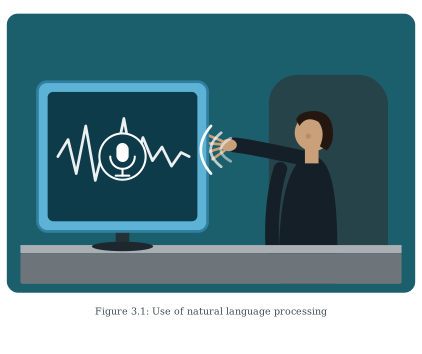
An NLP system can convert in both directions between written and spoken language (this two-way exchange between a person and a device is what Figure 3.1 depicts):
- Speech-to-text — the system listens to spoken words and produces written text (this is what happens when you dictate a search query).
- Text-to-speech — the system reads written text aloud in a synthesised voice.
Emerging application areas
- Machine translation — a rapidly emerging field in which machines translate text from one language to another with a fair amount of correctness. …
Drawn by us to help you understand the concept clearly, and verified to make sure it's accurate. For exams, practice from your textbook's own diagram.
This figure illustrates natural language processing in action as a conversation between a person and a machine. On the right, a man sits at a desk with one arm raised toward a large flat-screen display on the left. Wireless sound-wave arcs drawn beside his hand represent his voice travelling toward the device — he is speaking to it rather than typing.
The screen answers in kind: it shows a white audio waveform with a circular microphone icon at its centre. The waveform stands for the machine's side of the spoken exchange — the device is listening to (and can respond in) human speech. …