Computer Science · Ch 3 — Emerging Trends
Smart Cities
Smart Cities
Rapid urbanisation is loading our cities beyond what traditional management can handle. City administrations face mounting challenges in managing:
- resources — land, water, waste, air pollution, health and sanitation
- daily life — traffic congestion, public safety and security
- infrastructure — road, rail, bridges, electricity, subways, disaster management, sports facilities, and the rest of the city's fabric
These pressures are forcing city planners around the world to look for smarter ways to manage cities and to make them sustainable and livable.
The smart-city idea
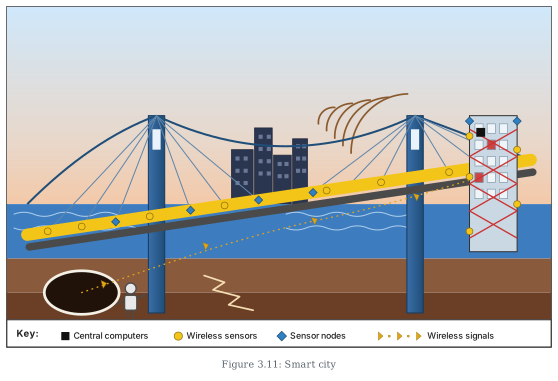
A smart city (Figure 3.11) uses computer and communication technology together with IoT to manage and distribute resources efficiently. Sensors embedded throughout the city's infrastructure watch for problems and report them automatically. The figure's examples show how this works:
- Smart building — uses sensors to detect earthquake tremors and then warn nearby buildings, so they can prepare themselves accordingly.
- Smart bridge — uses wireless sensors to detect any loose bolt, cable or crack, and alerts the concerned authorities through SMS.
- Smart tunnel — also uses wireless sensors, to detect any leakage or congestion inside the tunnel.
In each case, the information travels as wireless signals across a network of sensor nodes to a centralised computer for further analysis — measurement at the edge, decision-making at the centre.
A city working in unison …
Drawn by us to help you understand the concept clearly, and verified to make sure it's accurate. For exams, practice from your textbook's own diagram.
This illustration shows a smart-city scene in which the city's infrastructure itself is instrumented with sensors. The drawing contains four main elements:
- A blue suspension bridge over water, with yellow wireless-sensor dots placed along its cables and deck. As the section explains, a smart bridge's wireless sensors detect any loose bolt, cable or crack, and alert the concerned authorities through SMS.
- An underground tunnel, shown as a cutaway circle, fitted with sensors that detect leakage or congestion inside it.
- A city skyline in the background, emitting wireless-signal arcs — the city's systems in constant communication.
- A tall smart building at the right, studded with sensor nodes. The text explains that such a building uses sensors to detect earthquake tremors and then warns nearby buildings so they can prepare accordingly.
A key strip at the bottom of the figure maps the symbols used throughout: a black square = central computers, a yellow dot = wireless sensors, a blue diamond = sensor nodes, and a dotted triangle trail = wireless signals. …