Economics · Ch 3 — Theories of Employment and Income
Aggregate Demand, Aggregate Supply and Effective Demand
Aggregate Demand, Aggregate Supply and Effective Demand
At the heart of Keynes's theory are two schedules: aggregate demand and aggregate supply.
Aggregate Demand (AD) is the total expenditure that all buyers in the economy plan to make on final goods and services at each level of employment/income. In a simple closed economy with no government, it consists of planned consumption expenditure () and planned investment expenditure ():
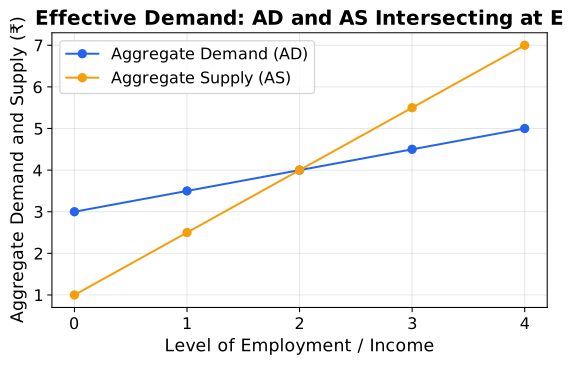
As income rises, consumption rises (but by less than income), while investment is taken as broadly autonomous in the short run — so the AD schedule slopes upward but less steeply than income itself.
Aggregate Supply (AS) is the total value of output (the aggregate supply price) that producers must receive to make it worthwhile to employ a given number of workers. As employment rises, the aggregate supply price rises, so the AS schedule also slopes upward; at full employment it becomes vertical, since output cannot rise further.
Effective Demand is the particular level of aggregate demand at which it becomes equal to aggregate supply — the point where . This is the equilibrium point at which the level of output, income and employment of the economy is determined. It is called effective because it is the demand that is actually 'made effective' in generating output and employment; other levels of demand are not sustained, because producers adjust output until planned demand and supply match.
The total planned expenditure on final goods and services in the economy at each level of income; in a simple closed economy without g …
The total value of output (aggregate supply price) that producers require in order to employ a given number of workers; it rises with employment and becomes …
The level of aggregate demand at which it equals aggregate supply; this equilibrium point determines the actual level of output, income and e …