Mathematics · Ch 7 — Applications of Differential Calculus
Angle between Two Curves
Angle between Two Curves
Definition 7.3. The angle between two curves, if they intersect, is defined as the acute angle between the tangent lines to the two curves at the point of intersection.
For two lines and (finite slopes ), the acute angle between them satisfies
Applied at a point of intersection of two curves, and are simply the two curves' tangent slopes there.
- If the two curves are parallel at the point of intersection , then .
- If the two curves are perpendicular (cut orthogonally) at , and both exist and are finite, then .
Working procedure. Find the point(s) of intersection of the two curves (by solving them simultaneously), differentiate each curve to get its slope, evaluate both slopes at the point of intersection, and substitute into the formula (or check the parallel/orthogonal special case directly). …
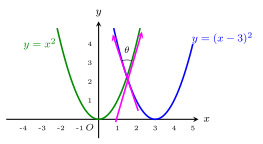
Drawn by us to help you understand the concept clearly, and verified to make sure it's accurate. For exams, practice from your textbook's own diagram.
What this figure shows. The parabolas y = x^2 and y = (x-3)^2 intersecting at (3/2, 9/4), with their tangent lines at the intersection and the angle theta b …
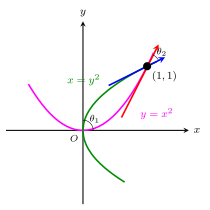
Drawn by us to help you understand the concept clearly, and verified to make sure it's accurate. For exams, practice from your textbook's own diagram.
What this figure shows. The curves y = x^2 and x = y^2 intersecting at (0,0) and (1,1), with theta1 = 90 degrees at the origin and the tangent lines and angle the …