It generalises to any finite number of terms: ∣z1+z2+⋯+zn∣≤∣z1∣+∣z2∣+⋯+∣zn∣.
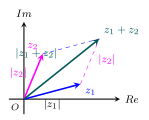
Geometric interpretation. In the triangle with vertices O,z1,z1+z2, the side corresponding to the vector z1+z2 cannot be longer than the sum of the lengths of the other two sides — exactly the ordinary triangle inequality from geometry, which is where the property gets its name.
Distance property. If z1=x1+iy1 and z2=x2+iy2, then
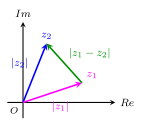
So ∣z1−z2∣ is exactly the ordinary distance between the pointsz1 and z2 in the Argand plane. Considering O,z1,z2 as a triangle and applying the triangle inequality to its sides gives two useful bounds used repeatedly to estimate ∣z∣ from a given constraint: ∣z1+z2∣≤∣z1∣+∣z2∣ and ∣z1−z2∣≥∣z1∣−∣z2∣. …
Figure 2.17Triangle inequality $|z_1+z_2|\le|z_1|+|z_2|$ shown on the addition parallelogram
ⓘDrawn by us to help you understand the concept clearly, and verified to make sure it's accurate. For exams, practice from your textbook's own diagram.
What this figure shows. Triangle inequality ∣z1+z2∣≤∣z1∣+∣z2∣ shown on the addition parallelogr …
Figure 2.18Distance $|z_1-z_2|$ between two points as the third side of triangle $O z_1 z_2$
ⓘDrawn by us to help you understand the concept clearly, and verified to make sure it's accurate. For exams, practice from your textbook's own diagram.
What this figure shows. Distance ∣z1−z2∣ between two points as the third side of triangle $O z_1 z_ …
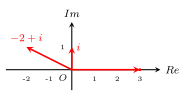
Figure 2.19Example 2.11: the points $i,\,-2+i,\,3$ and their distances from the origin
ⓘDrawn by us to help you understand the concept clearly, and verified to make sure it's accurate. For exams, practice from your textbook's own diagram.
What this figure shows. Example 2.11: the points i,−2+i,3 and their distances from the origi …
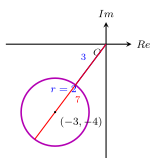
Figure 2.20Example 2.13: for $|z|=2$, the value $|z+3+4i|$ lies between $3$ and $7$ (circle of radius 2 centred at $(-3,-4)$)
ⓘDrawn by us to help you understand the concept clearly, and verified to make sure it's accurate. For exams, practice from your textbook's own diagram.
What this figure shows. Example 2.13: for ∣z∣=2, the value ∣z+3+4i∣ lies between 3 and 7 (circle of radius 2 centred at $(- …
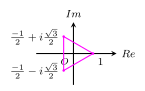
Figure 2.21Fig 2.21: the points $1,\ -\frac{1}{2}+i\frac{\sqrt{3}}{2},\ -\frac{1}{2}-i\frac{\sqrt{3}}{2}$ as vertices of an equilateral triangle in the Argand plane
ⓘDrawn by us to help you understand the concept clearly, and verified to make sure it's accurate. For exams, practice from your textbook's own diagram.
What this figure shows. Fig 2.21: the points 1,−21+i23,−21−i23 as vertices of an equilateral triangle in the …