Skip to content

Mathematics · Ch 8 — Differentials and Partial Derivatives

Linear Approximation and Differential of a Function of Several Variables

8.6

Linear Approximation and Differential of a Function of Several Variables

Just as a differentiable one-variable function is well approximated near x0x_0 by its tangent line, a function of two (or three) variables is well approximated near a point by its tangent plane (respectively tangent hyperplane).

Definition 8.10 (Linear Approximation and Differential, two variables). Let A={(x,y)∣a<x<b, c<y<d}⊂R2A=\{(x,y)\mid a<x<b,\,c<y<d\}\subset\mathbb R^2, F:A→RF:A\to\mathbb R, (x0,y0)∈A(x_0,y_0)\in A.

  1. The linear approximation of FF at (x0,y0)(x_0,y_0) is

    F(x,y)≈F(x0,y0)+∂F∂x∣(x0,y0)(x−x0)+∂F∂y∣(x0,y0)(y−y0).(12)F(x,y) \approx F(x_0,y_0) + \frac{\partial F}{\partial x}\bigg|_{(x_0,y_0)}(x-x_0) + \frac{\partial F}{\partial y}\bigg|_{(x_0,y_0)}(y-y_0). \qquad(12)

  2. The differential of FF is

    dF=∂F∂x(x,y) dx+∂F∂y(x,y) dy,where dx=Δx, dy=Δy.(13)dF = \frac{\partial F}{\partial x}(x,y)\,dx + \frac{\partial F}{\partial y}(x,y)\,dy, \qquad \text{where } dx=\Delta x,\ dy=\Delta y. \qquad(13)

    Definition 8.11 (Linear Approximation and Differential, three variables). For A={(x,y,z)∣a<x<b, c<y<d, e<z<f}⊂R3A=\{(x,y,z)\mid a<x<b,\,c<y<d,\,e<z<f\}\subset\mathbb R^3, F:A→RF:A\to\mathbb R, (x0,y0,z0)∈A(x_0,y_0,z_0)\in A:

    F(x,y,z)≈F(x0,y0,z0)+Fx∣(x0,y0,z0)(x−x0)+Fy∣(x0,y0,z0)(y−y0)+Fz∣(x0,y0,z0)(z−z0),(14)F(x,y,z) \approx F(x_0,y_0,z_0) + F_x\big|_{(x_0,y_0,z_0)}(x-x_0) + F_y\big|_{(x_0,y_0,z_0)}(y-y_0) + F_z\big|_{(x_0,y_0,z_0)}(z-z_0), \qquad(14)

    dF=Fx(x,y,z) dx+Fy(x,y,z) dy+Fz(x,y,z) dz,dx=Δx, dy=Δy, dz=Δz.(15)dF = F_x(x,y,z)\,dx + F_y(x,y,z)\,dy + F_z(x,y,z)\,dz, \qquad dx=\Delta x,\ dy=\Delta y,\ dz=\Delta z. \qquad(15)

    (The same pattern extends to any number of variables, though this course restricts itself to at most three.) Geometric meaning. For one variable, the linear approximation at x0x_0 is the tangent line to y=f(x)y=f(x) at x0x_0. For two variables, the linear approximation at (x0,y0)(x_0,y_0) is the tangent plane to the surface z=F(x,y)z=F(x,y) at (x0,y0)(x_0,y_0) — the natural one-dimension-higher analogue. Worked pattern (differential). For w(x,y,z)=x2y+y2z+z2xw(x,y,z)=x^2y+y^2z+z^2x: compute wx=2xy+z2w_x=2xy+z^2, wy=2yz+x2w_y=2yz+x^2, wz=2zx+y2w_z=2zx+y^2, then by (15), dw=(2xy+z2) dx+(2yz+x2) dy+(2zx+y2) dz.dw = (2xy+z^2)\,dx + (2yz+x^2)\,dy + (2zx+y^2)\,dz. …
Figure 8.13Fig 8.13 Linear approximation by the tangent plane: the tangent plane to the surface z=f(x,y) at the point (x0,y0,f(x0,y0)) best-approximates the surface near that point
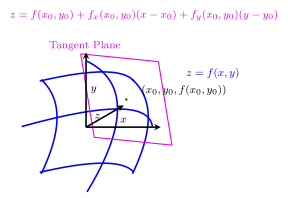
Fig. 8.13 — Fig 8.13 Linear approximation by the tangent plane: the tangent plane to the surface z=f(x,y) at the point (x0,y0,f(x0,y0)) best-approximates the surface near that point

Drawn by us to help you understand the concept clearly, and verified to make sure it's accurate. For exams, practice from your textbook's own diagram.

What this figure shows. Fig 8.13 Linear approximation by the tangent plane: the tangent plane to the surface z=f(x,y) at the point (x0,y0,f(x0,y0)) best-approximates the surface …