Mathematics · Ch 10 — Ordinary Differential Equations
Formation of Differential Equations from Geometrical Problems
Formation of Differential Equations from Geometrical Problems
When a family of curves is given by an equation containing arbitrary constants, the differential equation the whole family satisfies is found by differentiating times and eliminating the constants from the resulting equations (§10.4). Two symmetry checks help along the way: eliminating one arbitrary constant always yields a first-order equation; eliminating two always yields a second-order equation; and so on.
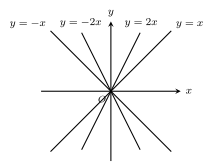
Example 10.2 (one constant → order 1). The family of all straight lines through the origin is , with the only arbitrary constant (Fig. 10.1 sketches four members of this family: ). Differentiating once gives ; substituting back into eliminates , leaving the first-order equation
Example 10.3 (two constants → order 2). For (two constants ), differentiating twice gives and . So directly, — no further substitution was even needed, since the second derivative reproduces exactly.
Example 10.4 (circles through two fixed points). For the family of circles through the fixed points and , the centre must lie on the -axis: writing the centre as with arbitrary gives . Differentiating once: . Substituting back and simplifying yields the first-order equation
Example 10.5 (parabola family). For (one constant ), differentiating gives ; substituting back and simplifying gives the first-order equation
…
Drawn by us to help you understand the concept clearly, and verified to make sure it's accurate. For exams, practice from your textbook's own diagram.
What this figure shows. A set of axes with several lines drawn through the origin for different slopes (four rays labelled are shown), illustrating the one-parameter family whose differential equation is derived in Example 10.2. …