Economics · Ch 2 — Theory of Consumer Behaviour
Optimal Choice of the Consumer
Optimal Choice of the Consumer
2.3 Optimal Choice of the Consumer
The Consumer's Problem
The budget set contains every bundle the consumer can afford. But which specific bundle will she actually choose? Economics assumes the consumer has well-defined preferences over all possible bundles — she can compare any two bundles and decide either that she prefers one to the other, or that she is indifferent between them. A rational consumer always acts according to her preferences, choosing the bundle that gives her maximum satisfaction.
The consumer's problem can therefore be restated: from the bundles available in her budget set, she must move to the point on the highest possible indifference curve that her budget allows.
Why the Optimum Lies on the Budget Line
A point below the budget line cannot be the optimum. If preferences are monotonic (more of any good is always preferred), then for any point below the budget line there exists some point on the budget line that contains more of at least one good and no less of the other. That point on the budget line is strictly preferred. Points above the budget line are unaffordable. Therefore, the optimum bundle must lie on the budget line itself.
For a rational consumer with monotonic preferences, the optimum bundle is always on the budget line — never inside it.
Where on the Budget Line? The Tangency Condition
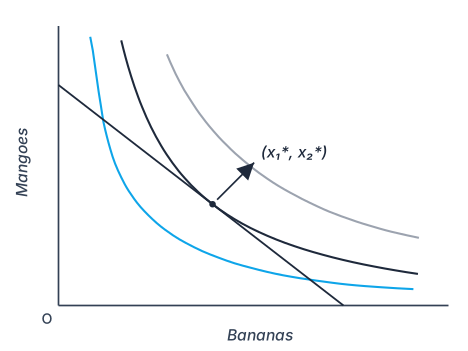
The optimum is located at the point where the budget line is tangent to one of the indifference curves.
Equality of the Marginal Rate of Substitution and the Ratio of the Prices
At the point of tangency, two slopes become equal: the slope of the indifference curve — the Marginal Rate of Substitution (MRS), the rate at which the consumer is willing to substitute one good for the other — and the slope of the budget line — the price ratio, the rate at which she is able to substitute one good for the other in the market. At the consumer's optimum, these two rates must be the same:
where is the price of good 1 (say, bananas) and the price of good 2 (say, mangoes).
Why This Equality Must Hold
Suppose at some point on the budget line the MRS is 2, meaning the consumer is willing to give up 2 mangoes to get 1 extra banana. Suppose both goods have the same price (price ratio = 1). At this point, the consumer is willing to sacrifice 2 mangoes for a banana, but in the market she can get an extra banana by giving up just 1 mango. If she buys that extra banana, she can have more of both goods compared to her current bundle — she moves to a preferred bundle. Therefore, a point where MRS exceeds the price ratio cannot be the optimum.
A similar argument holds when MRS is less than the price ratio. The consumer would be better off giving up bananas for mangoes. Only when MRS equals the price ratio is there no possibility of a mutually beneficial trade — the consumer has reached her optimum.
A common mistake is to think the optimum is simply where an indifference curve intersects the budget line. It must be a tangency — the curves just touch, sharing the same slope at that single point.
The Tangency in the Diagram
Figure 2.12 (described in the textbook) shows the consumer's optimum at the bundle . At this point, the budget line is tangent to the black indifference curve. This indifference curve is the highest one the consumer can reach given her budget. The grey indifference curve above it is unaffordable — every point on it lies above the budget line. The blue indifference curve below it is affordable but inferior — every point on it gives less satisfaction than the tangency point. Any other point on the budget line itself lies on a lower indifference curve and is therefore inferior to .
Drawn by us to help you understand the concept clearly, and verified to make sure it's accurate. For exams, practice from your textbook's own diagram.
Figure 2.12 shows a single two-dimensional graph. The vertical axis measures mangoes, the horizontal axis measures bananas. A straight, downward-sloping budget line runs across the graph. Three indifference curves are drawn: one low (blue), one middle (black), and one high (grey). The budget line just touches the middle indifference curve at exactly one point, marked with a dot and an arrow. That point is labelled — the consumer’s optimum bundle.
The high indifference curve lies entirely above the budget line; no point on it is affordable. The low indifference curve cuts the budget line twice, so part of it lies inside the budget set and part outside; its affordable bundles all give less satisfaction than the optimum on the middle curve. Every other point on the budget line itself (except the tangency point) lies on a lower indifference curve than the middle one. So the tangency point is the only bundle on the budget line that reaches the highest possible indifference curve.
What this teaches is the condition for consumer optimum: the budget line must be tangent to an indifference curve. At that point, the slope of the indifference curve (the marginal rate of substitution, MRS) equals the slope of the budget line (the price ratio ). The consumer’s willingness to trade one good for another (MRS) exactly matches the market’s rate of trade (the price ratio). If MRS were higher than the price ratio, the consumer could gain by buying more bananas and fewer mangoes; if MRS were lower, she could gain by doing the opposite. Only at tangency is there no further gain from reallocating spending — that is the optimum. …
…