Botany · Ch 2 — Biological Classification
Slime Moulds
Slime Moulds
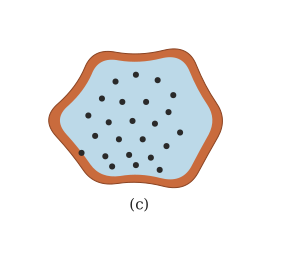
Slime moulds are saprophytic protists, meaning they feed on dead and decaying organic matter. Their body moves along decaying twigs and leaves, engulfing organic material as it creeps forward.
Under suitable conditions, the many individual bodies come together and form an aggregation called a plasmodium, which may grow and spread over several feet — making it one of the largest structures formed by a protist. During unfavourable conditions, the plasmodium differentiates and forms fruiting bodies bearing spores at their tips.
Important features of these spores:
- they possess true walls, unlike the naked feeding stage
- they are extremely resistant and can survive for many years, even under adverse conditions
- they are dispersed by air currents, which spreads the slime mould to new places …
Drawn by us to help you understand the concept clearly, and verified to make sure it's accurate. For exams, practice from your textbook's own diagram.
This composite figure shows four representative members of the Kingdom Protista. In (a) a dinoflagellate is drawn with its stiff cellulose plates on the cell surface and a furrow housing its flagella; these are mostly marine, photosynthetic forms. In (b) Euglena is shown as a spindle-shaped cell with a long flagellum and a flexible pellicle instead of a cell wall, able to switch between photosynthesis and a heterotrophic mode. In (c) a slime mould appears as an irregular, lobed mass that creeps over decaying material engulfing organic matter. In (d) Paramoecium is a slipper-sha …