Botany · Ch 7 — Biomolecules
How do Enzymes bring about such High Rates of Chemical Conversions?
How do Enzymes bring about such High Rates of Chemical Conversions?
To see how enzymes achieve their remarkable speeds, we need to look a little more closely at how an enzyme handles its substrate. The key ideas are the active site, the substrate, the enzyme-substrate complex, the transition state, and activation energy.
Substrate, active site and the ES complex
A chemical or metabolic conversion is a reaction, and the chemical that gets converted into product is called the substrate. So an enzyme — a protein with a three-dimensional structure that includes an active site — takes a substrate (S) and turns it into a product (P). In shorthand, S becomes P.
For this to happen, several things must occur in order:
- The substrate has to diffuse towards the active site of the enzyme.
- The substrate then binds at the active site, inside its cleft or pocket.
- This binding produces an enzyme-substrate complex, written as the ES complex (E standing for enzyme).
- This complex is only a transient arrangement — it forms briefly and does not last.
The transition state
While the substrate is held at the active site, its structure is altered. It takes on a new, special form called the transition state structure. Very soon after the necessary breaking and making of bonds is completed, the finished product is released from the active site. In other words, over the course of the reaction the structure of the substrate is gradually transformed into the structure of the product, and this transformation has to pass through the transition state.
There may in fact be several "altered structural states" lying between the stable substrate and the stable product. All of these in-between states are unstable. Stability here is a matter of the energy of the molecule or structure — the more stable a form, the lower its energy.
Activation energy and how enzymes lower it
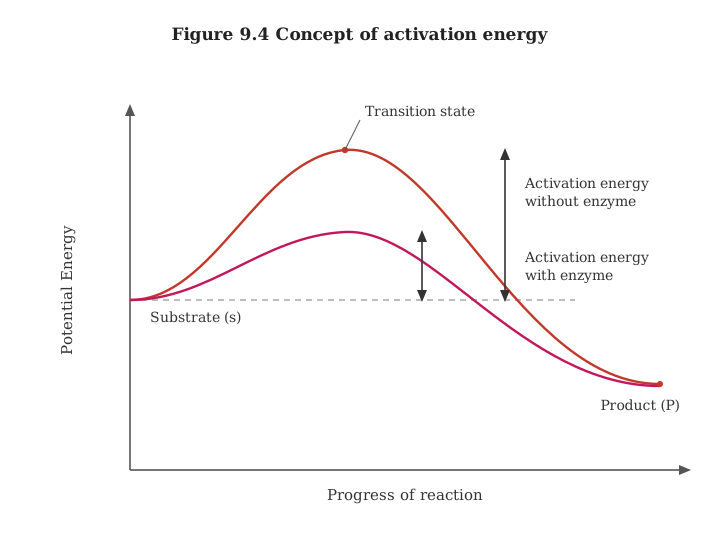
This energy picture can be shown on a graph. On such a graph the vertical axis (y-axis) stands for the potential energy of the molecules, and the horizontal axis (x-axis) shows the progress of the transformation, moving from substrate through the transition state to product. Two things stand out from this picture:
- The energy difference between S and P. If the product P sits at a lower energy level than the substrate S, the reaction is exothermic — you do not need to supply energy (by heating) to make the product. If P is higher than S, the reaction is endothermic and requires energy.
- The energy hump on the way. Whether the reaction is exothermic (spontaneous) or endothermic (energy-requiring), the substrate must first climb to a much higher energy level, the transition state, before it can become product. …
Drawn by us to help you understand the concept clearly, and verified to make sure it's accurate. For exams, practice from your textbook's own diagram.
This graph explains what activation energy is and how an enzyme speeds a reaction. The potential energy of the molecules is plotted along the course of a reaction: the reactants (substrate) start at one level, must rise over an energy barrier to a high-energy transition state, and then fall to the lower energy of the products. The height of that barrier is the activation energy — the energy that has to be supplied before the reaction can proceed. The figure draws two curves: without an enzyme the barrier is high, but with an enzyme the peak is much lower. By lowering the activation energy in thi …