Botany · Ch 8 — Cell Cycle and Cell Division
Meiosis I
Meiosis I
Meiosis I is the first of the two divisions that together make up meiosis, and it is the division that actually reduces the chromosome number. It is here that homologous chromosomes are brought together, exchange pieces of genetic material, and are then pulled apart into separate cells. Because of these events, meiosis I is more elaborate than any single mitotic division, and its prophase in particular is unusually long and involved.
Prophase I
Prophase of the first meiotic division is considerably longer and more complicated than the prophase of an ordinary mitotic division. On account of the distinctive changes chromosomes undergo, it has been split into five successive sub-stages: leptotene, zygotene, pachytene, diplotene and diakinesis.
Leptotene
At the leptotene stage the chromosomes slowly become visible under the light microscope as thread-like structures. As the stage proceeds, the chromosomes continue to compact and coil more tightly, so their outlines grow steadily clearer.
Zygotene
During zygotene the chromosomes begin to come together in pairs. This pairing, in which each chromosome lines up alongside its partner, is called synapsis, and the two members that pair in this way are the homologous chromosomes (one inherited from each parent). Electron microscope studies show that this pairing is accompanied by the assembly of an elaborate protein structure between the paired partners, known as the synaptonemal complex. A pair of synapsed homologous chromosomes held together in this way is called a bivalent, or a tetrad. These paired structures, however, are seen much more distinctly in the stage that follows.
Pachytene
Leptotene and zygotene are comparatively brief; pachytene lasts longer. By now each bivalent is resolved into its four chromatids, so the structure is clearly recognised as a tetrad. The defining feature of this stage is the appearance of recombination nodules — the specific points along the paired chromosomes where crossing over takes place between the non-sister chromatids of the two homologous chromosomes.
- Crossing over is the exchange of genetic material between two homologous chromosomes.
- It is an enzyme-driven process, carried out by an enzyme called recombinase.
- The outcome is recombination, a fresh reshuffling of the genetic material carried on the two chromosomes.
Recombination between the homologous chromosomes is finished by the close of pachytene, but the exchange leaves the chromosomes physically joined at the points where crossing over occurred.
Diplotene
The start of diplotene is marked by the breakdown of the synaptonemal complex. Freed from this scaffold, the recombined homologous chromosomes of each bivalent begin to move apart from one another, yet they cannot separate completely because they remain tied together at the sites of crossing over. These persisting connections appear as X-shaped structures called chiasmata. Diplotene can be extraordinarily prolonged; in the egg cells (oocytes) of certain vertebrates it may last for months or even years.
Diakinesis
Diakinesis is the last sub-stage of prophase I and is characterised by terminalisation of chiasmata, in which the chiasmata slide toward the ends of the chromosomes. By this stage the chromosomes are fully condensed, and the meiotic spindle is put together to make ready for the separation of the homologous chromosomes. As diakinesis ends, the nucleolus disappears and the nuclear envelope breaks down. This sub-stage therefore serves as the transition into metaphase.
Metaphase I
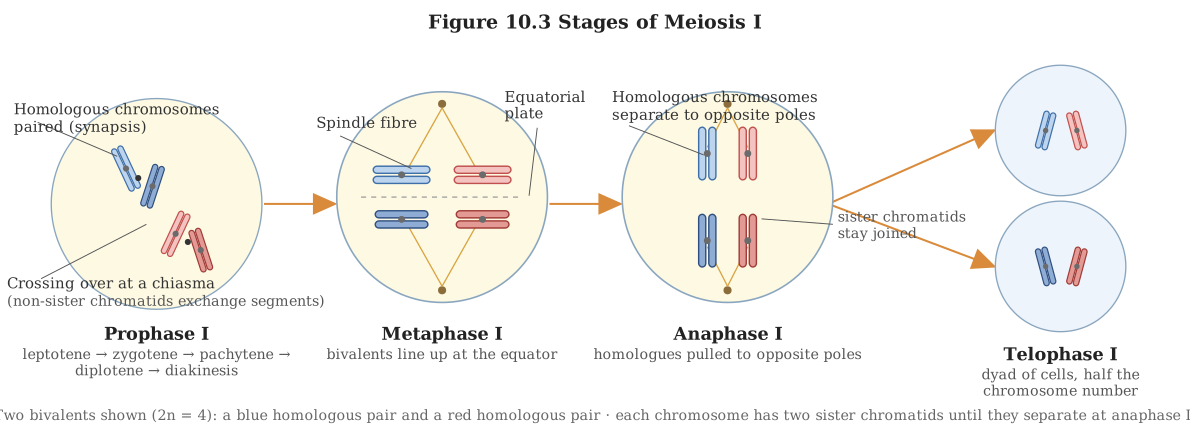
In metaphase I the bivalent chromosomes arrange themselves on the equatorial plate at the centre of the cell. Microtubules extending from the two opposite poles of the spindle attach to the kinetochores of the homologous chromosomes — importantly, the two homologues of a bivalent are captured by fibres from opposite poles.
Anaphase I …
Drawn by us to help you understand the concept clearly, and verified to make sure it's accurate. For exams, practice from your textbook's own diagram.
These panels show meiosis I, the first of the two meiotic divisions and the one that halves the chromosome number. Its long prophase I passes through five sub-stages: leptotene (chromosomes condense), zygotene (homologous chromosomes pair up in a process called synapsis, forming bivalents), pachytene (the paired chromosomes, now a tetrad of four chromatids, exchange segments by crossing over at points called chiasmata), diplotene (the homologues begin to separate but stay joined at the chiasmata) and diakinesis (the chromosomes are fully condensed and the nuclear envelope breaks down). In metaphase I the bivalents line up at the equator; in anaphase I the two homologous chromosomes of each pair are pulled to opposite poles while the sister chromatids stay together; and in …