Botany · Ch 8 — Cell Cycle and Cell Division
Phases of Cell Cycle
Phases of Cell Cycle
A convenient way to understand a typical eukaryotic cell cycle is to look at human cells grown in culture. Such cells divide roughly once every 24 hours. This timing, however, is not fixed for all life — it differs from one organism to another and even between different cell types within the same organism. Yeast, for instance, can complete an entire cell cycle in only about 90 minutes.
The cell cycle is split into two fundamental phases:
- Interphase — the period between two successive divisions.
- M Phase (Mitosis phase) — the stage where the actual cell division takes place.
Although the M Phase is the most visible event, it occupies only a small slice of time. In the 24-hour cycle of a human cell, the division itself lasts only about an hour, while interphase makes up more than 95 per cent of the total duration.
M Phase
The M Phase begins with nuclear division — the separation of the daughter chromosomes, known as karyokinesis — and normally ends with the division of the cytoplasm, called cytokinesis.
Interphase
Interphase is often described as the resting phase, but this label is misleading. Far from resting, the cell is busy preparing for its coming division by growing and by replicating its DNA in an orderly way. Interphase is itself divided into three sub-phases:
- G1 phase (Gap 1) — This is the interval between the end of mitosis and the start of DNA replication. During G1 the cell is metabolically active and grows steadily, but it does not copy its DNA.
- S phase (Synthesis) — This is the period when DNA synthesis, or replication, actually occurs. During S phase the amount of DNA per cell doubles: if the starting quantity is written as 2C, it rises to 4C. Importantly, the chromosome number does not change — a cell that was diploid (2n) at G1 still has 2n chromosomes after S phase; only the amount of DNA has increased, not the count of chromosomes. In animal cells, while DNA replication is proceeding in the nucleus during S phase, the centriole is duplicating out in the cytoplasm.
- G2 phase (Gap 2) — Here the cell manufactures proteins in readiness for mitosis, and cell growth continues.
The quiescent stage (G0) …
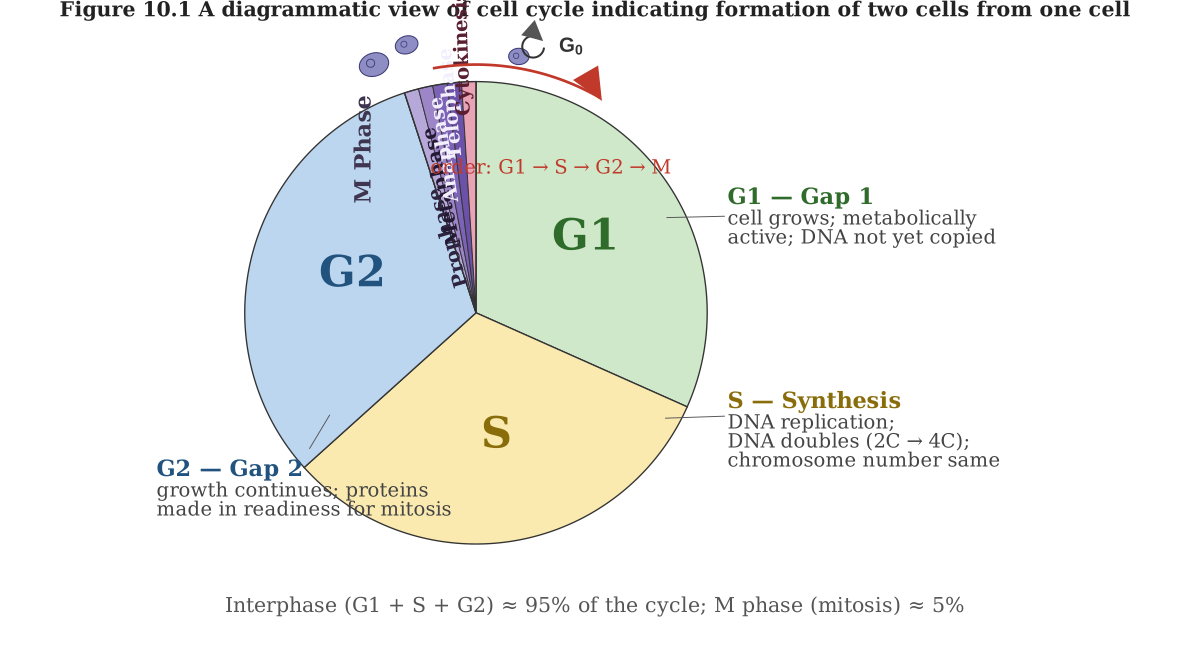
Drawn by us to help you understand the concept clearly, and verified to make sure it's accurate. For exams, practice from your textbook's own diagram.
This 'clock' diagram lays out the cell cycle — the ordered sequence a cell passes through from one division to the next. Most of the circle is interphase, the long growth-and-preparation period, which is split into three parts: the G1 phase, in which the cell grows and is metabolically active but has not yet copied its DNA; the S phase, in which the DNA is replicated so that each chromosome comes to have two identical copies; and the G2 phase, in which the cell grows further and makes the proteins needed for division. The remaining, smaller arc is the M phase (mitosis), in which the nucleus divides (karyokinesis) and then the cytoplasm divides (cytokinesis) to give two daughter cells. A branch off G1 leads to the G0, or quiescent, phase that …