Botany · Ch 3 — Plant Kingdom
Bryophytes
Bryophytes
Bryophytes are the group of simple land plants that includes the mosses and the liverworts. They are commonly seen growing in moist, shaded places, such as the damp hillsides where they form soft green carpets. Because they can grow on soil yet still depend on water to complete sexual reproduction, they are often described as the amphibians of the plant kingdom: rooted on land but tied to water for one crucial part of their life.
Where they grow and what they do
These plants prefer damp, humid and shaded localities. Even where the ground is bare, bryophytes are important pioneers: they take part in plant succession, helping colonise fresh rock and soil and preparing it for other plants that follow.
The plant body
The body of a bryophyte is more advanced and better differentiated than that of algae, but it is still simple compared with higher plants.
- It is thallus-like, and may lie flat (prostrate) or stand upright (erect).
- It clings to the surface it grows on by means of rhizoids, which may be made of a single cell or several cells.
- Bryophytes do not have true roots, true stems or true leaves. What they have are only root-like, leaf-like or stem-like structures that resemble these organs without being genuinely the same.
The main plant body is haploid, meaning it carries a single set of chromosomes. Since this body is the part that produces the gametes, it is called the gametophyte.
Sex organs and fertilisation
The sex organs of bryophytes are multicellular, unlike the simpler reproductive structures of algae.
- The male sex organ is the antheridium. It produces male gametes known as antherozoids, each of which bears two flagella (biflagellate) and can swim.
- The female sex organ is the archegonium. It is shaped like a flask and contains a single egg.
The swimming antherozoids are released into a film of water, through which they travel to reach the archegonium. This is the reason water is essential: without it the male gametes cannot make their journey. Once an antherozoid reaches the egg, the two fuse to form the zygote.
From zygote to sporophyte
The zygote does not divide by reduction division (meiosis) straight away. Instead it grows into a multicellular structure called the sporophyte. This sporophyte is not independent; it stays attached to the green, photosynthetic gametophyte and draws its nourishment from it. Later, some cells of the sporophyte undergo meiosis to form haploid spores. Each spore can germinate and grow into a new gametophyte, completing the cycle.
Importance of bryophytes
As a group, bryophytes have little direct economic value, but several of their contributions are worth noting.
- Some mosses serve as food for plant-eating mammals, birds and other animals. …
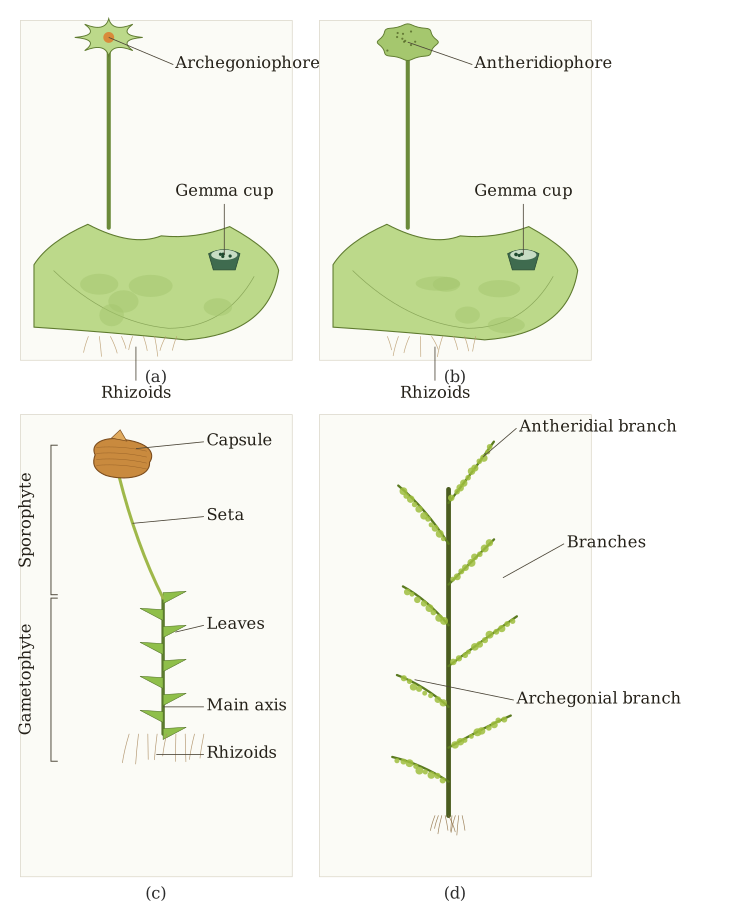
Drawn by us to help you understand the concept clearly, and verified to make sure it's accurate. For exams, practice from your textbook's own diagram.
This plate shows examples of bryophytes, often called the amphibians of the plant kingdom because they need water for reproduction. The liverwort Marchantia is drawn as a flat, ribbon-like green thallus lying on the soil, held down by rhizoids and carrying little gemma cups for vegetative reproduction; the (a) female thallus bears umbrella-shaped stalks called archegoniophores and the (b) male thallus bears antheridiophores. The mosses are shown by (c) Funaria, whose leafy upright gametophyte carries the sporophyte — a stalk (seta) topped by a spore capsule — and by (d) the gametophyte of Sphagnum, drawn as a tufted, densely branched moss plant whose branches are marked out by type: antheridial branches, which carry the male sex organs, archegonial branches, which carry the female sex organs, and the plant's ordinary vegetative bran …