Botany · Ch 9 — Sexual Reproduction in Flowering Plants
Flower – A Fascinating Organ of Angiosperms
Flower – A Fascinating Organ of Angiosperms
People have valued flowers for as long as human history goes back — not just biologically, but aesthetically, socially, religiously, and culturally. Flowers stand in for feelings as varied as love, affection, happiness, grief, and mourning. (Try it: name five ornamental flowers commonly grown at home or in gardens, then five more that show up in your own family's social or cultural celebrations — and look up what floriculture actually means.) …
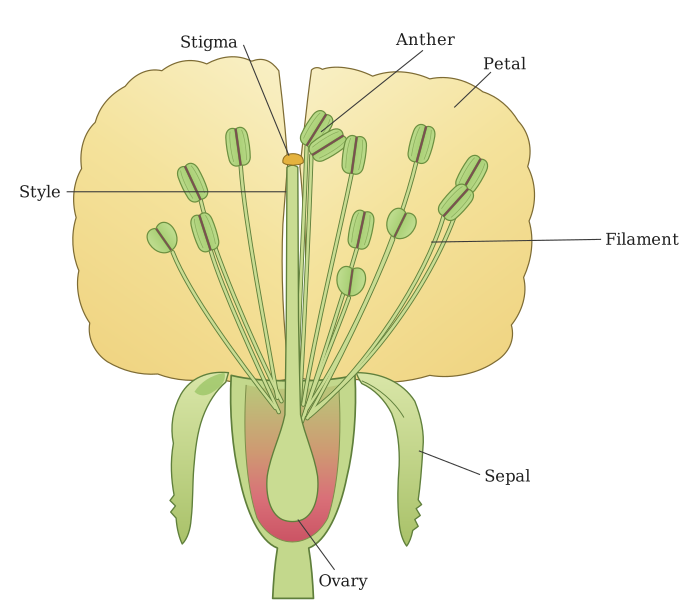
Drawn by us to help you understand the concept clearly, and verified to make sure it's accurate. For exams, practice from your textbook's own diagram.
Figure 1.1 is a schematic longitudinal section (L.S.) of a typical flower, cut vertically through the centre to reveal the internal arrangement of its parts. The cut is made along the long axis of the flower, so you see the flower split into two symmetrical halves — like slicing an apple from stem to base.
At the bottom of the diagram is the thalamus, the swollen, cup-like or conical base on which all floral parts are inserted. Moving outward from the centre, the figure shows four distinct whorls arranged concentrically on the thalamus.
The outermost whorl is the calyx, composed of sepals — these are the leaf-like, usually green structures that enclose and protect the flower bud. Inside the calyx lies the corolla, made up of petals, which are often brightly coloured and serve to attract pollinators. Both the calyx and corolla are shown as separate, distinct layers on the thalamus.
Moving inward, the next whorl is the androecium — the male reproductive part. The figure labels a single stamen, which consists of two parts: a slender stalk called the filament, and a swollen, bilobed structure at its tip called the anther. The anther is the site where pollen grains (male gametophytes) are produced.
At the very centre of the flower sits the gynoecium — the female reproductive part. This is shown as a single pistil (though in some flowers the gynoecium may consist of multiple fused or free carpels). The pistil is divided into three regions: the stigma at the top, a sticky surface that receives pollen; the style, a slender neck connecting the stigma to the ovary; and the ovary, the swollen basal part that encloses one or more ovules. The ovules are shown as small, rounded structures inside the ovary — each ovule contains the female gametophyte (embryo sac). …