Q.Nitric oxide reacts with Br2 and gives nitrosyl bromide as per reaction given below: 2NO
🔒You're viewing a preview — the full solution, concept, methods & PYQ mapping are locked.
🔒 Start your 14-day free trial to unlock the full solution →Concept understanding — Equilibrium Constant Calculation
Equilibrium Constant Calculation: From Intuition to Precision
Imagine you're at a party where people can move between two rooms. Some people prefer the kitchen (more snacks), others prefer the living room (better music). After a while, the number of people in each room stops changing — not because everyone froze, but because the rate of people leaving the kitchen equals the rate of people entering it. The system is in dynamic equilibrium.
Chemical reactions work the same way. A reversible reaction like
A+B⇌C+D doesn't stop when it reaches equilibrium. Instead, the forward reaction (making C and D) and the reverse reaction (making A and B) happen at the same rate. The concentrations of A, B, C, and D become constant — not equal, but constant.
The equilibrium constant K is a number that tells you where this balance lies. It answers the question: At equilibrium, which side of the reaction is favoured?
The Intuitive Idea
Think of a seesaw. If K is very large (say 106), the equilibrium sits heavily on the product side — almost all A and B have turned into C and D. If K is very small (say 10−6), the opposite is true: hardly any product forms. If K is around 1, both sides have comparable amounts.
So K is a ratio — a comparison of product concentrations to reactant concentrations at equilibrium, each raised to the power of their stoichiometric coefficients.
The Precise Statement
For a general reversible reaction at a given temperature:
aA+bB⇌cC+dD
the equilibrium constant Kc (for concentrations in mol/L) is:
Kc=[A]a[B]b[C]c[D]d
where [X] means the equilibrium concentration of species X in moles per litre.
The exponents come directly from the balanced chemical equation. If the coefficient of A is 2, you square its concentration. This is not optional — it's built into the definition.
What K Actually Depends On
K is constant at a given temperature. Change the temperature, and K changes. But K does not depend on:
- Initial concentrations
- Presence of a catalyst (catalysts speed up both directions equally)
- Pressure or volume changes (for Kc; Kp for gases has its own rules)
This is a critical exam point: if a problem gives you initial concentrations and asks for K, you must first find equilibrium concentrations — you cannot plug in initial values.
A Worked Example
Problem:
N2(g)+3H2(g)⇌2NH3(g)
At 500°C, equilibrium concentrations are:
[N2]=0.50 M, [H2]=1.50 M, [NH3]=0.20 M
Calculate Kc.
Solution:
Write the expression:
Kc=[N2][H2]3[NH3]2
Substitute:
Kc=(0.50)(1.50)3(0.20)2=0.50×3.3750.04=1.68750.04≈0.0237
The units cancel because the numerator and denominator both have units of (mol/L)2 and (mol/L)4 respectively — but by convention, Kc is reported without units. The numerical value is what matters.
Common Pitfalls
- Forgetting the exponents: A coefficient of 2 means square the concentration, not double it.
- Using initial concentrations: You must use equilibrium concentrations only. …
The key idea is to use the stoichiometric changes from the initial amounts to the equilibrium amounts.
Step 1: Write the balanced reaction and define changes.
2NO(g)+Br2(g)⇌2NOBr(g)
Let x be the moles of Br2 that react. Then NO reacts by 2x, and NOBr forms by 2x.
Step 2: Use the given equilibrium amount of NOBr.
We are told 0.0518 mol of NOBr is present at equilibrium. Since initial NOBr = 0:
2x=0.0518⇒x=0.0259
Step 3: Calculate equilibrium amounts of NO and Br2. …
The equilibrium constant is not needed here — the stoichiometric ratios directly give the equilibrium amounts. At equilibrium, NO = 0.0352 mol and Br₂ = 0.0178 mol.
This is a straightforward stoichiometry problem disguised as an equilibrium calculation. The key insight: you don't need the equilibrium constant at all. The reaction tells you exactly how much of each reactant gets consumed to produce the given amount of product.
Let's see why.
The balanced equation is:
2NO(g)+Br2(g)⇌2NOBr(g)
This means: for every 2 moles of NOBr formed, 2 moles of NO and 1 mole of Br₂ are consumed. The ratio is clean and direct.
- Find how much NO is consumed
We are told that 0.0518 mol of NOBr is obtained at equilibrium. From the stoichiometry:
Moles of NO consumed=Moles of NOBr formed=0.0518 mol
Why? Because the coefficient of NO and NOBr are both 2 — they react and form in a 1:1 molar ratio.
- Find equilibrium amount of NO
Initial NO = 0.087 mol
NO consumed = 0.0518 mol
NO at equilibrium=0.087−0.0518=0.0352 mol
- Find how much Br₂ is consumed
From the stoichiometry, 1 mole of Br₂ is consumed for every 2 moles of NOBr formed. So:
Moles of Br2 consumed=21×0.0518=0.0259 mol
- Find equilibrium amount of Br₂
Initial Br₂ = 0.0437 mol
Br₂ consumed = 0.0259 mol
Br2 at equilibrium=0.0437−0.0259=0.0178 mol …
Showing the 12 most recent of 49 on this concept.
- TG EAPCET 2026Set eng-2026-05-09-AN1 markMCQQ.A gaseous mixture contains H2 and O2. The pressure of the mixture is 1 bar. The weight percentage of O2 is 80. The ratio of partial pressures of H2 and O2 is (A) 5 (B) 4 (C) 0.2 (D) 0.25
›Reveal solutionSolution
Take 100 g of mixture: 80 g O2 and 20 g H2; the partial-pressure ratio equals the mole ratio =4.
Weight percentage of O2 is 80%, so in 100 g of mixture there are 80 g O2 and 20 g H2.
nO2=3280=2.5 mol,nH2=220=10 mol …
- TG EAPCET 2026Set eng-2026-05-09-AN1 markMCQQ.The following equilibrium is established at 1100 K in a closed V L flask C(s) + CO2(g) ⇌ 2CO(g) The pressure of equilibrium mixture is 1 atm. Among the gaseous compounds, CO has 84% by mass. Kc of this reaction is (approximately) (R = 0.082 L atm mol−1K−1) (Assume that CO and CO2 are ideal gases) (A) 10×10−2 (B) 3×10⁻² (C) 1×10⁻² (D) 8×10⁻²
›Reveal solutionSolution
The key is to use the mass percentage of CO to find the mole fractions and partial pressures, then convert Kp to Kc via Kc=Kp(RT)−Δn. The approximate value is 3×10⁻².
The reaction involves a solid (carbon) and two gases. Since the solid’s activity is constant, the equilibrium constant in terms of partial pressures is Kp=PCO2PCO2. We are given the total pressure (1 atm) and the mass composition of the gas mixture — CO is 84% by mass. That means in every 100 g of gas mixture, 84 g is CO and 16 g is CO2. From mass, we can get moles, then mole fractions, then partial pressures, and finally Kp. The question asks for Kc, so we’ll use the relation Kp=Kc(RT)Δn, where Δn=2−1=1.
-
Find the mole ratio from mass data.
Molar mass of CO = 28 g/mol, of CO2 = 44 g/mol.
In 100 g of mixture:
Moles of CO = 2884=3 mol
Moles of CO2 = 4416=114≈0.3636 mol
Total moles of gas = 3+114=1133+114=1137≈3.3636 mol
-
Mole fractions and partial pressures.
Mole fraction of CO: yCO=37/113=3733
Mole fraction of CO2: yCO2=37/114/11=374
Total pressure P=1 atm, so:
PCO=yCO×1=3733 atm
PCO2=yCO2×1=374 atm
-
Calculate Kp.
Kp=PCO2PCO2=4/37(33/37)2=372332×437=37×41089=1481089
Simplify: 1089÷148≈7.358
So Kp≈7.36 atm.
-
Convert Kp to Kc.
For the reaction C(s)+CO2(g)⇌2CO(g), Δn=2−1=1. …
-
- TG EAPCET 2026Set eng-2026-05-10-AN1 markMCQQ.At T(K) consider the following equilibrium reaction HgO (s) ⇌ Hg(g) + 21O2(g) The correct relation between Kp and PTotal (PT) is (A) Kp=31/22⋅PT1/2 (B) Kp=33/22⋅PT1/2 (C) Kp=33/22⋅PT3/2 (D) Kp=33/21⋅PT
›Reveal solutionSolution
For the decomposition of solid HgO, the partial pressures of the gaseous products Hg and O2 are related by their stoichiometry. Expressing these partial pressures in terms of the total pressure PT and substituting into the Kp expression yields Kp=33/22PT3/2.
The equilibrium constant Kp for a reaction involving gases is defined in terms of the partial pressures of the gaseous reactants and products. For the given reaction, HgO (s) ⇌ Hg (g) + 21O2(g), only the gaseous species, Hg(g) and O2(g), contribute to the Kp expression. The solid reactant, HgO(s), does not appear in the Kp expression because its "concentration" (or activity) is considered constant and is absorbed into the value of Kp.
The key idea here is to relate the partial pressures of the gaseous products to the total pressure of the system using their stoichiometric coefficients. Since both Hg(g) and O2(g) are produced from the decomposition of HgO(s), their relative amounts (and thus their partial pressures) will be directly proportional to their stoichiometric coefficients in the balanced chemical equation.
-
Identify Gaseous Species and Stoichiometry:
The equilibrium reaction is:
HgO (s) ⇌ Hg (g) + 21O2(g)
The gaseous products are Hg(g) and O2(g).
From the stoichiometry, for every 1 mole of Hg(g) produced, 21 mole of O2(g) is produced. This means the number of moles of O2 is half the number of moles of Hg.
-
Relate Partial Pressures to Stoichiometry:
According to Dalton's Law of Partial Pressures, the partial pressure of a gas in a mixture is proportional to its mole fraction. Since the volume and temperature are common for all gases, the ratio of partial pressures is equal to the ratio of their moles.
Let PHg be the partial pressure of Hg(g) and PO2 be the partial pressure of O2(g).
Based on the stoichiometry:
PO2=21PHg
-
Express Partial Pressures in Terms of Total Pressure (PT):
The total pressure PT is the sum of the partial pressures of all gaseous components:
PT=PHg+PO2
Substitute the relationship from step 2 into this equation:
PT=PHg+21PHg
PT=(1+21)PHg
PT=23PHg
Now, we can express PHg in terms of PT:
PHg=32PT
And subsequently, PO2 in terms of PT: …
-
- TG EAPCET 2026Set eng-2026-05-10-FN1 markMCQQ.If the kinetic energy of the molecules in 8.0 g methane at 47°C is x kJ, then kinetic energy (in kJ) of the molecules in same amount of dihydrogen at 127°C is (A) x (B) 5x (C) 10x (D) 20x
›Reveal solutionSolution
The kinetic energy of an ideal gas depends only on the number of molecules and the absolute temperature. For equal masses, the ratio of kinetic energies is the ratio of mole counts times the ratio of absolute temperatures. The answer is 10x.
The key idea here is that the average kinetic energy of a gas molecule depends only on temperature — not on the type of molecule. For an ideal gas, the total kinetic energy of a sample is simply the number of molecules times the average kinetic energy per molecule. That means if you have the same number of molecules at the same temperature, the total kinetic energy is identical, regardless of whether the gas is methane or hydrogen.
But here the masses are equal, not the mole counts. So the first step is to figure out how many molecules (or moles) are present in each case. Then apply the temperature difference.
Let’s work through it step by step.
-
Find the number of moles in 8.0 g of each gas.
Molar mass of methane (CH4) = 12+4×1=16 g/mol.
Moles of methane = 168.0=0.5 mol.
Molar mass of dihydrogen (H2) = 2×1=2 g/mol.
Moles of dihydrogen = 28.0=4 mol.
So the same mass gives 8 times more moles of hydrogen than methane.
-
Recall the formula for total kinetic energy of an ideal gas.
For n moles at absolute temperature T, the total translational kinetic energy is
KE=23nRT
where R is the universal gas constant. This comes from the kinetic theory: each molecule has 23kBT on average, and there are nNA molecules.
- Write the kinetic energy for methane. Methane: n1=0.5 mol, T1=47∘C=47+273=320 K.
KEmethane=23×0.5×R×320=23×160R=240R
And we are told this equals x kJ. So x=240R (in kJ, if R is in kJ/mol·K).
- Write the kinetic energy for dihydrogen. …
-
- TG EAPCET 2026Set eng-2026-05-11-FN1 markMCQQ.At 300 K, a 10 L vessel contains 0.4 g of He, 1.6 g of O2 and 1.4 g of N2. The partial pressure of He gas (in atm) is (Assume ideal behaviour for all gases) (R = 0.0821 L atm K−1 mol−1) (A) 0.123 (B) 0.246 (C) 0.323 (D) 0.133
›Reveal solutionSolution
The partial pressure of He is found by calculating its moles, then using the ideal gas law with the given volume and temperature. The result is 0.246 atm, which corresponds to option (B).
Concept & Intuition
In a mixture of ideal gases, each gas behaves as if it alone occupies the container. The partial pressure of a gas is the pressure it would exert if it were the only gas present, at the same temperature and volume. So we don’t need the other gases at all — just the moles of He, the volume, and the temperature. The ideal gas law PV=nRT directly gives the partial pressure.
Step-by-step solution
- Find the number of moles of He Molar mass of He = 4 g/mol. Mass of He = 0.4 g.
nHe=4 g/mol0.4 g=0.1 mol
- Apply the ideal gas law for He alone The partial pressure PHe satisfies
PHeV=nHeRT
Given: V=10 L, T=300 K, R=0.0821 L atm K−1mol−1.
PHe=VnHeRT=100.1×0.0821×300
- Calculate First, 0.1×0.0821=0.00821. …
- TG EAPCET 2026Set ap-2026-05-04-FN1 markMCQQ.At T(K), the kinetic energy of one mole of an ideal gas is 3735 J. If its pressure is 1 atm, the volume of gas is (R=8.3 J mol−1 K−1) (A) 12.3 L (B) 24.6 L (C) 49.2 L (D) 36.8 L
›Reveal solutionSolution
The kinetic energy of one mole of an ideal gas is directly related to its temperature. By first calculating the temperature from the given kinetic energy, we can then use the ideal gas law to find the volume. The volume of the gas is 24.6 L.
The kinetic energy of an ideal gas is a direct measure of its absolute temperature. For an ideal gas, the internal energy is purely kinetic, and this kinetic energy is distributed among the translational degrees of freedom of the gas molecules. The average translational kinetic energy per molecule is 23kT, where k is Boltzmann's constant. For one mole of gas, we multiply this by Avogadro's number (NA), and since kNA=R (the ideal gas constant), the total translational kinetic energy for one mole of an ideal gas is 23RT.
Once we determine the temperature of the gas using this relationship, we can then use the ideal gas law, PV=nRT, to find the volume. This law connects the macroscopic properties of pressure (P), volume (V), temperature (T), and the number of moles (n) of an ideal gas.
Here's how to solve the problem step-by-step:
-
Calculate the temperature (T) using the kinetic energy:
The kinetic energy of one mole of an ideal gas is given by the formula:
Ek=23RT
We are given Ek=3735 J and R=8.3 J mol−1 K−1. We can rearrange the formula to solve for T:
T=3R2Ek
Substitute the given values:
T=3×8.3 J mol−1 K−12×3735 J
T=24.97470 K
T=300 K
-
Convert pressure to SI units:
The ideal gas law (PV=nRT) requires pressure in Pascals (Pa) if R is in J mol−1 K−1 and volume is in m3.
We are given P=1 atm. We know that 1 atm=1.01325×10⁵ Pa.
So, P=1.01325×10⁵ Pa. …
-
- TG EAPCET 2026Set ap-2026-05-04-FN1 markMCQQ.At 293 K, HCl(g) is dissolved in cyclohexane. Identify the graph obtained for this solution (x-axis = mole fraction of HCl dissolved in cyclohexane; y-axis = partial pressure of HCl (g)) (A) [FIGURE] A straight line of positive slope starting from a positive intercept on the y-axis (does not pass through the origin) (B) [FIGURE] A straight line of negative slope, starting high on the y-axis and falling towards the x-axis (C) [FIGURE] A straight line of positive slope passing through the origin (D) [FIGURE] A horizontal straight line (y constant, independent of x)
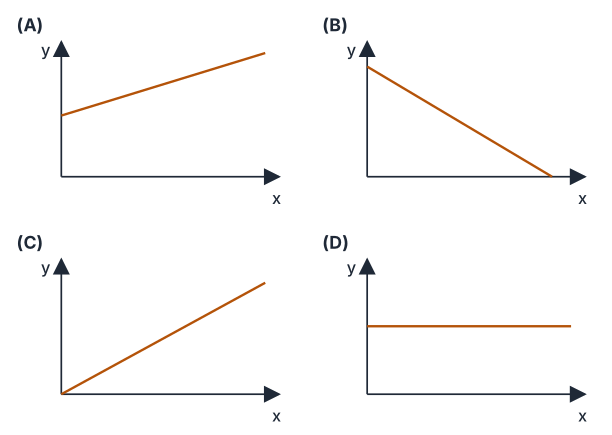
›Reveal solutionSolution
HCl dissolved in cyclohexane behaves as a simple Henry's-law solute, so pHCl=KHxHCl. This is a straight line of positive slope passing exactly through the origin — option (C).
The concept first
When a gas dissolves physically (no reaction, no ionisation) in a liquid, Henry's law applies:
p=KHx
where p is the partial pressure of the gas above the solution, x its mole fraction in solution and KH the Henry's-law constant at that temperature. Notice the law is linear and homogeneous: no additive constant.
Step-by-step
- Identify the system. HCl(g) in cyclohexane at 293 K. Cyclohexane is non-polar; HCl does not ionise in it and forms no compound with it. So HCl is simply a dissolved gas — a Henry's-law solute.
- Write the relation. pHCl=KHxHCl, with KH constant at the fixed temperature 293 K.
- Read it as a graph. With y=pHCl and x=xHCl, this is y=KHx, i.e. y=mx with m=KH>0: a straight line, positive slope, intercept zero. …
- TG EAPCET 2025Set eng-2025-05-02-FN1 markMCQQ.For the reaction N2O4(g)⇌2NO2(g), the correct relation between degree of dissociation (α) of N2O4(g) and equilibrium constant, Kp is (P = total pressure of mixture) (A) α=4+PKpPKp (B) α=4+KpKp (C) α=4+PKpPKp21 (D) α=(4+KpKp)21
›Reveal solutionSolution
The key is to express the equilibrium constant Kp in terms of the degree of dissociation α and total pressure P, then solve for α. The correct relation is α=4+Kp/PKp/P, which corresponds to option (C).
The reaction is N2O4(g)⇌2NO2(g).
We start with 1 mole of N2O4 and let α be the fraction that dissociates.
The total number of moles at equilibrium changes, so partial pressures depend on both α and total pressure P.
The equilibrium constant Kp is defined in terms of partial pressures, so we need to express each partial pressure as (mole fraction) × (total pressure).
-
Set up the initial and equilibrium moles
- Initial: N2O4=1 mole, NO2=0
- At equilibrium: N2O4 remaining = 1−α NO2 formed = 2α
- Total moles at equilibrium: ntotal=(1−α)+2α=1+α
-
Write mole fractions and partial pressures
- Mole fraction of N2O4: 1+α1−α Partial pressure PN2O4=1+α1−α⋅P
- Mole fraction of NO2: 1+α2α Partial pressure PNO2=1+α2α⋅P
-
Write the expression for Kp
Kp=PN2O4(PNO2)2
Substitute:
Kp=1+α1−α⋅P(1+α2α⋅P)2=(1+α)24α2P2⋅(1−α)P1+α=(1+α)(1−α)4α2P
- Simplify the denominator (1+α)(1−α)=1−α2 So:
Kp=1−α24α2P
- Solve for α Multiply both sides: Kp(1−α2)=4α2P ⇒Kp−Kpα2=4Pα2 …
-
- TG EAPCET 2025Set eng-2025-05-02-AN1 markMCQQ.At 1000 K, the equilibrium constant for the reaction CO2(g)+H2(g)⇌CO(g)+H2O(g) is 0.53. In a one litre vessel, at equilibrium the mixture contains 0.25 mole of CO, 0.5 mole of CO2, 0.6 mole of H2 and x moles of H2O. The value of x is (A) 0.563 (B) 0.363 (C) 0.636 (D) 0.736
›Reveal solutionSolution
Apply Kc=[CO2][H2][CO][H2O] and solve for x; this gives x=0.636 — option (C).
Concept
For CO2(g)+H2(g)⇌CO(g)+H2O(g) the equilibrium constant is
Kc=[CO2][H2][CO][H2O].
Since the vessel is 1 L, each molar concentration equals the number of moles.
Solution …
- TG EAPCET 2025Set eng-2025-05-02-AN1 markMCQQ.The osmotic pressure (in atm) of an aqueous solution containing 0.01 mol of NaCl (degree of dissociation 0.94) and 0.03 mol of glucose in 500 mL at 27 ∘C is (R = 0.082 L atm K−1mol−1) (A) 2.43 (B) 4.23 (C) 3.24 (D) 3.42
›Reveal solutionSolution
Sum the effective particles: NaCl (i=1.94) plus glucose (i=1), then apply Π=VneffRT to get 2.43 atm — option (A).
Concept
Osmotic pressure counts total dissolved particles: ΠV=neffRT, where for NaCl the van't Hoff factor is i=1+α(n−1).
Solution
NaCl (n=2, α=0.94): i=1+0.94(2−1)=1.94.
Effective particles: …
- TG EAPCET 2025Set eng-2025-05-03-AN1 markMCQQ.At 298K, a flask ‘A’ of unknown volume (V) contains oxygen at 5 atm. Another flask ‘B’ of volume 2L contains helium at 3 atm. Two flasks are connected together by a small tube of zero volume. After the two gases are completely mixed, if the resulting mixture is found to have the mole fraction of oxygen as 0.2, the volume of flask ‘A’ (in L) is (Assume oxygen and helium as ideal gases) (A) 0.1 (B) 0.3 (C) 0.2 (D) 0.4
›Reveal solutionSolution
Setting the mole fraction of oxygen to 0.2 gives V=0.3 L — option (B).
Concept
At constant temperature the moles of an ideal gas are proportional to PV, so the factor 1/RT cancels and mole fractions can be built directly from PV products.
Solution
Moles (as PV). Oxygen in flask A: nO2∝5V. Helium in flask B: nHe∝3×2=6.
Mole fraction of oxygen after mixing:
xO2=5V+65V=0.2
Solve for V: …
- TG EAPCET 2025Set eng-2025-05-03-FN1 markMCQQ.At 298K, a flask ‘A’ of unknown volume (V) contains oxygen at 5 atm. Another flask ‘B’ of volume 2L contains helium at 3 atm. Two flasks are connected together by a small tube of zero volume. After the two gases are completely mixed, if the resulting mixture is found to have the mole fraction of oxygen as 0.2, the volume of flask ‘A’ (in L) is (Assume oxygen and helium as ideal gases) (A) 0.2 (B) 0.3 (C) 0.4 (D) 0.1
›Reveal solutionSolution
The key idea is that the mole fraction of oxygen after mixing equals the ratio of its initial moles to the total moles. Using the ideal gas law, we set up an equation and solve for the unknown volume V, finding V = 0.4 L.
Concept and Intuition
When two gases mix at constant temperature, the total number of moles is conserved. The mole fraction of a component after mixing is simply the number of moles of that component divided by the total moles. Since both gases are ideal and at the same temperature (298 K), we can use PV=nRT to relate pressure, volume, and moles. The key is that the initial pressures and volumes give us the moles of each gas, and the final mixture’s mole fraction of oxygen provides an equation to solve for the unknown volume V.
Step-by-step solution
-
Find moles of oxygen in flask A
For oxygen: pressure PO2=5 atm, volume VA=V L, temperature T=298 K.
Using the ideal gas law: nO2=RTPO2VA=RT5V.
-
Find moles of helium in flask B
For helium: pressure PHe=3 atm, volume VB=2 L.
So nHe=RTPHeVB=RT3×2=RT6.
-
Total moles after mixing
The total moles in the mixture:
ntotal=nO2+nHe=RT5V+RT6=RT5V+6.
- Use the given mole fraction of oxygen The mole fraction of oxygen after mixing is 0.2:
ntotalnO2=0.2.
Substitute the expressions:
RT5V+6RT5V=0.2.
The RT cancels, giving: …
-
🎓Unlock everything free for 14 days
- ✓Full step-by-step solutions
- ✓Concept-first explanations
- ✓Methods, shortcuts & mistakes
- ✓PYQ mapping + timed mock tests
Full access for 14 days. No credit card required.