Chemistry · Ch 13 — Hydrocarbons
Carcinogenicity and Toxicity
Carcinogenicity and Toxicity
9.6 Carcinogenicity and Toxicity
Benzene and polynuclear hydrocarbons — compounds with more than two benzene rings fused together — are toxic and possess cancer-producing (carcinogenic) properties. This is not a minor footnote in organic chemistry; it is a direct link between molecular structure and human health that every student must understand.
The Origin of Carcinogenic Hydrocarbons
These polynuclear hydrocarbons form during the incomplete combustion of organic materials. The major sources are:
- Tobacco (cigarette smoke)
- Coal (burning, coking processes)
- Petroleum (engine exhaust, industrial emissions)
When these materials burn without enough oxygen, the carbon atoms do not fully oxidise to . Instead, they rearrange into fused ring systems — stable, planar molecules that resist further breakdown.
How They Cause Cancer
Once these hydrocarbons enter the human body (through inhalation, ingestion, or skin contact), they do not remain inert. They undergo a series of biochemical reactions inside cells. The key steps are:
- Metabolic activation — Enzymes in the liver (particularly cytochrome P450) oxidise the hydrocarbon, converting it into a reactive epoxide or diol-epoxide.
- DNA binding — This activated form is highly electrophilic. It attacks nucleophilic sites on DNA bases, forming covalent adducts.
- Mutation — The adducts distort the DNA helix, causing errors during replication. If these errors occur in critical genes (oncogenes or tumour suppressor genes), the cell can lose control over division.
- Cancer — Uncontrolled cell proliferation leads to tumour formation.
The carcinogenic effect is not immediate. It depends on dose, duration of exposure, and individual genetic susceptibility. But the molecular mechanism — damage to DNA — is the same for all such hydrocarbons.
Examples of Carcinogenic Hydrocarbons
The textbook lists several polynuclear hydrocarbons known to be carcinogenic. These are all fused benzene ring systems — rings that share adjacent carbon atoms.
![Fig. carcinogenic-1,2-benzanthracene-9.6 — 1,2-Benzanthracene (benz[a]anthracene): a carcinogenic polynuclear hydrocarbon of four fused benzene rings, three in a line with the fourth fused at an angle.](/figures/hydrocarbons/carcinogenic-polynuclear-benzanthracene.svg)
Drawn by us to help you understand the concept clearly, and verified to make sure it's accurate. For exams, practice from your textbook's own diagram.
1,2-Benzanthracene (benz[a]anthracene): four fused benzene rings — three in a line with the fourth fused at an angle — one of the carcinogenic polynuclear hydrocarbons the textbook lists as …
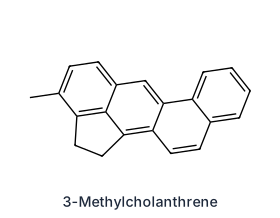
Drawn by us to help you understand the concept clearly, and verified to make sure it's accurate. For exams, practice from your textbook's own diagram.
3-Methylcholanthrene: four fused six-membered rings plus a five-membered ring, carrying one methyl group — among the most potent of the textbook's listed carcin …
![Fig. carcinogenic-1,2-benzpyrene-9.6 — 1,2-Benzpyrene (benzo[a]pyrene): a carcinogenic polynuclear hydrocarbon of five fused benzene rings built on the pyrene core.](/figures/hydrocarbons/carcinogenic-polynuclear-benzpyrene.svg)
Drawn by us to help you understand the concept clearly, and verified to make sure it's accurate. For exams, practice from your textbook's own diagram.
1,2-Benzpyrene (benzo[a]pyrene): five fused benzene rings on the pyrene core. It is the most studied of these carcinogens — the key cancer-causing …
![Fig. carcinogenic-1,2,5,6-dibenzanthracene-9.6 — 1,2,5,6-Dibenzanthracene (dibenz[a,h]anthracene): a carcinogenic polynuclear hydrocarbon of five fused rings, an anthracene core with a benzo ring fused at an angle on each end, on opposite sides.](/figures/hydrocarbons/carcinogenic-polynuclear-dibenzanthracene.svg)
Drawn by us to help you understand the concept clearly, and verified to make sure it's accurate. For exams, practice from your textbook's own diagram.
1,2,5,6-Dibenzanthracene (dibenz[a,h]anthracene): an anthracene core with an extra benzo ring fused at an angle on each end, on opposite s …
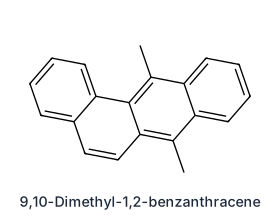
Drawn by us to help you understand the concept clearly, and verified to make sure it's accurate. For exams, practice from your textbook's own diagram.
9,10-Dimethyl-1,2-benzanthracene: the benzanthracene ring system with two methyl groups on its central (meso) carbons. The methyl substitution makes it markedly more carcinoge …
Benzopyrene is the most studied. It is the primary carcinogen in cigarette smoke. Its metabolic product, benzopyrene-7,8-diol-9,10-epoxide, binds directly to guanine in DNA.
Why Are These Hydrocarbons Carcinogenic?
The key structural feature is the fused ring system with more than two benzene rings. Why does this matter?
- Planarity — Fused rings force the molecule into a flat, rigid shape. This allows it to intercalate (slide between) DNA base pairs.
- Electron-rich regions — The conjugated system creates areas of high electron density. Metabolic oxidation targets these regions, producing the reactive epoxide.
- Stability — The aromatic stabilisation of the rings means the molecule persists in the body long enough to reach cells and undergo activation.
Not all polynuclear hydrocarbons are carcinogenic. The specific arrangement of rings and the presence of certain substituents determine whether a given compound can form the right reactive intermediate. But as a general rule: the more fused rings, the greater the risk.
The Connection to Benzene
Benzene itself is a known carcinogen (it causes leukaemia). The textbook groups benzene with polynuclear hydrocarbons because the underlying principle is the same:
- Benzene is metabolised to benzene oxide, which rearranges to phenol or reacts with DNA.
- Chronic exposure to benzene damages bone marrow stem cells, leading to blood cancers.
Benzene is not just a laboratory reagent. It is present in gasoline, industrial solvents, and cigarette smoke. Its toxicity is why modern chemistry labs use toluene or xylene as safer substitutes wherever possible.