Chemistry · Ch 12 — Organic Chemistry – Some Basic Principles and Techniques
Distillation
Distillation
Distillation: The Core Idea
Distillation is a separation technique that exploits differences in boiling points. When you heat a liquid mixture, the component with the lower boiling point vaporises first. These vapours are then cooled and condensed back into a liquid, collected separately from the original mixture. This method works because different liquids have different vapour pressures at the same temperature, and a liquid boils when its vapour pressure equals the external pressure.
The textbook introduces four distinct types of distillation, each tailored to a specific kind of mixture or purification problem.
Simple Distillation
This is the most straightforward form of distillation. It is used for two main purposes:
- Separating a volatile liquid from a non-volatile impurity. For example, distilling water to remove dissolved salts.
- Separating two liquids whose boiling points differ significantly. A difference of about 30–40 K is generally considered sufficient.
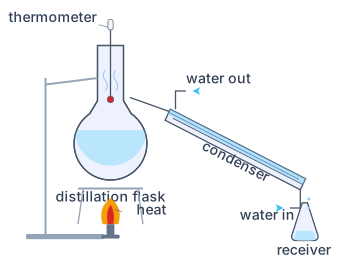
How it works: The liquid mixture is placed in a round-bottom flask and heated. The vapours of the lower-boiling component form first. These vapours travel into a condenser, where they are cooled by circulating water, and the condensed liquid (the distillate) is collected in a receiver. The higher-boiling component remains in the flask and can be collected later after the first component has been completely removed.
Example from the textbook: Chloroform (b.p. 334 K) and aniline (b.p. 457 K) are easily separated by simple distillation. The difference in their boiling points is 123 K, which is more than enough.
Drawn by us to help you understand the concept clearly, and verified to make sure it's accurate. For exams, practice from your textbook's own diagram.
Fig. 8.5 is a schematic of a simple distillation setup. A round-bottom flask holds the liquid mixture and is heated from below by a burner. A thermometer is inserted into the neck so that its bulb sits exactly at the level of the side arm — this is where the vapour temperature is read, right before the vapour turns into the condenser. The side arm leads into a downward-inclined water-cooled condenser; cooling water enters at the lower end of the jacket and exits at the upper end, so the jacket stays full and heat exchange is efficient. The condensed distillate drips into a receiver at the outlet.
The physical idea is straightforward: when a mixture of liquids with different boiling points is heated, the more volatile component (the lower boiling point) vaporises first. That vapour is led away, cooled back to liquid, and collected separately, while the higher-boiling component stays behind in the flask.
A common mistake is to think the thermometer measures the temperature of the liquid in the flask. It does not — it measures the temperature of the vapour just before it enters the condenser, which equals the boiling point of the distillate at that pressure. …
Simple distillation fails when the boiling points of the two liquids are close. In such a case, both components vaporise simultaneously, and the condensed vapour will be a mixture, not a pure substance.
Fractional Distillation
When the difference in boiling points is small (say, less than 30 K), simple distillation is ineffective. The vapours of both components form within the same temperature range and condense together. Fractional distillation solves this problem by using a fractionating column.
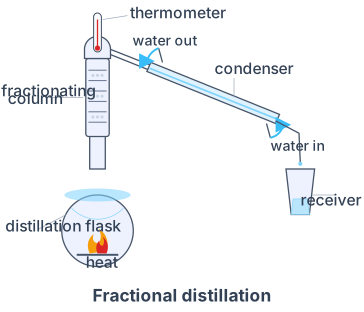
The Role of the Fractionating Column: The column is fitted over the mouth of the round-bottom flask. It provides a large surface area for heat exchange between the rising hot vapours and the descending condensed liquid. This creates a series of repeated condensation and vaporisation cycles.
The Process Step-by-Step:
- The mixture is heated. Vapours rise into the fractionating column.
- As the vapours ascend, they cool. The component with the higher boiling point condenses first on the surfaces of the column packing (e.g., glass beads or metal plates).
- This condensed liquid, now richer in the higher-boiling component, trickles back down the column.
- The rising vapours, still hot, re-vaporise some of this descending liquid. This process strips more of the lower-boiling component from the descending liquid.
- With each cycle, the vapours rising up the column become progressively richer in the more volatile (lower-boiling) component.
- By the time the vapours reach the top of the column, they are essentially pure in the low-boiling component. These vapours pass into the condenser and are collected.
- Meanwhile, the liquid remaining in the distillation flask becomes progressively richer in the higher-boiling component.
Drawn by us to help you understand the concept clearly, and verified to make sure it's accurate. For exams, practice from your textbook's own diagram.
Fig. 8.6 shows the simple-distillation setup upgraded with a fractionating column — a long vertical tube inserted between the flask and the condenser, packed with an inert material (glass beads, porcelain rings, or metal wire) that provides a large surface area.
As vapour rises from the boiling liquid, it meets the cooler packing and partly condenses. That condensate trickles back down and meets fresh hot vapour rising up. At every level the rising vapour and descending liquid exchange material: the vapour loses some of its less-volatile component (which stays in the liquid) and gains more of the more-volatile component (which re-evaporates from the liquid). This repeated vaporisation–condensation cycle is the heart of the technique.
The result is a temperature gradient along the column — near the higher-boiling component's boiling point at the bottom, near the lower-boiling component's at the top. Only the most volatile component finally reaches the condenser and is collected. In effect, a fractionating column performs many simple distillations inside a single tube, giving a much sharper separation than one distillation could. …
Think of the fractionating column as a "staircase" of purity. Each condensation-vaporisation cycle is a step up the staircase, and each step is called a theoretical plate. The more plates a column has, the better the separation.
Key Definition:
Each successive condensation and vaporisation unit in the fractionating column is called a theoretical plate. Commercially, columns with hundreds of plates are available for high-purity separations.
Drawn by us to help you understand the concept clearly, and verified to make sure it's accurate. For exams, practice from your textbook's own diagram.
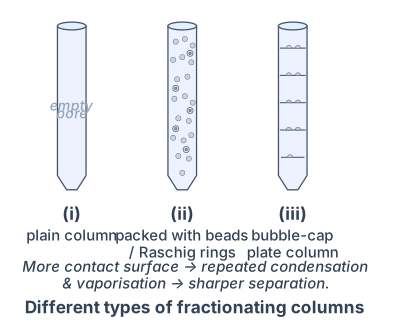
Fig. 8.7 compares two designs of fractionating column, drawn in cut-away to show their internal structure. Both increase the surface area available for vapour–liquid contact, which is what improves the separation.
The first is a simple packed column — a tube filled with small glass beads (or ceramic rings). Each bead is a surface on which rising vapour can condense and descending liquid can re-evaporate, so a packed column offers many contact points along its length.
The second is a bubble-plate (tray) column — a series of horizontal plates, each fitted with a bubble cap. Rising vapour is forced up through the central riser of each cap and bubbles through the layer of liquid held on the plate, while excess liquid overflows down a downcomer to the plate below. …
Real-World Application: The most famous application of fractional distillation is in the petroleum industry, where crude oil is separated into fractions like gasoline, kerosene, diesel, and lubricating oil.
Distillation under Reduced Pressure
This method is used for liquids that have very high boiling points or that decompose at or near their normal boiling points.
The Principle: A liquid boils when its vapour pressure equals the external pressure. If you reduce the external pressure, the liquid will boil at a lower temperature. This allows you to distil a heat-sensitive substance without decomposing it.
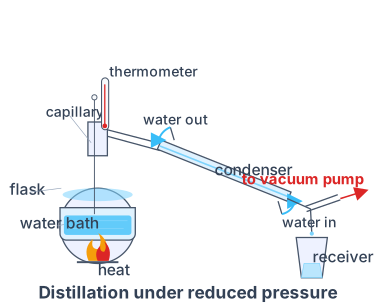
How it works: The distillation apparatus is connected to a water pump or a vacuum pump. By reducing the pressure on the surface of the liquid, it boils at a temperature significantly lower than its normal boiling point. The rest of the process (condensation and collection) is the same as in simple distillation.
Example from the textbook: Glycerol is separated from spent-lye in the soap industry using this technique. Glycerol has a high boiling point and would decompose if heated to its normal boiling point under atmospheric pressure.
Drawn by us to help you understand the concept clearly, and verified to make sure it's accurate. For exams, practice from your textbook's own diagram.
Fig. 8.8 shows a distillation setup modified for reduced pressure. The flask sits on a water bath (not a direct flame), a fine capillary dips into the liquid, and the sealed receiver is connected — through a manometer that reads the pressure — to a vacuum pump.
The physical idea is simple: a liquid boils when its vapour pressure equals the external pressure above it. By lowering that external pressure with the pump, the liquid is made to boil at a much lower temperature than at atmospheric pressure. For a heat-sensitive substance — glycerol, for instance, separated from spent-lye in the soap industry — heating it to its normal boiling point would cause it to decompose; under reduced pressure it boils at a temperature low enough to stay intact.
The capillary bleeds a fine stream of air bubbles through the liquid, providing nucleation sites so that boiling stays smooth and does not suddenly erupt (bumping). The water bath supplies gentle, even heating. …
The relationship is: . This is a direct consequence of the definition of boiling point.
Steam Distillation
This technique is specifically designed to separate substances that are steam-volatile and immiscible with water.
The Principle: When two immiscible liquids are heated together, the mixture boils when the sum of their individual vapour pressures equals the atmospheric pressure. This is a key point: the total vapour pressure is the sum of the vapour pressures of the two immiscible components.
where is the vapour pressure of the organic liquid and is the vapour pressure of water. …
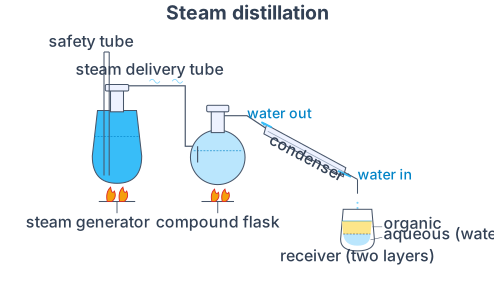
Drawn by us to help you understand the concept clearly, and verified to make sure it's accurate. For exams, practice from your textbook's own diagram.
Fig. 8.9 shows a steam-distillation setup: a steam generator (a flask of boiling water) connected by a delivery tube to a second flask containing the water-immiscible organic compound. Steam bubbles through the mixture, and the vapour leaving the flask — a mixture of steam and the volatile organic compound — passes into a water condenser, cools, and collects in a receiver as two distinct layers that are then separated with a separating funnel (aniline is separated from an aniline–water mixture this way).
The principle is that two immiscible liquids each exert their own vapour pressure independently, as if the other were absent, so the mixture boils when the sum of the two vapour pressures equals the atmospheric pressure:
where is the vapour pressure of the organic liquid and that of water. …