Chemistry · Ch 12 — Organic Chemistry – Some Basic Principles and Techniques
Fission of a Covalent Bond
Fission of a Covalent Bond
A covalent bond is not permanent — it can break during a chemical reaction. The way it breaks determines what reactive intermediates form and what kind of reaction follows. There are exactly two ways a covalent bond can break: heterolytic cleavage and homolytic cleavage.
Heterolytic Cleavage
In heterolytic cleavage, the bond breaks unevenly. The shared pair of electrons stays entirely with one of the two fragments. One atom gets both electrons; the other gets none.
After heterolysis, one fragment ends up with a sextet of electrons (six electrons in its valence shell) and a positive charge. The other fragment has a complete octet with at least one lone pair and a negative charge. For example, bromomethane undergoes heterolytic cleavage like this:
The methyl group loses an electron and becomes positively charged; the bromine atom takes both bonding electrons and becomes a bromide ion with a full octet.
Do not confuse heterolytic cleavage with ionic bond dissociation. In heterolytic cleavage, a covalent bond breaks, but the electrons go to one atom — the fragments themselves become ions. The bond was covalent; the products are ions.
Carbocations
A species in which a carbon atom has only six electrons in its valence shell and carries a positive charge is called a carbocation (older name: carbonium ion). The ion is the methyl cation or methyl carbonium ion.
Carbocations are classified by how many carbon atoms are directly attached to the positively charged carbon:
| Type | Number of carbons attached to | Example | Name |
|---|---|---|---|
| Primary | 1 | Ethyl cation | |
| Secondary | 2 | Isopropyl cation | |
| Tertiary | 3 | tert-Butyl cation |
Carbocations are highly unstable and reactive. They do not exist for long — they react as soon as they form. Their stability, however, follows a clear order. Alkyl groups attached to the positively charged carbon stabilise the carbocation through two effects: the inductive effect (alkyl groups push electron density toward the positive carbon) and hyperconjugation (delocalisation of electrons from adjacent C–H bonds). These effects are studied in detail in sections 8.7.5 and 8.7.9.
The observed order of carbocation stability is:
Methyl cation is the least stable; tertiary butyl cation is the most stable.
The stability order of carbocations is: methyl < primary < secondary < tertiary. More alkyl groups on the positive carbon = more stable carbocation.
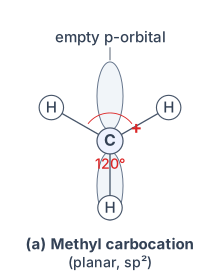
Shape and hybridisation of carbocations: The positively charged carbon in a carbocation is hybridised. The three hybrid orbitals lie in a plane at to each other. Each overlaps with the orbital of a hydrogen atom (or another atom) to form a sigma bond. The remaining orbital on carbon is perpendicular to the molecular plane and contains no electrons — it is empty. This gives the carbocation a trigonal planar shape.
For , the structure is a flat triangle with the carbon at the centre and the three hydrogens at the corners. The empty orbital sticks out above and below the plane.
Drawn by us to help you understand the concept clearly, and verified to make sure it's accurate. For exams, practice from your textbook's own diagram.
The methyl carbocation () has only six valence electrons around carbon. With three bonds and no lone pair, the carbon is hybridised: the three orbitals lie in one plane at to each other, forming sigma bonds to the three hydrogen atoms, so the whole unit is flat. Perpendicular to this plane — sticking out above and below — lies an empty unhybridised orbital. That empty orbital is why the carbocation is electron-deficient and highly reactive as an electrophile. …
Carbanions
Heterolytic cleavage can also go the other way — the carbon atom can take the shared pair of electrons. If a group Z attached to carbon leaves without its electron pair, the carbon gains both bonding electrons and becomes negatively charged:
The species is the methyl anion. A carbon species that carries a negative charge on carbon is called a carbanion.
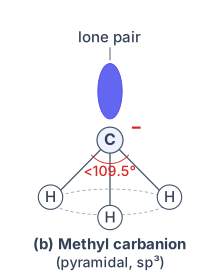
Shape and hybridisation of carbanions: The carbon in a carbanion is generally hybridised. It has four pairs of electrons around it — three bonding pairs and one lone pair. The lone pair occupies one of the orbitals. Because the lone pair repels more strongly than a bonding pair, the bond angles are compressed slightly from the ideal . The structure is a distorted tetrahedron.
Drawn by us to help you understand the concept clearly, and verified to make sure it's accurate. For exams, practice from your textbook's own diagram.
The methyl carbanion () has eight valence electrons around carbon: three bonds and one lone pair. To accommodate four electron domains, carbon uses hybridisation, giving a pyramidal shape very much like ammonia (): three orbitals bond to hydrogen and the fourth holds the lone pair at the apex. Because a lone pair repels bonding pairs more strongly than a bond does, the H–C–H angles are squeezed slightly below the ideal tetrahedral . …
Carbanions, like carbocations, are unstable and reactive species.
In heterolytic cleavage, either fragment can take the electron pair. If carbon loses the pair, you get a carbocation. If carbon gains the pair, you get a carbanion. Which one forms depends on the nature of the leaving group and the reaction conditions.
Ionic (Polar) Reactions
Organic reactions that proceed through heterolytic bond cleavage are called ionic reactions, heteropolar reactions, or simply polar reactions. The name reflects that the bond breaks to form ions (or at least species with full positive and negative charges).
Homolytic Cleavage
In homolytic cleavage, the bond breaks evenly. One electron from the shared pair goes with each of the bonded atoms. Instead of an electron pair moving, a single electron moves.
The movement of a single electron is shown by a half-headed curved arrow (also called a fish-hook arrow). This is different from the full-headed arrow used for two-electron movement in heterolytic cleavage.
Homolytic cleavage produces neutral species — atoms or groups that contain an unpaired electron. These species are called free radicals.
A typical homolytic cleavage requires energy, usually in the form of heat or light:
Here, is an alkyl free radical and is a halogen atom free radical. Both are neutral and each has one unpaired electron.
Like carbocations and carbanions, free radicals are very reactive.
Do not confuse the arrow styles. A full-headed curved arrow () shows movement of an electron pair. A half-headed fish-hook arrow () shows movement of a single electron. Using the wrong arrow in an exam costs marks.
Classification and Stability of Free Radicals
Alkyl free radicals are classified as primary, secondary, or tertiary, depending on how many carbon atoms are attached to the carbon bearing the unpaired electron:
| Type | Example | Name |
|------|---------|------| …