Q.The following reaction is classified as: CH3CH2I + KOH(aq) → CH3CH2OH + KI.
🔒You're viewing a preview — the full solution, concept, methods & PYQ mapping are locked.
🔒 Start your 14-day free trial to unlock the full solution →Concept understanding — Nucleophilic Substitution
Nucleophilic Substitution: The Intuitive Idea
Imagine you're holding a key that fits perfectly into a lock. Now imagine someone else comes along with a different key, pushes yours out, and takes your place. That's the core picture of nucleophilic substitution — one group (the leaving group) gets kicked out of a molecule, and a new group (the nucleophile) takes its spot.
In organic chemistry, carbon atoms often carry a leaving group — something like a halogen (Cl, Br, I) or a good leaving group like tosylate. The carbon is slightly positive because the leaving group pulls electron density away. A nucleophile — a species rich in electrons, often with a lone pair or a negative charge — is attracted to this positive carbon. It attacks, and the leaving group departs with its bonding electrons.
The word "nucleophile" means "nucleus-loving" — it's attracted to positive (electron-deficient) centres. "Leaving group" is exactly what it sounds like: a group that can leave, taking its electron pair with it.
The Precise Statement
Nucleophilic substitution is a reaction where a nucleophile (Nu⁻ or Nu:) replaces a leaving group (L) attached to a carbon atom. The general equation is:
Nu−+R-L⟶R-Nu+L−
Here, R is the carbon skeleton (alkyl group), L is the leaving group, and Nu is the nucleophile. The reaction happens because the nucleophile is a stronger base (or has a stronger desire for the carbon) than the leaving group.
Two Main Mechanisms: SN1 and SN2
This isn't just one reaction — it's a family with two distinct pathways, depending on the structure of the carbon and the conditions.
SN2: One Step, Backside Attack
In SN2 (Substitution, Nucleophilic, Bimolecular), the nucleophile attacks the carbon from the opposite side of the leaving group. The leaving group departs at the same time. It's like a dance where one partner enters as the other leaves — a single, concerted step.
- Rate depends on both the nucleophile and the substrate: rate = k[Nu][R-L]
- Stereochemistry: The carbon inverts (like an umbrella turning inside out). If the starting carbon is chiral, you get the opposite configuration.
- Best for: Primary carbons (least steric hindrance). Methyl and primary alkyl halides are ideal.
SN2 is very sensitive to steric hindrance. Tertiary carbons are so crowded that the nucleophile cannot reach the backside — SN2 essentially does not happen there.
SN1: Two Steps, Carbocation Intermediate
In SN1 (Substitution, Nucleophilic, Unimolecular), the leaving group leaves first, forming a carbocation (a carbon with only six electrons, positively charged). Then the nucleophile attacks this flat, planar carbocation from either side.
- Rate depends only on the substrate: rate = k[R-L] (the slow step is the leaving group departing)
- Stereochemistry: The nucleophile can attack from either face of the planar carbocation, so you get a racemic mixture (both configurations) if the carbon was chiral.
- Best for: Tertiary carbons (they form stable carbocations). Secondary carbons can work under certain conditions. Primary carbons almost never do SN1 because the carbocation would be too unstable.
The key difference: SN2 is one step with inversion; SN1 is two steps with racemisation. SN2 needs a good nucleophile and an unhindered carbon; SN1 needs a stable carbocation and a polar solvent that can stabilise ions.
How to Tell Which One Happens
| Factor | Favours SN2 | Favours SN1 |
|--------|-------------|-------------| …
The key idea is nucleophilic substitution — the hydroxide ion (OH−) from KOH attacks the electrophilic carbon bonded to iodine, replacing the leaving group (I−).
Reasoning:
- The substrate is a primary alkyl halide (CH3CH2I) with a polar C–I bond.
- Aqueous KOH provides OH− ions, which are strong nucleophiles (and weak bases in water). …
This is a classic nucleophilic substitution (SN2) reaction where the hydroxide ion (OH−) from KOH attacks the electrophilic carbon bearing iodine, displacing iodide (I−) to form ethanol.
The reaction is:
CH3CH2I+KOH (aq)→CH3CH2OH+KI
Let’s understand why this is nucleophilic substitution and not any of the other options.
1. Identify the functional group and the reagent
The substrate is ethyl iodide — a primary alkyl halide. The carbon bonded to iodine is sp³-hybridised and carries a partial positive charge because iodine is more electronegative than carbon. The reagent is aqueous KOH, which provides OH− ions in solution.
The OH− ion is a strong nucleophile (electron-rich, with a lone pair) and also a strong base. In aqueous solution, its nucleophilic character dominates over its basicity because water is a protic solvent that solvates the base, but here the key is that the substrate is primary — so substitution is strongly favoured over elimination.
2. What happens at the molecular level?
The hydroxide ion attacks the carbon that holds the iodine. This carbon is electrophilic (electron-deficient) because iodine pulls electron density away. The attack happens from the opposite side of the iodine (backside attack), pushing the iodine out as a leaving group.
The bond between carbon and iodine breaks heterolytically — iodine takes both electrons and leaves as I−. Simultaneously, the OH− forms a new bond with carbon.
The product is ethanol (CH3CH2OH) and potassium iodide (KI).
In aqueous KOH, the OH− is the actual nucleophile. The potassium ion (K+) is a spectator — it just balances charge. So the net reaction is:
CH3CH2I+OH−→CH3CH2OH+I−
3. Why is this not elimination?
Elimination would require the OH− to abstract a β-hydrogen (a hydrogen on the carbon next to the one bearing iodine), forming a double bond and producing ethene (CH2=CH2) plus water and I−.
But here, the product is ethanol — an alcohol — not an alkene. So elimination is not happening. Also, primary alkyl halides strongly favour substitution over elimination when a strong nucleophile like OH− is used, especially in aqueous conditions.
4. Why is this not electrophilic substitution?
Electrophilic substitution involves an electrophile (electron-deficient species) attacking a substrate, typically an aromatic ring. Here, the attacking species is OH−, which is a nucleophile (electron-rich). So this is the opposite — it’s nucleophilic, not electrophilic. …
- TG EAPCET 2026Set eng-2026-05-09-AN1 markMCQQ.Which of the following represents the water-gas shift reaction? (A) C(s)+H2O(g)1270KCO(g)+H2(g) (B) CH4(g)+H2O(g)1270K,NiCO(g)+3H2(g) (C) CO(g)+H2O(g)673K,catalystCO2(g)+H2(g) (D) CH4(g)+2O2(g)→CO2(g)+2H2O(l)
›Reveal solutionSolution
The water-gas shift reaction converts carbon monoxide and steam into carbon dioxide and hydrogen, increasing hydrogen yield from water gas. Option (C) correctly represents this reaction.
The water-gas shift reaction is a crucial industrial process, particularly in the production of hydrogen. To understand it, let's first define "water gas" and then see how the "shift" reaction comes into play.
Water gas is a mixture of carbon monoxide (CO) and hydrogen (H2), typically produced by passing steam over hot coke (carbon) at high temperatures:
C(s)+H2O(g)1270KCO(g)+H2(g)
While water gas itself is a valuable fuel, the goal in many industrial applications is to produce pure hydrogen. The water-gas shift reaction is employed to convert the carbon monoxide present in water gas into additional hydrogen. This is achieved by reacting the carbon monoxide with more steam.
Here's how we can identify the correct reaction:
-
Analyze Option (A):
C(s)+H2O(g)1270KCO(g)+H2(g)
This reaction represents the production of water gas itself, often called coal gasification or the Bosch process (when followed by the shift reaction). It is not the water-gas shift reaction, but rather the reaction that produces the water gas that will then undergo the shift.
-
Analyze Option (B):
CH4(g)+H2O(g)1270K,NiCO(g)+3H2(g)
This reaction is known as steam reforming of methane. It's a primary industrial method for producing hydrogen from natural gas. While it produces CO and H2 (similar to water gas), it starts with methane, not carbon, and is a different process from the water-gas shift.
-
Analyze Option (C):
CO(g)+H2O(g)673K,catalystCO2(g)+H2(g) …
-
- TG EAPCET 2026Set eng-2026-05-11-FN1 markMCQQ.Identify the reaction, which does not give isopropyl alcohol (A) CHX2=CH−CHX3HX2O/HX+ (B) CHX3CHO(ii) HX2O(i) CHX3MgBr (C) (CHX3)2CONaBHX4 (D) CHX2O(ii) HX2O(i) CX2HX5MgBr
›Reveal solutionSolution
The key is to identify which reaction yields a product other than isopropyl alcohol (propan-2-ol). Only option (D) gives propan-1-ol, not isopropyl alcohol.
Concept & Intuition
Isopropyl alcohol is propan-2-ol, (CHX3)X2CHOH. To get it, the carbon skeleton must have a three-carbon chain with the —OH group on the middle carbon. Each reaction here builds an alcohol from a carbonyl or alkene; we just check the product’s structure. The trick is that Grignard reactions add the alkyl group to the carbonyl carbon, so the alcohol’s —OH ends up on the carbon that was the carbonyl carbon. For isopropyl alcohol, that carbonyl carbon must become the secondary carbon of a three-carbon chain.
Step-by-step reasoning
-
Option (A): CHX2=CH−CHX3HX2O/HX+
Acid-catalyzed hydration of propene follows Markovnikov’s rule: the H adds to the less substituted carbon, OH to the more substituted carbon.
CHX2=CH−CHX3+HX2OHX+CHX3−CH(OH)−CHX3
Product: propan-2-ol (isopropyl alcohol). So (A) gives it.
-
Option (B): CHX3CHO(ii) HX2O(i) CHX3MgBr
Acetaldehyde (CHX3CHO) reacts with methylmagnesium bromide. The Grignard reagent adds CHX3X− to the carbonyl carbon.
CHX3−C(=O)−H+CHX3MgBrHX2OCHX3−C(OH)(CHX3)−H
That’s (CHX3)X2CHOH — again isopropyl alcohol. So (B) gives it.
-
Option (C): (CHX3)2CONaBHX4
Sodium borohydride reduces acetone (a ketone) to a secondary alcohol.
(CHX3)2C=ONaBHX4(CHX3)2CHOH
Product: isopropyl alcohol. So (C) gives it.
-
Option (D): CHX2O(ii) HX2O(i) CX2HX5MgBr …
-
- TG EAPCET 2026Set eng-2026-05-11-AN1 markMCQQ.Which of the following reactions give hydrogen gas? I. Reaction of tin with steam II. Passage of steam over hot coke III. Passage of air over hot coke (A) II, III only (B) I, III only (C) I, II, III (D) I, II only
›Reveal solutionSolution
The key is to identify which reactions produce molecular hydrogen (H2). Tin reacts with steam to give H2, steam over hot coke gives water gas (CO+H2), but air over hot coke gives CO and CO2 — no H2. So only I and II yield hydrogen.
Concept & Intuition
Hydrogen gas is produced when a reducing agent (like a metal or carbon) reacts with water (steam) or when water itself is decomposed. But if oxygen is present (as in air), carbon preferentially burns to oxides, not hydrogen. The key is to check the products: if the reaction involves water or steam and a sufficiently reactive element, H2 is likely; if it involves free oxygen, H2 is not formed.
- Reaction I: Tin with steam Tin is below iron in the reactivity series but still reacts with steam at high temperature. The reaction is:
Sn+2H2OΔSnO2+2H2
Tin displaces hydrogen from water, producing hydrogen gas. So I gives H2.
- Reaction II: Steam over hot coke This is the classic water-gas reaction. Hot carbon (coke) reduces steam:
C+H2Ored heatCO+H2
The mixture of carbon monoxide and hydrogen is called water gas. Clearly, II gives H2.
- Reaction III: Passage of air over hot coke …
- TG EAPCET 2024Set ap-2024-05-08-FN1 markMCQQ.An alkene X (C5H10) on reaction with HBr gave Y (C5H11Br). Y undergoes hydrolysis via SN1 mechanism. What is X? (A) CH3−CH=CH−CH2−CH3 (pent-2-ene) (B) CH3−CH2−CH2−CH=CH2 (pent-1-ene) (C) (CH3)2CH−CH=CH2 (3-methylbut-1-ene) (D) (CH3)2C=CH−CH3 (2-methylbut-2-ene)
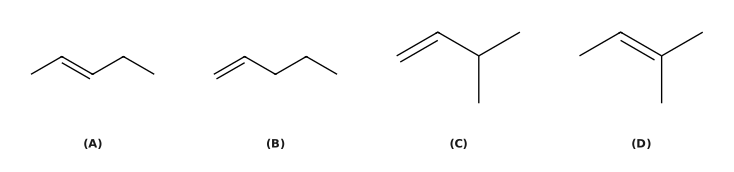
›Reveal solutionSolution
SN1 hydrolysis requires a tertiary halide (stable carbocation intermediate). Working backwards, the alkene that gives a tertiary bromide on Markovnikov addition of HBr is 2-methylbut-2-ene — option (D).
The concept first: two ideas, used in reverse
Idea 1 — What SN1 tells us about Y.
The SN1 mechanism has two steps:
R−Br slow R++Br−R++H2O fast R−OH2+−H+R−OH
The rate-determining step is the ionisation, so the reaction is fast only when the carbocation R+ is stable. Carbocation stability, set by the electron-releasing inductive effect and hyperconjugation of alkyl groups, runs
3∘>2∘>1∘>CH3+
Hence tertiary halides hydrolyse by SN1, primary halides by SN2, and secondary sit in between. If we are told Y hydrolyses by SN1, then Y is a 3∘ bromide.
Idea 2 — What Markovnikov's rule tells us about X→Y.
HBr (no peroxide) adds by the ionic route: H+ attaches to the doubly-bonded carbon that produces the more stable carbocation, and Br− then bonds to that cationic carbon. So the Br ends up on the more substituted carbon.
Step-by-step: test each alkene
- (A) Pent-2-ene, CH3CH=CHCH2CH3. Both alkene carbons are CH; protonation either way gives a secondary carbocation, so Y is a 2∘ bromide. Not the best SN1 substrate. ✗
- (B) Pent-1-ene, CH3CH2CH2CH=CH2. Markovnikov gives CH3CH2CH2CHBrCH3 via a secondary cation. ✗
- (C) 3-Methylbut-1-ene, (CH3)2CH−CH=CH2. Direct Markovnikov protonation gives the secondary cation (CH3)2CH−C+H−CH3 and hence a 2∘ bromide. ✗ (It can rearrange by a hydride shift, but the question asks for the clean, direct answer.) …
- TG EAPCET 2024Set eng-2024-05-09-AN1 markMCQQ.Identify the major product (P) in the following reaction sequence
[!FORMULA] (CH3)3CBrAlcoholic KOHΔXHBrP
(A) (CH3)3CBr (B) (CH3)2CHCH2Br (C) CH3−CH−CH2−CH3∣Br (D) CH3−CH=CH−CH2Br›Reveal solutionSolution
The reaction proceeds via E2 elimination to give an alkene, followed by electrophilic addition of HBr that follows Markovnikov’s rule, yielding the rearranged product 2‑bromo‑2‑methylpropane. The correct option is (A).
Concept and intuition:
The sequence starts with a tertiary alkyl bromide. Alcoholic KOH under heat favors E2 elimination over substitution because the base is strong and the solvent is polar but not strongly nucleophilic. The only possible elimination gives 2‑methylpropene (isobutylene). Then HBr adds to this alkene. Since the alkene is symmetrical, Markovnikov addition places the bromine on the more substituted carbon, regenerating the original tertiary bromide. The key insight: the product of the second step is the same as the starting material, so the overall sequence is a “round trip.”
Step‑by‑step reasoning:
- First step – E2 elimination The substrate is (CH3)3CBr, a tertiary alkyl halide. Alcoholic KOH is a strong base (ethoxide or hydroxide in ethanol) and the reaction is heated. Under these conditions, elimination (E2) dominates over substitution (SN2 is impossible on a tertiary carbon; SN1 would be slow without a good leaving group in a protic solvent, but here the strong base drives E2). The only β‑hydrogens are on the three methyl groups, all equivalent. Elimination removes a β‑hydrogen and the bromine, forming a double bond between C1 and C2:
(CH3)3CBralc. KOHΔCH2=C(CH3)2+KBr+H2O
So X is 2‑methylpropene (isobutylene).
- Second step – electrophilic addition of HBr HBr adds to the alkene via a two‑step mechanism: protonation forms the more stable carbocation, then bromide attacks. The alkene is symmetrical: both carbons of the double bond are equally substituted (one is CH2, the other is C(CH3)2). Markovnikov’s rule says the hydrogen adds to the less substituted carbon, giving the more stable tertiary carbocation:
CH2=C(CH3)2+H+→(CH3)3C+
Then bromide ion attacks the carbocation: …
- TG EAPCET 2024Set ap-2024-05-07-FN1 markMCQQ.Arrange the following halides in decreasing order of their reactivity towards dehydrohalogenation A. CH3−CH2−CH2−CH2−Br (straight-chain, primary alkyl bromide) B. [FIGURE] a branched alkyl bromide — Br on the branched (secondary) carbon of a methyl-branched chain C. CH3−CH2−CH2−CH2−Cl (straight-chain, primary alkyl chloride) D. [FIGURE] a branched alkyl chloride — Cl on a fully substituted (tertiary) carbon (A) B > D > A > C (B) B > D > C > A (C) D > B > A > C (D) D > B > C > A
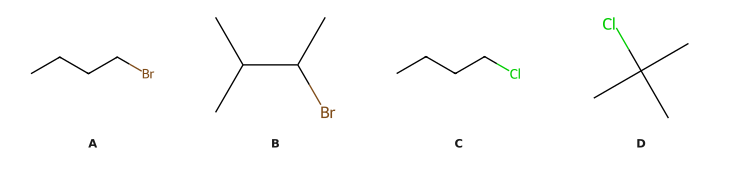
›Reveal solutionSolution
Dehydrohalogenation rate follows the Saytzeff rule and depends on both carbocation stability (tertiary > secondary > primary) and leaving-group ability (Br > Cl). The order is D > B > A > C.
Dehydrohalogenation is an elimination reaction where a hydrogen halide (HX) is removed from an alkyl halide to form an alkene. This typically proceeds via an E2 mechanism with strong bases or E1 with weak bases. The rate depends on two critical factors:
Carbocation stability (or transition-state stability): The more substituted the carbon bearing the halogen, the more stable the developing positive character in the transition state. Tertiary > secondary > primary.
Leaving-group ability: Better leaving groups accelerate elimination. Bromide is a better leaving group than chloride because Br⁻ is more stable (larger, more polarizable) than Cl⁻.
Let me decode the structures and rank them:
-
Identify each compound:
- A: CHX3−CHX2−CHX2−CHX2−Br — primary alkyl bromide
- B: Branched with Br on a secondary carbon — secondary alkyl bromide
- C: CHX3−CHX2−CHX2−CHX2−Cl — primary alkyl chloride
- D: Branched with Cl on a tertiary carbon — tertiary alkyl chloride
-
Apply the carbocation stability principle:
The carbon bearing the halogen determines reactivity. For elimination:
- D (tertiary) forms the most stable transition state
- B (secondary) is intermediate
- A and C (both primary) are least reactive by this criterion
-
Apply the leaving-group effect:
Between compounds with the same substitution:
- Bromides (A, B) react faster than chlorides (C, D)
But we must compare across both factors: …
-
- TG EAPCET 2023Set ap-2023-05-10-AN1 markMCQQ.Which of the following statements are not correct about the SN2 reaction? I) It proceeds with complete inversion of configuration II) It is a first order reaction III) It involves the formation of intermediate IV) Tertiary alkyl halides are least reactive towards this reaction (A) I & II only (B) III & IV only (C) II & III only (D) I & IV only
›Reveal solutionSolution
SN2 reactions are bimolecular and proceed through a single transition state without forming an intermediate, leading to inversion of configuration. Statements II and III are incorrect because SN2 is a second-order reaction and does not involve an intermediate. The correct option is (C).
The SN2 reaction, or Substitution Nucleophilic Bimolecular reaction, is a fundamental type of organic reaction where a nucleophile replaces a leaving group on an electrophilic carbon atom. Understanding its mechanism, kinetics, and stereochemistry is key to predicting its outcome and reactivity. The "2" in SN2 signifies that the rate-determining step involves two species: the substrate (alkyl halide) and the nucleophile.
Let's break down the characteristics of an SN2 reaction to evaluate each statement.
-
Mechanism and Stereochemistry (Statement I):
The SN2 reaction is a concerted, one-step process. This means the bond formation between the nucleophile and the carbon, and the bond breaking between the carbon and the leaving group, occur simultaneously. The nucleophile attacks the carbon atom from the backside, directly opposite to the leaving group. This backside attack causes the configuration of the carbon atom to invert, much like an umbrella turning inside out in a strong wind. This phenomenon is known as Walden inversion.
ImportantIf the carbon atom undergoing substitution is chiral, an SN2 reaction will always result in a product with the opposite configuration to the reactant. This is referred to as complete inversion of configuration.
Therefore, statement I, "It proceeds with complete inversion of configuration," is correct.
-
Kinetics (Statement II):
The rate of an SN2 reaction depends on the concentration of both the alkyl halide (substrate) and the nucleophile. This is because both species are involved in the single, rate-determining step.
The rate law for an SN2 reaction is given by:
Rate=k[R-X][Nu−]
Here, k is the rate constant, [R-X] is the concentration of the alkyl halide, and [Nu−] is the concentration of the nucleophile. Since the rate depends on the concentration of two species, the reaction is second order overall (first order with respect to the alkyl halide and first order with respect to the nucleophile).
Therefore, statement II, "It is a first order reaction," is incorrect.
-
Intermediates (Statement III):
As established, the SN2 reaction is a concerted process. It does not involve the formation of any stable, isolable intermediate. Instead, it passes through a single, high-energy transition state. In this transition state, the carbon atom is simultaneously partially bonded to both the incoming nucleophile and the departing leaving group. The carbon atom is pentacoordinate (has five partial bonds) in this fleeting state.
Watch outA common misconception is to confuse a transition state with an intermediate. An intermediate is a species that exists for a measurable period and can sometimes be isolated, whereas a transition state is a fleeting, high-energy arrangement of atoms at the peak of an energy barrier, which cannot be isolated. …
-
- TG EAPCET 2023Set eng-2023-05-14-AN1 markMCQQ.Addition of HBr to propene in presence of a peroxide takes place contrary to Markovnikov rule. This can be explained by the mechanism involving (A) electrophile (B) free radical (C) nucleophile (D) carbene
›Reveal solutionSolution
The anti-Markovnikov addition of HBr to propene in the presence of a peroxide proceeds via a free radical mechanism, not an ionic one. The correct option is (B).
The key to this question lies in understanding why the usual Markovnikov rule is reversed. Normally, addition of HX to an alkene follows Markovnikov’s rule (the hydrogen attaches to the less substituted carbon). But with HBr and peroxides, the product is the opposite. The reason is a complete change in the reaction mechanism — from ionic to free radical.
Concept and intuition:
In the absence of peroxides, HBr adds via an electrophilic mechanism: the alkene acts as a nucleophile, attacking a proton (H⁺), forming a carbocation. The more stable carbocation (tertiary > secondary > primary) determines the product — that’s Markovnikov.
However, peroxides (like ROOR) decompose into oxygen-centered radicals. These radicals initiate a chain reaction where the bromine atom (Br•) becomes the attacking species, not H⁺. The bromine radical adds to the alkene in a way that forms the more stable carbon radical, which then abstracts a hydrogen from HBr. This leads to the anti-Markovnikov product.
Let’s walk through the mechanism step by step.
- Initiation — Peroxide decomposition Peroxides (e.g., di-tert-butyl peroxide) undergo homolytic cleavage when heated or exposed to light:
RO–ORΔ2RO∙
Each alkoxy radical (RO•) is highly reactive and seeks to abstract a hydrogen atom.
- Chain propagation — Generation of bromine radical The alkoxy radical abstracts a hydrogen from HBr:
RO∙+H–Br⟶ROH+Br∙
Now we have a bromine atom (Br•), a neutral radical. This is the key reactive species.
- Addition of bromine radical to propene
The bromine radical adds to the double bond of propene. Which carbon does it attack?
- If Br• adds to the terminal carbon (C1), the resulting radical is a secondary carbon radical (more stable).
- If Br• adds to the internal carbon (C2), the resulting radical is a primary carbon radical (less stable). Radical stability follows the same order as carbocations: tertiary > secondary > primary. So the bromine radical adds to the less substituted carbon (the terminal one) to give the more stable radical:
CH3–CH=CH2+Br∙⟶CH3–C∙H–CH2Br
This is the opposite regiochemistry from the ionic mechanism.
- Hydrogen abstraction from HBr …
- TG EAPCET 2023Set eng-2023-05-14-FN1 markMCQQ.Which of the following is least reactive towards SN1 reactions? (A) C6H5CH2Cl (B) C6H5Cl (C) H2C=CH−CH2Cl (D) (C6H5)2CHCl
›Reveal solutionSolution
The key idea is that SN1 reactivity depends on carbocation stability; the least reactive substrate is the one whose carbocation is least stabilized. That is (B) C6H5Cl, because the phenyl carbocation is extremely unstable.
Concept & Intuition
SN1 reactions proceed via a two-step mechanism: first, the leaving group departs, forming a carbocation; then the nucleophile attacks. The rate-determining step is carbocation formation, so anything that stabilizes the carbocation speeds up the reaction. Conversely, a substrate that cannot form a reasonably stable carbocation will be very slow. Here, we compare four chlorides: we need to judge the stability of the carbocation that would result from losing Cl−.
-
Identify the carbocation each substrate would form
- (A) C6H5CH2Cl → benzylic carbocation C6H5CH2+
- (B) C6H5Cl → phenyl carbocation C6H5+
- (C) H2C=CH−CH2Cl → allyl carbocation H2C=CH−CH2+
- (D) (C6H5)2CHCl → diphenylmethyl carbocation (C6H5)2CH+
-
Rank carbocation stability
- Benzylic and allylic carbocations are stabilized by resonance: the positive charge is delocalized into the π-system.
- Diphenylmethyl has two phenyl rings, so even more resonance stabilization — it is the most stable here.
- Phenyl carbocation is anti-aromatic (if you consider the empty p orbital in the ring, it would be a 4π-electron system in the cation form) and extremely unstable; it is not stabilized by resonance because the empty orbital is orthogonal to the π-system. In fact, it is so unstable that SN1 is essentially impossible for chlorobenzene.
-
Apply to SN1 reactivity
- More stable carbocation → faster SN1 reaction.
- Least stable carbocation → slowest (least reactive).
- The phenyl carbocation is by far the least stable; therefore C6H5Cl is least reactive. …
-
- TG EAPCET 2022Set eng-2022-07-19-FN1 markMCQQ.The major products P and Q in the following reactions, respectively, are
[!FORMULA] HX3C−C≡C−CHX2CHX3HX2,LindlarX′s CatalystP
[!FORMULA] HX3C−C≡C−CHX2CHX3Na/liquid NHX3Q
(A) P \hspace{0.2cm} Alkene (cis) \hspace{0.5cm} Q \hspace{0.2cm} Alkene (cis) (B) P \hspace{0.2cm} Alkane \hspace{1.2cm} Q \hspace{0.2cm} Alkene (trans) (C) P \hspace{0.2cm} Alkene (cis) \hspace{0.5cm} Q \hspace{0.2cm} Alkene (trans) (D) P \hspace{0.2cm} Alkene (trans) \hspace{0.2cm} Q \hspace{0.2cm} Alkene (trans)›Reveal solutionSolution
The key idea is that Lindlar’s catalyst gives syn addition of hydrogen to an alkyne, producing a cis-alkene, while Na/liq. NH₃ gives anti addition, producing a trans-alkene. For the given alkyne, P is cis-2-pentene and Q is trans-2-pentene, so the correct option is (C).
The question tests a classic contrast in organic chemistry: the stereochemistry of alkyne reduction. An alkyne has a triple bond — two π bonds — and adding one mole of H₂ can stop at the alkene stage if we use a poisoned catalyst (Lindlar’s) or a dissolving metal reduction (Na/NH₃). The difference lies entirely in how the two hydrogen atoms add across the triple bond.
Lindlar’s catalyst (Pd/CaCO₃ poisoned with lead or quinoline) adsorbs H₂ on its surface and delivers both hydrogens to the same face of the alkyne — this is syn addition. The result is a cis-alkene. In contrast, sodium in liquid ammonia generates solvated electrons that add to the alkyne, forming a radical anion; the subsequent protonation steps force the two hydrogens to end up on opposite faces — anti addition — giving a trans-alkene.
Now let’s apply this to the specific molecule: pent-2-yne (CH₃–C≡C–CH₂CH₃). The triple bond is between carbons 2 and 3.
-
Identify the starting alkyne.
The structure is CHX3−C≡C−CHX2CHX3, which is pent-2-yne. It is an internal, unsymmetrical alkyne. The triple bond is not at the end, so both products will be disubstituted alkenes.
-
Reaction with Lindlar’s catalyst (P).
HX2 in the presence of Lindlar’s catalyst adds both hydrogen atoms to the same side of the triple bond.
The product is cis-pent-2-ene:
CHX3−C≡C−CHX2CHX3HX2,LindlarCHX3−C=C−CHX2CHX3
with the two hydrogens on the same side (cis geometry). So P is a cis-alkene.
- Reaction with Na/liq. NH₃ (Q). …
-
- TG EAPCET 2021Set eng-2021-08-04-FN1 markMCQQ.Identity Z in the following reaction CH3CH2OH PBr3 X alc. KOH Y (i) H2SO4,RT (ii) H2O, heat Z (A) CH2=CH2 (B) CH3CH2OH (C) CH3CH2–O–CH2CH3 (D) CH3CH2–SO3H
›Reveal solutionSolution
This reaction sequence involves a series of transformations: first, substitution of an alcohol to an alkyl halide, then elimination to an alkene, and finally, acid-catalyzed hydration of the alkene back to an alcohol. The final product Z is ethanol (CH3CH2OH).
The problem asks us to identify the final product Z in a multi-step organic reaction sequence. To do this, we need to determine the product of each individual step, understanding the type of reaction and the role of the reagents involved. This sequence demonstrates common transformations in organic chemistry: nucleophilic substitution, elimination, and electrophilic addition (hydration).
Concept and Intuition
- Alcohol to Alkyl Halide (Substitution): Alcohols can be converted to alkyl halides by replacing the hydroxyl group (−OH) with a halogen atom. Reagents like PBr3, PCl5, SOCl2, or HX are commonly used for this nucleophilic substitution. PBr3 specifically replaces −OH with −Br.
- Alkyl Halide to Alkene (Elimination): Alkyl halides can undergo elimination reactions to form alkenes. This typically happens when a strong base is used, especially in an alcoholic solvent (e.g., alcoholic KOH). The base abstracts a proton from a carbon adjacent to the carbon bearing the halogen, and the halogen leaves as a halide ion, forming a double bond. This is known as dehydrohalogenation.
- Alkene to Alcohol (Hydration): Alkenes can be converted back to alcohols by adding water across the double bond. This process, called hydration, can be achieved through various methods. Acid-catalyzed hydration, using dilute acid (like H2SO4) and heat, is one such method. The reaction proceeds via the formation of a carbocation intermediate, followed by nucleophilic attack of water and deprotonation.
Let's apply these concepts to the given reaction sequence.
Step-by-Step Solution
- First Reaction: CH3CH2OH PBr3 X
- The starting material is ethanol, CH3CH2OH, which is a primary alcohol.
- PBr3 (phosphorus tribromide) is a reagent used to convert alcohols into alkyl bromides. The hydroxyl group (−OH) is replaced by a bromine atom (−Br). This is a nucleophilic substitution reaction.
- The reaction proceeds as follows:
CH3CH2OH+PBr3⟶CH3CH2Br+H3PO3
* Therefore, **X is bromoethane (CH$_3$CH$_2$Br)**.2. Second Reaction: X alc. KOH Y
* The reactant is X, which we identified as bromoethane (CH3CH2Br).
* The reagent is alcoholic KOH (potassium hydroxide in an alcohol solvent). Alcoholic KOH is a strong base and promotes elimination reactions, specifically dehydrohalogenation, where a hydrogen atom and a halogen atom are removed from adjacent carbon atoms to form an alkene.
* In this case, a hydrogen atom from the methyl group and the bromine atom from the ethyl group are removed.
* The reaction proceeds as follows:
CH3CH2Br+alc. KOH⟶CH2=CH2+KBr+H2O
* Therefore, **Y is ethene (CH$_2$=CH$_2$)**. …
🎓Unlock everything free for 14 days
- ✓Full step-by-step solutions
- ✓Concept-first explanations
- ✓Methods, shortcuts & mistakes
- ✓PYQ mapping + timed mock tests
Full access for 14 days. No credit card required.