Q.Which of the following species, do not show disproportionation reaction and why ? ClO–, ClO2–, ClO3– and ClO4– Also write reaction for each of the species that disproportionates.
Concept understanding — Oxidation Reduction
Let’s start with something you already know from everyday life.
The intuition: what does “oxidation” really mean?
Think of a piece of iron left out in the rain. Over time, it turns into reddish-brown rust. Or think of a slice of apple turning brown when you leave it on the table. Or a fire burning wood to ash. In all these cases, something is combining with oxygen — that’s the original meaning of “oxidation.” The iron combines with oxygen from the air to form iron oxide (rust). The apple’s chemicals react with oxygen in the air. The wood burns because carbon in the wood combines with oxygen.
So the first, simplest idea: oxidation = adding oxygen. And the reverse — taking oxygen away — was called reduction. For example, if you heat iron oxide with carbon, the carbon steals the oxygen away, leaving pure iron. That’s reduction: removing oxygen.
But chemists soon realised this was too narrow. Many reactions that look like oxidation-reduction don’t involve oxygen at all. For instance, when sodium metal reacts with chlorine gas to make table salt, no oxygen is involved — yet the sodium clearly “rusts” in a sense, and the chlorine “steals” something from it.
So the definition had to be broadened.
The precise modern definition: electron transfer
Here’s the clean, exam-ready statement:
Oxidation is the loss of electrons by a substance.
Reduction is the gain of electrons by a substance.
They always happen together — you cannot have one without the other. That’s why we call them redox reactions (short for reduction-oxidation).
Let’s see this with the sodium-chlorine example:
- Sodium atom (Na) loses one electron to become Na+. That’s oxidation.
- Chlorine atom (Cl) gains that electron to become Cl− . That’s reduction.
You can write the two halves separately:
Na→Na++e−(oxidation)
Cl+e−→Cl−(reduction)
Add them together:
Na+Cl→Na++Cl−
That’s table salt.
A handy mnemonic: OIL RIG — Oxidation Is Loss (of electrons), Reduction Is Gain (of electrons).
How to spot a redox reaction without seeing electrons
You can’t watch electrons move directly. So chemists use oxidation numbers (also called oxidation states) — a bookkeeping system that tracks electrons.
Rules (simplified for first-time learners):
- An atom in its elemental form has oxidation number 0.
- A monatomic ion has oxidation number equal to its charge (e.g., Na+ is +1, Cl− is -1).
- Oxygen is usually -2 (except in peroxides).
- Hydrogen is usually +1 (except in metal hydrides).
- The sum of oxidation numbers in a neutral compound is 0; in a polyatomic ion, it equals the ion’s charge.
Then:
- Oxidation = increase in oxidation number.
- Reduction = decrease in oxidation number.
Example: Rusting of iron.
4Fe+3O2→2Fe2O3
- Fe starts at 0 (elemental). In Fe2O3, each Fe is +3. So Fe’s oxidation number goes up from 0 to +3 → oxidation.
- O starts at 0 (in O2). In Fe2O3, each O is -2. So O’s oxidation number goes down from 0 to -2 → reduction.
A common mistake: thinking that “reduction” means something becomes smaller or less. It doesn’t — it’s about gaining electrons (or losing oxygen, in the old sense). The name comes from metallurgy: when you “reduce” iron ore to iron, you’re taking away oxygen, so the mass reduces.
One more way to think about it
In any redox reaction, one substance donates electrons (the reducing agent) and another accepts them (the oxidising agent).
- The reducing agent gets oxidised (it loses electrons).
- The oxidising agent gets reduced (it gains electrons).
This sounds backwards at first, but it’s consistent: the agent does something to the other substance. The reducing agent reduces the other substance (by giving it electrons), so the reducing agent itself gets oxidised.
Reducing agent → gets oxidised (loses electrons).
Oxidising agent → gets reduced (gains electrons).
Summary for your notes
| Concept | Old definition (oxygen) | Modern definition (electrons) |
|---|---|---|
| Oxidation | Gain of oxygen | Loss of electrons |
| Reduction | Loss of oxygen | Gain of electrons |
| Redox reaction | Both happen together | Both happen together |
Final takeaway: Whenever you see a reaction where elements change their oxidation numbers, you’re looking at a redox reaction. The substance whose oxidation number increases is oxidised (loses electrons). The one whose oxidation number decreases is reduced (gains electrons). And they always come as a pair.
A quick search for "Oxidation Reduction class 11 chemistry" or "NCERT chemistry syllabus oxidation reduction" will confirm what's true here: this concept is a standard, curriculum-aligned part of Class 11 Chemistry. Given how often it's tested in JEE Main, NEET and state CET Chemistry papers, it's worth revisiting this explanation until the reasoning feels automatic, not just the final formula.
Disproportionation in Chlorine Oxyanions
Concept: Disproportionation occurs when a species simultaneously undergoes oxidation and reduction. This is only possible when the element exists in an intermediate oxidation state — it must be able to both increase and decrease its oxidation number.
Step 1: Determine the oxidation state of chlorine in each species.
- ClOX−: Cl is in +1 state
- ClOX2X−: Cl is in +3 state
- ClOX3X−: Cl is in +5 state
- ClOX4X−: Cl is in +7 state (maximum for Cl)
Step 2: Identify which can disproportionate.
Since chlorine's oxidation states range from −1 to +7, only species in intermediate states (+1, +3, +5) can disproportionate. ClOX4X− has Cl in its highest oxidation state (+7), so it cannot be oxidised further and thus cannot disproportionate.
Disproportionation reactions:
3ClOX−ClOX3X−+2ClX−
6ClOX2X−hν4ClOX3X−+2ClX−
4ClOX3X−3ClOX4X−+ClX−
ClOX4X− does not disproportionate because chlorine is already in its maximum oxidation state (+7) and cannot be oxidised further.
Only ClO₄⁻ does not disproportionate — chlorine there is already at its highest possible oxidation state (+7), with no room to oxidise further. ClO⁻, ClO₂⁻, and ClO₃⁻ all disproportionate, since chlorine sits at an intermediate state (+1, +3, and +5 respectively) in each of them.
Understanding Disproportionation
Disproportionation is a special type of redox reaction where the same element in a single species undergoes both oxidation and reduction simultaneously. For this to happen, the element must be in an intermediate oxidation state—it needs room to both increase (oxidise) and decrease (reduce) its oxidation number.
The key question: can chlorine in each oxyanion move both up and down the oxidation ladder?
Chlorine's oxidation states in these species are:
- ClO⁻: Cl is +1
- ClO₂⁻: Cl is +3
- ClO₃⁻: Cl is +5
- ClO₄⁻: Cl is +7
Chlorine's range spans from -1 (in Cl⁻) to +7 (its maximum). Any species where chlorine sits at an intermediate value can potentially disproportionate. But if chlorine is already at or near its maximum oxidation state, it has nowhere to go upward—disproportionation becomes impossible.
A quick rule: species with the element in its highest oxidation state cannot disproportionate because oxidation (going higher) is blocked. Similarly, the lowest state cannot disproportionate because reduction is blocked.
Analysis of Each Species
1. ClO⁻ (hypochlorite, Cl in +1 state)
Chlorine at +1 is well within the intermediate range. It can:
- Reduce to Cl⁻ (oxidation state -1)
- Oxidise to ClO₃⁻ (oxidation state +5)
This species does disproportionate in alkaline solution:
3ClO−⟶2Cl−+ClO3−
Here, two chlorine atoms reduce from +1 to -1, while one oxidises from +1 to +5.
2. ClO₂⁻ (chlorite, Cl in +3 state)
Chlorine at +3 is also intermediate. It can:
- Reduce to Cl⁻ (oxidation state -1)
- Oxidise to ClO₃⁻ (oxidation state +5)
This species does disproportionate:
6ClO2−hν4ClO3−+2Cl−
This disproportionation is photochemical — it happens on absorbing light (hν). Four chlorine atoms are oxidised from +3 to +5, while two are reduced from +3 to -1.
3. ClO₃⁻ (chlorate, Cl in +5 state)
Chlorine at +5 is still an intermediate state — the next higher state, +7 (ClO₄⁻), is reachable, and so are lower states such as -1 (Cl⁻). This species does disproportionate:
4ClO3−⟶Cl−+3ClO4−
One chlorine atom is reduced all the way from +5 to -1, while the other three are each oxidised from +5 to +7.
4. ClO₄⁻ (perchlorate, Cl in +7 state)
Chlorine at +7 is at its maximum oxidation state. It cannot oxidise further—there's no +8 or +9 for chlorine, so there is no higher state left for it to disproportionate into. Therefore, disproportionation is impossible.
ClO₄⁻ is the only one of the four that does not disproportionate.
A common mistake is thinking that any oxyanion can disproportionate. Remember: the element must have accessible oxidation states both above and below its current value. Maximum and minimum states are dead ends.
Summary Table
| Species | Oxidation State of Cl | Disproportionates? | Reason |
|---|---|---|---|
| ClO⁻ | +1 | Yes | Intermediate state; can go to -1 and +5 |
| ClO₂⁻ | +3 | Yes | Intermediate state; can go to -1 and +5 |
| ClO₃⁻ | +5 | Yes | Intermediate state; can go to -1 and +7 |
| ClO₄⁻ | +7 | No | Maximum oxidation state; cannot oxidise further |
Only ClO₄⁻ does not disproportionate, because chlorine is already at its maximum oxidation state (+7). ClO⁻, ClO₂⁻, and ClO₃⁻ all disproportionate:
- 3ClO−⟶2Cl−+ClO3−
- 6ClO2−hν4ClO3−+2Cl−
- 4ClO3−⟶Cl−+3ClO4−
Showing the 12 most recent of 19 on this concept.
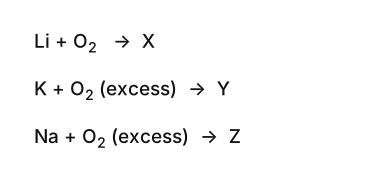
- TG EAPCET 2026Set ap-2026-05-04-AN1 markMCQQ.In the unbalanced reactions given below, the oxidation numbers of oxygen in X, Z and Y are respectively Li + O2 → X K + O2(excess) → Y Na + O2(excess) → Z (A) −1,−2,−21 (B) −2,−1,−21 (C) −2,−21,−1 (D) −1,−21,−2
›Reveal solutionSolution
The key is to recall the specific products formed when alkali metals react with oxygen: Li gives Li₂O (O⁻²), Na gives Na₂O₂ (O⁻¹), and K gives KO₂ (O in −½). The correct order is −2, −1, −½, which corresponds to option (B).
The problem asks for the oxidation numbers of oxygen in the products X, Y, and Z formed from the reactions of Li, K, and Na with oxygen. This is not a generic “metal + oxygen → metal oxide” situation — each alkali metal behaves differently due to the size and stability of the resulting anion. The key concept is the nature of the oxide, peroxide, or superoxide formed, which directly determines oxygen’s oxidation state.
Why this approach works:
Instead of balancing equations, we recall the characteristic product for each metal:
- Lithium, being the smallest alkali metal, forms only the normal oxide (O²⁻).
- Sodium forms the peroxide (O₂²⁻, each O is −1).
- Potassium (and larger alkali metals) forms the superoxide (O₂⁻, each O is −½).
Thus, we can directly read off the oxidation numbers.
- Lithium + O₂ → X Lithium is small; the Li⁺ ion strongly stabilizes the small O²⁻ ion. The product is lithium oxide:
4Li+O2→2Li2O
In Li₂O, oxygen is in the oxide ion O²⁻, so its oxidation number is −2.
- Potassium + excess O₂ → Y Potassium is large; it stabilizes the larger superoxide ion O₂⁻. With excess oxygen, the product is potassium superoxide:
K+O2(excess)→KO2
In KO₂, the anion is O₂⁻. The overall charge on O₂⁻ is −1, so each oxygen atom has oxidation number −½.
- Sodium + excess O₂ → Z Sodium is intermediate in size. With excess oxygen, it forms sodium peroxide:
2Na+O2(excess)→Na2O2
In Na₂O₂, the anion is O₂²⁻ (peroxide). The overall charge is −2, so each oxygen atom has oxidation number −1.
Thus, the oxidation numbers of oxygen in X, Z, and Y are −2, −1, and −½ respectively.
Watch outA common mistake is to assume all alkali metals form the same oxide (O²⁻). Remember: only Li gives the normal oxide; Na gives peroxide; K, Rb, Cs give superoxides.
TipYou can remember the pattern by the size of the metal ion: small cation (Li⁺) → small anion (O²⁻); medium (Na⁺) → medium (O₂²⁻); large (K⁺) → large (O₂⁻).
✓Final answerThe correct option is (B).
ANSWER: B
- TG EAPCET 2026Set ap-2026-05-04-AN1 markMCQQ.Given below are two statements Statement-I: Reducing property of dioxide increases from SO2 to TeO2. Statement-II: Pb3O4 on heating gives lead dioxide and oxygen The correct answer is (A) Both statements I and II are correct (B) Statement I is correct, but statement II is not correct (C) Statement I is not correct, but statement II is correct (D) Both statements I and II are not correct
›Reveal solutionSolution
Statement-I is false because reducing power actually decreases down Group 16 (SO₂ > TeO₂), and Statement-II is true because Pb₃O₄ decomposes to PbO and O₂, not PbO₂. So both are not correct.
Concept & Intuition
This question tests two separate ideas: (1) the trend in reducing property of dioxides of Group 16 elements (S, Se, Te, Po), and (2) the thermal decomposition behaviour of lead(II,IV) oxide (Pb₃O₄).
- For Statement-I: Reducing property means the ability to donate electrons (get oxidised). Down Group 16, the +4 oxidation state becomes more stable (the inert‑pair effect), so the dioxide becomes harder to oxidise — hence reducing power decreases.
- For Statement-II: Pb₃O₄ is a mixed oxide (2PbO·PbO₂). On heating, the PbO₂ part decomposes to PbO and O₂, so the overall product is PbO and O₂, not PbO₂.
Let’s check each carefully.
-
Statement-I: Reducing property of dioxide increases from SO₂ to TeO₂
- Reducing property means the tendency of the dioxide to get oxidised to a higher oxidation state (e.g., +4 → +6).
- Down Group 16, the stability of the +4 oxidation state increases due to the inert‑pair effect (the 6s² electrons in Te and Po are reluctant to participate).
- Therefore, TeO₂ is more stable and less willing to be oxidised than SO₂.
- In fact, SO₂ is a strong reducing agent (easily oxidised to SO₃ or H₂SO₄), while TeO₂ is quite stable and shows little reducing behaviour.
- Conclusion: Reducing property decreases down the group. So Statement-I is false.
-
Statement-II: Pb₃O₄ on heating gives lead dioxide and oxygen
- Pb₃O₄ (red lead) is actually 2PbO·PbO₂.
- When heated strongly, the PbO₂ component decomposes:
PbO2ΔPbO+21O2
- So the overall reaction is:
Pb3O4Δ3PbO+21O2
- It does not give PbO₂ as a product; PbO₂ itself decomposes.
- Conclusion: Statement-II is also false.
Watch outA common mistake is to think Pb₃O₄ simply loses oxygen to give PbO₂. In reality, PbO₂ is less stable than PbO at high temperature, so the final product is PbO.
- Final evaluation
- Statement-I: Incorrect
- Statement-II: Incorrect
- Therefore, both statements are not correct.
✓Final answerThe correct option is (D).
ANSWER: D
- TG EAPCET 2025Set eng-2025-05-02-FN1 markMCQQ.Match the following List – 1 (Chemical) List – 2 (Use) A. KOH I. Coolant B. Na(l) II. Antacid C. Li III. Electrochemical cells D. Mg(OH)2 IV. Absorbent for CO2 The correct answer is (A) A – II, B – III, C – IV, D – I (B) A – IV, B – I, C – III, D – II (C) A – IV, B – III, C – II, D – I (D) A – III, B – IV, C – I, D – II
›Reveal solutionSolution
This matching question tests your knowledge of the industrial and everyday uses of common chemicals. The correct pairing is: KOH as a CO₂ absorbent, liquid sodium as a coolant, lithium in electrochemical cells, and magnesium hydroxide as an antacid — which corresponds to option (B).
The key to solving this is not memorising random facts, but understanding why each substance is used for its specific purpose. The properties of the chemical — its reactivity, physical state, and chemical behaviour — directly determine its application.
Let’s go through each one.
-
KOH (Potassium hydroxide) — This is a strong base, similar to NaOH but more soluble and more reactive. It readily reacts with acidic gases like carbon dioxide to form potassium carbonate (K2CO3). This makes it an excellent absorbent for CO₂, especially in gas purification systems or in closed environments (like submarines or spacecraft). So A matches with IV.
-
Na(l) (Liquid sodium) — Sodium metal has a low melting point (about 98°C) and an exceptionally high thermal conductivity. As a liquid, it can flow through pipes and carry heat away very efficiently. It is also chemically stable at high temperatures in the absence of air/water. For these reasons, liquid sodium is used as a coolant in fast-breeder nuclear reactors. So B matches with I.
-
Li (Lithium) — Lithium is the lightest metal and has the highest electrochemical potential (standard reduction potential of -3.04 V). This means it can produce a high voltage per cell. Combined with its low density, lithium is ideal for electrochemical cells (batteries) — especially rechargeable lithium-ion batteries, where it provides high energy density. So C matches with III.
-
Mg(OH)₂ (Magnesium hydroxide) — This is a sparingly soluble base. It does not dissociate completely in water, so it gives a mild, buffered alkaline solution. This makes it safe to ingest in small amounts — it neutralises excess stomach acid (HCl) without causing a sudden, harsh reaction. That is why it is used as an antacid (often sold as milk of magnesia). So D matches with II.
Watch outA common mistake is to confuse KOH with an antacid. But KOH is far too caustic — it would burn the stomach lining. Antacids must be mild bases like Mg(OH)₂ or Al(OH)₃. Similarly, liquid sodium is not used in batteries (that’s solid sodium or lithium), and lithium is not used as a coolant (its melting point is too high for that purpose).
TipIf you ever forget, think of the physical state: liquids (like Na(l)) are great for carrying heat; solids (like Li) are used in solid electrodes; and mild, insoluble bases (like Mg(OH)₂) are safe for the stomach.
✓Final answerThe correct option is (B) — A–IV, B–I, C–III, D–II.
-
- TG EAPCET 2025Set eng-2025-05-03-FN1 markMCQQ.Which of the following reactions is an example of Clemmensen reduction? (A) O∣R−C−OC2H51. DIBAL-H2. H2OR−C−H+C2H5OHR−C−OC2H5 (B) O∣R−C−H(i) NH2-NH2(ii) KOH∣CH2CH2(OH)2R−CH3R−C−H (C) O∣R−C−CH3Zn-HgHClR−CH2−CH3R−C−CH3 (D) O∣R−C−Cl+H2PdBaSO4R−C−H+HClR−C−Cl
›Reveal solutionSolution
Clemmensen reduction uses Zn‑Hg / HCl to reduce a carbonyl group (C=O) directly to a methylene group (CH₂). The reaction in option (C) matches this exactly, giving the final product R–CH₂–CH₃ from a ketone.
Concept & Intuition
The Clemmensen reduction is a classic method for converting a carbonyl group (in an aldehyde or ketone) into a methylene (CH₂) group. The key reagents are zinc amalgam (Zn‑Hg) and concentrated hydrochloric acid (HCl). The reaction works under strongly acidic conditions, where the carbonyl oxygen is protonated and then reduced by the zinc metal, ultimately replacing the C=O with two hydrogen atoms. This is the go‑to method when you want to remove a carbonyl group from a molecule without using basic conditions (which would be needed for the alternative Wolff‑Kishner reduction).
Now let’s examine each option.
-
Option (A) – This shows an ester (R–COOEt) being reduced to an aldehyde (R–CHO) using DIBAL‑H, followed by hydrolysis. That is a partial reduction of an ester to an aldehyde, not a Clemmensen reduction. The reagents are completely different.
-
Option (B) – This shows an aldehyde (R–CHO) being treated with hydrazine (NH₂–NH₂) and then KOH in ethylene glycol. That is the Wolff‑Kishner reduction, which also converts a carbonyl to a methylene group, but under basic conditions. The Clemmensen reduction uses acidic conditions (Zn‑Hg / HCl), not basic.
-
Option (C) – Here we have a ketone (R–CO–CH₃) treated with Zn‑Hg / HCl. The product is R–CH₂–CH₃, meaning the carbonyl oxygen has been replaced by two hydrogens. This is the textbook definition of a Clemmensen reduction. The reagents and transformation match perfectly.
-
Option (D) – This shows an acid chloride (R–COCl) being hydrogenated over Pd/BaSO₄ (the Rosenmund reduction) to give an aldehyde. That is a catalytic hydrogenation that stops at the aldehyde stage, not a Clemmensen reduction.
Watch outA common mistake is confusing Clemmensen (acidic, Zn‑Hg/HCl) with Wolff‑Kishner (basic, NH₂‑NH₂/KOH). Both reduce C=O to CH₂, but the conditions are opposite. Option (B) is Wolff‑Kishner, not Clemmensen.
TipTo quickly identify a Clemmensen reduction in a multiple‑choice question, look for the phrase “Zn‑Hg / HCl” or “zinc amalgam / hydrochloric acid” next to a carbonyl compound. No other common reduction uses that exact reagent pair.
✓Final answerThe correct option is (C).
ANSWER: C
-
- TG EAPCET 2025Set ap-2025-04-29-AN1 markMCQQ.Identify the correct statements I. Lithium halides are somewhat covalent in nature II. NaNO3 on heating gives NO2 gas III. LiHCO3 is a solid IV. All alkali metals form ethynides on reaction with ethyne The correct option is (A) I, II, III only (B) II, IV only (C) I only (D) I, III only
›Reveal solutionSolution
Only statement I is correct. Lithium halides exhibit some covalent character due to the small size and high polarizing power of the Li+ ion. The final answer is (C).
Let's analyze each statement to determine its correctness.
Concept and Intuition
This question tests your understanding of the anomalous properties of lithium and general trends in alkali metal chemistry, including Fajan's rules, thermal decomposition of nitrates, stability of bicarbonates, and reactivity with ethyne. Lithium, being the first element in Group 1, often shows properties that differ significantly from the rest of the group due to its exceptionally small size and high charge density.
Step-by-step Analysis
-
Statement I: Lithium halides are somewhat covalent in nature.
- Reasoning: This statement relates to Fajan's rules, which describe the factors influencing the covalent character in ionic compounds. A small cation with a high positive charge density has a greater ability to polarize the electron cloud of an anion. Lithium (Li+) is the smallest cation among the alkali metals. Its high charge density allows it to significantly distort the electron cloud of halide anions (F−, Cl−, Br−, I−). This distortion leads to a sharing of electron density between the lithium ion and the halide ion, imparting a noticeable covalent character to lithium halides, even though they are predominantly ionic. This effect is more pronounced with larger anions (e.g., LiI is more covalent than LiF).
- Verdict: This statement is correct.
-
Statement II: NaNO3 on heating gives NO2 gas.
- Reasoning: The thermal decomposition of alkali metal nitrates follows different pathways depending on the metal.
- Lithium nitrate (LiNO3) decomposes to lithium oxide, nitrogen dioxide gas, and oxygen gas, similar to the nitrates of Group 2 elements:
- Reasoning: The thermal decomposition of alkali metal nitrates follows different pathways depending on the metal.
4LiNO3(s)Δ2Li2O(s)+4NO2(g)+O2(g)
* However, other alkali metal nitrates (NaNO$_3$, KNO$_3$, RbNO$_3$, CsNO$_3$) decompose to form the corresponding nitrite and oxygen gas, but *not* nitrogen dioxide gas:2NaNO3(s)Δ2NaNO2(s)+O2(g)
*   Since NaNO$_3$ produces NaNO$_2$ and O$_2$, and not NO$_2$ gas, this statement is incorrect.
*   **Verdict:** This statement is **incorrect**.
3. Statement III: LiHCO3 is a solid.
* Reasoning: Lithium bicarbonate (LiHCO3) is known to exist only in aqueous solution. It is unstable and cannot be isolated as a stable solid. When attempts are made to crystallize it, it decomposes into lithium carbonate (Li2CO3), water, and carbon dioxide:
LiHCO3(aq)evaporationLi2CO3(s)+H2O(l)+CO2(g)
*   In contrast, bicarbonates of other alkali metals (like NaHCO$_3$ and KHCO$_3$) are stable solids and can be readily isolated. This is another anomalous property of lithium.
*   **Verdict:** This statement is **incorrect**.
4. Statement IV: All alkali metals form ethynides on reaction with ethyne.
* Reasoning: Ethyne (acetylene, H-C≡C-H) has acidic hydrogens. Alkali metals can react with ethyne to form ethynides (acetylides).
* Lithium reacts directly with ethyne gas to form lithium ethynide:
2Li(s)+C2H2(g)→Li2C2(s)+H2(g)
* However, for other alkali metals like sodium and potassium, the direct reaction with ethyne gas is not as facile. They typically require specific conditions, such as reaction in liquid ammonia, to form their ethynides:2Na(s)+C2H2(g)liq. NH3Na2C2(s)+H2(g)
*   Since the statement implies a general ability for *all* alkali metals to form ethynides *on reaction with ethyne* under similar or direct conditions, and this is not true for all (e.g., Na and K require specific solvents like liquid ammonia), the statement is considered incorrect in the context of typical direct reactions.
*   **Verdict:** This statement is **incorrect**.
Based on the analysis, only statement I is correct.
✓Final answerThe correct option is (C).
-
- TG EAPCET 2025Set ap-2025-04-29-FN1 markMCQQ.Match the following List – 1 (Compound) A O3 B SO2 C H2SO4 D PH3 List – 2 (Use) I anti-chlor II Storage batteries III germicide IV smoke screens (A) A – III, B – II, C – I, D – IV (B) A – IV, B – II, C – I, D – III (C) A – III, B – I, C – II, D – IV (D) A – IV, B – I, C – II, D – III
›Reveal solutionSolution
This question requires matching common chemical compounds with their primary applications based on their characteristic properties. We will identify the key use for Ozone, Sulfur Dioxide, Sulfuric Acid, and Phosphine, leading to the correct option (C).
The utility of a chemical compound is directly linked to its unique physical and chemical properties. Understanding these properties allows us to predict and explain why certain substances are used for specific purposes in industry, medicine, or everyday life. For instance, strong oxidizing agents are often used as disinfectants, while strong acids have roles in batteries or industrial processes.
Let's match each compound from List-1 with its appropriate use from List-2:
-
Compound A: O3 (Ozone)
Ozone is a powerful oxidizing agent. This property makes it highly effective in killing bacteria, viruses, and other microorganisms.
- Use: Due to its strong oxidizing and germicidal properties, ozone is widely used as a disinfectant and sterilizing agent, for example, in water purification and air treatment.
- Match: Therefore, O3 matches with III germicide.
-
Compound B: SO2 (Sulfur Dioxide)
Sulfur dioxide acts as a reducing agent and also has bleaching properties (though often temporary). One of its important applications is in removing excess chlorine.
- Use: After fabrics are bleached with chlorine, residual chlorine can damage the fabric or interfere with subsequent dyeing processes. Sulfur dioxide is used to neutralize this excess chlorine, acting as an "anti-chlor."
- Match: Therefore, SO2 matches with I anti-chlor.
-
Compound C: H2SO4 (Sulfuric Acid)
Sulfuric acid is a strong mineral acid and is highly corrosive. It is one of the most widely produced industrial chemicals.
- Use: A significant application of sulfuric acid is as an electrolyte in lead-acid storage batteries, commonly found in automobiles. Its ability to conduct electricity and participate in reversible chemical reactions makes it ideal for this purpose.
- Match: Therefore, H2SO4 matches with II Storage batteries.
-
Compound D: PH3 (Phosphine)
Phosphine is a highly toxic gas. When impure (containing traces of P2H4), it is spontaneously flammable in air.
- Use: This property of spontaneous combustion, producing dense white fumes of phosphorus pentoxide (P4O10), makes it useful in applications requiring smoke generation. For example, it is used in Holme's signals, which are used as smoke screens or flares at sea.
- Match: Therefore, PH3 matches with IV smoke screens.
Combining these matches:
- A - III
- B - I
- C - II
- D - IV
This combination corresponds to option (C).
✓Final answerThe correct match is A – III, B – I, C – II, D – IV, which corresponds to option (C).
-
- TG EAPCET 2024Set ap-2024-05-07-FN1 markMCQQ.Match the following List I (Ore) A Siderite B Malachite C Sphalerite D Zincite List II (Composition) I ZnS II ZnO III FeCO3 IV Cu2S V CuCO3.Cu(OH)2 Options : (A) A-III B-I C-V D-II (B) A-III B-IV C-I D-II (C) A-III B-V C-I D-II (D) A-IV B-V C-II D-I
›Reveal solutionSolution
This question tests knowledge of common ores and their chemical compositions. The correct matches are: Siderite → FeCO₃, Malachite → CuCO₃·Cu(OH)₂, Sphalerite → ZnS, Zincite → ZnO, which corresponds to option (C).
The key here is to recall the standard chemical formulas for these well-known ores. Each ore is a naturally occurring mineral from which a metal is extracted. The composition is often given as a simple carbonate, sulfide, oxide, or a basic carbonate. Let’s match them one by one.
-
Siderite (A) is an iron ore. Its name comes from the Greek sideros (iron). It is iron(II) carbonate, so its composition is FeCO₃. This matches III in List II.
→ So A → III.
-
Malachite (B) is a green copper ore, often used as a gemstone. It is a basic copper carbonate, with the formula CuCO₃·Cu(OH)₂. This matches V in List II.
→ So B → V.
-
Sphalerite (C) is the chief ore of zinc. It is zinc sulfide, ZnS. This matches I in List II.
→ So C → I.
-
Zincite (D) is another zinc ore, but it is zinc oxide, ZnO. This matches II in List II.
→ So D → II.
Now, looking at the options:
- (A) A-III, B-I, C-V, D-II → Incorrect (B should be V, not I).
- (B) A-III, B-IV, C-I, D-II → Incorrect (B should be V, not IV; IV is Cu₂S, which is chalcocite).
- (C) A-III, B-V, C-I, D-II → Correct.
- (D) A-IV, B-V, C-II, D-I → Incorrect (A should be III, not IV; C should be I, not II; D should be II, not I).
TipA common pitfall is confusing Malachite (basic carbonate) with Chalcocite (Cu₂S) or Cuprite (Cu₂O). Remember: Malachite is green and has the distinctive formula CuCO₃·Cu(OH)₂.
Watch outDo not mix up Sphalerite (ZnS) and Zincite (ZnO). Sphalerite is the most common zinc ore; Zincite is rarer and often red or orange.
✓Final answerThe correct option is (C).
ANSWER: C
-
- TG EAPCET 2024Set ap-2024-05-07-FN1 markMCQQ.Which of the following does not evolve O2, when made to react with water? (A) F2 (B) XeF2 (C) XeF4 (D) XeF6
›Reveal solutionSolution
When reacted with water, F2, XeF2, and XeF4 undergo redox reactions that oxidize water to O2, but XeF6 undergoes a non-redox hydrolysis to form XeO3, meaning it does not evolve O2. The correct option is (D).
The Concept: Hydrolysis and Oxidation States
At the heart of this question lies the concept of hydrolysis, which is a reaction with water. Specifically, we need to determine if these hydrolysis reactions are also redox reactions (reduction-oxidation reactions) where oxygen from water is oxidized to molecular oxygen (O2).
Water (H2O) contains oxygen in the -2 oxidation state. For O2 to be evolved, the oxygen in water must be oxidized from -2 to 0. This means that another species in the reaction must be reduced.
Let's consider the general behavior:
- Strong Oxidizing Agents: If a compound is a very strong oxidizing agent, it will readily oxidize water to O2.
- Xenon Fluorides (XeFn): These compounds feature xenon in positive oxidation states. When they react with water, two main scenarios can occur:
- Redox Hydrolysis: Xenon is reduced (e.g., to Xe gas, oxidation state 0) or disproportionates (changes to both higher and lower oxidation states), and in doing so, it oxidizes water to O2. This typically happens when xenon is in a lower positive oxidation state.
- Non-Redox Hydrolysis: Xenon's oxidation state remains unchanged. Water molecules simply replace fluoride ligands, forming xenon oxides or oxyfluorides. In this case, oxygen's oxidation state also remains -2, and no O2 is evolved. This is more likely when xenon is already in a high, stable oxidation state.
We'll examine each option by looking at the oxidation states of xenon and oxygen before and after the reaction with water.
Step-by-Step Analysis
Let's break down the reaction of each compound with water and track the oxidation states.
1. (A) F2 with H2O
Fluorine (F2) is the most electronegative element and the strongest oxidizing agent known. It readily oxidizes water.
- Initial Oxidation States:
- F in F2: 0
- O in H2O: -2
- Reaction: The reaction is vigorous, even explosive, and produces oxygen gas. 2F2(g)+2H2O(l)→4HF(aq)+O2(g)
- Final Oxidation States:
- F in HF: -1 (Fluorine is reduced from 0 to -1)
- O in O2: 0 (Oxygen is oxidized from -2 to 0)
Since oxygen's oxidation state changes from -2 to 0, O2 is evolved.
2. (B) XeF2 with H2O
Xenon difluoride (XeF2) reacts with water, and this is a redox process.
- Initial Oxidation States:
- Xe in XeF2: +2 (since F is -1)
- O in H2O: -2
- Reaction: 2XeF2(s)+2H2O(l)→2Xe(g)+4HF(aq)+O2(g)
- Final Oxidation States:
- Xe in Xe: 0 (Xenon is reduced from +2 to 0)
- O in O2: 0 (Oxygen is oxidized from -2 to 0)
Here, xenon is reduced, and water is oxidized. Therefore, O2 is evolved.
3. (C) XeF4 with H2O
Xenon tetrafluoride (XeF4) also undergoes a redox hydrolysis, which is a disproportionation reaction for xenon.
- Initial Oxidation States:
- Xe in XeF4: +4
- O in H2O: -2
- Reaction: The hydrolysis of XeF4 is complex, involving disproportionation of xenon. 6XeF4(s)+12H2O(l)→2XeO3(aq)+4Xe(g)+24HF(aq)+3O2(g)
- Final Oxidation States:
- Xe in XeO3: +6
- Xe in Xe: 0
- (Xenon disproportionates from +4 to +6 and 0)
- O in O2: 0 (Oxygen is oxidized from -2 to 0)
In this reaction, xenon disproportionates, and water is oxidized. Thus, O2 is evolved.
4. (D) XeF6 with H2O
Xenon hexafluoride (XeF6) reacts with water in a different manner. Depending on the amount of water, it can undergo partial or complete hydrolysis. For complete hydrolysis, the reaction is:
- Initial Oxidation States:
- Xe in XeF6: +6
- O in H2O: -2
- Reaction (Complete Hydrolysis): XeF6(s)+3H2O(l)→XeO3(aq)+6HF(aq) This reaction forms xenon trioxide (XeO3), which is a highly explosive compound.
- Final Oxidation States:
- Xe in XeO3: +6 (since O is -2, x+3(−2)=0⇒x=+6)
- O in XeO3: -2
Notice that the oxidation state of xenon remains +6, and the oxidation state of oxygen remains -2. There is no change in the oxidation state of oxygen from water to O2. This is a non-redox hydrolysis where fluoride ligands are replaced by oxide ligands from water.
Therefore, O2 is NOT evolved when XeF6 reacts with water.
TipThe key difference for XeF6 is that xenon is already in a very high oxidation state (+6). It doesn't need to be reduced to Xe(0) or disproportionate in a way that forces water to be oxidized to O2. Instead, it forms XeO3, where xenon retains its +6 oxidation state, and oxygen from water simply becomes part of the XeO3 molecule without changing its own oxidation state.
Watch outWhile XeF6 can undergo partial hydrolysis to form XeOF4 and XeO2F2, these reactions also do not involve a change in the oxidation state of xenon or the evolution of O2. The complete hydrolysis to XeO3 is the most relevant for this question.
The compound that does not evolve O2 when made to react with water is XeF6.
✓Final answerThe correct option is (D).
ANSWER: D
- TG EAPCET 2023Set eng-2023-05-13-FN1 markMCQQ.Which of the following is the strongest reducing agent? (A) TeO3 (B) SO3 (C) TeO2 (D) SO2
›Reveal solutionSolution
The strongest reducing agent is the species most easily oxidized (loses electrons). Among the given oxides, SO2 is the most readily oxidized to a higher oxidation state, making it the strongest reducing agent. The correct option is (D).
Concept and Intuition
A reducing agent donates electrons and gets oxidized itself. To compare reducing strength among oxides, we look at the oxidation state of the central atom (S or Te) and its tendency to increase further. Lower oxidation states are generally easier to oxidize, but stability trends in the periodic table also matter: sulfur in +4 is less stable than tellurium in +4, so SO2 is more eager to lose electrons than TeO2. Higher oxides like SO3 and TeO3 are already in their maximum oxidation states (+6) and cannot be easily oxidized—they are oxidizing agents, not reducing ones.
Step-by-step reasoning
-
Determine oxidation states
- In SO2: S is +4 (since O is -2 each, total -4, so S = +4).
- In SO3: S is +6.
- In TeO2: Te is +4.
- In TeO3: Te is +6. A reducing agent must be able to increase its oxidation state. Species already at +6 (the maximum for group 16) cannot be oxidized further under normal conditions—they are at the top of their oxidation ladder. So (A) and (B) are out.
-
Compare the +4 oxides: SO2 vs TeO2
Both can be oxidized to +6 (forming SO3 or TeO3). Which does so more readily?
- Sulfur is a smaller, more electronegative atom than tellurium. The +4 state for sulfur is less stable because the small size leads to greater electron-electron repulsion and a higher tendency to lose electrons to reach the more stable +6 state.
- Tellurium, being larger and more metallic, is more comfortable in the +4 state; it is harder to oxidize further.
- Experimentally, SO2 is a well-known reducing agent (e.g., it decolorizes KMnO4, reduces Fe3+ to Fe2+), while TeO2 is much less reactive as a reductant.
-
Eliminate the weaker candidates
- TeO3 and SO3 are already fully oxidized—they can only be reduced, not oxidized. They are oxidizing agents.
- TeO2 is a weak reducing agent compared to SO2.
-
Conclusion
SO2 is the strongest reducing agent among the four.
TipA quick mnemonic: In group 16, the lower the period, the more stable the +4 state becomes. So sulfur's +4 is "unstable" and eager to become +6, making SO2 a strong reductant. Tellurium's +4 is more stable, so TeO2 is a weaker reductant.
Watch outA common mistake is to think that a lower oxidation state always means a stronger reducing agent. While true in a general sense, you must also consider the element's position in the periodic table. For example, H2O (O is -2) is not a strong reducing agent because oxygen is very electronegative and stable in that state. Always compare within the same group or similar contexts.
✓Final answerThe correct option is (D).
ANSWER: D
-
- TG EAPCET 2023Set eng-2023-05-12-FN1 markMCQQ.Match the following List–I (Substance) A) Na2O2 B) D2O C) Cs D) Mg(OH)2 List–II (Use) I. Photoelectric cells II. Antacid III. Oxidising agent IV. Moderator The correct answer is (A) A - III, B - IV, C - I, D - II (B) A - IV, B - III, C - II, D - I (C) A - III, B - IV, C - II, D - I (D) A - II, B - IV, C - I, D - III
›Reveal solutionSolution
This is a matching problem linking four substances to their primary uses. The correct pairing is: Na₂O₂ as an oxidising agent, D₂O as a moderator, Cs in photoelectric cells, and Mg(OH)₂ as an antacid — which corresponds to option (A).
The key is to recall the characteristic chemical or physical property of each substance and then match it to the most prominent application listed. Let’s go through each one carefully.
-
A) Na₂O₂ (Sodium peroxide)
- Sodium peroxide contains the peroxide ion (O₂²⁻), which is a strong oxidising agent. It readily releases oxygen or accepts electrons in reactions (e.g., with water or CO₂).
- Its common use is as an oxidising agent in bleaching, in oxygen generators, and in chemical synthesis.
- Therefore, A matches with III (Oxidising agent).
-
B) D₂O (Deuterium oxide, heavy water)
- D₂O is water where hydrogen is replaced by deuterium (²H). Its key property is a much lower neutron absorption cross-section than ordinary water, making it ideal for slowing down (moderating) neutrons in nuclear reactors without capturing them.
- It is not used as an oxidising agent, antacid, or in photoelectric cells.
- Hence, B matches with IV (Moderator).
-
C) Cs (Caesium)
- Caesium is an alkali metal with the lowest ionisation energy among stable elements. This makes it extremely sensitive to light — electrons are easily ejected when photons strike its surface (the photoelectric effect).
- It is widely used in photoelectric cells (e.g., in light sensors, night-vision devices).
- So, C matches with I (Photoelectric cells).
-
D) Mg(OH)₂ (Magnesium hydroxide)
- Magnesium hydroxide is a mild base, poorly soluble in water. It neutralises stomach acid without being too harsh, and is the active ingredient in many antacids (e.g., milk of magnesia).
- It is not used as an oxidising agent, moderator, or in photoelectric cells.
- Thus, D matches with II (Antacid).
Watch outA common mistake is to confuse D₂O with an oxidising agent because of the “oxide” in its name, or to think Cs is used as a moderator because it’s a metal. Always focus on the specific property: D₂O’s neutron moderation and Cs’s photoelectric sensitivity.
Putting the matches together:
A → III, B → IV, C → I, D → II.
This corresponds exactly to option (A).
✓Final answerThe correct option is (A).
ANSWER: A
-
- TG EAPCET 2023Set eng-2023-05-12-FN1 markMCQQ.Consider the reaction P4+3NaOH+3H2O→Q+3NaH2PO2 Identify the reaction in which Q is not the product. (Equations are not balanced.) (A) Ca3P2+H2O→ (B) H3PO3Δ (C) PH4I+KOH→ (D) PCl3+H2O→
›Reveal solutionSolution
The reaction given produces phosphine (PH3) as Q; we must find which option does not yield PH3. The correct option is (B) because H3PO3 on heating disproportionates into H3PO4 and PH3, but the question asks for the reaction where Q is not a product — and in (B) Q is a product, so it is not the answer; actually we need the one where Q is absent. Re‑checking: (B) does produce PH3, so it is not the answer. The reaction that does not give PH3 is (D) PCl3+H2O→H3PO3+HCl, so Q is absent. Final result: (D).
TipThe key is to identify Q first. From the given equation P4+3NaOH+3H2O→Q+3NaH2PO2, note that NaH2PO2 is sodium hypophosphite. This is a classic disproportionation of white phosphorus in warm alkali: P4 is both oxidised (to hypophosphite) and reduced (to phosphine). Hence Q is phosphine, PH3.
Now we examine each option to see which one does not produce PH3.
- Option (A): Ca3P2+H2O→ Calcium phosphide reacts with water to give phosphine:
Ca3P2+6H2O→3Ca(OH)2+2PH3
So Q (PH3) is produced. Not the answer.
- Option (B): H3PO3Δ Phosphorous acid on heating disproportionates:
4H3PO3Δ3H3PO4+PH3
Again, PH3 is formed. So Q is produced. Not the answer.
- Option (C): PH4I+KOH→ Phosphonium iodide reacts with a base to give phosphine:
PH4I+KOH→KI+H2O+PH3
Q is produced. Not the answer.
- Option (D): PCl3+H2O→ Phosphorus trichloride hydrolyses to phosphorous acid and hydrochloric acid:
PCl3+3H2O→H3PO3+3HCl
No phosphine is formed. Hence Q is not a product here.
Watch outA common mistake is to think that because PCl3 contains phosphorus in the +3 state, it might disproportionate like H3PO3. But PCl3 simply hydrolyses; it does not undergo redox under these conditions. Only the acid H3PO3 disproportionates on heating.
✓Final answerThe correct option is (D).
ANSWER: D
- TG EAPCET 2023Set eng-2023-05-14-AN1 markMCQQ.In +2 oxidation state, which of the following lanthanoids act as reducing agents? (A) Ce, Pr (B) Eu, Gd (C) Eu, Yb (D) Lu, Er
›Reveal solutionSolution
The key is that lanthanoids in +2 oxidation states act as reducing agents when they can easily lose an electron to reach a stable +3 state, typically due to a half-filled or fully filled f-subshell. The correct pair is Eu and Yb, so option (C) is correct.
Concept and Intuition
Lanthanoids are most stable in the +3 oxidation state, which corresponds to the loss of two 6s electrons and one 4f electron (or sometimes one 5d electron). A +2 state is relatively rare and occurs only when it leads to a particularly stable electronic configuration — either a half-filled (4f⁷) or fully filled (4f¹⁴) f-subshell.
A lanthanoid in the +2 state will act as a reducing agent if it can easily lose another electron to revert to the stable +3 state. That ease is greatest when the +2 configuration is already close to a noble-gas-like f-shell (f⁷ or f¹⁴), so the +3 state is even more stable. The classic examples are Eu²⁺ (4f⁷) and Yb²⁺ (4f¹⁴).
Watch outA common mistake is to think that any lanthanoid with a +2 state is a reducing agent. But Ce²⁺, for instance, has a 4f² configuration — not especially stable — and actually tends to be oxidized to Ce⁴⁺ (a stable f⁰ state) rather than to Ce³⁺. So Ce²⁺ is not a reducing agent in the same sense.
Step-by-Step Reasoning
-
Recall the stable +2 configurations
The +2 oxidation state is most stable when it yields either 4f⁷ (half-filled) or 4f¹⁴ (fully filled). Among lanthanoids, these occur for:
- Eu²⁺: [Xe]4f⁷ (half-filled)
- Yb²⁺: [Xe]4f¹⁴ (fully filled)
-
Why these act as reducing agents
A reducing agent donates electrons. For Eu²⁺ and Yb²⁺, the +2 state is already quite stable, but the +3 state is even more stable (Eu³⁺ is 4f⁶, Yb³⁺ is 4f¹³). The energy difference is small, so they readily lose one more electron to become +3. This makes them strong reducing agents.
-
Check the other options
- (A) Ce, Pr: Ce²⁺ (4f²) is not particularly stable; Ce is more known for Ce⁴⁺ (4f⁰). Pr²⁺ is also unstable and not a typical reducing agent.
- (B) Eu, Gd: Eu²⁺ works, but Gd²⁺ (4f⁷? No — Gd³⁺ is 4f⁷, so Gd²⁺ would be 4f⁸, not half-filled) is not stable; Gd is not a reducing agent in +2.
- (D) Lu, Er: Lu²⁺ (4f¹⁴? Actually Lu³⁺ is 4f¹⁴, so Lu²⁺ would be 4f¹⁵ — impossible) and Er²⁺ (4f¹²) are not stable reducing agents.
-
Conclusion
Only Eu and Yb among the listed pairs reliably act as reducing agents in the +2 state.
TipA quick memory aid: "Europium and Ytterbium are the two that go from +2 to +3 easily" — both have special f-shell stability in the +2 state.
✓Final answerThe correct option is (C).
ANSWER: C
-
🎓Unlock everything free for 14 days
- ✓Full step-by-step solutions
- ✓Concept-first explanations
- ✓Methods, shortcuts & mistakes
- ✓PYQ mapping + timed mock tests
Full access for 14 days. No credit card required.