Q.Consider the reactions : 2S2O3 2–(aq) + I2(s) → S4O6 2–(aq) + 2I–(aq) S2O3 2–(aq) + 2Br2(l) + 5H2O(l) → 2SO4 2–(aq) + 4Br–(aq) + 10H+(aq) Why does the same reductant, thiosulphate react differently with iodine and bromine ?
🔒You're viewing a preview — the full solution, concept, methods & PYQ mapping are locked.
🔒 Start your 14-day free trial to unlock the full solution →Concept understanding — Oxidation State Stability
Oxidation State Stability: The First Meeting
Imagine you have a pile of Lego bricks. Some colours click together easily; others keep falling apart. An atom's oxidation state is like the colour of a Lego brick — it tells you how many electrons the atom has lost (positive state) or gained (negative state) compared to its neutral form. But not all oxidation states are equally happy. Some are rock-solid; others are fragile and want to change.
That's oxidation state stability: why some oxidation states of an element are comfortable and long-lasting, while others are restless and reactive.
The Intuition: Why would an atom "prefer" one state over another?
An atom wants to be stable. In chemistry, stability usually means one of two things:
- A full outer shell — like noble gases (8 electrons in the outermost shell, or 2 for helium). Atoms will gain, lose, or share electrons to get there.
- A half-filled or fully-filled subshell — this is a special bonus stability. For example, chromium loves having a 3d5 configuration (half-filled d-subshell) even if it means sacrificing a 4s electron.
So when an atom takes on an oxidation state, it's essentially deciding how many electrons to give away or accept. The "best" oxidation states are those that leave the atom with a stable electronic configuration.
This is why sodium (Na) almost always shows +1 — losing one electron gives it the same electron configuration as neon (a noble gas). It's not trying to be fancy; it's trying to be comfortable.
The Precise Statement
Oxidation state stability refers to the tendency of an element to exist in a particular oxidation state under given conditions (temperature, pH, presence of other substances). An oxidation state is stable if:
- The atom's electronic configuration after gaining/losing electrons is noble-gas-like (octet) or has a half-filled/full-filled d or f subshell.
- The energy required to reach that state is low compared to other possible states.
- The state does not spontaneously change into another state (e.g., by reacting with air, water, or itself).
Stability order (general trend):
For main-group elements: oxidation states that give a noble gas configuration are most stable.
For transition metals: +2 and +3 are common, but stability varies with the element and the environment.
Examples to cement the idea
| Element | Common stable states | Why? |
|---|---|---|
| Sodium (Na) | +1 | Losing 1 electron → Ne configuration (2,8) |
| Chlorine (Cl) | -1 | Gaining 1 electron → Ar configuration (2,8,8) |
| Iron (Fe) | +2, +3 | Both leave d-subshell partially filled; +3 is more stable in acidic conditions |
| Manganese (Mn) | +2, +7 | +2 is stable (half-filled d⁵); +7 is stable in permanganate ion (MnO₄⁻) due to strong bonding with oxygen |
| Carbon (C) | +4, -4 | Both give noble gas configuration (He for +4? No — careful: carbon's +4 means losing 4 electrons, leaving 1s², which is He-like. -4 means gaining 4 electrons, giving Ne-like 2,8) |
Don't confuse "common" with "stable". Carbon's +4 is common but not always stable — CO₂ is stable, but CCl₄ is not very stable in water. Stability depends on the compound, not just the element.
The deeper reason: Why do some states "disproportionate"?
Some oxidation states are so unstable that the atom reacts with itself. This is called disproportionation — one atom in an intermediate state splits into two atoms: one higher, one lower.
Example: Copper(I) in water. Cu⁺ (oxidation state +1) is unstable in aqueous solution. It spontaneously does this:
2Cu+→Cu2++Cu
One Cu⁺ gets oxidised to Cu²⁺ (more stable in water), the other gets reduced to Cu metal (even more stable). The +1 state was disproportionation-unstable.
A quick check: If an element has three consecutive oxidation states (say +1, +2, +3), the middle one (+2) is often prone to disproportionation if the +1 and +3 states are both stable. This is common for elements like copper, mercury, and thallium.
What determines stability in practice? …
The key idea is that the stability of intermediate oxidation states of sulphur determines the reaction pathway. Iodine is a mild oxidant, while bromine is a strong oxidant.
Reasoning:
- In thiosulphate (S2O32−), sulphur has an average oxidation state of +2 (the two S atoms are structurally non-equivalent; +2 is their average).
- Iodine (I2) is a weak oxidising agent — it lifts sulphur only from an average of +2 to +2.5 (in tetrathionate, S4O62−): a one-electron change per thiosulphate, stopping at an intermediate state. …
Thiosulphate (S2O32−) acts as a mild reductant with iodine (forming tetrathionate, S4O62−) but as a strong reductant with bromine (oxidising all the way to sulphate, SO42−) because the oxidising power of bromine (E∘≈+1.09 V) is much greater than that of iodine (E∘≈+0.54 V). The final products are determined by the stability of oxidation states of sulphur under the given oxidising strength.
The key to understanding this lies in the relative oxidising strengths of iodine and bromine, and how they affect the oxidation state of sulphur in thiosulphate.
Thiosulphate ion, S2O32−, has a fascinating structure: a central sulphur carrying the three oxygens, and a second, sulphide-like sulphur bonded only to sulphur. The two atoms are not equivalent; the average oxidation state of sulphur is +2, and that average is the cleanest bookkeeping to follow. The outer, electron-rich sulphur is the site an oxidant attacks first.
Now, why do the products differ?
- Iodine is a mild oxidant. Its standard reduction potential is only about +0.54 V. It can only skim the most easily removed electrons. Two thiosulphate units couple through a new S–S bond to form tetrathionate, S4O62−, whose average sulphur state is +2.5 — per the chapter's own analysis of the tetrathionate ion, the two end sulphurs sit at +5 and the two middle ones at 0. The reaction is:
2S2O32−+I2→S4O62−+2I−
Here, each thiosulphate loses just one electron (average sulphur state: +2→+2.5 across its two sulphur atoms).
- Bromine is a powerful oxidant. With E∘≈+1.09 V, it can rip electrons from both sulphur atoms, oxidising them all the way to the +6 state (as in sulphate, SO42−). The reaction is more vigorous and requires water to provide oxygen atoms:
S2O32−+2Br2+5H2O→2SO42−+4Br−+10H+
Each sulphur goes from average +2 to +6 — a loss of 4 electrons per sulphur, or 8 electrons per thiosulphate. That's a much deeper oxidation.
A common mistake is to think that thiosulphate always gets oxidised to tetrathionate. That's only true with mild oxidants like iodine. With strong oxidants like bromine, chlorine, or acidified permanganate, the oxidation goes all the way to sulphate. Always check the oxidising strength first.
Think of it like this: Iodine is a polite oxidant — it only takes the "low-hanging fruit" (the –2 sulphur). Bromine is aggressive — it takes everything it can, oxidising both sulphur atoms completely. The same principle applies to other reductants: the product depends on how strong the oxidant is.
- Why doesn't iodine oxidise further? Because pushing sulphur beyond the tetrathionate stage demands a much higher potential than iodine can provide. The S4O62− ion is quite stable under mild conditions. In fact, this reaction is the basis of iodometric titrations — a classic analytical method. …
Showing the 12 most recent of 22 on this concept.
- TG EAPCET 2026Set eng-2026-05-09-AN1 markMCQQ.In winter, polar stratospheric clouds formed over Antarctica provide surface on which compound 'X' responsible for depletion of ozone is formed. What is X? (A) Peroxyacetyl nitrate (B) Acrolein (C) Chlorine nitrate (D) Sulphuryl chloride
›Reveal solutionSolution
The compound formed on polar stratospheric clouds that directly depletes ozone is chlorine nitrate — option (C).
The key here is understanding the chemistry of ozone depletion over Antarctica. In winter, the polar vortex isolates the air above Antarctica, allowing temperatures to drop low enough for polar stratospheric clouds (PSCs) to form. These clouds are not just passive bystanders — they provide a surface for heterogeneous chemical reactions that convert inactive chlorine reservoirs into active forms that destroy ozone.
The most important reservoir species is chlorine nitrate, ClONO2. Normally, chlorine is locked up in this compound and in hydrogen chloride (HCl), which do not react with ozone. But on the surface of PSC particles, a reaction occurs:
ClONO2+HClPSC surfaceCl2+HNO3
The molecular chlorine (Cl2) produced is photolysed by sunlight when spring returns, releasing chlorine radicals that catalytically destroy ozone. So the compound 'X' that is formed on PSCs and is directly responsible for the depletion is chlorine nitrate — it is the key chlorine reservoir that gets activated.
Let’s walk through the reasoning step by step.
-
Identify the context. The question is about the Antarctic ozone hole. In winter, the stratosphere over Antarctica becomes extremely cold, and polar stratospheric clouds form. These clouds are composed of ice or nitric acid trihydrate crystals.
-
Understand the role of PSCs. Normally, chlorine in the stratosphere exists in "reservoir" forms that are harmless to ozone. The two main reservoirs are chlorine nitrate (ClONO2) and hydrogen chloride (HCl). On their own, these do not react with ozone.
-
The critical reaction on PSCs. On the surface of PSC particles, a heterogeneous reaction takes place:
ClONO2+HCl→Cl2+HNO3
Here, chlorine nitrate reacts with HCl to produce molecular chlorine (Cl2) and nitric acid (HNO3). The nitric acid remains in the cloud particles, while Cl2 is a gas.
- Activation in spring. When sunlight returns to Antarctica in spring, Cl2 is photolysed:
Cl2+UV light→2Cl∙
These chlorine atoms then catalytically destroy ozone in a cycle:
Cl∙+O3→ClO∙+O2
ClO∙+O→Cl∙+O2 …
-
- TG EAPCET 2026Set eng-2026-05-09-FN1 markMCQQ.Iodine on reaction with concentrated nitric acid gives three products X, Y and Z. The sum of oxidation numbers of the central atoms in X, Y and Z is (A) 5 (B) 6 (C) 7 (D) 4
›Reveal solutionSolution
I2+10HNO3→2HIO3+10NO2+4H2O; central-atom oxidation numbers +5 (I)+4 (N)+(−2) (O)=7.
Iodine is oxidised by concentrated nitric acid to iodic acid, while the acid is reduced to nitrogen dioxide, and water is formed:
I2+10HNO3(conc.)⟶2HIO3+10NO2+4H2O
The three products and the oxidation number of their central atoms are:
- X=HIO3: central atom I has oxidation number +5. …
- TG EAPCET 2026Set ap-2026-05-04-AN1 markMCQQ.Electrolysis of 50% H2SO4 solution at high current density gives a compound ‘A’. Hydrolysis of ‘A’ gives ‘B’. The number of moles of O2 produced when 5 moles of ‘B’ reacts with 2 moles of acidified KMnO4 solution is (A) 4 (B) 5 (C) 6 (D) 7
›Reveal solutionSolution
Electrolysis of concentrated sulfuric acid at high current density produces peroxydisulfuric acid (A). Its hydrolysis yields hydrogen peroxide (B). Hydrogen peroxide then reacts with acidified potassium permanganate, acting as a reducing agent to produce oxygen gas. Given the stoichiometric amounts of reactants, 5 moles of O2 are produced.
The problem involves a sequence of chemical reactions: an electrolysis reaction, followed by a hydrolysis reaction, and finally a redox reaction. To solve this, we need to identify the compounds formed at each step and then use stoichiometry for the final reaction.
Concept and Intuition
- Electrolysis of Sulfuric Acid: When an aqueous solution of sulfuric acid is electrolyzed, there are competing reactions at the anode (oxidation). Typically, water is oxidized to oxygen gas. However, at high concentrations of sulfuric acid (like 50%) and high current densities, the overpotential for oxygen evolution becomes significant. This kinetic factor favors the oxidation of sulfate ions (SO42−) to peroxydisulfate ions (S2O82−), which then forms peroxydisulfuric acid (H2S2O8). This is a key industrial method for producing peroxydisulfuric acid.
- Hydrolysis of Peroxydisulfuric Acid: Peroxydisulfuric acid is an unstable compound that readily hydrolyzes in the presence of water. This hydrolysis proceeds in steps, ultimately yielding sulfuric acid and hydrogen peroxide. This reaction is also an important industrial route for hydrogen peroxide production.
- Redox Reaction with Permanganate: Hydrogen peroxide (H2O2) is a versatile compound that can act as both an oxidizing and a reducing agent. In the presence of a strong oxidizing agent like acidified potassium permanganate (KMnO4), hydrogen peroxide acts as a reducing agent, getting oxidized to oxygen gas (O2). Permanganate, in turn, is reduced to Mn2+ in acidic medium. Balancing this redox reaction is crucial for determining the stoichiometry.
Step-by-step Solution
-
Identify Compound 'A' from Electrolysis:
Electrolysis of 50% H2SO4 solution at high current density leads to the oxidation of sulfate ions at the anode.
Anode reaction: 2H2SO4→H2S2O8+2H++2e−
Cathode reaction: 2H++2e−→H2
Overall reaction: 2H2SO4electrolysisH2S2O8+H2
Compound 'A' is peroxydisulfuric acid (H2S2O8).
-
Identify Compound 'B' from Hydrolysis of 'A':
Peroxydisulfuric acid undergoes hydrolysis in the presence of water. This reaction typically occurs in two steps:
›Proof
Step 1: H2S2O8+H2O→H2SO5+H2SO4 (Peroxymonosulfuric acid, Caro's acid)
Step 2: H2SO5+H2O→H2SO4+H2O2
Adding these two steps gives the overall hydrolysis reaction.
The overall hydrolysis reaction is:
[!FORMULA]
H2S2O8+2H2O→2H2SO4+H2O2
Compound 'B' is hydrogen peroxide (H2O2).
-
Balance the Redox Reaction between 'B' (H2O2) and Acidified KMnO4:
In this reaction, H2O2 acts as a reducing agent and is oxidized to O2. MnO4− acts as an oxidizing agent and is reduced to Mn2+ in acidic medium.
- Oxidation half-reaction: …
- TG EAPCET 2026Set ap-2026-05-04-AN1 markMCQQ.Which one of the following statements is not correct regarding interhalogen compounds? (A) IF7 and ClF3 are colourless gases (B) BrF5 and ClF5 are colourless liquids (C) ClF3 on hydrolysis gives HCl and HOF (D) Except F–F bond, X–X' bond of interhalogens is weaker than X–X bond of halogens
›Reveal solutionSolution
The key idea is to recall the physical states, colours, and hydrolysis products of common interhalogen compounds. The incorrect statement is (C), because ClF3 on hydrolysis gives HF, not HCl, and HOF is not a product.
Interhalogen compounds are formed when two different halogens combine. Their properties — colour, physical state, and chemical reactivity — follow trends based on the size and electronegativity of the constituent halogens. The question tests your ability to spot a factual error in these properties, especially the hydrolysis behaviour of ClF3, which is a classic trap.
Let’s examine each statement one by one.
-
Statement (A): IF7 and ClF3 are colourless gases
IF7 (iodine heptafluoride) is indeed a colourless gas at room temperature. ClF3 (chlorine trifluoride) is also a colourless gas (though it can be condensed to a pale yellow liquid under pressure). Both are gases, and both are colourless. This statement is correct.
-
Statement (B): BrF5 and ClF5 are colourless liquids
BrF5 (bromine pentafluoride) is a colourless liquid. ClF5 (chlorine pentafluoride) is also a colourless liquid at room temperature. This matches known data. Statement (B) is correct.
-
Statement (C): ClF3 on hydrolysis gives HCl and HOF
This is the suspect one. Hydrolysis of interhalogens typically produces a mixture of the oxyacid of the central halogen and the hydrohalic acid of the more electronegative halogen. For ClF3, the central atom is chlorine (less electronegative than fluorine), and fluorine is more electronegative.
The actual hydrolysis reaction is:
ClF3+2H2O→HClO2+3HF
(Chlorous acid and hydrogen fluoride are formed, not HCl and HOF).
HOF (hypofluorous acid) is a rare, unstable compound and does not form here. Also, HCl would require chlorine to be in the –1 oxidation state, but in ClF3, chlorine is in +3 state — hydrolysis doesn’t reduce it to –1. So statement (C) is factually wrong. …
-
- TG EAPCET 2026Set ap-2026-05-05-FN1 markMCQQ.Observe the following reaction sequence
[!FORMULA] StyreneHBrX(i)KCN(ii)H3O+Y(i)Br2/red P(ii)H2OZ
Correct statement regarding Y, Z is (A) Y is stronger acid than benzoic acid (B) Z is stronger acid than Y (C) Y can be reduced with NaBH4 (D) Z on decarboxylation gives benzyl bromide›Reveal solutionSolution
The reaction sequence converts styrene into a substituted carboxylic acid (Y) and then into an α-bromo acid (Z). The correct statement is that Z is a stronger acid than Y due to the electron-withdrawing effect of the bromine atom.
The problem is about understanding how functional groups transform step by step, and then comparing acid strengths. The key concept is inductive effect — how electronegative atoms near a carboxylic acid group affect its acidity. Let’s trace the chemistry.
-
Styrene + HBr follows Markovnikov’s rule. The double bond in styrene is conjugated with the benzene ring, but HBr adds such that the bromine goes to the more substituted carbon (the one attached to the ring). So X is 1-bromo-1-phenylethane (Ph–CHBr–CH₃).
-
X + KCN does an Sₙ2 substitution. The bromine is on a secondary carbon, but benzylic position makes it reactive. CN⁻ replaces Br, giving a nitrile. Then H₃O⁺ hydrolyzes the nitrile to a carboxylic acid. So Y is 2-phenylpropanoic acid (Ph–CH(CH₃)–COOH).
-
Y + Br₂/red P is the Hell-Volhard-Zelinsky (HVZ) reaction. Red P generates a small amount of PBr₃, which converts the carboxylic acid to an acyl bromide. Then Br₂ substitutes the α-hydrogen (the one next to the COOH group). Water in the second step hydrolyzes the acyl bromide back to the acid. So Z is 2-bromo-2-phenylpropanoic acid (Ph–CBr(CH₃)–COOH).
Now evaluate each statement:
(A) Y is stronger acid than benzoic acid — False. Benzoic acid has the COOH directly attached to the benzene ring, which stabilizes the conjugate base via resonance. In Y, the COOH is separated by a CH(CH₃) group, so no such resonance. Benzoic acid (pKa ≈ 4.2) is stronger than 2-phenylpropanoic acid (pKa ≈ 4.5). …
-
- TG EAPCET 2025Set eng-2025-05-02-AN1 markMCQQ.Consider the given sequence of reactions.
[!FORMULA] C2H6+23O2(CH3COO)2Mn,ΔXNaY
Electrolysis of aqueous solution of Y gives gases P and Q at anode. P and Q are respectively. (A) C2H6,CO2 (B) CH4,CO2 (C) C2H6,H2 (D) CH4,CO›Reveal solutionSolution
The reaction sequence converts ethane into sodium acetate, whose electrolysis (Kolbe’s electrolysis) yields ethane and CO₂ at the anode. The correct option is (A).
Concept & Intuition
This problem tests your knowledge of two key organic reactions:
- Catalytic oxidation of alkanes – Ethane is oxidised to acetic acid using oxygen in the presence of manganese(II) acetate as a catalyst.
- Kolbe’s electrolysis – Electrolysis of a concentrated aqueous solution of a sodium salt of a carboxylic acid produces alkanes and CO₂ at the anode.
The trick is to identify intermediate X (acetic acid) and then Y (sodium acetate). Once you know Y, the anode gases are determined by the Kolbe mechanism.
Step-by-step reasoning
- Identify X from the first reaction Ethane (C2H6) reacts with oxygen in the presence of (CH3COO)2Mn (manganese(II) acetate) and heat. This is a vapour-phase oxidation that converts ethane into acetic acid:
C2H6+23O2(CH3COO)2Mn,ΔCH3COOH(X)
The catalyst selectively oxidises the methyl group to a carboxyl group without breaking the C–C bond.
- Identify Y from the second reaction Acetic acid (X) reacts with sodium metal. Sodium is a strong reducing agent and reacts with the acidic hydrogen of the carboxyl group:
2CH3COOH+2Na→2CH3COONa+H2
So Y is sodium acetate (CH3COONa).
- Electrolysis of aqueous sodium acetate (Y) In aqueous solution, sodium acetate dissociates:
CH3COONa→CH3COO−+Na+
At the anode, acetate ions undergo Kolbe electrolysis:
- Two acetate ions lose electrons to form acetate radicals:
2CH3COO−→2CH3COO⋅+2e−
- The radicals decarboxylate (lose CO₂) to give methyl radicals:
2CH3COO⋅→2CH3⋅+2CO2
- Two methyl radicals couple to form ethane: 2CH3⋅→C2H6 …
- TG EAPCET 2025Set eng-2025-05-04-FN1 markMCQQ.Which of the following gives more number of oxides on reacting with HCl? (A) Na2CO3 (B) NaHCO3 (C) NaNO2 (D) Na2SO3
›Reveal solutionSolution
The key is to count the distinct gaseous oxides produced when each salt reacts with HCl. Only NaNO2 yields two different oxides (NO and NO2), so it gives the most.
The question asks which salt, when treated with hydrochloric acid, produces the greatest number of oxides (meaning gaseous oxide products). We need to think about the chemical reactions: HCl is a strong acid, so it will protonate the anion of each salt, often leading to decomposition that releases oxides of carbon, nitrogen, or sulfur.
Concept & Intuition
The number of oxides formed depends on the stability and possible decomposition pathways of the acid formed in situ. For example, carbonates and bicarbonates give only CO2 (one oxide). Sulfites give SO2 (one oxide). But nitrites are special: the unstable nitrous acid (HNO2) can decompose in two ways, producing both NO and NO2 — two different oxides. So the winner is the nitrite.
Let’s check each option step by step.
-
Option (A): Na2CO3
Reaction: Na2CO3+2HCl→2NaCl+H2O+CO2↑
Only one gaseous oxide: carbon dioxide (CO2).
Count = 1.
-
Option (B): NaHCO3
Reaction: NaHCO3+HCl→NaCl+H2O+CO2↑
Again, only CO2 is produced.
Count = 1.
-
Option (C): NaNO2
Reaction: NaNO2+HCl→NaCl+HNO2
Nitrous acid (HNO2) is unstable and decomposes:
2HNO2→NO↑+NO2↑+H2O
This yields two different gaseous oxides: nitric oxide (NO) and nitrogen dioxide (NO2).
Count = 2. …
-
- TG EAPCET 2025Set eng-2025-05-04-FN1 markMCQQ.Which of the following statements is not correct? (A) Carbonates of alkaline earth metals are insoluble in water (B) Beryllium halides are covalent in nature (C) Alkali metal halides have high negative enthalpies of formation (D) The super oxides of alkali metals are colourless
›Reveal solutionSolution
The key idea is to recall the specific anomalous properties of beryllium and the colour of superoxides. The incorrect statement is (D) — alkali metal superoxides are coloured, not colourless.
The question tests your grasp of periodic trends and exceptions in s-block chemistry. Each statement must be checked against known facts. Let’s go through them one by one.
-
Statement (A): Carbonates of alkaline earth metals are insoluble in water
This is correct. The carbonates of Mg, Ca, Sr, Ba, and Ra are all sparingly soluble in water. The lattice energy of these carbonates is high due to the divalent cation, and the hydration energy is insufficient to overcome it. Only beryllium carbonate is slightly different (it decomposes easily), but the statement refers to the group as a whole, and it holds true.
-
Statement (B): Beryllium halides are covalent in nature
This is correct. Beryllium is the smallest alkaline earth metal with a high charge density (high polarising power). According to Fajan’s rules, it strongly polarises the halide anion, leading to significant covalent character. BeCl₂, for example, is a covalent polymer in the solid state and exists as a linear molecule in the vapour phase.
-
Statement (C): Alkali metal halides have high negative enthalpies of formation
This is correct. The formation of alkali metal halides from their elements is highly exothermic. The large negative enthalpy arises because the alkali metals have low ionisation energies and the halogens have high electron affinities, plus the lattice energy of the resulting ionic crystal is substantial. For example, ΔH_f° for NaCl is about –411 kJ/mol.
-
Statement (D): The super oxides of alkali metals are colourless …
-
- TG EAPCET 2025Set ap-2025-04-29-AN1 markMCQQ.What are X and Y in the following reaction sequence? 2-Methylbutane KMnO4 X Y C5H11Cl (Conc. = concentrated) (A) (CH3)2C(OH)CH2CH3 (2-methylbutan-2-ol) ; Conc. HCl (B) (CH3)2CHCH2CH2OH (3-methylbutan-1-ol) ; Conc. HCl, ZnCl2 (C) [FIGURE] a branched C5 alcohol with the −OH drawn below the carbon next to the methyl branch ; Conc. HCl (D) [FIGURE] a branched C5 alcohol with the −OH drawn at the end of the chain ; NaCl, H2SO4
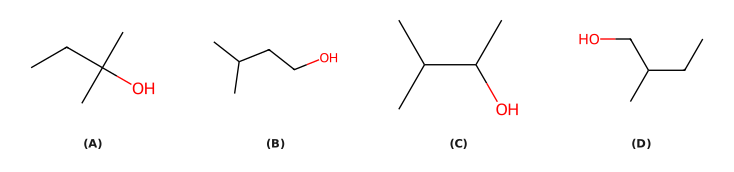
›Reveal solutionSolution
KMnO4 hydroxylates the lone tertiary C–H of 2-methylbutane to give 2-methylbutan-2-ol, and this tertiary alcohol is converted to the chloride by conc. HCl alone (no ZnCl2). Option (A).
The concept first — two selectivity rules
Rule 1: KMnO4 oxidises the tertiary C–H of a branched alkane.
Alkanes are famously inert, but a tertiary C–H is the weakest (3∘<2∘<1∘ bond-dissociation energy) because the radical/cation left behind is best stabilised by the three alkyl groups. So a mild oxidant such as KMnO4 (or KMnO4/OH−) selectively inserts an −OH at the tertiary carbon, converting the alkane into a tertiary alcohol and leaving the primary/secondary C–H bonds untouched.
Draw 2-methylbutane and find its tertiary carbon:
CH3−∣CCH3H−CH2−CH3
The C-2 carbon carries three carbon neighbours and only one H — that is the tertiary C–H. Oxidise it:
(CH3)2CH−CH2CH3 KMnO4 (CH3)2C(OH)−CH2CH3
X=2-methylbutan-2-ol, a 3∘ alcohol (C5H12O)
Rule 2: the Lucas test — how each class of alcohol meets HCl.
Conversion R−OH→R−Cl by HCl goes through protonation of the −OH (making H2O, a good leaving group) and then loss of water to a carbocation (SN1). The ease therefore tracks carbocation stability:
Alcohol Reagent needed Speed Tertiary conc. HCl alone, room temperature immediate turbidity Secondary conc. HCl + anhydrous ZnCl2 (Lucas reagent) turbidity in ∼5 min Primary conc. HCl + ZnCl2, and heat no turbidity at RT The Lewis acid ZnCl2 is a crutch: it coordinates the OH and helps a reluctant (2°/1°) alcohol ionise. A tertiary alcohol forms its cation so readily that it needs no crutch at all. …
- TG EAPCET 2025Set ap-2025-04-29-AN1 markMCQQ.Permanganate titrations cannot be performed satisfactorily in presence of HCl. The reason is (A) Both HCl and KMnO4 act as oxidising agents (B) KMnO4 is a weaker oxidising agent in presence of HCl (C) KMnO4 oxidises HCl into Cl2 (D) KMnO4 acts as a reducing agent in the presence of HCl
›Reveal solutionSolution
Permanganate (KMnO4) is a strong oxidising agent. In the presence of hydrochloric acid (HCl), it oxidises the chloride ions (Cl−) to chlorine gas (Cl2), leading to inaccurate titration results. The correct option is (C).
Permanganate titrations are a type of redox titration where potassium permanganate (KMnO4) acts as a powerful oxidising agent. For a titration to be accurate, the titrant (KMnO4 in this case) must react only with the analyte (the substance being measured) and not with any other component of the solution. The problem asks why HCl interferes with these titrations. The core reason is that HCl itself can be oxidised by KMnO4, leading to a side reaction that consumes the titrant unnecessarily.
Here's a step-by-step explanation:
- KMnO4 as a strong oxidising agent: Potassium permanganate (KMnO4) is widely used as an oxidising agent in volumetric analysis. In an acidic medium, the permanganate ion (MnO4−), where manganese is in the +7 oxidation state, is reduced to the manganese(II) ion (Mn2+). This change in oxidation state involves the gain of five electrons:
MnO4−(aq)+8H+(aq)+5e−→Mn2+(aq)+4H2O(l)
This reaction is the basis of its oxidising power. The acidic medium is crucial for this reduction to occur efficiently.2. The role of acid in permanganate titrations:
An acidic medium is typically required for permanganate titrations to ensure the complete reduction of MnO4− to Mn2+. However, the choice of acid is critical. Strong acids like sulfuric acid (H2SO4) are usually preferred because the sulfate ions (SO42−) are very stable and are not easily oxidised by MnO4−.
- Interference by hydrochloric acid (HCl): Hydrochloric acid (HCl) provides the necessary H+ ions for the permanganate reduction. However, it also introduces chloride ions (Cl−) into the solution. Chloride ions are susceptible to oxidation by strong oxidising agents like MnO4−. The chloride ions (oxidation state -1) can be oxidised to elemental chlorine (Cl2), where chlorine has an oxidation state of 0.
2Cl−(aq)→Cl2(g)+2e−
- The side reaction: When KMnO4 is added to a solution containing HCl, it will not only react with the intended analyte but also with the chloride ions from HCl. This constitutes a side reaction:
2MnO4−(aq)+10Cl−(aq)+16H+(aq)→2Mn2+(aq)+5Cl2(g)+8H2O(l)
This reaction shows that permanganate oxidises chloride ions to chlorine gas. … - TG EAPCET 2025Set ap-2025-04-29-FN1 markMCQQ.What are X and Y in the following reaction sequence? CX4HX10KMnOX4CX4HX10O20% H3PO4358KXKMnOX4H+Y (A) \chemfig{C(-[2]H)(-[6]H)(-[4]CH_3)} ; \ce{O + HCOOH} (B) \chemfig{C(-[2]H)(-[6]H)(-[4]CH_3)} ; \ce{O + CO_2 + H_2O} (C) \chemfig{C(-[2]CH_2OH)(-[6]CH_2OH)} ; \chemfig{C(-[2]OH)(-[6]OH)} (D) \chemfig{C(-[2]CH_2CH_3)(-[6]CH_2CH_3)} ; \ce{CH_3COOH}
›Reveal solutionSolution
Butane is oxidised to tert-butanol, which dehydrates to 2-methylpropene (X); hot acidic KMnOX4 cleaves the terminal =CHX2 to give acetone together with COX2 and HX2O (Y) — option (B).
Step 1 — CX4HX10KMnOX4CX4HX10O:
Butane is oxidised to the alcohol CX4HX10O, i.e. 2-methylpropan-2-ol (tert-butyl alcohol), (CHX3)X3C−OH.
Step 2 — dehydration (20% HX3POX4, 358 K) gives X:
Acid-catalysed dehydration removes water to form the alkene 2-methylpropene (isobutylene):
(CHX3)X3C−OHHX3POX4358K(CHX3)X2C=CHX2 (X)+HX2O
Step 3 — oxidative cleavage (KMnOX4/H+) gives Y: …
- TG EAPCET 2024Set ap-2024-05-07-AN1 markMCQQ.Identify the oxidizing reactions of KMnO4 in acidic medium I) Liberation of iodine from KI II) Conversion of Fe2+ to Fe3+ III) Oxidation of nitrite to nitrate IV) Oxidation of iodide to iodate The correct option is (A) II, III, IV only (B) I, II, IV only (C) I, III, IV only (D) I, II, III only
›Reveal solutionSolution
In acidic medium, KMnO₄ acts as a strong oxidizing agent, reducing MnO₄⁻ to Mn²⁺. It oxidizes I⁻ to I₂ (not IO₃⁻), Fe²⁺ to Fe³⁺, and NO₂⁻ to NO₃⁻. Thus, reactions I, II, and III are correct, but IV is not. The correct option is (D).
Concept & Intuition
Potassium permanganate (KMnO₄) in acidic medium is one of the most powerful common oxidants. Its half-reaction is:
MnO4−+8H++5e−→Mn2++4H2O(E∘=+1.51 V)
This high reduction potential means it can oxidize many species, but the extent of oxidation depends on the reducing agent and conditions. For iodide (I⁻), the product can be I₂ or IO₃⁻ depending on pH and concentration — but in acidic medium, the typical product is I₂, not IO₃⁻. Let’s check each reaction.
Step-by-step reasoning
- Reaction I: Liberation of iodine from KI KI provides I⁻ ions. In acidic medium, KMnO₄ oxidizes I⁻ to I₂:
2MnO4−+10I−+16H+→2Mn2++5I2+8H2O
This is a classic redox reaction — the purple color fades and brown iodine appears. So I is correct.
- Reaction II: Conversion of Fe²⁺ to Fe³⁺ Fe²⁺ is easily oxidized to Fe³⁺ by KMnO₄ in acid:
MnO4−+5Fe2++8H+→Mn2++5Fe3++4H2O
This is a standard titration reaction. So II is correct.
- Reaction III: Oxidation of nitrite to nitrate Nitrite (NO₂⁻) is oxidized to nitrate (NO₃⁻) by KMnO₄ in acid:
2MnO4−+5NO2−+6H+→2Mn2++5NO3−+3H2O
The nitrogen goes from +3 to +5 oxidation state. So III is correct.
- Reaction IV: Oxidation of iodide to iodate …
🎓Unlock everything free for 14 days
- ✓Full step-by-step solutions
- ✓Concept-first explanations
- ✓Methods, shortcuts & mistakes
- ✓PYQ mapping + timed mock tests
Full access for 14 days. No credit card required.