Q.Consider the expansion of 1 mol of an ideal gas (from 2 L to 10 L at 25 °C) conducted reversibly.
🔒You're viewing a preview — the full solution, concept, methods & PYQ mapping are locked.
🔒 Start your 14-day free trial to unlock the full solution →Concept understanding — Irreversible Expansion Work
Irreversible Expansion Work – From Intuition to Precision
Imagine you have a gas trapped inside a cylinder with a piston. If you suddenly pull the piston outward, the gas expands rapidly into the newly available space. That's an irreversible expansion — the gas doesn't pass through a series of equilibrium states; it rushes, swirls, and settles only at the end.
Now, think about the work done by the gas during this process. Work, in physics, is force times displacement. For a piston, force is pressure times area, so work becomes PΔV. But here's the catch: during an irreversible expansion, the pressure of the gas is not uniform throughout the cylinder. There are pressure gradients, turbulence, and the gas near the piston face may be at a different pressure than the gas deeper inside.
So how do we calculate the work done?
The Key Insight
The work done by the gas is determined by the external pressure it pushes against — not its own internal pressure. Why? Because the piston moves only in response to the net force acting on it. That net force comes from the external pressure on the other side of the piston.
For any expansion (reversible or irreversible), the work done by the gas is:
W=∫PextdV
where Pext is the pressure exerted on the gas by the surroundings (the piston face).
During a reversible expansion, the gas is always in equilibrium with the surroundings, so Pgas=Pext at every instant. That's why you can replace Pext with Pgas and integrate using the gas's equation of state.
During an irreversible expansion, Pgas is not equal to Pext — and often, Pext is held constant (like when you suddenly release the piston against atmospheric pressure). In that case, the work simplifies dramatically:
W=PextΔV
The Intuitive Picture
Think of pushing a heavy box across a rough floor. The work you do depends on the force you apply (your "external" force), not on the internal stresses inside the box. Similarly, the gas does work against the external resistance it meets — the piston's opposing force.
If the external pressure is constant (say, 1 atm), the gas does work equal to Pext× (change in volume), regardless of how chaotically it expands. The gas might have been at 10 atm initially, but it only does work against the 1 atm it actually pushes.
A common mistake: using the gas's own pressure to calculate irreversible work. Unless the process is reversible, Pgas=Pext, and using Pgas gives the wrong answer.
The Precise Statement
Irreversible expansion work is the work done by a gas when it expands through a series of non-equilibrium states. It is calculated using the external pressure that opposes the expansion:
Wirr=∫V1V2PextdV
For the most common case — expansion against a constant external pressure (like the atmosphere or a fixed weight on the piston): …
The key idea is that for a reversible isothermal expansion of an ideal gas, the work done is given by W=−nRTlnV1V2.
Step 1: Identify the given data: n=1 mol, T=25∘C=298 K, V1=2 L, V2=10 L, and R=0.0821 L·atm·mol⁻¹·K⁻¹ (or 8.314 J·mol⁻¹·K⁻¹).
Step 2: Use the formula for reversible isothermal work:
W=−nRTlnV1V2
Step 3: Substitute values (using L·atm for volume compatibility):
W=−1×0.0821×298×ln(210)
W=−24.46×ln(5)≈−24.46×1.609=−39.36 L⋅atm …
For an isothermal reversible expansion of an ideal gas, the work done is given by W=−nRTln(V2/V1). Substituting n=1, T=298 K, V1=2 L, V2=10 L, and R=8.314 J/mol⋅K, we get W≈−3988 J.
Why This Approach Works
The key idea is that in a reversible expansion, the external pressure is always infinitesimally less than the internal pressure of the gas. This means the gas does maximum work against the surroundings. For an ideal gas undergoing isothermal (constant temperature) reversible expansion, the pressure-volume work is not simply PΔV because pressure changes continuously. Instead, we integrate the infinitesimal work dW=−PextdV, and since Pext=Pgas (reversible condition), we use the ideal gas law P=nRT/V.
The natural logarithm appears because integrating 1/V gives lnV. This is a classic result — every student of thermodynamics should recognize it instantly.
Wrev, isothermal=−nRTlnV1V2
Step-by-Step Solution
-
Identify the process and given data
We have 1 mole of an ideal gas expanding isothermally at 25 ∘C from 2 L to 10 L. The process is reversible.
- n=1 mol
- T=25 ∘C=298 K (always convert to Kelvin)
- V1=2 L
- V2=10 L
- R=8.314 J/mol⋅K (standard value for work in joules)
-
Write the expression for reversible isothermal work
For an ideal gas, the work done BY the gas during a reversible isothermal expansion is:
W=−∫V1V2PdV=−∫V1V2VnRTdV
Since nRT is constant (isothermal), it comes out of the integral:
W=−nRT∫V1V2VdV=−nRT[lnV]V1V2=−nRTlnV1V2
The negative sign indicates work is done by the system (gas) on the surroundings. In many exam contexts, you may be asked for the magnitude, but always include the sign for correctness.
- Substitute the values
W=−(1 mol)(8.314 J/mol⋅K)(298 K)ln(2 L10 L)
Simplify the ratio: 10/2=5, so ln5≈1.6094.
- Calculate step by step First compute nRT:
nRT=1×8.314×298=2477.572 J
Then multiply by ln5: …
- TG EAPCET 2025Set ap-2025-04-29-FN1 markMCQQ.Isotherms (p,V1 lines) of one mole of an ideal gas were obtained at T1(K) and T2(K). The slopes of these two lines are in the ratio 1:2. If T1=1000K, then T2 (in K) is (A) 1000 (B) 2000 (C) 200 (D) 4000
›Reveal solutionSolution
For an ideal gas, a plot of pressure (p) against the inverse of volume (1/V) at constant temperature (an isotherm) is a straight line passing through the origin, with a slope directly proportional to the temperature. Given the slopes are in a 1:2 ratio, the temperatures will also be in a 1:2 ratio, leading to T2=2000K.
The problem asks us to find the temperature T2 given T1 and the ratio of slopes of isotherms plotted as p versus 1/V. To solve this, we need to understand how the ideal gas law relates to such a graph.
The ideal gas law describes the relationship between pressure (P), volume (V), temperature (T), and the number of moles (n) of an ideal gas:
PV=nRT
where R is the ideal gas constant.
An isotherm is a curve representing the states of a gas at a constant temperature. When we plot p against 1/V, we are essentially looking for a relationship of the form y=mx+c, where y=p and x=1/V.
Let's rearrange the ideal gas law to match this form:
P=VnRT
P=(nRT)(V1)
Comparing this to the equation of a straight line, y=mx+c:
- y corresponds to P (pressure)
- x corresponds to V1 (inverse of volume)
- The intercept c is 0, meaning the line passes through the origin.
- The slope m corresponds to nRT.
Since n (number of moles) and R (ideal gas constant) are constant for a given amount of gas, the slope of the p versus 1/V isotherm is directly proportional to the absolute temperature T.
Now, let's apply this understanding to the given problem.
-
Express the slope in terms of temperature:
For an ideal gas, the equation relating pressure p and inverse volume 1/V at a constant temperature T is derived from the ideal gas law:
p=(nRT)V1
This is in the form y=mx, where y=p and x=1/V.
The slope of this line is m=nRT.
-
Write the slopes for T1 and T2:
Let m1 be the slope of the isotherm at temperature T1, and m2 be the slope of the isotherm at temperature T2.
m1=nRT1
m2=nRT2 …
- TG EAPCET 2024Set ap-2024-05-08-FN1 markMCQQ.At T(K), the following graph is obtained for an ideal gas [FIGURE: a P (y-axis) versus V (x-axis) plot showing a smooth decreasing hyperbolic isotherm] Which of the following graph correctly represents the work done on the gas (shaded part)? (A) [FIGURE] P–V isotherm with the entire area under the curve shaded, extending right from the P-axis down to the V-axis (B) [FIGURE] P–V isotherm with the area under the curve shaded only between two finite volumes (a strip bounded on the left and right by vertical lines) (C) [FIGURE] P–V isotherm with the region ABOVE the curve shaded (a rectangular block sitting on top of the curve) (D) [FIGURE] P–V isotherm with the area under the curve shaded starting from a very small volume and running far to the right along the V-axis
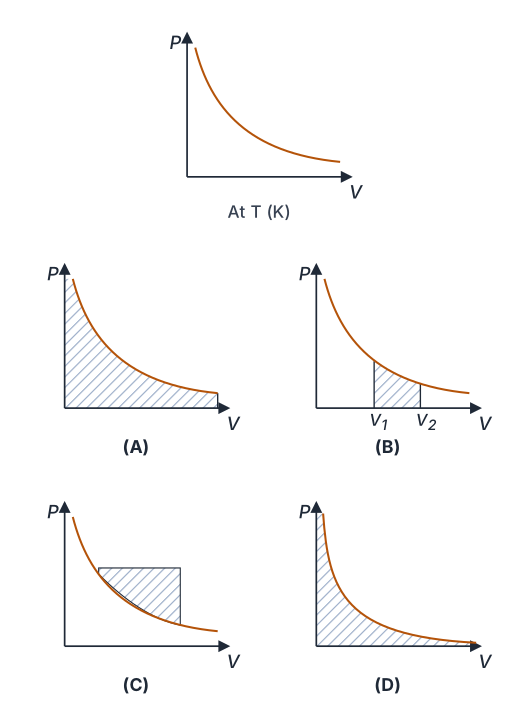
›Reveal solutionSolution
Work done on a gas is w=−∫V1V2PdV — the area under the P–V curve between the two volume limits. Only the graph shading the strip between V1 and V2 can represent it: option (B).
The concept first: why work is an area on a P–V plot
When a gas in a cylinder is compressed against an external pressure Pext, pushing the piston in by a tiny amount changes the volume by dV and the work done on the gas is
dw=−PextdV
The minus sign is the sign convention: compression means dV<0, so dw>0 — work is done on the gas, its energy rises.
For a reversible change the external pressure is only infinitesimally different from the gas pressure, so Pext≃P (the pressure plotted on the graph), and summing all the little slices:
w=−∫V1V2PdV
A definite integral of P with respect to V is, geometrically, the area lying between the curve P(V) and the V-axis, cut off by the vertical lines V=V1 and V=V2. That is the whole reason a P–V diagram is so useful: work is an area on it.
For the isothermal ideal gas drawn in the stem, P=nRT/V, and the integral evaluates to the familiar
w=−nRTlnV1V2=2.303nRTlogV2V1
Step-by-step: test each shaded region
- What must the region look like? Four boundaries: the isotherm on top, the V-axis below, and two vertical lines at the initial volume V1 and the final volume V2. No process runs from V=0, and no process has an undefined end point. …
- TG EAPCET 2024Set eng-2024-05-11-FN1 markMCQQ.At 300 K, 3.0 moles of an ideal gas at 3.0 atm pressure is compressed isothermally to one half of its volume by an external pressure of 6.0 atm. The work done (in kJ) is (Given, R = 0.082 L atm K−1mol−1) (1 L atm = 101.3 J) (A) 7.476 (B) 11.214 (C) 3.738 (D) 14.952
›Reveal solutionSolution
For an irreversible compression against a constant external pressure, w=−PextΔV=73.8 L atm =7.476 kJ.
Initial volume of the gas:
V1=PnRT=3.03.0×0.082×300=24.6 L.
Compressed to half its volume:
V2=2V1=12.3 L,ΔV=V2−V1=−12.3 L.
Work done on the gas against the constant external pressure Pext=6.0 atm: …
- TG EAPCET 2023Set eng-2023-05-14-AN1 markMCQQ.At T(K) 2 mole of an ideal gas is allowed to expand reversibly and isothermally from a pressure of 10 atmospheres to 1 atmosphere. The work done (in kJ) is (R=8.3 J K−1 mol−1) (A) −3.82×10⁻¹×T (B) −4.82×10⁻¹×T (C) −2.82×10⁻²×T (D) −3.82×10⁻²×T
›Reveal solutionSolution
For an isothermal reversible expansion of an ideal gas, work done is W=−nRTln(Pi/Pf). Substituting n=2, R=8.3, Pi=10, Pf=1 gives W=−2×8.3×T×ln(10)≈−38.2T J, which is −3.82×10⁻²×T kJ. The correct option is (D).
The key concept is the formula for reversible isothermal work on an ideal gas. When a gas expands reversibly at constant temperature, the pressure changes continuously, so we must integrate PdV. Using the ideal gas law PV=nRT, we replace P with nRT/V, leading to W=−nRTln(Vf/Vi). Since pressure and volume are inversely related at constant temperature (PiVi=PfVf), we can also write W=−nRTln(Pi/Pf). This form is convenient here because we are given pressures directly.
Now, step by step:
- Identify the formula. For a reversible isothermal expansion of an ideal gas:
W=−nRTln(ViVf)=−nRTln(PfPi).
The negative sign indicates work is done by the system (expansion).
-
Plug in the values.
- n=2 mol
- R=8.3 J K−1 mol−1
- T is the temperature in Kelvin (kept as a variable)
- Pi=10 atm, Pf=1 atm, so PfPi=10.
Thus:
W=−2×8.3×T×ln(10).
- Compute ln(10). ln(10)≈2.302585. Multiply:
2×8.3=16.6,16.6×2.302585≈38.2229.
So W≈−38.22×T joules.
- Convert to kilojoules. …
- TG EAPCET 2022Set eng-2022-07-20-FN1 markMCQQ.In the reaction H2O(l)→H2O(s) at 0∘C and 1 atm, the internal energy change is −41 kJ/mol. What will be the value of molar enthalpy change? (A) −41 kJ/mol (B) 41 kJ/mol (C) 30 kJ/mol (D) −30 kJ/mol
›Reveal solutionSolution
For the freezing of water, the change in volume is very small, making the PΔV work term negligible compared to the internal energy change. Therefore, the molar enthalpy change is approximately equal to the molar internal energy change. The molar enthalpy change is −41 kJ/mol.
Concept and Intuition
The relationship between enthalpy change (ΔH) and internal energy change (ΔU) for a process is given by the first law of thermodynamics applied to constant pressure conditions. Enthalpy is defined as H=U+PV. Therefore, for a process occurring at constant pressure P, the change in enthalpy is:
ΔH=ΔU+PΔV
Here, ΔU is the change in internal energy, P is the constant pressure, and ΔV is the change in volume of the system. The term PΔV represents the pressure-volume work done by or on the system.
- For reactions involving gases: The volume changes (ΔV) can be substantial, and thus the PΔV term is often significant and cannot be ignored. For ideal gases, PΔV=ΔngRT, where Δng is the change in the number of moles of gas.
- For reactions involving only liquids and solids (condensed phases): The volume changes are typically very small. Consequently, the PΔV term is usually negligible compared to ΔU. In such cases, it is a common and often accurate approximation to state that ΔH≈ΔU.
In this problem, we are dealing with the phase transition of water from liquid to solid (freezing). While water is unique in that its volume increases upon freezing (ice is less dense than liquid water), this volume change is still very small compared to the volume changes observed in gas-phase reactions. We need to calculate the PΔV term to see if it's significant.
Step-by-Step Solution
-
Identify the given information and the reaction:
The reaction is the freezing of water:
H2O(l)→H2O(s)
The conditions are 0∘C and 1 atm.
The internal energy change is ΔU=−41 kJ/mol.
We need to find the molar enthalpy change, ΔH.
-
Recall the fundamental relationship:
As discussed, the relationship between ΔH and ΔU at constant pressure is:
ΔH=ΔU+PΔV
-
Determine the change in molar volume (ΔV):
To calculate PΔV, we need the molar volumes of liquid water and ice at 0∘C and 1 atm. We use standard density values:
- Molar mass of water (M) = 18.015 g/mol
- Density of liquid water (ρl) at 0∘C = 0.9998 g/cm3
- Density of ice (ρs) at 0∘C = 0.9167 g/cm3
Calculate the molar volume of liquid water (Vl):
Vl=ρlM=0.9998 g/cm318.015 g/mol=18.0186 cm3/mol
Calculate the molar volume of ice (Vs):
Vs=ρsM=0.9167 g/cm318.015 g/mol=19.651 cm3/mol
Now, calculate the change in molar volume (ΔV):
ΔV=Vs−Vl=19.651 cm3/mol−18.0186 cm3/mol=1.6324 cm3/mol …
- TG EAPCET 2022Set eng-2022-07-18-FN1 markMCQQ.If 92 g Na reacts with water in open vessel at 300 K. What is the value of work done? [Assume ideal nature of the gaseous product] (A) 0.0 (B) −4988.4 J (C) −2494.2 J (D) −9976.8 J
›Reveal solutionSolution
92 g Na =4 mol releases 2 mol H2; against the atmosphere w=−ΔngRT=−2×8.314×300=−4988.4 J.
Step 1 — reaction and moles of gas.
2Na+2H2O⟶2NaOH+H2↑
nNa=2392=4 mol⇒nH2=24=2 mol.
Step 2 — work of expansion. In an open vessel the gas expands against constant atmospheric pressure, so
w=−PΔV=−ΔngRT, …
🎓Unlock everything free for 14 days
- ✓Full step-by-step solutions
- ✓Concept-first explanations
- ✓Methods, shortcuts & mistakes
- ✓PYQ mapping + timed mock tests
Full access for 14 days. No credit card required.