Q.The enthalpies of all elements in their standard states are:
Concept understanding — Standard Enthalpy of Formation
Standard Enthalpy of Formation: From Intuition to Definition
Imagine you're building a house. You don't start from a finished house — you start from raw materials: bricks, cement, wood, steel. The cost of assembling those raw materials into the final house is a useful number. In chemistry, we do the same thing with compounds.
Every chemical compound is made from elements in their natural, most stable forms. The standard enthalpy of formation (ΔfH∘) is the energy change when you build one mole of a compound from its elements, with everything in their standard states.
The Intuition First
Think of it as the "birth certificate" energy of a compound. It tells you:
- How much energy is released or absorbed when the compound is formed from scratch.
- Whether the compound is more stable (lower energy) or less stable (higher energy) than the elements it came from.
If ΔfH∘ is negative, the compound is more stable than its elements — energy was released during formation. If positive, the compound is less stable — energy had to be absorbed to force the elements together.
The Precise Definition
ΔfH∘=enthalpy change when 1 mole of a compound is formed from its constituent elements in their standard states, under standard conditions (1 bar pressure, specified temperature, usually 298 K)
Key points to lock in:
- Exactly 1 mole of the compound is formed — not 2, not 0.5.
- Elements in their standard states — this means the most stable physical form of the element at 1 bar and the given temperature. For example:
- Carbon: graphite (not diamond)
- Oxygen: O2(g) (not O3)
- Hydrogen: H2(g)
- Bromine: Br2(l) (liquid at room temperature)
- Standard conditions: 1 bar pressure (not 1 atm — slight difference, but in most exams they treat them as equivalent unless specified). Temperature is usually 298 K (25°C), but can be any specified temperature.
The Critical Rule: Elements Have Zero Formation Enthalpy
The standard enthalpy of formation of any element in its standard state is zero by definition.
This is not a measurement — it's a convention. We set the zero point of the energy scale at the most stable form of each element. So:
- ΔfH∘ of O2(g) = 0
- ΔfH∘ of C(graphite) = 0
- ΔfH∘ of Br2(l) = 0
But ΔfH∘ of O3(g) is not zero — ozone is not the standard state of oxygen.
Worked Example: Water
Write the formation reaction for liquid water:
H2(g)+21O2(g)→H2O(l)
The ΔfH∘ for H2O(l) is −285.8 kJ/mol.
What does this tell you? When 1 mole of water is formed from hydrogen gas and oxygen gas (both in their standard states), 285.8 kJ of heat is released. The water molecule is more stable than the separate elements.
Common Mistake to Avoid
Do NOT write the formation reaction with coefficients other than those that produce exactly 1 mole of product. For example, writing 2H2+O2→2H2O gives the enthalpy change for 2 moles of water — that's not the standard enthalpy of formation. You must divide by 2.
Also, the product must be in its standard state. For water, that's liquid at 298 K — not steam (H2O(g)). The formation enthalpy of steam is different (−241.8 kJ/mol).
Why This Concept Matters
Standard enthalpies of formation are the building blocks of thermochemistry. Once you have a table of ΔfH∘ values for common compounds, you can calculate the enthalpy change for any reaction using Hess's law:
ΔrH∘=∑ΔfH∘(products)−∑ΔfH∘(reactants)
This is the single most powerful tool in thermochemistry — and it all rests on the definition you just learned.
If you've searched "Standard Enthalpy of Formation class 11 chemistry notes" or "Standard Enthalpy of Formation NCERT solutions", this page covers exactly that ground — the concept is a standard part of the Class 11 Chemistry NCERT/CBSE syllabus. It also carries real weight in JEE Main, NEET and state CET Chemistry papers, where questions on standard enthalpy of formation test both conceptual understanding and calculation speed.
The key idea is the Standard Enthalpy of Formation convention: the enthalpy of the most stable form of an element in its standard state is defined as zero. This provides a consistent reference point for all thermochemical calculations.
- By definition, the standard enthalpy of formation (ΔfH∘) of an element in its standard state is zero.
- "Standard state" means the pure element at 1 bar pressure and the specified temperature (usually 298 K), in its most stable physical form (e.g., graphite for carbon, O2(g) for oxygen).
- Therefore, the enthalpy of all elements in their standard states is assigned a value of zero, not unity, not negative, and not different for each element.
The value is zero.
The standard enthalpy of formation of any element in its standard state is defined as zero. This is a convention that sets a reference point for all enthalpy calculations. Therefore, the correct answer is (ii) zero.
The question asks about the enthalpies of elements in their standard states. This is a fundamental concept in thermochemistry, and the answer hinges on understanding what "standard state" means and how we define enthalpy changes.
The Concept: Why Zero?
Enthalpy (H) is a state function, but we can never measure its absolute value. We can only measure changes in enthalpy (ΔH). To make these changes meaningful and comparable, we need a common reference point.
The Standard Enthalpy of Formation (ΔHf∘) of a compound is defined as the enthalpy change when one mole of the compound is formed from its constituent elements in their standard states under standard conditions (1 bar pressure, usually 298 K).
For this definition to work, we must assign a value to the enthalpy of the elements themselves. By international convention, the standard enthalpy of formation of an element in its most stable allotropic form at 1 bar and the specified temperature is taken as zero.
This is a convention, not a discovery. It's like setting sea level as zero for measuring altitude. It doesn't mean the element has no internal energy; it means we've chosen it as the baseline.
Step-by-Step Reasoning
-
Identify the core principle. The question is about the "enthalpies of all elements in their standard states." This directly refers to the standard enthalpy of formation (ΔHf∘) of the elements themselves.
-
Recall the definition. The standard enthalpy of formation of a substance is the enthalpy change when 1 mole of that substance is formed from its elements in their standard states. For an element in its standard state, "forming it from itself" involves no chemical change.
-
Apply the convention. Since there is no chemical reaction involved in "forming" an element from itself, the enthalpy change is zero. By definition, we set ΔHf∘=0 for all elements in their standard states.
-
Consider the exceptions (the nuance). The phrase "most stable allotropic form" is crucial. For example:
- Carbon in the form of graphite has ΔHf∘=0.
- Carbon in the form of diamond has ΔHf∘=+1.9 kJ/mol (because it is not the most stable form at standard conditions).
- Oxygen gas (O2) has ΔHf∘=0.
- Ozone gas (O3) has ΔHf∘=+142.7 kJ/mol.
A common mistake is to think that all forms of an element have zero enthalpy. Only the most stable form at standard conditions has ΔHf∘=0. Other allotropes have non-zero values.
- Evaluate the options.
- (i) unity: Incorrect. The value is not 1.
- (ii) zero: Correct. This is the standard convention.
- (iii) < 0: Incorrect. The value is exactly zero, not negative.
- (iv) different for each element: Incorrect. While different elements have different absolute enthalpies, the convention sets them all to zero for their standard states.
Think of it like a bank account. You can't know the total money in the world, but you can track deposits and withdrawals. Setting the "balance" of elements to zero is like opening a new account with a zero balance. All transactions (reactions) are then measured relative to that starting point.
The correct option is (ii) zero.
- TG EAPCET 2025Set eng-2025-05-02-FN1 markMCQQ.At 298 K, the enthalpy change (in kJ) for the reaction given below is CH4(g) + O2(g) → C(s) + 2H2O(l) (Given): H2(g) + 21O2(g) → H2O(l); ΔHΘ = −286 kJ C(s) + O2(g) → CO2(g); ΔHΘ = −394 kJ CH4(g) + 2O2(g) → CO2(g) + 2H2O(l); ΔHΘ = −890 kJ (A) +496 (B) −496 (C) −1284 (D) +680
›Reveal solutionSolution
We use Hess's law to combine the given thermochemical equations so that they sum to the target reaction. The target enthalpy change works out to −496 kJ, so the correct option is (B).
Concept & Intuition
We are given three reactions with known enthalpy changes and asked to find ΔH for:
CH4(g)+O2(g)→C(s)+2H2O(l)
Notice that this reaction is not a standard combustion — it produces solid carbon and liquid water, not CO₂. The trick is to use Hess’s law: enthalpy change depends only on initial and final states, not the path. So we can algebraically manipulate the given equations (reverse them, multiply them by coefficients) so that when added, they yield the target equation. The sum of the corresponding ΔH values (with sign changes and scaling) gives the answer.
Step-by-step solution
- Write the target equation clearly Target:
CH4(g)+O2(g)→C(s)+2H2O(l)ΔH=?
-
List the given equations with their ΔHΘ
- H2(g)+21O2(g)→H2O(l); ΔH=−286 kJ
- C(s)+O2(g)→CO2(g); ΔH=−394 kJ
- CH4(g)+2O2(g)→CO2(g)+2H2O(l); ΔH=−890 kJ
-
Plan the combination
The target has CH4 on the left and C(s) on the right. Equation (iii) has CH4 on the left but produces CO2, not C. Equation (ii) shows how to get from C to CO2 — if we reverse it, we go from CO2 to C. That suggests:
- Use (iii) as is (to get CH4 on left).
- Reverse (ii) (to turn CO2 into C).
- Then cancel any extra species.
-
Reverse equation (ii)
Reversed: CO2(g)→C(s)+O2(g); ΔH=+394 kJ (sign flips).
-
Add the reversed (ii) to equation (iii)
(iii): CH4(g)+2O2(g)→CO2(g)+2H2O(l); ΔH=−890
- reversed (ii): CO2(g)→C(s)+O2(g); ΔH=+394 Sum: CH4(g)+2O2(g)+CO2(g)→CO2(g)+2H2O(l)+C(s)+O2(g) Cancel CO2(g) on both sides. Also cancel one O2(g) from left (2 O₂) with the one on right, leaving one O₂ on left: Result: CH4(g)+O2(g)→C(s)+2H2O(l) That’s exactly the target! Enthalpy sum: −890+394=−496 kJ.
-
Check the sign
The sum gives ΔH=−496 kJ. This is a good check: the target is not the complete combustion of methane (which gives CO₂). Here we produce solid carbon, which is less stable than CO₂, so the reaction should be less exothermic (or even endothermic) compared to full combustion. Full combustion of CH₄ gives −890 kJ. Our reaction gives only water, not CO₂, so it should be less negative than −890 kJ — and −496 kJ is. As an independent check, use formation enthalpies:
- Formation of CH₄: not given directly, but we can find it. From (iii): CH4+2O2→CO2+2H2O; ΔH=−890 Using (ii) and (i): formation of CO₂ = −394, formation of H₂O(l) = −286 each. So ΔHcomb=[ΔHf(CO2)+2ΔHf(H2O)]−[ΔHf(CH4)+2ΔHf(O2)] −890=[−394+2(−286)]−[ΔHf(CH4)+0] −890=[−394−572]−ΔHf(CH4) −890=−966−ΔHf(CH4) So ΔHf(CH4)=−966+890=−76 kJ/mol. Now target: CH4(g)+O2(g)→C(s)+2H2O(l) ΔH=[ΔHf(C)+2ΔHf(H2O)]−[ΔHf(CH4)+ΔHf(O2)] ΔHf(C)=0, ΔHf(H2O)=−286, ΔHf(CH4)=−76, ΔHf(O2)=0 So ΔH=[0+2(−286)]−[−76+0]=−572+76=−496 kJ. Yes, −496 kJ is correct.
Watch outA common mistake is to forget that reversing a reaction flips the sign of ΔH. Another is to mis-cancel oxygen molecules — always count atoms on both sides carefully.
TipWhen you have a target that produces an element in its standard state (like C(s)), look for a given reaction that consumes that element and reverse it. That’s the key move here.
✓Final answerThe correct option is (B).
ANSWER: B
- TG EAPCET 2025Set ap-2025-04-30-FN1 markMCQQ.Observe the following equation H2O2(g)→2H(g)+2[O](g); ΔaHΘ=1066 kJ mol−1. If ΔO−HΘ is 464 kJ mol−1, then ΔO−OHΘ (in kJ mol−1) value will be (A) 602 (B) 138 (C) 690 (D) 276
›Reveal solutionSolution
The key idea is that the given enthalpy change is the sum of bond dissociation enthalpies for all bonds broken in H2O2. Using the O–H bond enthalpy, we isolate the O–O bond enthalpy. The answer is 138 kJ mol⁻¹.
The concept here is bond enthalpy — the energy required to break one mole of a specific bond in the gas phase. When a molecule like hydrogen peroxide (H2O2) is completely atomised into its constituent atoms, every bond in the molecule is broken. The total enthalpy change for that atomisation is simply the sum of the bond enthalpies of all bonds present.
In H2O2(g), the structure is H–O–O–H. That means there are:
- two O–H bonds
- one O–O bond
So the atomisation enthalpy ΔaHΘ must equal 2×ΔO−HHΘ+ΔO−OHΘ.
We are given ΔaHΘ=1066 kJ mol−1 and ΔO−HHΘ=464 kJ mol−1. The only unknown is the O–O bond enthalpy.
Let’s work it through.
- Write the bond-breaking equation for atomisation:
H2O2(g)→2H(g)+2O(g)
The enthalpy change for this is the sum of all bond enthalpies broken.
- Express that sum:
ΔaHΘ=2×ΔO−HHΘ+ΔO−OHΘ
- Substitute the known values:
1066=2×464+ΔO−OHΘ
1066=928+ΔO−OHΘ
- Solve for the O–O bond enthalpy:
ΔO−OHΘ=1066−928=138 kJ mol−1
Watch outA common mistake is to forget that there are two O–H bonds in H2O2, not one. If you only subtract 464 from 1066, you get 602, which is option (A) — a tempting but wrong answer.
TipAlways draw the Lewis structure or the connectivity of the molecule before summing bond enthalpies. For H2O2, the O–O bond is the central single bond, and each oxygen also bonds to one hydrogen. That gives exactly three bonds to break.
✓Final answerThe value of ΔO−OHΘ is 138 kJ mol−1, which corresponds to option (B).
- TG EAPCET 2024Set ap-2024-05-08-FN1 markMCQQ.The metal having highest melting point among lanthanides is (A) Ce (B) Sm (C) Yb (D) Dy
›Reveal solutionSolution
Dy has the highest melting point of the four; Yb and Ce are low because of weaker metallic bonding.
In the lanthanide series the melting point depends on the number of electrons an atom contributes to the metallic (delocalised) bonding. Metals that release more bonding electrons pack more strongly and melt higher; Eu and Yb behave as divalent metals (stable half- and fully-filled 4f giving only 2 bonding electrons) and show anomalously low melting points.
Approximate melting points of the given metals:
- Ce ~ 795 C
- Sm ~ 1074 C
- Yb ~ 824 C (divalent, low)
- Dy ~ 1412 C
Dysprosium clearly has the highest melting point of the set.
✓Final answerThe correct option is (D).
ANSWER: D
- TG EAPCET 2024Set ap-2024-05-07-AN1 markMCQQ.Match the following
[!FORMULA] ABCDNaLiHFIIIIIIIV1529964186
(A) A – IV; B – I; C – II; D – III (B) A – IV; B – III; C – I; D – II (C) A – III; B – II; C – I; D – IV (D) A – IV; B – II; C – I; D – III›Reveal solutionSolution
Atomic radius generally increases down a group and decreases across a period. Ordering the given elements by this trend and matching them to the provided radii gives the correct correspondence. The final matching is Na-186 pm, Li-152 pm, H-64 pm, F-99 pm.
The atomic radius of an element is a measure of the size of its atoms, typically defined as half the distance between the nuclei of two identical atoms bonded together. Understanding how atomic radius changes across the periodic table is crucial for solving this problem.
Concept: Periodic Trends in Atomic Radius
-
Down a Group (Vertical Column): As we move down a group, the atomic radius generally increases. This is because each successive element adds a new electron shell, which is further away from the nucleus. Even though the nuclear charge increases, the shielding effect of the inner electrons effectively reduces the attraction between the nucleus and the outermost electrons, causing the atomic size to expand.
-
Across a Period (Horizontal Row): As we move from left to right across a period, the atomic radius generally decreases. This is because electrons are added to the same principal energy shell, but the nuclear charge (number of protons) increases. The increased nuclear charge pulls the electrons closer to the nucleus, leading to a stronger attraction and a smaller atomic size. The shielding effect from electrons in the same shell is not very effective.
Let's apply these concepts to the given elements: Na, Li, H, and F.
-
Identify the positions of the elements in the periodic table:
- H (Hydrogen): Group 1, Period 1. It is the smallest element.
- Li (Lithium): Group 1, Period 2.
- Na (Sodium): Group 1, Period 3.
- F (Fluorine): Group 17, Period 2.
-
Compare elements within the same group (Li and Na):
Both Li and Na are in Group 1. Na is below Li.
Following the trend that atomic radius increases down a group, we can conclude:
Atomic radius of Na>Atomic radius of Li
-
Compare elements within the same period (Li and F):
Both Li and F are in Period 2. Li is on the far left (Group 1), and F is on the far right (Group 17).
Following the trend that atomic radius decreases across a period, we can conclude:
Atomic radius of Li>Atomic radius of F
-
Consider Hydrogen:
Hydrogen is the smallest element. Its atomic radius is significantly smaller than that of Li and F.
-
Order the elements by their atomic radii:
Combining the above comparisons, we get the following order from largest to smallest atomic radius:
Na>Li>F>H
-
Match the ordered elements with the given atomic radii:
The given radii are 152 pm, 99 pm, 64 pm, and 186 pm.
- The largest radius (186 pm) must correspond to Na.
- The second largest radius (152 pm) must correspond to Li.
- The third largest radius (99 pm) must correspond to F.
- The smallest radius (64 pm) must correspond to H.
Therefore, the matching is:
- A: Na → IV (186 pm)
- B: Li → I (152 pm)
- C: H → III (64 pm)
- D: F → II (99 pm)
This corresponds to option (A).
✓Final answerThe correct matching is A – IV; B – I; C – III; D – II, which corresponds to option (A).
-
- TG EAPCET 2024Set ap-2024-05-07-AN1 markMCQQ.The electronic configuration of four elements are given below
[!FORMULA] [He]2s22p5I[Ne]3s23p5II[He]2s22p4III[Ne]3s23p4IV
The correct order of magnitude (without sign) of their electron gain enthalpies is (A) II > III > IV > I (B) II > I > III > IV (C) II > I > IV > III (D) I > II > IV > III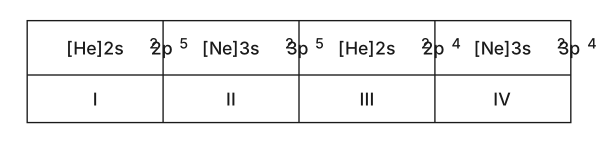
›Reveal solutionSolution
The four elements are F, Cl, O and S. Halogens beat chalcogens, and the small second-period atoms (F, O) are anomalously less exothermic than Cl and S, so the order of magnitude is Cl>F>S>O = II > I > IV > III, which is option (C).
The concept first
Electron gain enthalpy ΔegH is the enthalpy change when a gaseous atom accepts an electron:
X(g)+e−→X−(g)
It is usually negative (energy released), and the question asks for the magnitude, i.e. how strongly the atom wants that electron.
Two forces are in tension:
- Nuclear pull. A high effective nuclear charge and a small size hold the incoming electron tightly → more energy released.
- Electron–electron repulsion. The incoming electron must join an already-occupied shell. If that shell is small and compact, the crowding costs energy → less energy released.
For most of the periodic table the first effect wins, and you get the familiar rule "ΔegH becomes more negative across a period, less negative down a group." But at the top of groups 16 and 17 the second effect takes over. Fluorine's and oxygen's valence shells are n=2, unusually compact, so the new electron feels fierce repulsion from the electrons already there. The result is the famous anomaly:
∣ΔegH∣:Cl>F,S>O
Chlorine, not fluorine, has the most negative electron gain enthalpy of any element.
Step-by-step
- Identify the four elements from their configurations.
- I: [He]2s22p5 → 9 electrons → Fluorine (F), group 17, period 2.
- II: [Ne]3s23p5 → 17 electrons → Chlorine (Cl), group 17, period 3.
- III: [He]2s22p4 → 8 electrons → Oxygen (O), group 16, period 2.
- IV: [Ne]3s23p4 → 16 electrons → Sulphur (S), group 16, period 3.
- Group 17 before group 16. A halogen (ns2np5) is one electron short of a noble-gas octet, so gaining an electron is enormously favourable. A chalcogen (ns2np4) is two short, so it gains far less. Therefore
{F,Cl}>{O,S}.
- Within group 17: Cl beats F. Fluorine is tiny (2p shell), so the seven electrons already there repel the incoming eighth strongly. Chlorine's 3p shell is roomier, and the added electron is accommodated far more comfortably.
∣ΔegH∣:Cl(−349)>F(−328) kJmol−1
So II>I.
- Within group 16: S beats O. Exactly the same argument, and the gap is much wider because oxygen is even more cramped relative to sulphur.
∣ΔegH∣:S(−200)>O(−141) kJmol−1
So IV>III.
- Combine.
Cl(349)>F(328)>S(200)>O(141)
⇒II>I>IV>III
- Why the tempting options fail. Option (B) puts II > I > III > IV, i.e. O > S — that forgets the oxygen anomaly. Option (D) starts with F, forgetting the chlorine anomaly. Option (A) mixes the groups entirely.
✓Final answerThe correct order of magnitude of electron gain enthalpy is Cl>F>S>O, i.e. II > I > IV > III — option (C).
ANSWER: C
- TG EAPCET 2023Set eng-2023-05-12-AN1 markMCQQ.The enthalpies of formation of gaseous N2O and NO at 298 K are 82.0 and 90.0 kJ mol−1 respectively. The enthalpy change of the reaction N2O(g) + 21 O2(g) → 2NO(g) is (A) −74 kJ (B) +98 kJ (C) +89 kJ (D) −47 kJ
›Reveal solutionSolution
The enthalpy change of a reaction is found by subtracting the sum of the enthalpies of formation of the reactants from that of the products. Here, the result is +98 kJ, so the correct option is (B).
The key concept is Hess’s law and the definition of enthalpy of formation. The enthalpy of formation (ΔHf∘) of a compound is the heat change when one mole of it is formed from its elements in their standard states. For a reaction, the standard enthalpy change ΔH∘ is:
ΔH∘=∑ΔHf∘(products)−∑ΔHf∘(reactants)
We don’t need to know the formation enthalpies of elements (like O2) because they are zero by definition. So we just plug in the given numbers.
- Identify the reaction:
N2O(g)+21O2(g)→2NO(g)
-
Write the formation enthalpies given:
- ΔHf∘(N2O)=+82.0 kJ mol−1
- ΔHf∘(NO)=+90.0 kJ mol−1
- ΔHf∘(O2)=0 (element in standard state)
-
Apply the formula:
ΔH∘=[2×ΔHf∘(NO)]−[1×ΔHf∘(N2O)+21×ΔHf∘(O2)]
- Substitute the numbers:
ΔH∘=[2×90.0]−[82.0+21×0]
ΔH∘=180.0−82.0=+98.0 kJ
Watch outA common mistake is to forget the stoichiometric coefficients. Here, we have 2 moles of NO, so we must multiply its formation enthalpy by 2. Also, note that the reaction is endothermic (positive ΔH), so options with negative signs are traps.
TipYou can also think of this as: breaking N2O into elements costs 82 kJ, then forming 2 NO from those elements releases 2×90=180 kJ, but since formation of NO is endothermic, it actually requires energy — so the net is 180−82=+98 kJ.
✓Final answerThe correct option is (B).
ANSWER: B
- TG EAPCET 2022Set eng-2022-07-18-AN1 markMCQQ.Among the following given substances, the one with zero ΔfH∘ is (A) Diamond (B) Graphite (C) Fullerene (D) Bituminous coal
›Reveal solutionSolution
The standard enthalpy of formation (ΔfH∘) is zero for the most stable elemental form at 1 bar and 298 K. For carbon, that is graphite, so option (B) is correct.
The concept here is the definition of standard enthalpy of formation. ΔfH∘ is the enthalpy change when one mole of a compound is formed from its elements in their standard states. The key phrase is "standard states" — for any element, the standard state is its most stable physical form at 1 bar pressure and 298 K. By convention, the ΔfH∘ of an element in its standard state is exactly zero. This is a reference point, like setting sea level as zero altitude.
So the question reduces to: which form of carbon is the most stable under standard conditions? Let's examine each option.
-
Graphite is the thermodynamically most stable allotrope of carbon at 298 K and 1 bar. Its layered structure has the lowest Gibbs free energy among all carbon allotropes. Therefore, by definition, its ΔfH∘ is zero.
-
Diamond is a metastable allotrope of carbon. It has a higher enthalpy than graphite (about 1.9 kJ/mol higher at 298 K). Since it is not the most stable form, its ΔfH∘ is positive, not zero.
-
Fullerene (like C60) is another allotrope with a higher enthalpy than graphite. Its formation from graphite is endothermic, so ΔfH∘ is positive.
-
Bituminous coal is not a pure element — it is a complex mixture of carbon, hydrogen, oxygen, nitrogen, and sulfur compounds. It is not an elemental form of carbon at all, so the concept of ΔfH∘ being zero does not apply.
Watch outA common mistake is to think that because diamond and graphite are both "pure carbon," they both have ΔfH∘=0. Only the most stable allotrope qualifies. Diamond is less stable, so its formation from graphite is endothermic — meaning its ΔfH∘ is positive.
TipFor any element with multiple allotropes (like carbon, oxygen, phosphorus, sulfur), always check which one is the standard state. For carbon, it's graphite; for oxygen, it's O2 gas; for phosphorus, it's white phosphorus; for sulfur, it's rhombic sulfur.
✓Final answerThe substance with zero ΔfH∘ is graphite, option (B).
-
- TG EAPCET 2022Set eng-2022-07-19-FN1 markMCQQ.Given H2(g)+21O2(g)→H2O(l);ΔH=−285kJ N2O5(g)+H2O(l)→2HNO3(l);ΔH=−76.6kJ N2(g)+3O2(g)+H2(g)→2HNO3(l);ΔH=−348.2kJ Calculate the ΔH of 2N2(g)+5O2(g)→2N2O5(g). (A) 572 kJ (B) 419 kJ (C) 14.5 kJ (D) 26.8 kJ
›Reveal solutionSolution
Use Hess’s law to combine the given thermochemical equations so that they sum to the target reaction. The enthalpy change is 26.8 kJ, option (D).
The core idea is that enthalpy is a state function — it doesn’t matter how you get from reactants to products, only where you start and end. So if we can add, subtract, or reverse the given reactions to exactly match the target equation, we can simply add and subtract their ΔH values in the same way. This is Hess’s law, and it’s the only reliable tool for this kind of problem.
Let’s label the three given reactions for clarity:
- H2(g)+21O2(g)→H2O(l); ΔH1=−285 kJ
- N2O5(g)+H2O(l)→2HNO3(l); ΔH2=−76.6 kJ
- N2(g)+3O2(g)+H2(g)→2HNO3(l); ΔH3=−348.2 kJ
We want: 2N2(g)+5O2(g)→2N2O5(g); ΔH=?
-
Start with the target’s reactants. We need 2N2 on the left. Reaction 3 has one N2, so multiply it by 2:
2N2(g)+6O2(g)+2H2(g)→4HNO3(l); ΔH=2×(−348.2)=−696.4 kJ
But we have too much O2 and unwanted H2 and HNO3 — we’ll cancel them later.
-
We need 2N2O5 on the right. Reaction 2 has one N2O5 on the left, so reverse it and multiply by 2:
4HNO3(l)→2N2O5(g)+2H2O(l); ΔH=−2×(−76.6)=+153.2 kJ
(Reversing flips the sign; multiplying by 2 doubles the magnitude.)
-
Now cancel the H2O that appears. Reaction 1 produces one H2O from H2 and 21O2. We have 2H2O on the right from step 2, so we need to consume them. Reverse reaction 1 and multiply by 2:
2H2O(l)→2H2(g)+O2(g); ΔH=−2×(−285)=+570 kJ
-
Add all three modified reactions and their ΔH values.
From step 1: 2N2+6O2+2H2→4HNO3; ΔH=−696.4
From step 2: 4HNO3→2N2O5+2H2O; ΔH=+153.2
From step 3: 2H2O→2H2+O2; ΔH=+570
Sum the left sides: 2N2+6O2+2H2+4HNO3+2H2O
Sum the right sides: 4HNO3+2N2O5+2H2O+2H2+O2
Cancel identical species on both sides: 4HNO3, 2H2O, and 2H2 cancel.
Left remains: 2N2+6O2
Right remains: 2N2O5+O2
Subtract the extra O2 from both sides: 2N2+5O2→2N2O5 — exactly the target.
-
Add the enthalpy changes:
ΔH=−696.4+153.2+570=26.8 kJ
Watch outA common mistake is forgetting to reverse the sign when flipping a reaction, or mis-multiplying the ΔH when scaling. Always write the modified ΔH explicitly before adding.
TipIf you prefer, you can treat this algebraically: write each reaction as an equation with its ΔH, then solve for the target by eliminating the unwanted species (like H2O, HNO3, H2) — it’s the same logic, just more systematic.
✓Final answerThe ΔH for 2N2(g)+5O2(g)→2N2O5(g) is 26.8 kJ, which corresponds to option (D).
- TG EAPCET 2022Set eng-2022-07-20-AN1 markMCQQ.The bond enthalpies of heavy hydrogen, O–O and D–O are +400, +498 and +490 kJ mol−1, respectively. The ΔrH∘ of the reaction to produce D2O is (A) −300 kJ mol−1 (B) −331 kJ mol−1 (C) 29.1 kJ mol−1 (D) 2.91 kJ mol−1
›Reveal solutionSolution
The standard enthalpy of reaction (ΔrH∘) is calculated by subtracting the total energy released during bond formation in products from the total energy required to break bonds in reactants. For the formation of D2O, this results in −331 kJ mol−1.
The enthalpy change of a reaction (ΔrH∘) can be estimated using bond enthalpies. Bond enthalpy is the energy required to break one mole of a particular type of bond in the gaseous state. Conversely, the same amount of energy is released when one mole of that bond is formed.
The core idea is that a chemical reaction involves breaking existing bonds in reactants and forming new bonds in products.
- Breaking bonds is an endothermic process: It requires energy input, so the enthalpy change associated with bond breaking is positive.
- Forming bonds is an exothermic process: It releases energy, so the enthalpy change associated with bond formation is negative.
Therefore, the net enthalpy change for a reaction can be calculated as:
ΔrH∘=∑(bond enthalpies of bonds broken in reactants)−∑(bond enthalpies of bonds formed in products)
This formula essentially sums the energy required to break all reactant bonds and subtracts the energy released when all product bonds are formed.
Let's apply this to the given problem.
- Write the balanced chemical equation for the formation of D2O: The reaction involves heavy hydrogen (D2) and oxygen (O2) forming heavy water (D2O).
D2(g)+21O2(g)→D2O(g)
We assume the product D$_2$O is in the gaseous state because bond enthalpies are defined for gaseous molecules. If the question implied liquid D$_2$O, an additional enthalpy of condensation would be needed, which is not provided.2. Identify the bonds broken in reactants:
* In D2(g), one D–D bond is broken.
* In 21O2(g), half of an O=O bond is broken.
> [!WARNING]
> The problem states "O–O" bond enthalpy as +498 kJ mol−1. This value is characteristic of an O=O (double) bond in diatomic oxygen, not a single O–O bond (which is much weaker, around 140-200 kJ mol−1). In such problems, when elemental oxygen is involved and a value like 498 kJ mol−1 is given for "O–O", it refers to the O=O bond in O2. We will proceed with this interpretation.
-
Identify the bonds formed in products:
- In D2O(g), two D–O bonds are formed. The structure of D2O is similar to H2O, with a central oxygen atom bonded to two deuterium atoms.
-
List the given bond enthalpies:
- Bond enthalpy of D–D = +400 kJ mol−1
- Bond enthalpy of O=O = +498 kJ mol−1 (as interpreted above)
- Bond enthalpy of D–O = +490 kJ mol−1
-
Calculate the total energy required to break bonds in reactants:
- Energy for D–D bond = 1×(+400 kJ mol−1)=+400 kJ mol−1
- Energy for O=O bond = 21×(+498 kJ mol−1)=+249 kJ mol−1
- Total energy to break bonds = 400+249=+649 kJ mol−1
-
Calculate the total energy released when bonds are formed in products:
- Energy for D–O bonds = 2×(+490 kJ mol−1)=+980 kJ mol−1
- Total energy released from forming bonds = +980 kJ mol−1 (Remember, this energy is released, so it contributes negatively to ΔrH∘).
-
Calculate the standard enthalpy of reaction (ΔrH∘):
Using the formula:
ΔrH∘=(Energy to break bonds)−(Energy released from forming bonds)
ΔrH∘=(+649 kJ mol−1)−(+980 kJ mol−1)
ΔrH∘=649−980
ΔrH∘=−331 kJ mol−1
✓Final answerThe ΔrH∘ of the reaction to produce D2O is −331 kJ mol−1.
- TG EAPCET 2021Set ap-2021-08-09-FN1 markMCQQ.Among the fuels given, the fuel with the highest calorific value (kJ/mole) is (A) H2(g) (B) CH4(g) (C) CNG(g) (D) LPG
›Reveal solutionSolution
Calorific value per mole depends on the energy released per mole of fuel burned. Among the given options, hydrogen has the highest energy per mole because its combustion releases about 286 kJ/mol, while methane releases about 890 kJ/mol — wait, that seems contradictory. Actually, per mole, methane releases more energy than hydrogen. But the question asks for the highest calorific value in kJ/mole, so we must compare standard enthalpies of combustion. Hydrogen: ~286 kJ/mol; Methane: ~890 kJ/mol; CNG is mostly methane; LPG is mostly propane/butane (~2220 kJ/mol for propane). So LPG has the highest per mole.
Concept & Intuition:
Calorific value is the heat released when one mole of a fuel is completely burned. Different fuels have different chemical bonds, so the energy released per mole varies. The key is to recall standard enthalpies of combustion for common fuels. Hydrogen burns to water, methane to CO₂ and water, and LPG (liquefied petroleum gas, mainly propane and butane) releases much more energy per mole because it has more carbon and hydrogen atoms to oxidize.
Step-by-step reasoning:
-
Identify the fuels and their typical composition
- (A) H₂(g): pure hydrogen.
- (B) CH₄(g): methane, the main component of natural gas.
- (C) CNG(g): compressed natural gas, primarily methane (~90%+).
- (D) LPG: liquefied petroleum gas, mainly propane (C₃H₈) and butane (C₄H₁₀).
-
Recall standard molar enthalpies of combustion (kJ/mol)
- H₂(g) + ½O₂ → H₂O(l): ΔH° = –286 kJ/mol
- CH₄(g) + 2O₂ → CO₂ + 2H₂O(l): ΔH° = –890 kJ/mol
- C₃H₈(g) + 5O₂ → 3CO₂ + 4H₂O(l): ΔH° = –2220 kJ/mol
- C₄H₁₀(g) + 6.5O₂ → 4CO₂ + 5H₂O(l): ΔH° = –2877 kJ/mol
Since CNG is essentially methane, its value is ~890 kJ/mol. LPG is a mixture, but a typical value for propane (the major component) is ~2220 kJ/mol.
-
Compare the magnitudes
- H₂: 286 kJ/mol
- CH₄ / CNG: 890 kJ/mol
- LPG: ~2220 kJ/mol (or higher for butane)
Clearly, LPG releases the most energy per mole.
-
Address a common pitfall
Watch outSome might think hydrogen has the highest calorific value per gram (because it is very light), but the question asks per mole. Per mole, larger hydrocarbon molecules release more energy because they contain more bonds to break and form.
-
Conclusion
Among the options, LPG has the highest calorific value in kJ/mole.
✓Final answerThe correct option is (D).
ANSWER: D
-
🎓Unlock everything free for 14 days
- ✓Full step-by-step solutions
- ✓Concept-first explanations
- ✓Methods, shortcuts & mistakes
- ✓PYQ mapping + timed mock tests
Full access for 14 days. No credit card required.