Chemistry · Ch 6 — Thermodynamics
The System and the Surroundings
The System and the Surroundings
The System and the Surroundings
Thermodynamics is the study of energy changes that accompany physical and chemical processes. To analyse these changes in a disciplined way, we must first define the region of the universe we are focusing on.
A system is that part of the universe which is under observation — the specific portion of matter and space where the changes of interest take place. Everything else in the universe that lies outside the system is called the surroundings. Together, the system and the surroundings constitute the universe.
This is a formal definition, but in practice the surroundings are not the entire rest of the universe. Most of the universe is far away and does not interact with the system in any measurable way. For all practical purposes, the surroundings are only that portion of the remaining universe which can actually interact with the system — typically the region of space in its immediate neighbourhood.
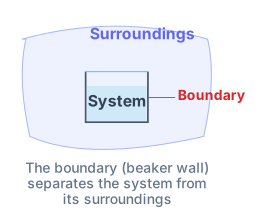
Consider a simple experiment: two substances A and B react in a beaker. The beaker containing the reaction mixture is the system. The room where the beaker sits — the air around it, the table, the walls — is the surroundings. The boundary between the system and the surroundings is the imaginary or real surface that separates them. This boundary is not just a conceptual line; it is designed to allow us to control and keep track of all movements of matter and energy into or out of the system.
The boundary can be real (like the walls of a beaker) or imaginary (like an imaginary surface drawn around a gas expanding in a cylinder). What matters is that we can use it to define exactly what is inside the system and what is outside. …
Drawn by us to help you understand the concept clearly, and verified to make sure it's accurate. For exams, practice from your textbook's own diagram.
The figure is a simple conceptual diagram, not a graph with axes. It shows a beaker containing a blue liquid, labelled SYSTEM, sitting inside a large, irregular cloud-like region labelled SURROUNDINGS. The wall of the beaker is explicitly marked as the boundary — the physical or imaginary surface that separates the system from everything else.
The core idea the figure teaches is that thermodynamics begins by defining a system (the part of the universe we choose to study) and then treating everything else that can interact with it as the surroundings. The boundary is the interface across which we track exchanges of matter and energy. In the example shown, the reaction mixture inside the beaker is the system; the room containing the beaker is the surroundings. The beaker wall acts as the boundary.
This figure grounds the most fundamental relationship in thermodynamics:
Here, the universe is the sum of the system and its surroundings — not the cosmos, but the total region of interest for a given problem. The system is the specific portion under observation (the blue liquid in the beaker). The surroundings are everything outside the system that can exchange energy or matter with it (the room, the air, the table). The boundary is the real or imaginary surface that separates them — it may be rigid or flexible, permeable or impermeable, diathermal or adiabatic, depending on the problem.
A common mistake is to think the "surroundings" means the entire universe. The textbook clarifies that only the portion of the remaining universe that can actually interact with the system matters for practical thermodynamics. The rest of the universe is irrelevant. …