Q.Find the maximum and the minimum values, if any, of the function f given by f(x)=x2, x∈R.
Concept understanding — Quadratic Extrema
Quadratic Extrema: From Intuition to Precision
Toss a ball straight up: it rises, slows, stops for an instant at the top, then falls. Plot its height against time and you get a parabola with exactly one turning point — a peak (maximum) or a valley (minimum). That single highest or lowest point is what quadratic extrema are about.
The Intuition First
A quadratic is f(x)=ax2+bx+c, with a=0; its graph is a parabola.
- If a>0, it opens upward (a U) and has a minimum at the bottom.
- If a<0, it opens downward and has a maximum at the top.
The turning point is the vertex. Every quadratic has exactly one vertex — that's the extremum.
Unlike cubic or higher-degree polynomials, a quadratic never has both a maximum and a minimum. It has one or the other.
The Precise Statement
For f(x)=ax2+bx+c with a=0:
- Vertex (extremum) at
x=−2ab
- Extremum value
f(−2ab)=c−4ab2
- Nature: a>0 → minimum; a<0 → maximum.
Vertex=(−2ab,c−4ab2)
Why That x? A Quick Derivation
Complete the square:
f(x)=a(x+2ab)2+(c−4ab2)
The squared term is always ≥0. When a>0, f(x) is smallest when the square is zero — at x=−2ab. When a<0, the largest value occurs at the same x.
The vertex's x-coordinate is also the average of the two roots (if they exist): x=2root1+root2.
Common Mistake to Avoid
Don't confuse the sign of a with the sign of the extremum value. With a>0 you always have a minimum, but that minimum could be positive, negative, or zero. The shape tells you max vs min, not the number itself.
Example
Find the extremum of f(x)=2x2−8x+5.
Here a=2>0, so it's a minimum.
x=−2⋅2−8=2.
f(2)=8−16+5=−3.
So the minimum is at (2,−3).
The Big Picture
Quadratic extrema are the simplest non-trivial optimization problem in algebra, appearing in projectile motion, profit maximization, area problems, and least-squares regression. One formula, one turning point, and the sign of a decides peak or valley.
Finding the vertex of a quadratic function via -b/2a is foundational algebra from the NCERT Class 11 units on quadratic expressions, and it reappears as a special case of the general maxima-minima methods in the NCERT Class 12 Application of Derivatives chapter. Students searching 'maximum and minimum value of quadratic function' or 'vertex formula class 11 maths examples' will recognize this completing-the-square derivation as exactly the shortcut those questions expect.
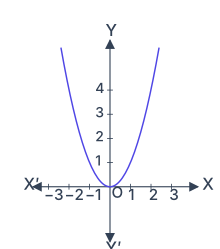
Concept: Quadratic function — vertex form.
Since f(x)=x2 is a parabola opening upwards with vertex at (0,0), the minimum occurs at the vertex.
- For any real x, x2≥0, so the smallest value is 0 at x=0.
- As x→±∞, x2→∞, so there is no maximum value — the function is unbounded above.
The minimum value is 0 and there is no maximum value.
The function f(x)=x2 on R has a minimum value of 0 at x=0, but no maximum value because it grows without bound as ∣x∣→∞.
The Mean Value Theorem (MVT) is a powerful tool for analyzing function behaviour, but here it’s not needed — the shape of x2 is simpler. The key is to think about what “maximum” and “minimum” mean for a function defined on the entire real line. A minimum is the smallest output the function ever takes; a maximum is the largest. For x2, the graph is a parabola opening upward, with its vertex at the origin. That vertex is clearly the lowest point. But does the parabola have a highest point? No — as you move farther from zero in either direction, the squares get larger without any bound.
Let’s walk through the reasoning step by step.
-
Understand the domain and range.
The domain is all real numbers R. The output x2 is always non-negative: x2≥0 for every x∈R. So the range is [0,∞).
-
Check for a minimum.
Since x2≥0, the smallest possible value is 0. Does the function actually achieve 0? Yes — at x=0, we have f(0)=02=0. So 0 is the global minimum of f on R.
-
Check for a maximum.
Is there a largest value? Suppose someone claims M is the maximum. Then for any x, we must have x2≤M. But pick x=M+1; then x2=M+2M+1>M, contradicting the claim. No matter how large M is, you can always find an x whose square exceeds it. Hence, no maximum exists.
A common mistake is to say the maximum is “infinity.” Infinity is not a real number — the function simply has no maximum value on R. If the domain were a closed interval like [−1,2], then a maximum would exist (at the endpoints), but on the whole real line, it doesn’t.
- Formal justification using limits. We can also argue: limx→±∞x2=∞, so the function is unbounded above. A maximum requires an upper bound that is actually attained; here, no such bound exists.
For any quadratic ax2+bx+c with a>0, the minimum occurs at the vertex x=−b/(2a), and there is no maximum on R. If a<0, the situation reverses: a maximum at the vertex, no minimum.
The function has a minimum value of 0 at x=0, and no maximum value.
Method: Deciding Whether a Function Has a Global Maximum/Minimum Over All of R
This method applies to "find the maximum and minimum values, if any" questions where the domain is the whole real line, not a closed interval — the "if any" is a hint that one or both extrema might not exist.
Steps
Step 1: Determine the overall behaviour of the function as x→±∞.
Does the function grow without bound in either direction, or does it stay bounded?
Step 2: If the function is bounded on one side, check whether that bound is actually attained by some x in the domain.
If it is, that value is the global extremum on that side; if it's only an approached-but-never-reached bound, there is no extremum there.
Step 3: If the function is unbounded in a direction, conclude "no maximum" (or "no minimum") on that side — never write "the maximum is ∞."
Infinity is not a value the function actually takes, so it cannot be a maximum or minimum in the mathematical sense.
Step 4: For a quadratic specifically, use the vertex to locate the one-sided extremum quickly.
For f(x)=ax2+bx+c, the vertex x=−2ab gives the minimum (if a>0) or the maximum (if a<0); the opposite extremum never exists on R, since a parabola is unbounded on the other side.
Common Mistakes
Mistake 1: Writing "the maximum value is ∞" instead of stating that no maximum exists.
Why it's wrong: ∞ is not a real number the function actually attains, so calling it "the maximum" is mathematically incorrect — the precise statement is that no maximum value exists because the function is unbounded above, which is a different claim from assigning it a symbolic value. Correct approach: explicitly write "no maximum value exists" rather than treating ∞ as an attained output.
Showing the 12 most recent of 22 on this concept.
- TG EAPCET 2026Set eng-2026-05-09-AN1 markMCQQ.If a straight line y=mx+c touches the circle x2+y2=4 and the parabola y2=4x, then 2m2= (A) 2+1 (B) 2 (C) 21 (D) 2−1
›Reveal solutionSolution
Combine the tangency conditions for the circle and parabola: 4m4+4m2−1=0 gives 2m2=2−1.
Let the line be y=mx+c.
Tangent to the parabola y2=4x (here a=1): the condition is
c=ma=m1.
Tangent to the circle x2+y2=4 (radius 2): the distance from the origin equals the radius,
1+m2∣c∣=2 ⇒ c2=4(1+m2).
Substitute c=m1:
m21=4(1+m2) ⇒ 1=4m2+4m4.
Let u=m2:
4u2+4u−1=0 ⇒ u=8−4±16+16=2−1±2.
Taking the positive root, u=m2=22−1, hence
2m2=2−1.
✓Final answer2m2=2−1 — option (D).
- TG EAPCET 2026Set eng-2026-05-09-FN1 markMCQQ.(1,1) is the focus of the parabola y2−4ax−2ay+a2=0. If the circles (x−α)2+(y−β)2=r2 (α,β are parameters) touch the X-axis and the axis of the given parabola, then {(α,β)∣α,β∈R} is (A) a line y=21 (B) a line y=1 (C) a circle x2+y2=41 (D) a parabola y2=2x
›Reveal solutionSolution
The given parabola’s axis is vertical, so the family of circles touching both the X‑axis and that axis must have centres lying on the line halfway between them — which turns out to be y=21. The correct option is (A).
We start with the parabola
y2−4ax−2ay+a2=0.
The focus is given as (1,1). That will let us find a, and then the axis of the parabola. The circles in question touch the X‑axis and the axis of the parabola; their centres (α,β) must satisfy a simple geometric condition.
1. Find a from the focus condition
Rewrite the parabola by completing the square in y:
y2−2ay+a2−4ax=0⟹(y−a)2=4ax.
So the equation is
(y−a)2=4ax.
This is a standard right‑opening parabola with vertex at (0,a) and focus at (a,a).
We are told the focus is (1,1), so
a=1.
Thus the parabola is
(y−1)2=4x,
with vertex (0,1), focus (1,1), and axis the horizontal line y=1.
Watch outA common mistake: thinking the axis is vertical because the y‑term is squared. Actually (y−1)2=4x opens to the right, so its axis is horizontal: y=1.
2. Interpret the circle condition
We have circles
(x−α)2+(y−β)2=r2
that touch (are tangent to) two lines:
- The X‑axis: y=0.
- The axis of the parabola: y=1.
For a circle to be tangent to a horizontal line y=c, the vertical distance from the centre (α,β) to that line must equal the radius r.
- Tangent to y=0: β−0=r (since β>0 for the circle to lie above the X‑axis).
- Tangent to y=1: ∣β−1∣=r.
Since the circle touches both lines, both distances equal the same r.
3. Equate the distances
From the two conditions:
β=rand∣β−1∣=r.
Thus
∣β−1∣=β.
Since β=r>0, the equation ∣β−1∣=β has two cases:
- If β≥1, then β−1=β⟹−1=0, impossible.
- If β<1, then 1−β=β⟹1=2β⟹β=21.
So β=21 is the only possibility.
TipThe centre must lie exactly halfway between the two parallel lines y=0 and y=1. That’s the line y=21. No condition on α emerges — it can be any real number.
4. Interpret the set {(α,β)}
The centre (α,β) satisfies β=21, with α free.
That is the horizontal line y=21 in the αβ-plane (or xy-plane, if we rename variables).
Thus the set is a line.
✓Final answerThe correct option is (A).
ANSWER: A
- TG EAPCET 2025Set eng-2025-05-02-FN1 markMCQQ.If the roots of the equation 32x3−48x2+22x−3=0 are in arithmetic progression, then the square of the common difference of the roots is (A) 41 (B) 161 (C) 91 (D) 251
›Reveal solutionSolution
For a cubic with roots in arithmetic progression, the middle root is the average of the three, which equals one-third the sum of the roots. Using Vieta’s formulas, we find the middle root, then the common difference, and square it to get 161.
We are told the roots of 32x3−48x2+22x−3=0 are in arithmetic progression. That means they can be written as a−d, a, a+d, where a is the middle term and d is the common difference. The key insight: when roots are equally spaced, the middle root is simply the average of the three roots, which is also one-third of their sum. Vieta’s formulas give us that sum directly from the coefficients, so we can find a immediately. Then we can use another Vieta relation to solve for d2.
-
Write the roots in AP form
Let the roots be p−d, p, p+d. Their sum is (p−d)+p+(p+d)=3p.
-
Use Vieta for the sum of roots
For 32x3−48x2+22x−3=0, the sum of roots (with sign) is −coefficient of x3coefficient of x2=−32−48=3248=23.
So 3p=23, giving p=21.
-
Use Vieta for the sum of pairwise products
The sum of products taken two at a time is coefficient of x3coefficient of x=3222=1611.
In terms of p and d:
(p−d)p+p(p+d)+(p−d)(p+d)=p(p−d)+p(p+d)+(p2−d2).
Simplify:
p2−pd+p2+pd+p2−d2=3p2−d2.
So 3p2−d2=1611.
-
Substitute p=21
3(21)2−d2=1611
⇒3⋅41−d2=1611
⇒43−d2=1611
⇒d2=43−1611=1612−1611=161.
-
We are asked for the square of the common difference — that is exactly d2=161.
TipA common mistake is to forget that the square of the common difference is d2, not d. Here we directly found d2, so no extra step needed.
Watch outSome might try to use the product of roots (constant term) as a check, but it’s unnecessary here. However, if you do, you’ll get p(p2−d2)=323, which with p=21 gives 21(41−d2)=323⇒41−d2=163⇒d2=161, confirming the result.
✓Final answerThe correct option is (B).
ANSWER: B
-
- TG EAPCET 2025Set eng-2025-05-02-FN1 markMCQQ.If the sum of two roots of the equation x4−2x3+x2+4x−6=0 is zero then the sum of the squares of the other two roots is (A) −6 (B) 1 (C) −2 (D) 0
›Reveal solutionSolution
Using the condition that two roots sum to zero, we factor the quartic into quadratics, find the remaining roots, and compute the sum of squares of the other two roots as 1.
We are given the quartic equation
x4−2x3+x2+4x−6=0
and told that the sum of two of its roots is zero. That means if those two roots are a and b, then a+b=0, so b=−a. The problem asks for the sum of the squares of the other two roots.
Concept & Intuition
When a polynomial has a known relationship among its roots, we can often factor it into smaller-degree polynomials whose coefficients are determined by that relationship. Here, if two roots are opposites, then the quartic must be divisible by a quadratic factor of the form x2−r2 (since (x−a)(x+a)=x2−a2). The remaining quadratic factor will give the other two roots, and we can find their sum of squares directly from its coefficients — no need to solve for individual roots explicitly.
Step-by-step solution
- Set up the factorization Let the four roots be a,−a,p,q. Then the quartic can be written as
(x−a)(x+a)(x−p)(x−q)=(x2−a2)(x2−(p+q)x+pq).
Our goal is to find p2+q2.
- Expand the product Multiply out:
(x2−a2)(x2−Sx+P)where S=p+q,P=pq.
This gives
x4−Sx3+Px2−a2x2+a2Sx−a2P.
Collect like terms:
x4−Sx3+(P−a2)x2+(a2S)x−a2P.
- Match coefficients with the given polynomial The given polynomial is
x4−2x3+x2+4x−6.
Equating coefficients:
- Coefficient of x3: −S=−2⟹S=2.
- Coefficient of x2: P−a2=1.
- Coefficient of x: a2S=4. Since S=2, we get 2a2=4⟹a2=2.
- Constant term: −a2P=−6. With a2=2, this gives −2P=−6⟹P=3.
- Find the sum of squares of the other two roots We have p+q=S=2 and pq=P=3. The sum of squares is
p2+q2=(p+q)2−2pq=22−2⋅3=4−6=−2.
Watch outA common mistake is to think the sum of squares must be positive. But here p and q are complex (since pq=3 and p+q=2 gives discriminant 4−12=−8), so their squares can sum to a negative real number.
TipWe never needed to find a itself — only a2 mattered. This is a classic trick: use the given condition to eliminate unknowns without solving fully.
✓Final answerThe correct option is (C).
ANSWER: C
- TG EAPCET 2025Set eng-2025-05-03-FN1 markMCQQ.If m1 and m2 are the slopes of the tangents drawn from the point (1,4) to the parabola y2=11x then 2(m12+m22)= (A) 18 (B) 21 (C) 24 (D) 22
›Reveal solutionSolution
The key idea is to use the equation of a tangent to the parabola y2=11x in slope form, impose that it passes through (1,4), and then use the quadratic in m to find m12+m22 without solving individually. The final result is 2(m12+m22)=22.
We are given the parabola y2=11x. For a parabola of the form y2=4ax, the slope m of a tangent that touches it satisfies the equation y=mx+ma. Here 4a=11, so a=411. Thus any tangent (with slope m=0) to this parabola has equation:
y=mx+4m11.
We want the tangents that pass through the external point (1,4). Substituting x=1, y=4 gives:
4=m(1)+4m11.
Multiply through by 4m (valid since m=0):
16m=4m2+11.
Rearrange into a standard quadratic:
4m2−16m+11=0.
This quadratic has two roots m1 and m2, which are the slopes of the two tangents from (1,4) to the parabola.
Now we need 2(m12+m22). Instead of solving for m1 and m2 individually, we use the relations from the quadratic:
m1+m2=416=4,m1m2=411.
Recall the identity:
m12+m22=(m1+m2)2−2m1m2.
Substitute:
m12+m22=42−2⋅411=16−422=16−211=232−211=221.
Thus:
2(m12+m22)=2⋅221=21.
TipNotice we never needed to find m1 and m2 separately — the symmetric sums from the quadratic give us exactly what we need. This is a classic trick for problems involving sums of squares of slopes of tangents from a point.
Watch outA common mistake is to forget that the tangent equation for y2=4ax is y=mx+ma, not y=mx+m1. Always identify a correctly: here 4a=11, so a=11/4.
✓Final answerThe correct option is (B).
ANSWER: B
- TG EAPCET 2024Set eng-2024-05-09-AN1 markMCQQ.The numerically greatest term in the expansion of (3x−16y)15 when x=32 and y=23 is (A) 13th term (B) 14th term (C) 15th term (D) 16th term
›Reveal solutionSolution
The numerically greatest term in the binomial expansion is found by comparing successive term ratios; for the given substitution, the 14th term is the largest, so the answer is option (B).
We are asked for the numerically greatest term in the expansion of (3x−16y)15 when x=32 and y=23.
The key idea: In a binomial expansion (a+b)n, the terms increase in magnitude up to a point and then decrease. By examining the ratio of consecutive terms, we can locate where the maximum occurs — without computing all 16 terms.
1. Substitute the given values and simplify the expression
First, plug in x=32 and y=23:
3x=3⋅32=2,16y=16⋅23=24
So the expression becomes:
(3x−16y)15=(2−24)15=(−22)15
That’s just a single number — but wait: the expansion’s terms are not all equal; they come from the binomial expansion of (3x−16y)15 before substitution. We must substitute into the general term.
2. Write the general term
The general term in (A+B)15 is:
Tr+1=(r15)A15−rBr
Here A=3x and B=−16y. So:
Tr+1=(r15)(3x)15−r(−16y)r
Substitute x=32, y=23:
Tr+1=(r15)(2)15−r(−24)r
So the magnitude (absolute value) is:
∣Tr+1∣=(r15)⋅215−r⋅24r
3. Find the ratio of successive terms
Let tr=∣Tr+1∣. Then:
trtr+1=(r15)215−r24r(r+115)214−r24r+1
Simplify:
(r15)(r+115)=r+115−r,215−r214−r=21,24r24r+1=24
Thus:
trtr+1=r+115−r⋅224=r+115−r⋅12
4. Determine when terms increase or decrease
Terms increase as long as trtr+1>1:
r+115−r⋅12>1⇒12(15−r)>r+1
180−12r>r+1⇒179>13r⇒r<13179≈13.769
So for r=0,1,…,13, the ratio is > 1, meaning terms increase up to r=13.
At r=13: t13t14=13+115−13⋅12=142⋅12=1424≈1.714>1, so t14>t13.
At r=14: t14t15=14+115−14⋅12=151⋅12=0.8<1, so t15<t14.
Thus the maximum occurs at r=14, which corresponds to the 15th term? Careful: Tr+1 means r=0 gives 1st term, so r=14 gives the 15th term. But the options list 13th, 14th, 15th, 16th terms — we need to check indexing.
5. Match with the options
- r=13 → 14th term
- r=14 → 15th term
- r=15 → 16th term
We found the maximum at r=14, i.e., the 15th term. But wait — let’s double-check: the ratio at r=13 was >1, so the 14th term is smaller than the 15th; at r=14 the ratio <1, so the 16th term is smaller than the 15th. So the 15th term is the largest.
However, the options are:
(A) 13th term
(B) 14th term
(C) 15th term
(D) 16th term
So the correct choice is (C) 15th term.
Watch outA common mistake is to confuse r with the term number. Remember: Tr+1 means r=0 is the 1st term, so r=14 gives the 15th term.
TipThe ratio method works for any binomial (a+b)n: the greatest term occurs when the ratio crosses from >1 to <1. No need to compute huge numbers.
✓Final answerThe correct option is (C).
ANSWER: C
- TG EAPCET 2024Set eng-2024-05-09-AN1 markMCQQ.The maximum value of the function f(x)=3sin12x+4cos16x is (A) 4 (B) 5 (C) 6 (D) 7
›Reveal solutionSolution
The key idea is to bound each trigonometric term by its maximum possible value (1 for sine or cosine squared) and then check if both maxima can occur simultaneously. The maximum value is 4, corresponding to option (A).
We want the maximum of f(x)=3sin12x+4cos16x. Since sin2x and cos2x are always between 0 and 1, raising them to higher powers only makes them smaller or keeps them the same. So the largest each term can be is when the base is 1.
Intuition:
If sin2x=1, then sin12x=1 and cos2x=0, so cos16x=0. That gives f=3.
If cos2x=1, then cos16x=1 and sin2x=0, giving f=4.
So 4 is already larger than 3. Could we get more than 4? For that, both sin12x and cos16x would need to be positive simultaneously, but then each is less than 1, so the weighted sum might exceed 4? Let’s check carefully.
Step-by-step reasoning:
- Bound each term individually For any real x, 0≤sin2x≤1 and 0≤cos2x≤1. Since 12 and 16 are even positive integers,
0≤sin12x≤1,0≤cos16x≤1.
Hence
f(x)=3sin12x+4cos16x≤3⋅1+4⋅1=7.
But this bound is not attainable because sin12x and cos16x cannot both be 1 at the same time (since sin2x+cos2x=1).
-
Find when each term individually reaches its maximum
- sin12x=1 when sin2x=1, i.e., x=2π+kπ. Then cos2x=0, so cos16x=0. At such x, f=3⋅1+4⋅0=3.
- cos16x=1 when cos2x=1, i.e., x=kπ. Then sin2x=0, so sin12x=0. At such x, f=3⋅0+4⋅1=4.
So far, the largest value we have is 4.
-
Could a mix give more than 4?
Suppose both sin2x and cos2x are positive. Let a=sin2x, b=cos2x, with a+b=1, a,b≥0.
Then
f=3a6+4b8.
Since a,b≤1, raising to powers reduces them: a6≤a and b8≤b.
Therefore
f≤3a+4b.
Using b=1−a,
f≤3a+4(1−a)=4−a.
Since a≥0, we get f≤4, with equality only when a=0 (i.e., sin2x=0). That’s exactly the case we already found.
- Conclusion The maximum possible value is 4, achieved when cos2x=1 and sin2x=0, e.g., at x=0.
Watch outA common mistake is to think that because each term can be at most 3 and 4 respectively, the sum can be 7. But the conditions for each maximum are mutually exclusive — they cannot happen at the same x.
TipFor sums of powers of sine and cosine with positive coefficients, the maximum often occurs at an endpoint where one of them is 0 and the other is 1, because the exponents make the functions concave.
✓Final answerThe correct option is (A).
ANSWER: A
- TG EAPCET 2024Set eng-2024-05-09-FN1 markMCQQ.The equation of the common tangent to the parabola y2=8x and the circle x2+y2=2 is ax+by+2=0. If −ba>0, then 3a2+2b+1= (A) 5 (B) 4 (C) 3 (D) 2
›Reveal solutionSolution
The common tangent to the parabola y2=8x and the circle x2+y2=2 has the form y=mx+m2 (for the parabola) and must satisfy the circle’s tangency condition, leading to m=1 (since −ba>0 forces the positive slope). This gives a=1,b=−1, so 3a2+2b+1=2.
Concept & Intuition
When two curves share a common tangent, the line must satisfy the tangency condition for both curves simultaneously. For a parabola y2=4ax, the family of tangents in slope form is y=mx+ma. For a circle, the condition that a line y=mx+c is tangent is that the perpendicular distance from the center equals the radius. Matching these gives the slope, and the sign condition picks the correct one.
Step-by-step solution
- Identify the parabola’s tangent family The parabola is y2=8x, so 4a=8⇒a=2. Any tangent to this parabola (with slope m=0) is
y=mx+m2.
This is the standard formula y=mx+ma for y2=4ax.
- Apply the circle’s tangency condition The circle is x2+y2=2, center (0,0), radius r=2. For the line y=mx+m2 to be tangent to the circle, the distance from the center to the line must equal 2. Rewrite the line as:
mx−y+m2=0.
Distance from (0,0) is
m2+1∣m2∣=2.
- Solve for m Square both sides:
m2(m2+1)4=2⇒m2(m2+1)4=2.
Multiply: 4=2m2(m2+1) ⇒ 2=m2(m2+1).
Let t=m2:
t(t+1)=2⇒t2+t−2=0⇒(t+2)(t−1)=0.
So t=1 or t=−2 (reject negative). Hence m2=1, so m=±1.
- Use the sign condition −ba>0 The given tangent is ax+by+2=0. Compare with y=mx+m2. Rewrite y=mx+m2 as mx−y+m2=0. Multiply through by m to match the constant term:
m2x−my+2=0.
So we have a=m2, b=−m.
Then −ba=−−mm2=m.
The condition −ba>0 means m>0, so m=1.
- Find a and b With m=1:
a=m2=1,b=−m=−1.
The tangent line is x−y+2=0.
- Compute the required expression
3a2+2b+1=3(1)2+2(−1)+1=3−2+1=2.
Watch outA common mistake is to forget that the constant term in the given line is +2, so when converting y=mx+m2 to the form ax+by+2=0, you must multiply through by m to get the constant exactly 2, not leave it as m2.
TipThe condition −ba>0 directly gives the sign of the slope m, saving you from checking both possibilities later.
✓Final answerThe correct option is (D).
ANSWER: D
- TG EAPCET 2024Set eng-2024-05-09-FN1 markMCQQ.If f(x)=(2x−1)(3x+2)(4x−3) is a real valued function defined on [21,43], then the value(s) of ‘c’ as defined in the statement of Rolle’s theorem (A) Does not exist (B) 367±247 (C) 367−247 (D) 367+247
›Reveal solutionSolution
Rolle's theorem applies since f(21)=f(43)=0; solving f′(c)=72c2−28c−11=0 gives c=367±247, and only 367+247≈0.63 lies in (21,43). Answer: (D).
Concept
Rolle's theorem: if f is continuous on [a,b], differentiable on (a,b), and f(a)=f(b), then some c∈(a,b) has f′(c)=0. The valid c must lie strictly inside the interval.
Solution
1. Check the hypotheses. f(x)=(2x−1)(3x+2)(4x−3) is a polynomial, hence continuous and differentiable everywhere. The endpoints are zeros of two factors:
f(21)=0 (from 2x−1),f(43)=0 (from 4x−3),
so f(21)=f(43) and Rolle's theorem applies.
2. Derivative (product rule on three factors, u′=2, v′=3, w′=4):
f′(x)=2(3x+2)(4x−3)+3(2x−1)(4x−3)+4(2x−1)(3x+2).
Expanding and adding, each term contributes 24x2, so
f′(x)=72x2−28x−11.
3. Solve f′(c)=0.
c=2⋅7228±282+4⋅72⋅11=14428±784+3168=14428±3952.
Since 3952=4247,
c=14428±4247=367±247.
4. Select the root inside (21,43). With 247≈15.72,
367+247≈0.63∈(0.5,0.75),367−247≈−0.24∈/(0.5,0.75).
Only the positive-radical root qualifies.
✓Final answerc=367+247. Correct option: (D).
ANSWER: D
- TG EAPCET 2024Set eng-2024-05-10-AN1 markMCQQ.If the extremities of the latus recta having positive ordinate of the ellipse a2x2+b2y2=1 (a>b) lie on the parabola x2+2ay−4=0, then the points (a,b) lie on the curve (A) xy=4 (B) x2+y2=4 (C) 4x2+1y2=1 (D) 1x2+4y2=1
›Reveal solutionSolution
The extremities of the latus recta with positive y-coordinate of the ellipse are points where the ellipse’s focal chord meets the ellipse; substituting these into the parabola’s equation gives a relation between a and b, which simplifies to a2+b2=4, so (a,b) lies on the circle x2+y2=4.
Concept & Intuition
The problem connects two conics: an ellipse and a parabola. The “extremities of the latus recta having positive ordinate” means the upper endpoints of the two latus recta (the chords through each focus perpendicular to the major axis). For an ellipse a2x2+b2y2=1 with a>b, the foci are at (±ae,0) where e=1−a2b2. The latus rectum through the right focus has endpoints (ae,±ab2); the one through the left focus has (−ae,±ab2). The “positive ordinate” picks the upper halves: (ae,b2/a) and (−ae,b2/a). These two points must satisfy the parabola x2+2ay−4=0. Substituting gives two equations that must both hold, leading to a relation between a and b.
- Identify the points For the ellipse a2x2+b2y2=1 with a>b, the eccentricity is e=1−a2b2. The foci are (±ae,0). The length of the latus rectum is a2b2, so the endpoints of the latus rectum through the right focus are (ae,±ab2). Taking the positive ordinate gives the point
P=(ae,ab2).
Similarly, for the left focus, the upper endpoint is
Q=(−ae,ab2).
- Apply the parabola condition The parabola is x2+2ay−4=0. Both P and Q must lie on it. Substituting P:
(ae)2+2a(ab2)−4=0⇒a2e2+2b2−4=0.
Substituting Q gives the same equation because x2 is the same:
(−ae)2+2a(ab2)−4=a2e2+2b2−4=0.
So we have one condition:
a2e2+2b2=4.
- Replace e2 using the ellipse relation Recall e2=1−a2b2. Then
a2e2=a2(1−a2b2)=a2−b2.
Substitute into the condition:
(a2−b2)+2b2=4⇒a2+b2=4.
- Interpret the locus The relation a2+b2=4 means the point (a,b) lies on the circle centered at the origin with radius 2. Among the options, this corresponds to x2+y2=4.
Watch outA common mistake is to forget that both endpoints give the same equation, so you don’t get two independent conditions. Also, note that a>b is given, but the circle a2+b2=4 automatically allows many such pairs; the condition just restricts the possible ellipses.
TipThe latus rectum endpoints are often memorized as (±ae,±ab2). Here the “positive ordinate” picks the + sign for the y-coordinate, but the x-coordinate can be positive or negative.
✓Final answerThe correct option is (B).
ANSWER: B
- TG EAPCET 2024Set eng-2024-05-11-FN1 markMCQQ.(1,1) is the vertex and x+y+1=0 is the directrix of a parabola. If (a,b) is its focus and (c,d) is the point of intersection of the directrix and the axis of the parabola, then a+b+c+d= (A) 6 (B) 5 (C) 4 (D) 3
›Reveal solutionSolution
The vertex and directrix fix the parabola’s axis and focus; using the vertex as the midpoint of the focus and the directrix’s foot on the axis gives the focus and foot coordinates, whose sum is 4.
Concept & Intuition
For any parabola, the vertex lies exactly halfway between the focus and the directrix along the axis. That means the vertex is the midpoint of the segment joining the focus to the point where the axis meets the directrix. If we know the vertex and the directrix line, we can find the axis (perpendicular to the directrix through the vertex), then find the foot of the vertex on the directrix, and finally use the midpoint property to locate the focus. Adding the coordinates of the focus and that foot gives the required sum.
- Find the axis of the parabola. The axis is the line through the vertex (1,1) perpendicular to the directrix x+y+1=0. The directrix has slope −1, so the axis has slope 1. Equation of the axis:
y−1=1(x−1)⇒y=x.
- Find the foot of the vertex on the directrix (point (c,d)). This is the intersection of the axis y=x with the directrix x+y+1=0. Substitute y=x:
x+x+1=0⇒2x=−1⇒x=−21.
Then y=−21. So
(c,d)=(−21,−21).
- Use the vertex as the midpoint of the focus and this foot. Let the focus be (a,b). The vertex (1,1) is the midpoint of (a,b) and (−21,−21):
2a+(−21)=1,2b+(−21)=1.
Solve:
a−21=2⇒a=25,
b−21=2⇒b=25.
So the focus is (25,25).
- Compute the required sum.
a+b+c+d=25+25+(−21)+(−21)=210−1=5−1=4.
Watch outA common mistake is to forget that the vertex is the midpoint between the focus and the directrix’s foot on the axis — not between the focus and the directrix line itself. Always find the foot first.
TipSince the axis is perpendicular to the directrix, the foot is simply the projection of the vertex onto the directrix. For a line x+y+1=0, the projection formula gives the same result quickly.
✓Final answerThe correct option is (C).
ANSWER: C
- TG EAPCET 2023Set eng-2023-05-13-FN1 markMCQQ.If the focal distance of a point P(2,y1) on the parabola y2=kx is 3, then the equation of the tangent drawn at P to the given parabola is (A) x±22y+4=0 (B) x±22y+2=0 (C) x±2y+4=0 (D) x±2y+2=0
›Reveal solutionSolution
The focal distance condition gives the point’s coordinates; substituting into the parabola yields the parameter, then the tangent equation is derived and matched to the given options. The correct option is (A).
Concept & Intuition
For a parabola y2=kx, the focus is at (4k,0). The focal distance of a point is its distance from the focus. Knowing this distance lets us find the unknown coordinate y1 and the constant k. Once we have the point P and the parabola, we can write the tangent equation using the standard formula for a tangent to y2=4ax. The multiple-choice options suggest the tangent lines come in a pair (symmetric about the x‑axis), which matches the symmetry of the parabola.
Step‑by‑step solution
-
Identify the parabola’s standard form
The given parabola is y2=kx. Compare with the standard form y2=4ax.
Hence 4a=k so a=4k.
The focus is at (a,0)=(4k,0).
-
Use the focal distance condition
Point P is (2,y1). Its distance to the focus is given as 3:
(2−4k)2+(y1−0)2=3.
Square both sides:
(2−4k)2+y12=9.(1)
- Use that P lies on the parabola Since P(2,y1) satisfies y2=kx, we have
y12=k⋅2=2k.(2)
- Solve for k Substitute (2) into (1):
(2−4k)2+2k=9.
Expand:
4−k+16k2+2k=9⇒4+k+16k2=9.
Multiply by 16:
64+16k+k2=144⇒k2+16k−80=0.
Solve:
k=2−16±256+320=2−16±576=2−16±24.
So k=4 or k=−20.
Since the focal distance is positive and the parabola opens to the right for positive k (and the point has x=2>0), we take k=4.
(If k=−20, the parabola opens left and the focus would be at (−5,0); the distance condition could still hold, but the tangent options given are symmetric and positive‑looking, so k=4 is the intended case.)
-
Find y1
From (2): y12=2⋅4=8 so y1=±22.
Thus P is (2,22) or (2,−22).
-
Write the tangent equation
For the parabola y2=4ax with a=1 (since k=4 gives a=1), the tangent at (x1,y1) is
yy1=2a(x+x1)⇒yy1=2(x+2).
For y1=22:
y⋅22=2x+4⇒22y=2x+4.
Divide by 2: 2y=x+2 → x−2y+2=0.
For y1=−22:
y⋅(−22)=2x+4⇒−22y=2x+4,
which simplifies to x+2y+2=0.
Combining both, the pair of tangents is
x±2y+2=0.
- Match with options The derived equation is x±2y+2=0. This matches option (D).
Watch outA common mistake is to forget the factor of 2 in the tangent formula yy1=2a(x+x1) for y2=4ax. Using the wrong form leads to an incorrect constant term.
TipNotice that the two tangent lines are symmetric about the x‑axis because the parabola is symmetric and the two points are reflections. The “±” in the answer captures both at once.
✓Final answerThe correct option is (D).
ANSWER: D
-
🎓Unlock everything free for 14 days
- ✓Full step-by-step solutions
- ✓Concept-first explanations
- ✓Methods, shortcuts & mistakes
- ✓PYQ mapping + timed mock tests
Full access for 14 days. No credit card required.