Q.A water tank has the shape of an inverted right circular cone with its axis vertical and vertex lowermost. Its semi-vertical angle is tan−1(0.5). Water is poured into it at a constant rate of 5 cubic metre per hour. Find the rate at which the level of the water is rising at the instant when the depth of water in the tank is 4 m.
Concept understanding — Related Rates
Related Rates
The idea: quantities that change together
Many real situations involve two or more quantities that all vary with time, linked by a fixed relationship. Inflate a balloon and its radius and volume both grow; slide a ladder down a wall and the top's height and the foot's distance both change. A related-rates problem gives you the rate at which one quantity is changing and asks for the rate of another, at some instant.
The key insight: if the quantities are tied together by an equation, then their rates are tied together too. We uncover that link by differentiating the equation with respect to time t.
The core mechanism: differentiate with respect to time
Every variable is a function of t, so differentiating brings in the chain rule — each variable's derivative picks up a factor of its own rate. For example, if the volume of a sphere is V=34πr3, then differentiating both sides with respect to t gives
dtdV=4πr2dtdr.
This single equation connects the rate the volume grows, dtdV, to the rate the radius grows, dtdr. Knowing one (and the current r) gives the other.
The standard procedure
Solving a related-rates problem
- Identify the quantities that change with time and the rate you want.
- Write an equation relating those quantities (geometry, a formula, etc.).
- Differentiate both sides with respect to t, treating every variable as a function of t.
- Substitute the known values and the known rate at the given instant.
- Solve for the unknown rate.
Worked example
Air is pumped into a spherical balloon at dtdV=100 cm3/s. How fast is the radius increasing when r=5 cm?
From dtdV=4πr2dtdr, substitute dtdV=100 and r=5:
100=4π(5)2dtdr=100πdtdr⟹dtdr=π1 cm/s.
Substitute the numerical values after differentiating, never before. If you plug r=5 into the volume formula first, r becomes a constant and its rate dtdr vanishes from the equation.
The everyday cases are the sphere/circle (V,A vs. r), the sliding ladder (x2+y2=ℓ2), and the filling cone. In each you differentiate the relation in t and solve for the missing rate.
Related rates problems are a named application within the NCERT Class 12 Application of Derivatives chapter, and classic setups like the growing balloon or the sliding ladder are staples of CBSE board and JEE Main 'rate of change' questions. Students searching 'related rates problems class 12 examples' or 'rate of change of volume and radius' will find this differentiate-then-substitute method is exactly the five-step procedure boards expect to see written out.
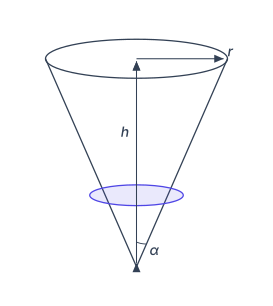
The key idea is Related Rates: we connect dtdV (given) to dtdh (required) using the geometry of the cone.
Step 1: Relate radius and height.
Semi-vertical angle α satisfies tanα=0.5=hr, so r=2h.
Step 2: Express volume in terms of h alone.
Volume of a cone: V=31πr2h=31π(2h)2h=12πh3.
Step 3: Differentiate with respect to time t.
dtdV=12π⋅3h2dtdh=4πh2dtdh.
Step 4: Substitute known values.
Given dtdV=5 m³/h and h=4 m:
5=4π(4)2dtdh=4πdtdh.
Thus dtdh=4π5 m/h.
The water level is rising at 4π5 metres per hour.
The key idea is to relate the volume of water in the cone to its depth using the geometry of the cone, then differentiate with respect to time. The rate at which the water level rises when the depth is 4 m is 4π5 m/h.
This is a classic related rates problem. The core idea is simple: we know how fast the volume is changing (dV/dt=5 m³/h), and we want to find how fast the depth is changing (dh/dt) at a specific moment. The bridge between these two rates is the geometric relationship between volume and depth for a cone.
The trick is that as water fills the cone, both the depth h and the radius r of the water's surface change together. But they aren't independent — the cone's fixed shape ties them together through the semi-vertical angle.
- Set up the geometry. The cone has a semi-vertical angle α where tanα=0.5. From the figure, tanα=r/h, so:
hr=0.5⇒r=2h
This is the crucial relation — at any depth h, the radius of the water surface is exactly half of h.
- Write the volume in terms of h only. The volume of a cone is V=31πr2h. Substitute r=h/2:
V=31π(2h)2h=31π⋅4h2⋅h=12πh3
V=12πh3
This expresses the volume of water entirely in terms of its depth — no separate r needed.
- Differentiate with respect to time. Both V and h are functions of time t. Differentiate both sides:
dtdV=12π⋅3h2⋅dtdh=4πh2⋅dtdh
- Plug in the known values. We are given dtdV=5 m³/h (constant), and we want dtdh when h=4 m:
5=4π(4)2⋅dtdh=4π⋅16⋅dtdh=4π⋅dtdh
- Solve for the rate.
dtdh=4π5 m/h
A common mistake is to treat r as constant when differentiating V=31πr2h. But r changes with h! Always eliminate r (or h) using the cone's geometry before differentiating — otherwise you'll need the product rule and an extra relation.
Notice that the answer doesn't depend on the cone's full size — only on its shape (the semi-vertical angle). The rate 4π5 is about 0.398 m/h, which makes sense: a wide, shallow cone (tan α = 0.5 means the radius grows slowly with depth) would have the water level rise relatively fast for a given inflow.
The rate at which the water level is rising when the depth is 4 m is 4π5 m/h.
Method: Related Rates for a Filling/Draining Container
The general five-step procedure for connecting a known rate to an unknown rate when two changing quantities are tied by a fixed geometric relationship.
Steps
Step 1: Identify the two rates and the fixed relationship
Here the given rate is dtdV and the required rate is dtdh. The container's shape (a cone with a fixed semi-vertical angle) links the radius r and height h of the water surface at every instant, since tan(semi-vertical angle)=hr.
Step 2: Eliminate the extra variable using the geometry, before differentiating
A volume formula for a cone naturally involves two variables, r and h. Use the fixed-angle relation to express r in terms of h (or vice versa) and substitute, so the volume becomes a function of a single variable:
V=31πr2h⟶V=V(h) only
Step 3: Differentiate both sides with respect to time
Apply the chain rule, since both V and h are functions of t:
dtdV=dhd[V(h)]⋅dtdh
Step 4: Substitute the given numerical values and solve
Plug in the known dtdV and the specific depth h at the instant asked about — only after differentiating, never before — then solve algebraically for the unknown rate.
Common Mistakes
Mistake 1: Differentiating V=31πr2h while treating r as constant
Why it's wrong: as water fills the cone, the radius of the water's surface changes together with the depth — it is not a fixed number, so it cannot be dropped from the differentiation. Differentiating with r held constant would produce an equation missing the crucial link between dtdh and the cone's geometry. Correct approach: use the semi-vertical angle to write r in terms of h (here r=h/2) and substitute into the volume formula before differentiating, so the volume is a function of h alone.
Mistake 2: Substituting the numerical depth before differentiating
Why it's wrong: plugging in h=4 into the volume formula first turns h into a constant, so the derivative with respect to time becomes dtdV=0 — losing the very relationship the problem needs. Correct approach: differentiate the general relation between V and h symbolically first, and only substitute the specific numbers (h=4, dtdV=5) into the resulting rate equation afterward.
Showing the 12 most recent of 30 on this concept.
- TG EAPCET 2024Set eng-2024-05-11-FN1 markMCQQ.If Water is poured into a cylindrical tank of radius 3.5 ft at the rate of 1 cu ft/min, then the rate at which the level of the water in the tank increases (in ft/min) is (A) 1541 (B) 778 (C) 772 (D) 111
›Reveal solutionSolution
The water level rises at a constant rate because the tank’s cross‑sectional area is constant; the rate is the inflow divided by the area. The answer is 772 ft/min, option (C).
Concept & Intuition
When you pour water into a cylinder, the volume added is directly proportional to the increase in height, because the cross‑sectional area doesn’t change with depth. So the rate of change of height is simply the volumetric flow rate divided by the area of the base. No calculus chain‑rule gymnastics needed — just a straightforward division.
- Identify the relationship The volume of water in a cylinder of radius r and height h is
V=πr2h.
Here r=3.5 ft, so the base area is
A=π(3.5)2=π×12.25=449π ft2.
- Differentiate with respect to time Since r is constant,
dtdV=πr2dtdh=Adtdh.
We are given dtdV=1 cu ft/min.
- Solve for dtdh
dtdh=A1=449π1=49π4.
- Simplify numerically Use π≈722 (common in such problems):
dtdh=49⋅7224=49×7224=7×224=1544=772.
TipIf you use π=22/7, the arithmetic simplifies neatly. The exact value 49π4 is fine, but the multiple‑choice options are given as rational numbers, so the approximation is intended.
Watch outA common mistake is to forget that the radius is 3.5, not 7, and accidentally use r=7 — that would give 1541, which is option (A). Always square the radius correctly.
✓Final answerThe correct option is (C).
ANSWER: C
- TG EAPCET 2025Set eng-2025-05-04-FN1 markMCQQ.The height of a cone with semi vertical angle π/3 is increasing at the rate of 2 units/min. The rate at which the radius of the cone is to be decreased so as to have a fixed volume always is (A) 3 (B) 21 (C) 31 (D) 2
›Reveal solutionSolution
For a cone of fixed volume, the radius must shrink at a rate that exactly compensates the growth in height. Using the relation V=31πr2h and differentiating with respect to time gives dtdr=−2hrdtdh. With semi-vertical angle π/3, we have r/h=tan(π/3)=3, so dtdr=−23⋅2=−3 units/min. The required rate of decrease is 3 units/min, so the correct option is (A).
The key idea is that "fixed volume" ties the radius and height together through a constraint. When one changes, the other must change in a specific way to keep the product r2h constant. The semi-vertical angle gives the instantaneous ratio of radius to height at the moment we are considering — that ratio is not constant over time (since the cone's shape changes), but at the instant we care about, it is fixed by the given angle.
Let’s work through it step by step.
- Write the volume constraint. For a cone, V=31πr2h. Since the volume is fixed, V is constant. Differentiating both sides with respect to time t:
dtdV=31π(2rdtdr⋅h+r2dtdh)=0.
Multiply through by 3/π (non-zero):
2rhdtdr+r2dtdh=0.
- Solve for dtdr. Rearranging:
2rhdtdr=−r2dtdh.
Assuming r=0, divide both sides by r:
2hdtdr=−rdtdh.
Hence:
dtdr=−2hrdtdh.
The negative sign tells us that if height increases, radius must decrease — exactly what we expect.
- Use the semi-vertical angle to find r/h. The semi-vertical angle is the angle between the axis and the slant height. In a right circular cone, tan(semi-vertical angle)=heightradius. Given the angle is π/3:
hr=tan3π=3.
So r=3h at the instant under consideration.
- Plug in the given rate. We are told dtdh=2 units/min. Substituting r/h=3 and dtdh=2:
dtdr=−21⋅hr⋅dtdh=−21⋅3⋅2=−3.
The negative sign means the radius is decreasing. The question asks for the rate at which the radius is to be decreased — that is, the magnitude of the decrease. So the required rate is 3 units/min.
Watch outA common mistake is to treat r/h as constant over time. It is not — the cone's shape changes as r and h change. But at the instant we are given the semi-vertical angle, the ratio is fixed. The derivative relation dtdr=−2hrdtdh is valid at that instant because r and h are the instantaneous values.
✓Final answerThe rate at which the radius must be decreased is 3 units/min, so the correct option is (A).
- TG EAPCET 2025Set eng-2025-05-04-AN1 markMCQQ.The height of a cone with semi vertical angle 3π is increasing at the rate of 2 units/min. The rate at which the radius of the cone is to be decreased so as to have a fixed volume always is (A) 31 (B) 21 (C) 3 (D) 2
›Reveal solutionSolution
The problem uses related rates with the cone’s volume fixed. Differentiating V=31πr2h and using dtdh=2 gives dtdr=−2hr⋅2. With semi-vertical angle π/3, hr=tan(π/3)=3, so dtdr=−3 units/min. The rate of decrease is 3.
Concept & Intuition
We have a cone whose height is increasing, but we want its volume to stay constant. That means the radius must shrink to compensate. The key is to relate the radius and height through the fixed semi-vertical angle — this gives a constant ratio r/h=tan(π/3)=3. Then we use calculus (related rates) to find how fast the radius must change when the height changes at 2 units/min.
Step-by-step solution
-
Volume of a cone
The volume is V=31πr2h. Since the volume is fixed, V is constant, so dtdV=0.
-
Differentiate implicitly with respect to time
Using the product rule:
dtdV=31π(2rdtdr⋅h+r2dtdh)=0.
Multiply through by 3/π (nonzero):
2rhdtdr+r2dtdh=0.
- Solve for dtdr
2rhdtdr=−r2dtdh⇒dtdr=−2hrdtdh.
- Use the given rate and geometry We are told dtdh=2 units/min. The semi-vertical angle is π/3, so in a right triangle formed by the height, radius, and slant height:
tan(3π)=hr=3.
Hence r=3h.
- Substitute into the rate equation
dtdr=−2h3h⋅2=−3.
The negative sign means the radius is decreasing. The rate of decrease is 3 units/min.
TipThe ratio r/h is constant because the angle is fixed — this lets us avoid needing actual values of r and h at any instant.
Watch outA common mistake is forgetting the factor 2 from differentiating r2, or mixing up which variable is increasing/decreasing. Always check the sign: if height increases and volume is fixed, radius must decrease.
✓Final answerThe correct option is (C).
ANSWER: C
-
- TG EAPCET 2024Set eng-2024-05-09-AN1 markMCQQ.A right circular cone is inscribed in a sphere of radius 3 units. If the volume of the cone is maximum, then semi vertical angle of the cone is (A) 4π (B) 6π (C) tan−1(2) (D) tan−1(21)
›Reveal solutionSolution
Maximum cone volume in a sphere of radius 3 occurs at semi-vertical angle tan−1(21) — option (D).
Let the sphere have radius R=3 and centre O. Let the cone have height h (apex to base) and base radius r. The base circle lies at distance ∣h−R∣ from the centre, so
r2=R2−(h−R)2=2Rh−h2.
Volume:
V=31πr2h=3π(2Rh2−h3).
Maximise:
dhdV=3π(4Rh−3h2)=0⇒h=34R.
With R=3: h=4. Then
r2=2Rh−h2=2(3)(4)−16=8⇒r=22.
The semi-vertical angle α satisfies
tanα=hr=422=21⇒α=tan−1(21).
✓Final answerSemi-vertical angle =tan−1(21) — option (D).
- TG EAPCET 2021Set eng-2021-08-04-AN1 markMCQQ.If the radius of a spherical balloon is increasing at the rate of 5 inch per minute, then the rate at which the volume increases (in cube inches per minute) when the radius is 10 inches is (A) 100π (B) 1000π (C) 2000π (D) 25000π
›Reveal solutionSolution
The rate of change of volume is found by differentiating the volume formula V=34πr3 with respect to time, using the chain rule. When r=10 inches and dtdr=5 in/min, the answer is 2000π cubic inches per minute.
The core idea here is related rates — a classic application of the chain rule in calculus. When a quantity changes over time, and another quantity depends on it, their rates of change are linked through differentiation. For a sphere, volume depends on radius, so if the radius grows at a known speed, the volume’s growth speed follows directly.
The trap many students fall into is forgetting that dtdV is not just the derivative of V with respect to r — you must multiply by dtdr because both are functions of time. Let’s walk through it cleanly.
- Write the relationship. The volume of a sphere of radius r is
V=34πr3.
- Differentiate both sides with respect to time t. Since r itself changes with t, use the chain rule:
dtdV=dtd(34πr3)=34π⋅3r2⋅dtdr=4πr2dtdr.
Notice how the 3 cancels with the 34, leaving a clean 4πr2 — that’s the surface area of the sphere. Makes intuitive sense: the volume grows like the surface area times the radial speed.
- Plug in the given values. We know dtdr=5 inches per minute, and we want the rate when r=10 inches:
dtdV=4π(10)2⋅5=4π⋅100⋅5=2000π.
Watch outA common mistake is to compute drdV=4πr2 and stop there, or to forget to multiply by dtdr. Always ask: “Am I differentiating with respect to r or t?” If the problem gives a time rate, you need the time derivative.
TipMemorize the shortcut: for any geometric formula V=kr3, the time derivative is dtdV=3kr2dtdr. Here k=34π, so 3k=4π, giving the same result instantly.
The units check out: inches2 times inches per minute gives cubic inches per minute, exactly what’s asked.
✓Final answerThe rate at which the volume increases is 2000π cubic inches per minute, which corresponds to option (C).
- TG EAPCET 2023Set eng-2023-05-14-AN1 markMCQQ.A ladder of length 13 mts has one end resting against a vertical wall and the other on the ground. If the lower end moves away from the wall at a speed of 2 mts/minute, then the speed (in mts/min) at which upper end falls when the bottom is 5 mts away from the wall is (A) 56 (B) 512 (C) 65 (D) 125
›Reveal solutionSolution
This is a classic related-rates problem: use the Pythagorean theorem to relate the ladder’s height and base distance, then differentiate with respect to time. The upper end falls at 65 m/min when the bottom is 5 m from the wall.
We have a ladder of fixed length 13 m leaning against a vertical wall. The bottom slides away from the wall at a constant speed of 2 m/min. We need the speed at which the top slides down the wall at the instant the bottom is 5 m from the wall.
Concept & Intuition
The ladder, wall, and ground form a right triangle: the ladder is the hypotenuse (always 13 m), the distance from the wall to the bottom is one leg, and the height of the top along the wall is the other leg. As the bottom moves, both legs change, but the hypotenuse stays fixed. This gives a relationship between the rates of change of the two legs — a classic related rates problem. Differentiating the Pythagorean relation with respect to time lets us connect the known speed (bottom moving away) to the unknown speed (top moving down).
- Set up variables and the fixed relation Let x = distance from the wall to the bottom of the ladder (in m). Let y = height of the top of the ladder on the wall (in m). The ladder length is constant:
x2+y2=132=169.
- Differentiate with respect to time Both x and y change with time t. Differentiate implicitly:
2xdtdx+2ydtdy=0.
Divide by 2:
xdtdx+ydtdy=0.
-
Identify known and unknown rates
We are given dtdx=2 m/min (positive because x increases).
We want dtdy when x=5 m.
Note: dtdy will be negative because y decreases (top falls). The problem asks for the speed (magnitude), so we will take the absolute value at the end.
-
Find y when x=5
From x2+y2=169:
52+y2=169⇒25+y2=169⇒y2=144⇒y=12 (positive height).
- Plug into the differentiated equation
(5)(2)+(12)dtdy=0⇒10+12dtdy=0.
Solve:
12dtdy=−10⇒dtdy=−1210=−65.
- Interpret the result The negative sign means the top is moving downward. The speed (magnitude) is 65 m/min.
TipA common mistake is forgetting the negative sign or mixing up which rate is given. Always check: if the bottom moves away, the top must move down, so dtdy should be negative.
Watch outAnother pitfall: using the given x=5 before differentiating. You must differentiate the general relation first, then substitute the specific values — otherwise you lose the relationship between the rates.
✓Final answerThe correct option is (C).
ANSWER: C
- TG EAPCET 2021Set eng-2021-08-06-FN1 markMCQQ.The semi vertical angle of a right circular cone is 30∘. If the height of the cone is 6.125 cm, then the approximate value of the volume of the cone (in cubic cm) is (A) (23.5)π (B) (76.5)π (C) 48π (D) (25.5)π
›Reveal solutionSolution
With semi-vertical angle 30∘, r=htan30∘, so V=31πh3tan230∘≈(25.5)π.
Radius from the semi-vertical angle. The semi-vertical angle α satisfies tanα=hr, so
r=htan30∘=3h,r2=3h2.
Volume. With h=6.125 cm,
V=31πr2h=31π⋅3h2⋅h=9πh3=9π(6.125)3≈25.53π.
✓Final answerV≈(25.5)π cubic cm — option (D).
- TG EAPCET 2021Set eng-2021-08-05-AN1 markMCQQ.The volume of a spherical balloon is increasing at the rate of 2 cm3/sec. When its radius is 4 cm, the rate of change of its surface area (in cm2/sec) is (A) 1 (B) 2 (C) 3 (D) 4
›Reveal solutionSolution
We use related rates to connect the given rate of change of volume to the rate of change of surface area via the radius. The rate of change of the surface area is 1 cm2/sec.
This problem asks us to find the rate of change of the surface area of a spherical balloon, given the rate of change of its volume at a specific instant. This is a classic application of "related rates" in differential calculus. The core idea is that if two or more quantities are related by an equation, and they are all changing with respect to a common variable (usually time), then their rates of change are also related. We use the chain rule to establish these relationships.
For a sphere, both its volume (V) and surface area (S) depend on its radius (r). If the radius changes over time, then both the volume and surface area will also change over time.
- The volume of a sphere is given by V=34πr3.
- The surface area of a sphere is given by S=4πr2.
We are given dtdV and need to find dtdS. Both these rates depend on dtdr, the rate at which the radius is changing. So, our strategy will be:
- Use the given rate of change of volume (dtdV) and the volume formula to calculate dtdr at the specified radius.
- Use this calculated dtdr and the surface area formula to find dtdS at that same radius.
Here's the step-by-step solution:
-
Identify the given information and what needs to be found.
We are given:
- The rate at which the volume of the spherical balloon is increasing: dtdV=2 cm3/sec.
- The radius of the balloon at the specific instant we are interested in: r=4 cm. We need to find:
- The rate of change of its surface area, dtdS, at that instant.
-
Write down the formulas for the volume and surface area of a sphere.
The volume of a sphere with radius r is V=34πr3.
The surface area of a sphere with radius r is S=4πr2.
-
Differentiate the volume formula with respect to time (t) to find dtdr.
Since V is a function of r, and r is a function of t, we apply the chain rule to differentiate V with respect to t:
dtdV=dtd(34πr3)
dtdV=34π⋅(3r2)⋅dtdr
dtdV=4πr2dtdr
Now, substitute the given values: $\frac{dV}{dt} = 2\ \text{cm}^3/\text{sec}$ and $r = 4\ \text{cm}$.2=4π(4)2dtdr
2=4π(16)dtdr
2=64πdtdr
Solving for $\frac{dr}{dt}$:dtdr=64π2=32π1 cm/sec
This is the rate at which the radius is increasing at the instant when $r=4\ \text{cm}$.4. Differentiate the surface area formula with respect to time (t) to find dtdS.
Similarly, S is a function of r, and r is a function of t. We use the chain rule to differentiate S with respect to t:
dtdS=dtd(4πr2)
dtdS=4π⋅(2r)⋅dtdr
dtdS=8πrdtdr
Now, substitute the value of $r = 4\ \text{cm}$ and the value of $\frac{dr}{dt} = \frac{1}{32\pi}\ \text{cm/sec}$ that we found in the previous step:dtdS=8π(4)(32π1)
dtdS=32π(32π1)
dtdS=1 cm2/sec
> [!TIP]
> A useful observation in this problem is that $\frac{dV}{dr} = 4\pi r^2$, which is the surface area $S$. Also, $\frac{dS}{dr} = 8\pi r$.
> We have $\frac{dV}{dt} = \frac{dV}{dr} \cdot \frac{dr}{dt} = S \cdot \frac{dr}{dt}$.
> And $\frac{dS}{dt} = \frac{dS}{dr} \cdot \frac{dr}{dt}$.
> From the first relation, $\frac{dr}{dt} = \frac{1}{S} \frac{dV}{dt}$.
> Substituting this into the second relation:
> $\frac{dS}{dt} = \frac{dS}{dr} \cdot \left(\frac{1}{S} \frac{dV}{dt}\right) = (8\pi r) \cdot \left(\frac{1}{4\pi r^2} \frac{dV}{dt}\right) = \frac{2}{r} \frac{dV}{dt}$.
> Using this shortcut with $r=4$ and $\frac{dV}{dt}=2$:
> $\frac{dS}{dt} = \frac{2}{4} \cdot 2 = \frac{1}{2} \cdot 2 = 1\ \text{cm}^2/\text{sec}$. This confirms our result efficiently.
The rate of change of the surface area when the radius is 4 cm is 1 cm2/sec.
✓Final answerThe rate of change of the surface area is 1 cm2/sec.
- TG EAPCET 2025Set eng-2025-05-03-FN1 markMCQQ.A man of 5 feet height is walking away from a light fixed at a height of 15 feet at the rate of K miles/hour. If the rate of increase of his shadow is 511 feet/sec, then K = (Take 1 mile = 5280 feet) (A) 2 (B) 3 (C) 5 (D) 4
›Reveal solutionSolution
K=3 miles/hour — option (B).
By similar triangles, if x is the man's distance from the pole and s his shadow's length, the tip of the shadow, the top of the lamp and the man's head are collinear:
15x+s=5s⇒5(x+s)=15s⇒5x=10s⇒s=2x.
Differentiating with respect to time:
dtds=21dtdx.
Given dtds=511 ft/sec,
dtdx=2⋅511=522 ft/sec.
Convert to miles/hour (1 mile =5280 ft, 1 hour =3600 sec):
K=522×52803600=522×2215=3.
✓Final answerK=3 miles/hour, i.e. option (B).
- TG EAPCET 2025Set eng-2025-05-03-AN1 markMCQQ.A man of 5 feet height is walking away from a light fixed at a height of 15 feet at the rate of K miles/hour. If the rate of increase of his shadow is 511 feet/sec, then K = (Take 1 mile = 5280 feet) (A) 2 (B) 3 (C) 4 (D) 5
›Reveal solutionSolution
Using similar triangles the shadow length is s=2x, so dtds=21dtdx. From dtds=511 ft/s the man's speed is 522 ft/s =3 mph. Answer: (B) 3.
Setup (similar triangles). Let the lamp be at height 15 ft, the man (5 ft tall) at distance x ft from the lamp post, and s the length of his shadow. The lamp-ground-shadow-tip triangle and the man-feet-shadow-tip triangle are similar:
x+s15=s5⇒15s=5x+5s⇒10s=5x⇒s=2x.
Differentiate.
dtds=21dtdx.
Solve for the man's speed. Given dtds=511 ft/s,
dtdx=2⋅511=522 ft/s.
Convert to miles/hour (1 mile =5280 ft, 1 hour =3600 s):
K=522⋅52803600=522⋅2215=515=3 mph.
Check: 3 mph =3⋅36005280=522=4.4 ft/s; half of that is 2.2=511 ft/s, matching the given shadow rate.
✓Final answerK=3 miles/hour - option (B).
ANSWER: B
- TG EAPCET 2026Set eng-2026-05-11-FN1 markMCQQ.If the base of an isosceles triangle is 32 feet and the two equal sides of it are increasing at the rate of 1 ft/s, then the rate of increase of its area (in sq.ft/sec) when the angle between the equal sides is a right angle is (A) 33 (B) 3 (C) 9 (D) 3
›Reveal solutionSolution
The area of an isosceles triangle is expressed in terms of the equal side length and the included angle. Using the given rate of change of the side and the fact that the angle is fixed at the instant of interest, the rate of increase of area is found to be 3 sq.ft/sec.
The problem gives an isosceles triangle with base 32 feet and equal sides that are increasing at 1 ft/s. We need the rate of increase of its area at the moment when the angle between the equal sides is a right angle.
The key is to choose a formula for area that directly involves the changing quantity (the equal side length) and the angle. For any triangle, area is 21absinC. Here, the two equal sides are the ones forming the included angle, so that formula is perfect.
- Set up the variables. Let the equal sides each have length s feet, and let θ be the angle between them. The area A of the triangle is
A=21⋅s⋅s⋅sinθ=21s2sinθ.
- What is given and what is wanted? We know dtds=1 ft/s. We want dtdA at the instant when θ=90∘=2π radians. But note: the base is fixed at 32 feet. Does that give a relation between s and θ? Yes — by the law of cosines, the base b satisfies
b2=s2+s2−2s2cosθ=2s2(1−cosθ).
So b=32 is constant, meaning s and θ are not independent — as s increases, θ must change to keep the base fixed. However, we only need the rate at a specific instant, not a full functional relation.
- Differentiate the area with respect to time. Since both s and θ can change with time,
dtdA=21(2sdtdssinθ+s2cosθ⋅dtdθ)=sdtdssinθ+21s2cosθdtdθ.
- Find s and dtdθ at the required instant. At θ=2π, sinθ=1, cosθ=0. The law of cosines gives
(32)2=2s2(1−cos2π)=2s2(1−0)=2s2.
So 18=2s2, hence s2=9 and s=3 feet (positive length).
Now we need dtdθ at that instant. Differentiate the law of cosines relation with respect to time. From b2=2s2(1−cosθ), since b is constant,
0=dtd[2s2(1−cosθ)]=4sdtds(1−cosθ)+2s2sinθdtdθ.
At θ=2π, cosθ=0, sinθ=1, s=3, dtds=1:
0=4(3)(1)(1−0)+2(9)(1)dtdθ=12+18dtdθ.
Thus 18dtdθ=−12, so dtdθ=−32 rad/s. (The angle is decreasing, which makes sense: as the sides lengthen, the angle must narrow to keep the base fixed.)
- Plug into the area rate formula. At the instant: s=3, dtds=1, sinθ=1, cosθ=0, dtdθ=−32.
dtdA=(3)(1)(1)+21(9)(0)(−32)=3+0=3.
Watch outA common mistake is to forget that θ changes with time and treat it as constant. That would give dtdA=sdtdssinθ=3⋅1⋅1=3, which accidentally matches the correct answer here — but only because cosθ=0 eliminates the dtdθ term. In general, you must include it.
TipWhen the included angle is 90∘, the cosθ term vanishes, so the rate depends only on the side length and its rate of change. That’s why the answer simplifies so neatly.
✓Final answerThe rate of increase of the area is 3 sq.ft/sec, which corresponds to option (D).
- TG EAPCET 2021Set eng-2021-08-06-AN1 markMCQQ.The side of an equilateral triangle is 5 units. In measuring the side, an error of 0.05 units is made. Then the percentage error in measuring the area of the triangle is (A) 2 (B) 3 (C) 4 (D) 5
›Reveal solutionSolution
We use the concept of differentials to approximate the error in the area of an equilateral triangle. For a small error in the side, the percentage error in the area is twice the percentage error in the side. The percentage error in the area is 2.
When a quantity is calculated using a measured value, and there's an error in the measurement, this error propagates through the calculation, leading to an error in the final calculated quantity. For small errors, we can use the concept of differentials to approximate how these errors propagate.
Consider a function y=f(x). If there is a small error Δx in the measurement of x, it causes a corresponding small error Δy in the calculated value of y. For sufficiently small Δx, the change Δy can be approximated by the differential dy:
Δy≈dy=dxdyΔx
The fractional error in y is yΔy, and the percentage error is yΔy×100%.
In this problem, we are dealing with the area of an equilateral triangle, which depends on its side length.
-
Identify the given information:
The side of the equilateral triangle is s=5 units.
The error in measuring the side is Δs=0.05 units.
-
State the formula for the area of an equilateral triangle:
The area A of an equilateral triangle with side s is given by:
A=43s2
- Find the differential of the area with respect to the side: To understand how a small change in s affects A, we differentiate A with respect to s:
dsdA=dsd(43s2)=43(2s)=23s
Now, we can express the approximate error in the area, $\Delta A$, using the differential $dA$:ΔA≈dA=dsdAΔs=23s⋅Δs
- Calculate the fractional error in the area: The fractional error in the area is AΔA. We substitute the expressions for ΔA and A:
AΔA=43s223s⋅Δs
We can simplify this expression:AΔA=41s221s⋅Δs=21⋅14⋅s2s⋅Δs=2sΔs
> [!IMPORTANT]
> For a quantity $y$ that depends on another quantity $x$ as $y = kx^n$ (where $k$ is a constant), the fractional error in $y$ is approximately $n$ times the fractional error in $x$:
> $$ \frac{\Delta y}{y} \approx n \frac{\Delta x}{x} $$
> In our case, $A = \frac{\sqrt{3}}{4} s^2$, so $n=2$. This confirms our derived relationship $\frac{\Delta A}{A} = 2 \frac{\Delta s}{s}$.
5. Substitute the given values and calculate the percentage error:
We have s=5 units and Δs=0.05 units.
First, calculate the fractional error in the side:
sΔs=50.05=55/100=1001=0.01
Now, use the relationship for the fractional error in the area:AΔA=2sΔs=2×0.01=0.02
Finally, convert this fractional error to a percentage error:Percentage error in area=AΔA×100%=0.02×100%=2%
✓Final answerThe percentage error in measuring the area of the triangle is 2.
-
🎓Unlock everything free for 14 days
- ✓Full step-by-step solutions
- ✓Concept-first explanations
- ✓Methods, shortcuts & mistakes
- ✓PYQ mapping + timed mock tests
Full access for 14 days. No credit card required.