Q.If u,v and w are functions of x, then show that dxd(u⋅v⋅w)=dxdu⋅v⋅w+u⋅dxdv⋅w+u⋅v⋅dxdw in two ways - first by repeated application of product rule, second by logarithmic differentiation.
🔒You're viewing a preview — the full solution, concept, methods & PYQ mapping are locked.
🔒 Start your 14-day free trial to unlock the full solution →Concept understanding — Chain Rule
The Chain Rule: Why It Makes Sense
Imagine you're assembling a toy. First you put part A into part B, then you put that combined piece into part C. The final toy's position depends on how you moved A, which then affected B, which then affected C. That's exactly what the chain rule captures — how a change in the first variable ripples through a sequence of functions to affect the final output.
Let's make this concrete. Suppose you have a function f that depends on g, and g itself depends on x:
y=f(g(x))
You want to know: if x changes by a tiny amount, how much does y change? The answer isn't just f′(g(x)) — because g(x) itself changes when x changes. You have to multiply the two rates:
- How fast does g change with respect to x? That's g′(x).
- How fast does f change with respect to its input g? That's f′(g(x)).
The total effect is the product:
dxdy=f′(g(x))⋅g′(x)
In Leibniz notation, this looks even more natural: dxdy=dudy⋅dxdu, where u=g(x). The du's "cancel" like fractions — though this is just a helpful memory aid, not a rigorous proof.
The Precise Statement
Chain Rule (single variable): If g is differentiable at x and f is differentiable at g(x), then the composite function h(x)=f(g(x)) is differentiable at x, and
h′(x)=f′(g(x))⋅g′(x)
That's it. One multiplication. But the power is enormous — it lets you differentiate almost any nested function.
A Simple Example
Differentiate h(x)=sin(3x2).
Here f(u)=sinu and g(x)=3x2. Then:
- f′(u)=cosu, so f′(g(x))=cos(3x2)
- g′(x)=6x
Multiply: h′(x)=cos(3x2)⋅6x=6xcos(3x2)
The most common mistake is forgetting to multiply by the inner derivative. Students often write dxdsin(3x2)=cos(3x2) and stop — that's wrong. The chain rule demands you also multiply by 6x.
Why It's Called a "Chain"
Think of a chain of links: x→g→f. Each link has its own rate of change. To find the total rate from x to f, you multiply the rates of each link. If you had three functions — say h(x)=f(g(k(x))) — you'd multiply three derivatives: …
Concept: Chain Rule & Product Rule
Method 1 — Repeated Product Rule
Treat u⋅v⋅w as (u⋅v)⋅w.
First apply product rule to u⋅v:
dxd(uv)=u′v+uv′.
Now differentiate the product with w:
dxd[(uv)w]=(u′v+uv′)w+(uv)w′
=u′vw+uv′w+uvw′.
Method 2 — Logarithmic Differentiation
Let y=uvw. Take log on both sides:
logy=logu+logv+logw.
Differentiate with respect to x:
y1dxdy=uu′+vv′+ww′. …
The derivative of a product of three functions is the sum of three terms, each differentiating one function while keeping the other two unchanged. This is proved by applying the product rule twice, or by taking logs, differentiating, and multiplying through.
Why this works — the Chain Rule in disguise
The product rule for two functions says:
dxd(uv)=u′v+uv′.
For three functions, we are really just applying that rule twice. Think of u⋅v⋅w as (u⋅v)⋅w — a product of two "functions", where the first factor is itself a product. The Chain Rule never appears directly here (no composition), but the idea of "differentiate one factor at a time" is the same pattern that extends to any number of factors.
Logarithmic differentiation gives an alternative view: it turns multiplication into addition, so the derivative becomes a sum of individual logarithmic derivatives — which is exactly the same result.
Method 1: Repeated application of the product rule
Step 1. Treat u⋅v⋅w as (uv)⋅w.
Let p=uv. Then we have dxd(p⋅w).
Step 2. Apply the product rule to p⋅w:
dxd(p⋅w)=dxdp⋅w+p⋅dxdw.
Step 3. Now dxdp=dxd(uv). Apply the product rule again:
dxdp=dxdu⋅v+u⋅dxdv.
Step 4. Substitute back:
dxd(uvw)=(dxdu⋅v+u⋅dxdv)⋅w+(uv)⋅dxdw.
Step 5. Expand:
dxd(uvw)=dxdu⋅v⋅w+u⋅dxdv⋅w+u⋅v⋅dxdw.
That's the result.
This pattern generalises: for n functions, the derivative is the sum of n terms, each differentiating exactly one factor. No need to memorise — just apply the product rule repeatedly.
Method 2: Logarithmic differentiation
Step 1. Assume u,v,w>0 (so logs are defined). Take the natural log of both sides:
log(uvw)=logu+logv+logw.
Step 2. Differentiate both sides with respect to x. On the left, by the Chain Rule:
dxdlog(uvw)=uvw1⋅dxd(uvw).
On the right, differentiate term by term: …
Method: Extending a Two-Factor Rule to Three Factors
When you're asked to derive a formula for three (or more) functions multiplied together, the general strategy is to reduce it to a rule you already know, applied more than once — never derive it from scratch with limits.
Steps
Step 1 (Method A — repeated product rule): Group two factors together first
Treat u⋅v⋅w as (u⋅v)⋅w — a product of two things, where the first "thing" happens to itself be a product. This lets you apply the ordinary two-factor product rule you already know, twice.
Step 2: Apply the product rule to the outer grouping
dxd[(uv)⋅w]=dxd(uv)⋅w+(uv)⋅dxdw
Step 3: Apply the product rule again to expand dxd(uv), then substitute back
dxd(uv)=dxduv+udxdv
Substituting gives the three-term result — each term differentiates exactly one of u,v,w while leaving the other two unchanged.
Step 4 (Method B — logarithmic differentiation): an independent cross-check …
Common Mistakes
Mistake 1: Writing only two terms instead of three when generalising the product rule
Why it's wrong: a very common error when extending the two-factor product rule to three factors is to write dxd(uvw)=u′vw+uvw′ (skipping the middle term uv′w) — an easy slip because the two-factor rule only has two terms to pattern-match against. Correct approach: apply the two-factor rule twice, in stages (first to (uv)⋅w, then to u⋅v inside), so no term gets silently dropped.
Mistake 2: Using logarithmic differentiation without noting the positivity requirement …
Showing the 12 most recent of 26 on this concept.
- TG EAPCET 2022Set eng-2022-07-20-FN1 markMCQQ.If f(x)=logexe−xsinx and f′(x)=f(x)⋅g(x), then g′(e)= (A) e−2−csc2(e) (B) 2e2−csc2(e) (C) 2e−2−csc2(e) (D) 2e−2+csc2(e)
›Reveal solutionSolution
We use logarithmic differentiation to simplify f(x) into a sum of terms, which directly gives us g(x)=f(x)f′(x). Differentiating g(x) and substituting x=e then yields the result. The value of g′(e) is 2e−2−csc2(e).
The problem asks us to find g′(e) given a function f(x) and the relationship f′(x)=f(x)⋅g(x). The function f(x) is a product and quotient of several functions, making direct differentiation quite cumbersome.
The key insight here is to recognize that the expression g(x)=f(x)f′(x) is precisely the derivative of loge∣f(x)∣. This means we can use logarithmic differentiation to find g(x) efficiently. By taking the natural logarithm of f(x) first, we convert products and quotients into sums and differences, which are much simpler to differentiate.
Here's how we approach the problem:
-
Express g(x) using logarithmic differentiation:
Given f′(x)=f(x)⋅g(x), we can write g(x)=f(x)f′(x).
This expression is the result of differentiating logef(x) with respect to x.
So, our first step is to take the natural logarithm of f(x) and then differentiate it.
We have f(x)=logexe−xsinx.
Taking the natural logarithm on both sides:
logef(x)=loge(logexe−xsinx)
Using the properties of logarithms ($\log(AB/C) = \log A + \log B - \log C$):logef(x)=loge(e−x)+loge(sinx)−loge(logex)
Simplify the first term: $\log_e (e^{-x}) = -x$.logef(x)=−x+loge(sinx)−loge(logex)
- Differentiate to find g(x): Now, differentiate both sides of the equation with respect to x:
dxd(logef(x))=dxd(−x)+dxd(loge(sinx))−dxd(loge(logex))
We know that $\frac{d}{dx} (\log_e f(x)) = \frac{f'(x)}{f(x)}$, which is $g(x)$. Differentiating each term on the right side: * $\frac{d}{dx} (-x) = -1$ * $\frac{d}{dx} (\log_e (\sin x)) = \frac{1}{\sin x} \cdot \cos x = \cot x$ * $\frac{d}{dx} (\log_e (\log_e x)) = \frac{1}{\log_e x} \cdot \frac{1}{x}$ (using the chain rule) Combining these, we get $g(x)$:g(x)=−1+cotx−xlogex1
- Differentiate g(x) to find g′(x): Now we need to find the derivative of g(x):
g′(x)=dxd(−1)+dxd(cotx)−dxd(xlogex1)
* $\frac{d}{dx} (-1) = 0$ * $\frac{d}{dx} (\cot x) = -\csc^2 x$ … -
- TG EAPCET 2024Set eng-2024-05-11-FN1 markMCQQ.If y=sin(log2x)+sin(log2x)+sin(log2x)+…∞, then dxdy= (A) 2x(2y−1)cos(log2x) (B) (2y−1)cos(log2x) (C) x(2y−1)cos(log2x) (D) x(2y−1)sin(log2x)
›Reveal solutionSolution
The infinite sum collapses to a simple equation y=sin(log2x)+y, which forces us to reinterpret the expression as a self-repeating pattern. The correct interpretation is y=sin(log2x)+sin(log2x)+…, leading to y2=sin(log2x)+y, and differentiating gives dxdy=x(2y−1)cos(log2x), so the answer is (C).
The key here is to first understand what the infinite expression actually means. At first glance, it looks like a sum of identical terms: sin(log2x)+sin(log2x)+… to infinity. But that sum would diverge (unless the term is zero), so it cannot be that. Instead, the notation is a classic trick: it means an infinite nested radical, where each radical contains the entire rest of the expression. That is:
y=sin(log2x)+sin(log2x)+sin(log2x)+…
This is a self-similar structure: the whole expression appears again inside itself. That self-reference lets us write a simple algebraic equation for y.
- Write the self-referential equation Since the expression inside the first square root is exactly the same as the whole y, we have:
y=sin(log2x)+y
This is the crucial step — it turns an infinite process into a finite equation.
- Square both sides
y2=sin(log2x)+y
Rearranging:
y2−y=sin(log2x)
- Differentiate implicitly with respect to x Differentiate both sides:
2ydxdy−dxdy=cos(log2x)⋅2x1⋅2
The derivative of sin(log2x) uses the chain rule: derivative of sin is cos, derivative of log2x is 2x1⋅2=x1. So:
- TG EAPCET 2021Set eng-2021-08-05-FN1 markMCQQ.The derivate of (logx)sinx with respect to cosx at x=2π is (A) π−4 (B) 2−π (C) π−2 (D) 4−π
›Reveal solutionSolution
To find the derivative of u with respect to v when both are functions of x, we use the chain rule: dvdu=dv/dxdu/dx. We apply logarithmic differentiation to find dxdu for u=(logx)sinx, and then evaluate the expression at x=2π. The result is π−2.
When asked to find the derivative of one function, say u, with respect to another function, say v, and both u and v are themselves functions of a third variable, say x, we use a specific application of the chain rule. This is often called parametric differentiation.
The core idea is that if u=f(x) and v=g(x), then the derivative of u with respect to v is given by:
dvdu=dv/dxdu/dx
provided dxdv=0.
In this problem, we have u=(logx)sinx and v=cosx. We need to find dvdu at x=2π.
Here's how we approach it:
-
Define the functions:
Let u=(logx)sinx and v=cosx.
Our goal is to find dvdu at x=2π.
-
Find dxdu using logarithmic differentiation:
The function u=(logx)sinx is of the form f(x)g(x), which is best differentiated using logarithms.
Take the natural logarithm on both sides:
logu=log((logx)sinx)
Using the logarithm property $\log(a^b) = b \log a$:logu=sinxlog(logx)
Now, differentiate both sides with respect to $x$. Remember to use the product rule on the right side and the chain rule on the left side.u1dxdu=dxd(sinx)⋅log(logx)+sinx⋅dxd(log(logx))
We know $\frac{d}{dx}(\sin x) = \cos x$. For $\frac{d}{dx}(\log(\log x))$, we apply the chain rule: $\frac{d}{dx}(\log(f(x))) = \frac{1}{f(x)} f'(x)$. Here, $f(x) = \log x$, so $f'(x) = \frac{1}{x}$.dxd(log(logx))=logx1⋅x1
Substitute these derivatives back into the equation:u1dxdu=cosxlog(logx)+sinx⋅xlogx1
Now, solve for $\frac{du}{dx}$:dxdu=u(cosxlog(logx)+xlogxsinx)
Substitute $u = (\log x)^{\sin x}$ back:dxdu=(logx)sinx(cosxlog(logx)+xlogxsinx)
- Find dxdv: The function v=cosx is straightforward to differentiate:
dxdv=−sinx
- Apply the chain rule dvdu=dv/dxdu/dx:
dvdu=−sinx(logx)sinx(cosxlog(logx)+xlogxsinx)
-
Evaluate at x=2π:
Now, substitute x=2π into the expression for dvdu.
Recall the values of trigonometric functions at x=2π:
sin(2π)=1
cos(2π)=0
Let's evaluate the numerator first: …
-
- TG EAPCET 2023Set eng-2023-05-12-AN1 markMCQQ.If sec(log2y2)=csc(log2x2), then dxdy= (A) yx (B) xy (C) −xy (D) −yx
›Reveal solutionSolution
The key idea is to rewrite the given equation using the identity secθ=csc(2π−θ), then equate the arguments of the logs (up to an additive constant) and differentiate implicitly. The result is dxdy=−xy, which corresponds to option (C).
We start with
sec(log2y2)=csc(log2x2).
Concept and intuition
The equation mixes secant and cosecant of different arguments. A natural way to compare them is to use the cofunction identity:
secA=csc(2π−A).
This lets us rewrite the left-hand side as a cosecant, so both sides become cosecants of some expressions. Then, because cosecant is not one-to-one over all reals, we must consider that equality of cosecants means their arguments differ by an integer multiple of 2π or are supplementary (since cscα=cscβ implies α=β+2πn or α=π−β+2πn). However, the presence of logs and the fact that x and y are variables (likely positive, so logs are defined) suggests the simplest branch will give the relation we need. We’ll assume the principal branch and later check that the derivative is independent of the integer constant.
Step-by-step solution
- Apply the cofunction identity
sec(log2y2)=csc(2π−log2y2).
So the equation becomes
csc(2π−log2y2)=csc(log2x2).
- Equate the arguments (up to periodicity) For cosecant, cscα=cscβ implies
α=β+2πkorα=π−β+2πk,
for some integer k.
The second case would introduce a constant shift that, upon differentiation, disappears anyway. So we take the simplest:
2π−log2y2=log2x2+C,
where C is a constant (combining the 2πk or π shift).
For differentiation, any constant C will vanish.
- Simplify the logs Recall log2y2=2log2y and log2x2=2log2x. So
2π−2log2y=2log2x+C.
- Differentiate implicitly with respect to x Differentiate term by term:
- TG EAPCET 2026Set eng-2026-05-11-FN1 markMCQQ.If f:R−{0}→R is a differentiable function such that 31f(x)+3f(x1)=x−310, then f′(3)−f′(31)= (A) 512 (B) 980 (C) 3 (D) 5
›Reveal solutionSolution
We differentiate the given functional equation with respect to x and then substitute x=3 to directly find the required expression. The value of f′(3)−f′(31) is 3.
The problem presents a functional equation involving f(x) and f(1/x), and asks for an expression involving their derivatives, f′(3) and f′(1/3). The most direct approach to solve such problems is to differentiate the given functional equation.
Here's why this approach works:
When you have an equation relating f(x) and f(1/x), differentiating it will introduce f′(x) and f′(1/x). The chain rule will be crucial for the term f(1/x). After differentiation, we will have a new equation involving derivatives. By carefully choosing a value for x (in this case, x=3), we can make the arguments of the derivatives match the terms we need to find.
Let's work through the steps.
- Write down the given functional equation: We are given the equation:
31f(x)+3f(x1)=x−310
This equation holds for all $x \in \mathbb{R}-\{0\}$.2. Differentiate both sides with respect to x:
Since the function f(x) is differentiable, we can differentiate both sides of the equation with respect to x.
Recall the chain rule: dxdf(g(x))=f′(g(x))⋅g′(x).
Here, for the term f(1/x), g(x)=1/x, so g′(x)=−1/x2.
Differentiating the left side:dxd[31f(x)+3f(x1)]=31f′(x)+3f′(x1)⋅(−x21)
=31f′(x)−x23f′(x1)
Differentiating the right side:dxd[x−310]=1−0=1
Equating the derivatives of both sides, we get:31f′(x)−x23f′(x1)=1
This is a new functional equation involving the derivatives. … - TG EAPCET 2023Set eng-2023-05-12-AN1 markMCQQ.If x=logp and y=p1 then dxdy= (A) −e−x (B) e−x (C) x (D) y
›Reveal solutionSolution
Express y as a function of x (namely y=e−x) and differentiate.
Concept. When two variables are given in terms of a common parameter, eliminate the parameter (or use dxdy=dx/dpdy/dp).
Step 1 — eliminate p. From x=logp we get p=ex. Hence
y=p1=e−x.
Step 2 — differentiate.
dxdy=dxd(e−x)=−e−x. …
- TG EAPCET 2026Set eng-2026-05-09-FN1 markMCQQ.If f(x) is a differentiable function and y=ef(x)+ef(x)+ef(x)+…∞, then dxdy= (A) 1+yyf′(x) (B) y(1+y)f′(x) (C) y(1−y)f′(x) (D) 1−yyf′(x)
›Reveal solutionSolution
The expression is an infinite nested exponent, so it satisfies y=ef(x)+y. Implicit differentiation gives dxdy=1−yyf′(x).
Setting up the self-similar equation. The right-hand side is an infinitely nested tower y=ef(x)+ef(x)+⋯. Because the exponent contains an exact copy of the whole expression, the tower folds into itself:
y=ef(x)+y
Take logarithms:
logy=f(x)+y
Differentiate both sides with respect to x:
y1dxdy=f′(x)+dxdy
Collect the derivative terms:
y1dxdy−dxdy=f′(x)⟹dxdy(y1−y)=f′(x)
Solve for the derivative: …
- TG EAPCET 2024Set eng-2024-05-11-FN1 markMCQQ.If y=tan−1[3xsin2(2x)−x3sin3(2x)−3x2sin(2x)], then dxdy= (A) x2−sin2(2x)6xcos(2x)−3sin(2x) (B) x2+sin2(2x)6xsin(2x)−3cos(2x) (C) x2+sin2(2x)2xcos(2x)−sin(2x) (D) x2+sin2(2x)6xcos(2x)−3sin(2x)
›Reveal solutionSolution
The key is to recognise the argument of tan−1 as the tangent triple-angle formula tan(3θ) with θ=tan−1(xsin(2x)), so y=3tan−1(xsin(2x)); differentiating gives dxdy=x2+sin2(2x)6xcos(2x)−3sin(2x), which matches option (D).
The expression inside the inverse tangent looks messy — a ratio of two cubic-looking polynomials in sin(2x) and x. That structure is a dead giveaway for the triple-angle formula for tangent:
tan(3θ)=1−3tan2θ3tanθ−tan3θ
But here we have 3xsin2(2x)−x3sin3(2x)−3x2sin(2x). If we set tanθ=xsin(2x), then:
- Numerator: sin3(2x)−3x2sin(2x)=x3[(xsin(2x))3−3(xsin(2x))]=x3(tan3θ−3tanθ)
- Denominator: 3xsin2(2x)−x3=x3[3(xsin(2x))2−1]=x3(3tan2θ−1)
So the fraction becomes:
x3(3tan2θ−1)x3(tan3θ−3tanθ)=3tan2θ−1tan3θ−3tanθ
But tan(3θ)=1−3tan2θ3tanθ−tan3θ=−3tan2θ−1tan3θ−3tanθ. So our fraction is actually −tan(3θ). However, tan−1(−tan(3θ))=−3θ (for appropriate principal values). Thus:
y=tan−1[−tan(3θ)]=−3θ=−3tan−1(xsin(2x))
Now differentiate.
- Differentiate y=−3tan−1(u) where u=xsin(2x).
dxdy=−3⋅1+u21⋅dxdu
- Find dxdu using the quotient rule:
u=xsin(2x)⇒dxdu=x22xcos(2x)−sin(2x)
- Compute 1+u2:
1+u2=1+x2sin2(2x)=x2x2+sin2(2x)
- Put it together:
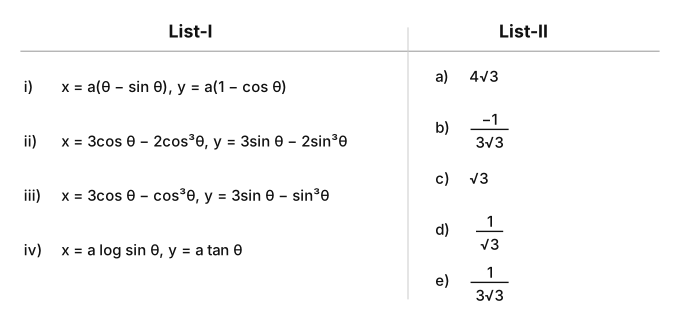
- TG EAPCET 2023Set eng-2023-05-14-AN1 markMCQQ.Match the values of dxdy at x=3π for the following system of curves in parametric form given in List-I with those of the items in List-II List-Ii) x=a(θ−sinθ), y=a(1−cosθ)ii) x=3cosθ−2cos3θ, y=3sinθ−2sin3θiii) x=3cosθ−cos3θ, y=3sinθ−sin3θiv) x=alogsinθ, y=atanθ List-IIa) 43b) −331c) 3d) 31e) 331 (A)(i) → c,(ii) → d,(iii) → b,(iv) → a (B)(i) → c,(ii) → e,(iii) → d,(iv) → a (C)(i) → d,(ii) → c,(iii) → b,(iv) → a (D)(i) → d,(ii) → c,(iii) → e,(iv) → b
›Reveal solutionSolution
Each slope simplifies to a clean trig expression — cot(θ/2), cotθ, −cot3θ and sec2θtanθ — evaluated at θ=π/3 they give 3, 31, −331, 43. That is i→c, ii→d, iii→b, iv→a — option (A).
The concept first: simplify symbolically, substitute last
When x and y are both functions of a parameter θ, the chain rule gives
dxdy=dx/dθdy/dθ(provided dx/dθ=0).
The temptation is to plug θ=π/3 into dy/dθ and dx/dθ immediately. Resist it: in every one of these four curves an enormous common factor cancels (a cos2θ, a 3sinθ, an a…), and the ratio collapses to something you can evaluate in your head. Simplify first, substitute last — that is the entire craft here.
(i) Cycloid: x=a(θ−sinθ), y=a(1−cosθ)
dθdx=a(1−cosθ),dθdy=asinθ
dxdy=a(1−cosθ)asinθ=2sin22θ2sin2θcos2θ=cot2θ
At θ=π/3: cot6π=3. ⇒ (i) → c
(ii) x=3cosθ−2cos3θ, y=3sinθ−2sin3θ
dθdx=−3sinθ+6cos2θsinθ=3sinθ(2cos2θ−1)=3sinθcos2θ
dθdy=3cosθ−6sin2θcosθ=3cosθ(1−2sin2θ)=3cosθcos2θ
The cos2θ cancels beautifully:
dxdy=cotθ⇒cot3π=31
⇒ (ii) → d
(iii) x=3cosθ−cos3θ, y=3sinθ−sin3θ
dθdx=−3sinθ+3cos2θsinθ=−3sinθ(1−cos2θ)=−3sin3θ
dθdy=3cosθ−3sin2θcosθ=3cosθ(1−sin2θ)=3cos3θ …
- TG EAPCET 2023Set eng-2023-05-13-FN1 markMCQQ.limx→01−cos4x(32x−x+1)sin5x= (A) 53(log18−1) (B) 165log(e81) (C) 154(log81−1) (D) 516[log(27)−1]
›Reveal solutionSolution
The limit is evaluated by expanding each term near x=0 using series expansions (or standard limits) and simplifying; the result matches option (B).
We need to compute
L=limx→01−cos4x(32x−x+1)sin5x.
The denominator and numerator both vanish at x=0, so this is a 00 form. The key is to replace each piece with its leading-order behaviour near x=0.
1. Expand the denominator
Recall the standard limit
1−cosu∼2u2as u→0.
Here u=4x, so
1−cos4x∼2(4x)2=8x2.
Thus the denominator behaves like 8x2 for small x.
2. Expand sin5x
sin5x∼5xas x→0.
So the numerator contains a factor 5x from the sine.
3. Expand 32x
Write 32x=e2xlog3. Using et∼1+t+2t2 for small t,
32x∼1+(2log3)x+2(2log3)2x2=1+2log3⋅x+2(log3)2x2.
4. Expand x+1
1+x=(1+x)1/2∼1+21x−81x2.
5. Combine the difference
32x−x+1∼(1+2log3⋅x+2(log3)2x2)−(1+21x−81x2).
Cancel the 1's:
∼(2log3−21)x+(2(log3)2+81)x2.
The constant term and x term are present; the x2 term will be of higher order when multiplied by the sine factor.
6. Assemble the numerator
The numerator is
(32x−x+1)⋅sin5x∼[(2log3−21)x+O(x2)]⋅(5x).
So the leading term is
5(2log3−21)x2.
7. Form the limit
L=limx→08x25(2log3−21)x2=85(2log3−21).
Simplify:
- TG EAPCET 2022Set eng-2022-07-20-AN1 markMCQQ.If x2+y2=t−t1, x4+y4=t2+t21 then dxdy= (A) yx (B) −yx (C) xy (D) −xy
›Reveal solutionSolution
The key is to relate the given equations by squaring the first and comparing with the second, which reveals that x2y2=−1, leading to dxdy=−yx.
We have two equations linking x, y, and a parameter t:
x2+y2=t−t1,x4+y4=t2+t21.
The goal is to find dxdy without explicitly solving for t. The trick is to notice that squaring the first equation will produce x4+y4+2x2y2, which we can compare with the second equation to eliminate t.
- Square the first equation:
(x2+y2)2=(t−t1)2.
Expanding both sides:
x4+y4+2x2y2=t2+t21−2.
- Substitute the second equation x4+y4=t2+t21 into the left side:
(t2+t21)+2x2y2=t2+t21−2.
- Cancel t2+t21 from both sides, leaving:
2x2y2=−2⇒x2y2=−1.
Watch outx2y2=−1 means x and y cannot both be real numbers — but the problem is algebraic, so we proceed with the relation as given. In implicit differentiation, this relation is enough.
- Differentiate x2y2=−1 implicitly with respect to x. Using the product rule: …
- TG EAPCET 2025Set eng-2025-05-03-FN1 markMCQQ.If x=1−tany, then dxdy= (A) −x4+2x2+22x (B) −x4−2x2+22x (C) x4−2x2+22x (D) x4+2x2+22x
›Reveal solutionSolution
Implicit differentiation gives dxdy=−x4−2x2+22x. Option (B).
Solution
From x=1−tany, square both sides:
x2=1−tany ⟹ tany=1−x2.
Differentiate x2=1−tany with respect to x:
2x=−sec2ydxdy ⟹ dxdy=−sec2y2x.
Express sec2y in terms of x using sec2y=1+tan2y: …
🎓Unlock everything free for 14 days
- ✓Full step-by-step solutions
- ✓Concept-first explanations
- ✓Methods, shortcuts & mistakes
- ✓PYQ mapping + timed mock tests
Full access for 14 days. No credit card required.