Q.Find the values of a,b,c, and d from the following equation: [2a+b5c−da−2b4c+3d]=[411−324]
🔒You're viewing a preview — the full solution, concept, methods & PYQ mapping are locked.
🔒 Start your 14-day free trial to unlock the full solution →Concept understanding — Vector Equality
Vector Equality
When are two vectors the same vector? A vector carries only two pieces of information — magnitude (length) and direction. It does not carry a fixed starting point. So two vectors are equal when they agree on both magnitude and direction, no matter where each one happens to be drawn.
Precise definition
Two vectors a and b are equal, written a=b, if and only if
- they have the same magnitude, ∣a∣=∣b∣, and
- they have the same direction.
Position is irrelevant. An arrow drawn at the top-left of the page and an identical-length, identical-direction arrow at the bottom-right are the same vector. This is why such vectors are called "free" vectors — you may slide them anywhere without changing them.
In component form
Equality becomes a simple check on coordinates. If
a=a1i^+a2j^+a3k^,b=b1i^+b2j^+b3k^,
then
a=b⟺a1=b1,a2=b2,a3=b3.
Equal vectors have equal corresponding components — a single vector equation is really three scalar equations at once.
Don't confuse it with neighbouring ideas
Equal vectors are not the same as coinitial vectors (which merely share a starting point) or collinear vectors (which are parallel but may differ in length or point oppositely). Two vectors of equal length pointing in opposite directions are not equal — they are negatives of each other, a=−b.
Why it matters …
Concept: Vector Equality — two matrices are equal if and only if their corresponding entries are equal.
Step 1: Equate the (1,1) and (1,2) entries:
2a+b=4,a−2b=−3
Step 2: Solve for a and b. From the second equation, a=2b−3. Substitute into the first:
2(2b−3)+b=4⟹4b−6+b=4⟹5b=10⟹b=2
Then a=2(2)−3=1.
Step 3: Equate the (2,1) and (2,2) entries:
5c−d=11,4c+3d=24 …
Two matrices are equal if and only if their corresponding entries are equal. This gives four simple linear equations in a,b,c,d. Solving them yields a=1, b=2, c=3, d=4.
The core idea here is vector equality applied to matrices. When two matrices are declared equal, every entry in the same position must match exactly. That’s not a suggestion — it’s the definition. So this single matrix equation is really a compact way of writing four separate equations, one for each position.
Let’s unpack it.
We have:
[2a+b5c−da−2b4c+3d]=[411−324]
Since the matrices are 2×2, equality means:
- Top-left entry: 2a+b=4
- Top-right entry: a−2b=−3
- Bottom-left entry: 5c−d=11
- Bottom-right entry: 4c+3d=24
Notice something beautiful: the equations for a,b are completely separate from those for c,d. They don’t mix. So we can solve them as two independent pairs.
Solving for a and b
We have:
{2a+b=4(1)a−2b=−3(2)
From (2), we get a=2b−3. Substitute into (1):
2(2b−3)+b=4⟹4b−6+b=4⟹5b=10⟹b=2
Then a=2(2)−3=1. …
Method: Turning a matrix equality into simultaneous equations
Use this when equal matrices have entries that are linear combinations of unknowns, giving small systems to solve.
Steps
Step 1: Equate corresponding entries.
Each position gives one linear equation in the unknowns.
Step 2: Group the equations that share unknowns. …
Common Mistakes
Mistake 1: Pairing the wrong constant with an entry.
Why it's wrong: the bottom-right entry gives 4c+3d=24, not =11; the numbers 11 and 24 sit in different positions. Correct approach: match each expression to the number in the same position.
Mistake 2: Arithmetic slips in elimination. …
Showing the 12 most recent of 21 on this concept.
- TG EAPCET 2021Set eng-2021-08-04-FN1 markMCQQ.If (49,45,415) is the centroid of a tetrahedron whose vertices are (a,2,1), (1,b,4), (4,0,c) and (1,1,7), then (A) a=b=c (B) a=b=c+1 (C) b=c=a+1 (D) a=c=b+1
›Reveal solutionSolution
The centroid of a tetrahedron is the average of its four vertices. Equating the given centroid to the average yields three equations, which give a=2, b=3, c=4, so b=c=a+1.
The centroid of a tetrahedron is not the same as the centroid of a triangle — but the idea is similar. For a triangle, the centroid is the average of the three vertices. For a tetrahedron (a 3D solid with four vertices), the centroid is simply the average of the coordinates of its four vertices. That’s the key concept: if the vertices are A, B, C, D, then the centroid G is
G=(4xA+xB+xC+xD,4yA+yB+yC+yD,4zA+zB+zC+zD).
We are told this centroid equals (49,45,415). So we just match coordinates and solve.
- Set up the x-coordinate equation. The x-coordinates of the vertices are a, 1, 4, 1. Their sum is a+1+4+1=a+6. The centroid’s x-coordinate is 4a+6, and this must equal 49.
4a+6=49⇒a+6=9⇒a=3.
- Set up the y-coordinate equation. The y-coordinates are 2, b, 0, 1. Their sum is 2+b+0+1=b+3. The centroid’s y-coordinate is 4b+3, and this must equal 45.
4b+3=45⇒b+3=5⇒b=2.
- Set up the z-coordinate equation. …
- TG EAPCET 2022Set eng-2022-07-18-FN1 markMCQQ.Let a=i+j+k, b=i−2j+k, c=i+3j−2k, d=2i+j−k be four vectors and let l=b⋅c and m=c⋅a. Then [mb+la b d]= (A) 79 (B) −63 (C) 0 (D) 1
›Reveal solutionSolution
The problem asks for the scalar triple product [mb+la b d], where l=b⋅c and m=c⋅a. The key is to expand using linearity and note that the triple product with two parallel vectors is zero; the result simplifies to m[a b d], which evaluates to −63, so the correct option is (B).
We are given four vectors:
a=i+j+k,b=i−2j+k,c=i+3j−2k,d=2i+j−k.
We define scalars:
l=b⋅c,m=c⋅a.
We need the scalar triple product:
[mb+la b d].
Concept and intuition:
The scalar triple product [u v w]=u⋅(v×w) is linear in each argument. Here the first argument is a linear combination of a and b. Expanding will give two terms. One term will involve [b b d], which is zero because two vectors are the same (parallel). The other term will be m[a b d]. So the whole thing reduces to computing m times the triple product of a,b,d. That’s much simpler.
Step-by-step solution:
- Compute l and m.
l=b⋅c=(1)(1)+(−2)(3)+(1)(−2)=1−6−2=−7.
m=c⋅a=(1)(1)+(3)(1)+(−2)(1)=1+3−2=2.
- Expand the triple product using linearity.
[mb+la b d]=m[b b d]+l[a b d].
Since [b b d]=0 (two identical vectors), we get:
=l[a b d].
- Compute [a b d]. Write vectors as rows (or columns) in a determinant:
a=(1,1,1),b=(1,−2,1),d=(2,1,−1).
The scalar triple product is:
[a b d]=1121−2111−1.
Compute the determinant:
=1⋅−211−1… - TG EAPCET 2024Set eng-2024-05-10-AN1 markMCQQ.If a=i+2j+k, b=3(i−j+k) and c is a vector such that a×c=b and a⋅c=3, then a⋅(c×b−b−c)= (A) 32 (B) 24 (C) 20 (D) 36
›Reveal solutionSolution
The key idea is to use vector identities to simplify the expression a⋅(c×b−b−c) into a form involving known dot and cross products, then substitute the given values to get the result 24, which corresponds to option (B).
We are given:
a=i+2j+k,b=3(i−j+k),a×c=b,a⋅c=3.
We need a⋅(c×b−b−c).
Concept and intuition:
The expression mixes dot and cross products. The term c×b is perpendicular to both c and b, but when dotted with a, we can use the scalar triple product identity: a⋅(c×b)=c⋅(b×a). Since we know a×c=b, we can relate b×a to something simpler. The other terms a⋅b and a⋅c are directly computable or given. This avoids solving for c explicitly.
Step-by-step solution:
- Simplify the triple product term. Use the scalar triple product cyclic property:
a⋅(c×b)=c⋅(b×a).
Now, b×a=−(a×b). But we know a×c=b. To relate a×b, take the cross product of both sides of a×c=b with a:
a×(a×c)=a×b.
Use the vector triple product identity: a×(a×c)=(a⋅c)a−(a⋅a)c.
So:
a×b=(a⋅c)a−∣a∣2c.
Given a⋅c=3, and ∣a∣2=12+22+12=6, we have:
a×b=3a−6c.
Hence:
b×a=−(a×b)=−3a+6c.
Therefore:
a⋅(c×b)=c⋅(b×a)=c⋅(−3a+6c)=−3(a⋅c)+6∣c∣2.
Since a⋅c=3, this becomes:
a⋅(c×b)=−9+6∣c∣2.
- Find ∣c∣2 using the given cross product. From a×c=b, take the magnitude squared: ∣a×c∣2=∣b∣2. …
- TG EAPCET 2021Set eng-2021-08-06-FN1 markMCQQ.If a=i+j+k, c=j−k, a×b=c and a⋅b=3, then b= (A) 31(5i+2j+2k) (B) 31(2i+5j+2k) (C) 31(2i+2j+5k) (D) 31(2i+5j+5k)
›Reveal solutionSolution
We use the vector triple product identity a×(a×b)=(a⋅b)a−(a⋅a)b to solve for b directly from the given cross and dot products. The answer is 31(2i+2j+5k), option (C).
The key idea is that we know a×b=c and a⋅b=3, but we don’t know b itself. The cross product alone gives only the part of b perpendicular to a; the dot product gives the parallel part. To extract b cleanly, we can cross a with the given cross product — this uses the vector triple product identity, which neatly separates b into components along and perpendicular to a.
- Set up the triple product. Take a×(a×b). By the identity:
a×(a×b)=(a⋅b)a−(a⋅a)b.
We know a⋅b=3, and a⋅a=12+12+12=3. So:
a×(a×b)=3a−3b.
- Replace a×b with c. Since a×b=c, we have:
a×c=3a−3b.
- Compute a×c. a=i+j+k, c=j−k.
a×c=i10j11k1−1=i(1⋅(−1)−1⋅1)−j(1⋅(−1)−1⋅0)+k(1⋅1−1⋅0)
=i(−1−1)−j(−1−0)+k(1−0)=−2i+j+k.
- Solve for b. From step 2: −2i+j+k=3a−3b. …
- TG EAPCET 2021Set eng-2021-08-05-AN1 markMCQQ.Let a,b,c be unit vectors such that 2a+3b+4c=0. Then ∣b×c∣= (A) 815 (B) 1615 (C) 415 (D) 215
›Reveal solutionSolution
By manipulating the given vector equation and using the properties of unit vectors, we first find the dot product b⋅c. Then, using the identity relating the magnitude of the cross product to the dot product, we calculate ∣b×c∣. The result is 815.
The problem asks for the magnitude of the cross product of two unit vectors, ∣b×c∣, given a linear relationship between three unit vectors. The core idea is to use the given vector equation 2a+3b+4c=0 to find the dot product b⋅c. Once we have this dot product, we can use a fundamental identity that connects the magnitude of the cross product, the magnitudes of the individual vectors, and their dot product. Since b and c are unit vectors, their magnitudes are 1, which simplifies the calculation significantly.
To find b⋅c from the given equation, we can isolate the term involving a and then take the dot product of both sides with themselves. This eliminates a from the equation and introduces dot products of b and c, which is exactly what we need.
Here is a step-by-step solution:
-
Understand the given information:
We are given that a,b,c are unit vectors. This means their magnitudes are 1:
∣a∣=1
∣b∣=1
∣c∣=1
We are also provided with the vector equation:
2a+3b+4c=0
-
Isolate a term to simplify the equation:
To establish a relationship between b and c that involves their dot product, we can move the term containing a to one side of the equation. This allows us to eliminate a when we take the dot product of the equation with itself.
2a=−(3b+4c)
-
Square both sides (take the dot product with itself):
Taking the dot product of each side with itself is a standard technique to introduce magnitudes and dot products of vectors.
(2a)⋅(2a)=(−(3b+4c))⋅(−(3b+4c))
Using the property x⋅x=∣x∣2, the left side becomes 4∣a∣2.
The right side simplifies to (3b+4c)⋅(3b+4c).
So, we have:
4∣a∣2=(3b+4c)⋅(3b+4c)
-
Expand the dot product and substitute magnitudes:
Expand the dot product on the right side using the distributive property:
(3b+4c)⋅(3b+4c)=(3b)⋅(3b)+(3b)⋅(4c)+(4c)⋅(3b)+(4c)⋅(4c)
=9(b⋅b)+12(b⋅c)+12(c⋅b)+16(c⋅c)
Since b⋅b=∣b∣2, c⋅c=∣c∣2, and b⋅c=c⋅b, this simplifies to:
=9∣b∣2+16∣c∣2+24(b⋅c)
Now, substitute this back into the equation from step 3:
4∣a∣2=9∣b∣2+16∣c∣2+24(b⋅c)
Since a,b,c are unit vectors, we substitute ∣a∣=1,∣b∣=1,∣c∣=1:
4(1)2=9(1)2+16(1)2+24(b⋅c)
4=9+16+24(b⋅c)
4=25+24(b⋅c) …
-
- TG EAPCET 2025Set eng-2025-05-02-AN1 markMCQQ.a,b,c are three unit vectors such that xa+yb+zc=p(b×c)+q(c×a)+r(a×b). If (a,b)=(b,c)=(c,a)=3π, (a,b×c)=6π and a,b,c form a right-handed system, then p+q+rx+y+z= (A) 43 (B) 21 (C) 22 (D) 83
›Reveal solutionSolution
The key idea is to express the given vector equation in terms of a basis formed by a,b,c and use the given angles to compute dot products and scalar triple products, leading to p+q+rx+y+z=83.
We are given three unit vectors a,b,c with pairwise angles 3π, and the angle between a and b×c is 6π, with a right-handed system. The equation
xa+yb+zc=p(b×c)+q(c×a)+r(a×b)
relates two linear combinations. The goal is to find p+q+rx+y+z.
Concept and intuition:
Since a,b,c are not coplanar (they form a right-handed system and have a nonzero scalar triple product), they form a basis for 3D space. The right side uses cross products, which are perpendicular to the original vectors. To compare coefficients, we can take dot products with each of a,b,c to get equations linking x,y,z to p,q,r. Then summing those equations yields the desired ratio.
- Compute the scalar triple product [abc]. For unit vectors with pairwise angles 3π, the volume of the parallelepiped is
[abc]=a⋅(b×c)=∣a∣∣b×c∣cos6π.
Since ∣b×c∣=sin3π=23, we get
[abc]=1⋅23⋅23=43.
This positive value confirms the right-handed system.
- Take dot product of the given equation with a.
Left side: x(a⋅a)+y(b⋅a)+z(c⋅a)=x+ycos3π+zcos3π=x+2y+2z.
Right side: p(b×c)⋅a+q(c×a)⋅a+r(a×b)⋅a.
- (b×c)⋅a=[abc]=43.
- (c×a)⋅a=0 (cross product perpendicular to a).
- (a×b)⋅a=0 (same reason). So right side = p⋅43. Equation (1):
x+2y+2z=43p.
- Take dot product with b.
Left: xcos3π+y+zcos3π=2x+y+2z.
Right: p(b×c)⋅b+q(c×a)⋅b+r(a×b)⋅b.
- (b×c)⋅b=0.
- (c×a)⋅b=[bca]=[abc]=43 (cyclic permutation).
- (a×b)⋅b=0. So right side = q⋅43. Equation (2):
2x+y+2z=43q.
- Take dot product with c. …
- TG EAPCET 2025Set eng-2025-05-02-AN1 markMCQQ.A, B, C, D are any four points. If E and F are mid points of AC and BD respectively, then AB+CB+CD+AD= (A) EF (B) 2EF (C) 3EF (D) 4EF
›Reveal solutionSolution
The sum of the four vectors equals four times the vector joining the midpoints of the diagonals, so the answer is 4 EF.
Concept and Intuition
We are dealing with vectors in free space — points A, B, C, D are arbitrary, and we want a neat expression for
AB+CB+CD+AD
in terms of the segment joining the midpoints of the diagonals AC and BD.
The key trick: midpoint vectors let us rewrite each side as a difference of position vectors. Then, by grouping terms cleverly, the sum collapses into a multiple of EF.
Step‑by‑Step Solution
- Assign position vectors Let the position vectors of A, B, C, D be a,b,c,d respectively (with respect to some origin). Then:
AB=b−a,CB=b−c,CD=d−c,AD=d−a.
- Write the sum
S=(b−a)+(b−c)+(d−c)+(d−a).
-
Collect like terms
- Terms with b: b+b=2b
- Terms with d: d+d=2d
- Terms with −a: −a−a=−2a
- Terms with −c: −c−c=−2c
So
S=2b+2d−2a−2c=2[(b+d)−(a+c)].
- Introduce midpoints E is the midpoint of AC, so e=2a+c. …
- TG EAPCET 2023Set eng-2023-05-13-FN1 markMCQQ.Let a=λi^+3j^+4k^, b=3i^−j^+λk^ and c=λi^+j^−3k^ be three vectors for some integer λ. If the volume of the parallelepiped with a,b,c as coterminous edges is 61 cubic units, then the number of possible values of λ is (A) 4 (B) 3 (C) 2 (D) 1
›Reveal solutionSolution
The volume of a parallelepiped is the absolute value of the scalar triple product. Setting ∣[a,b,c]∣=61 gives a cubic equation in λ; counting its integer solutions yields the answer.
Concept & Intuition
The volume of a parallelepiped formed by three vectors is the absolute value of their scalar triple product:
V=∣a⋅(b×c)∣.
This is also the absolute value of the determinant of the matrix whose rows (or columns) are the vectors.
We are told V=61, so we compute the determinant, set its absolute value equal to 61, and solve for the integer λ. The number of integer solutions is what we count.
Step-by-step solution
- Write the vectors in component form
a=(λ,3,4),b=(3,−1,λ),c=(λ,1,−3).
- Compute the scalar triple product The scalar triple product [a,b,c]=a⋅(b×c) equals the determinant:
Δ=λ3λ3−114λ−3.
Expand along the first row:
Δ=λ−11λ−3−33λλ−3+43λ−11.
Compute each minor:
−11λ−3=(−1)(−3)−(λ)(1)=3−λ,
3λλ−3=(3)(−3)−(λ)(λ)=−9−λ2,
3λ−11=(3)(1)−(−1)(λ)=3+λ.
Substitute back:
Δ=λ(3−λ)−3(−9−λ2)+4(3+λ).
- Simplify the expression
Δ=3λ−λ2+27+3λ2+12+4λ.
Combine like terms:
Δ=(−λ2+3λ2)+(3λ+4λ)+(27+12)=2λ2+7λ+39.
- Set the absolute value equal to 61 Volume is ∣Δ∣=61, so:
∣2λ2+7λ+39∣=61.
This gives two cases:
2λ2+7λ+39=61or2λ2+7λ+39=−61.
- Solve each equation
- First equation:
- TG EAPCET 2026Set eng-2026-05-11-AN1 markMCQQ.a,b,c are the position vectors of three points A, B, C respectively. If ∠ABC=2π, AB=i+4j+(4−λ)k, AC=(λ−1)i+6j+(2−λ)k, then λ= (A) 0 (B) −31 (C) −43 (D) 32
›Reveal solutionSolution
The right angle at B forces λ=32 (D).
∠ABC=2π means BA⊥BC. Writing these through the given vectors, BA=−AB and BC=AC−AB, so
BA⋅BC=−AB⋅(AC−AB)=∣AB∣2−AB⋅AC=0 ⇒ ∣AB∣2=AB⋅AC.
With AB=i+4j+(4−λ)k and AC=(λ−1)i+6j+(2−λ)k: …
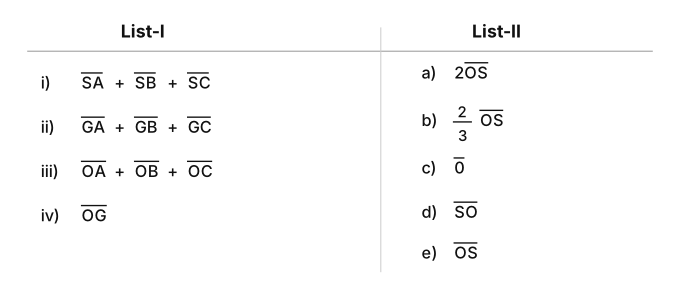
- TG EAPCET 2023Set eng-2023-05-14-AN1 markMCQQ.If S is the circumcentre, O is the orthocentre and G is the centroid of a triangle ABC, then match the items of the List-I with those of the items of List-II given below. ABC List-Ii) SA+SB+SCii) GA+GB+GCiii) OA+OB+OCiv) OG List-IIa) 2OSb) 32OSc) Od) SOe) OS Then the correct match is (A) i → c, ii → b, iii → e, iv → a (B) i → b, ii → c, iii → a, iv → d (C) i → d, ii → a, iii → c, iv → e (D) i → d, ii → c, iii → a, iv → b
›Reveal solutionSolution
Taking the circumcentre as origin makes the orthocentre h=a+b+c, from which all four expressions drop out at once: i→d, ii→c, iii→a, iv→b — option (D).
The concept first: choose the origin that makes the geometry speak
Vector proofs about triangle centres become almost trivial once you place the origin cleverly. Put the circumcentre S at the origin and let the vertices be a,b,c (all of equal length — the circumradius). Two standard facts then hold:
- Centroid: g=3a+b+c (the centroid is always the average of the vertices, whatever the origin).
- Orthocentre: h=a+b+c — a beautiful result that holds only when S is the origin.
Notice the immediate corollary: h=3g, so S, G and H are collinear and SG:GH=1:2. That is the Euler line, and this whole question is really the Euler line dressed as a matching exercise.
Step-by-step (throughout, S = origin, so s=0 and h=a+b+c)
(i) SA+SB+SC.
=(a−0)+(b−0)+(c−0)=a+b+c=h
And SO=h−0=h. So i → d (SO).
(ii) GA+GB+GC.
=(a−g)+(b−g)+(c−g)=(a+b+c)−3g=3g−3g=0
This is the defining property of the centroid — it is the balance point. So ii → c (0).
(iii) OA+OB+OC (here O = orthocentre, position h). …
- TG EAPCET 2022Set eng-2022-07-18-FN1 markMCQQ.Let a be a vector in the plane containing vectors b=i^+2j^+k^ and c=2i^−j^+k^. If a is perpendicular to i^+j^+3k^ and its projection on b is 36, then ∣a∣2= (A) 186 (B) 36 (C) 128 (D) 264
›Reveal solutionSolution
Writing a=αb+βc, the perpendicular and projection conditions give α=4, β=−6, so a=(−8,14,−2) and ∣a∣2=264 — option (D).
Plane condition. Since a lies in the plane of b=(1,2,1) and c=(2,−1,1),
a=αb+βc=(α+2β, 2α−β, α+β).
Perpendicular to d=(1,1,3): a⋅d=0 gives
(α+2β)+(2α−β)+3(α+β)=6α+4β=0 ⇒ 3α+2β=0.
Projection on b: ∣b∣a⋅b=36 with ∣b∣=6, so a⋅b=18. Using b⋅b=6 and c⋅b=1: …
- TG EAPCET 2026Set eng-2026-05-09-AN1 markMCQQ.If a=2i−j−3k, b=i+3j−2k, c=3i−2j+k are three vectors and a+λb is a vector, for some particular real values of λ, such that the magnitude of the projection of a+λb on c is 1410, then the sum of the squares of the magnitudes of all such vectors a+λb is (A) 188 (B) 225 (C) 121 (D) 181
›Reveal solutionSolution
The projection condition gives a quadratic in λ; the sum of squares of the magnitudes of the resulting vectors equals 181.
The problem asks for the sum of the squares of the magnitudes of all vectors a+λb whose projection onto c has a fixed magnitude. The key is to treat λ as an unknown, impose the projection condition, solve for λ, then compute ∣a+λb∣2 for each solution and add them.
- Write the projection condition. The magnitude of the projection of a vector v onto c is ∣c∣∣v⋅c∣. Here v=a+λb, so the condition is
∣c∣∣(a+λb)⋅c∣=1410.
- Compute the needed dot products and ∣c∣.
a⋅c=(2)(3)+(−1)(−2)+(−3)(1)=6+2−3=5.
b⋅c=(1)(3)+(3)(−2)+(−2)(1)=3−6−2=−5.
∣c∣=32+(−2)2+12=9+4+1=14.
- Form the equation in λ. The dot product is
(a+λb)⋅c=5+λ(−5)=5−5λ.
The projection magnitude condition becomes
14∣5−5λ∣=1410⇒∣5−5λ∣=10.
Dividing by 5: ∣1−λ∣=2.
- Solve for λ. 1−λ=2 gives λ=−1. 1−λ=−2 gives λ=3. So the two vectors are a−b and a+3b.
Watch outThe absolute value gives two solutions — do not drop the negative case. Many students stop at λ=−1 and miss λ=3.
- Compute ∣a+λb∣2 for each λ. First, find a⋅b:
a⋅b=(2)(1)+(−1)(3)+(−3)(−2)=2−3+6=5.
Also ∣a∣2=22+(−1)2+(−3)2=4+1+9=14,
and ∣b∣2=12+32+(−2)2=1+9+4=14.
For any λ,
🎓Unlock everything free for 14 days
- ✓Full step-by-step solutions
- ✓Concept-first explanations
- ✓Methods, shortcuts & mistakes
- ✓PYQ mapping + timed mock tests
Full access for 14 days. No credit card required.