Q.Find the angle between the following pairs of lines:
🔒You're viewing a preview — the full solution, concept, methods & PYQ mapping are locked.
🔒 Start your 14-day free trial to unlock the full solution →Concept understanding — Angle Between Lines
Angle Between Two Lines
In space, the angle between two lines is measured through their directions, not their positions — two lines that never meet still have a well-defined angle between them (the angle you would see if you slid one across to meet the other).
So the angle between the lines is just the angle between their direction vectors. If the lines run along b1 and b2,
cosθ=∣b1∣∣b2∣∣b1⋅b2∣
Why the absolute value
A line has two opposite directions, so b and −b describe the same line. The modulus in the numerator picks the acute angle (0∘≤θ≤90∘), which is the convention for the angle between lines.
In Cartesian form
If the lines have direction ratios (a1,b1,c1) and (a2,b2,c2),
cosθ=a12+b12+c12a22+b22+c22∣a1a2+b1b2+c1c2∣.
If instead you know the direction cosines (l1,m1,n1) and (l2,m2,n2), the denominators are both 1 and cosθ=∣l1l2+m1m2+n1n2∣.
Two special cases
- Parallel: the direction ratios are proportional, a2a1=b2b1=c2c1.
- Perpendicular: the dot product vanishes, a1a2+b1b2+c1c2=0.
Example …
Concept: Angle Between Lines — the angle between two lines equals the angle between their direction vectors. For lines given in vector form r=a+λb, use cosθ=∣b1∣∣b2∣∣b1⋅b2∣.
(i) Direction vectors: b1=3i^+2j^+6k^, b2=i^+2j^+2k^.
Dot product: b1⋅b2=3(1)+2(2)+6(2)=3+4+12=19.
Magnitudes: ∣b1∣=32+22+62=9+4+36=49=7; ∣b2∣=12+22+22=1+4+4=9=3.
cosθ=7×319=2119. Since 2119<1, θ=cos−1(2119).
(ii) Direction vectors: b1=i^−j^−2k^, b2=3i^−5j^−4k^.
Dot product: b1⋅b2=1(3)+(−1)(−5)+(−2)(−4)=3+5+8=16. …
The angle between two lines in vector form is found using the dot product of their direction vectors. For (i) the angle is θ=cos−1(2119), and for (ii) the angle is θ=cos−1(1583).
The key idea is simple: a line in space is defined by a point and a direction. The direction vector tells you which way the line runs. When two lines are given in the form r=a+λb, the angle between them is just the angle between their direction vectors b1 and b2. The position vectors a don't matter at all for the angle — they only tell you where the lines are located, not how they're oriented.
Why does this work? Because the direction vector is like an arrow along the line. If you slide both arrows to the same starting point, the angle between them is exactly the angle between the lines. The dot product formula b1⋅b2=∣b1∣∣b2∣cosθ gives us cosθ, and then we take the inverse cosine.
A common mistake is to include the position vectors a in the dot product. They are irrelevant for the angle — only the coefficients of λ and μ matter.
Let's work through each part step by step.
Part (i)
-
Identify the direction vectors.
For the first line, r=2i^−5j^+k^+λ(3i^+2j^+6k^), the direction vector is b1=3i^+2j^+6k^.
For the second line, r=7i^−6k^+μ(i^+2j^+2k^), the direction vector is b2=i^+2j^+2k^.
-
Compute the dot product.
b1⋅b2=(3)(1)+(2)(2)+(6)(2)=3+4+12=19.
-
Find the magnitudes.
∣b1∣=32+22+62=9+4+36=49=7.
∣b2∣=12+22+22=1+4+4=9=3.
-
Apply the formula.
cosθ=∣b1∣∣b2∣b1⋅b2=7×319=2119.
Therefore, θ=cos−1(2119).
Notice that 19/21 is already in simplest form. If the dot product had been zero, the lines would be perpendicular. If the direction vectors were scalar multiples, the lines would be parallel.
Part (ii)
- Identify the direction vectors. First line: r=3i^+j^−2k^+λ(i^−j^−2k^), so b1=i^−j^−2k^. …
Method: Angle between two lines from their direction vectors
The angle between two lines is the angle between their directions — where the lines sit is irrelevant. When lines are given as r=a+λb, only the b's matter.
Steps
Step 1: Pull out the two direction vectors b1,b2 — the coefficients of λ and μ. Discard the position vectors a entirely; they never enter the angle.
Step 2: Apply the cosine formula.
cosθ=∣b1∣∣b2∣∣b1⋅b2∣.
The absolute value in the numerator forces the acute angle, the convention for the angle between lines. …
Common Mistakes
Mistake 1: Including the position vectors a in the calculation.
Why it's wrong: the angle depends only on the directions b1,b2 (the coefficients of λ,μ); the constant vectors — even a large −56k^ — are irrelevant. Correct approach: dot only the direction vectors.
Mistake 2: Omitting the modulus in the numerator. …
Showing the 12 most recent of 44 on this concept.
- TG EAPCET 2021Set eng-2021-08-05-AN1 markMCQQ.The shortest distance between the Skew lines r=(3i+4j−2k)+λ(−i+2j+k) and r=(i−7j−2k)+μ(i+3j+2k) is (A) 5526 (B) 45 (C) 35 (D) 5536
›Reveal solutionSolution
The shortest distance is 35 — option (C).
For skew lines r=a1+λd1 and r=a2+μd2,
d=∣d1×d2∣∣(a2−a1)⋅(d1×d2)∣.
Here d1=(−1,2,1), d2=(1,3,2):
d1×d2=(2⋅2−1⋅3, −(−1⋅2−1⋅1), −1⋅3−2⋅1)=(1, 3, −5),∣d1×d2∣=35. …
- TG EAPCET 2023Set eng-2023-05-14-AN1 markMCQQ.If θ is the acute angle between the two lines whose direction cosines are connected by the relations l+m+n=0 and 2lm+2nl−mn=0, then cosθ= (A) 21 (B) 23 (C) 65 (D) 53
›Reveal solutionSolution
The acute angle between the two lines is found by solving the given constraints for direction cosines, then using the dot product formula; the result is cosθ=21, so the correct option is (A).
We are given two lines whose direction cosines (l,m,n) satisfy two conditions:
- l+m+n=0
- 2lm+2nl−mn=0
We need the cosine of the acute angle between these two lines.
Concept and Intuition
Direction cosines of a line satisfy l2+m2+n2=1. For two lines with direction cosines (l1,m1,n1) and (l2,m2,n2), the cosine of the angle between them is
cosθ=l1l2+m1m2+n1n2.
Here, both lines share the same pair of equations, so we must find two distinct sets (l,m,n) that satisfy both constraints. The trick: treat the equations as a system that yields a relation between the ratios of l,m,n, then find two independent direction vectors.
Step-by-step solution
-
Eliminate one variable using l+m+n=0
From l+m+n=0, we have n=−l−m.
-
Substitute into the second equation
The second condition is 2lm+2nl−mn=0. Substitute n:
2lm+2(−l−m)l−m(−l−m)=0.
Simplify:
2lm−2l2−2lm+ml+m2=0.
The 2lm and −2lm cancel. We get:
−2l2+ml+m2=0.
Multiply by −1:
2l2−ml−m2=0.
- Solve the quadratic in l and m Treat this as a quadratic in l:
2l2−ml−m2=0.
Using the quadratic formula:
l=4m±m2+8m2=4m±3m.
So the two possibilities are:
l=4m+3m=morl=4m−3m=−2m.
-
Find the corresponding direction ratios
- Case 1: l=m. Then n=−l−m=−2l. So direction ratios are (l,l,−2l), i.e., proportional to (1,1,−2).
- Case 2: l=−2m. Then m=−2l, and n=−l−(−2l)=l. So direction ratios are (l,−2l,l), i.e., proportional to (1,−2,1).
These are two distinct lines.
-
Compute cosθ using the dot product …
- TG EAPCET 2026Set eng-2026-05-10-AN1 markMCQQ.If the angle between the straight lines whose direction cosines satisfy the equations l−2m+n=0 and 2l2−3m2+n2=0 is θ, then cosθ= (A) 1059 (B) 733 (C) 2π (D) 4π
›Reveal solutionSolution
The problem asks for the cosine of the angle between two lines whose direction cosines satisfy two given equations. By solving the system for possible direction ratios and using the dot product formula, we find cosθ=1059, which corresponds to option (A).
We are given two conditions that the direction cosines (l,m,n) of each line must satisfy:
l−2m+n=0and2l2−3m2+n2=0.
Since direction cosines also satisfy l2+m2+n2=1, but we don’t need that directly — we only need the ratios of direction cosines to find the angle between the lines. The key idea: each line corresponds to a set (l,m,n) (up to a common factor) that satisfies both equations. The angle between two such lines is found from the dot product of their direction vectors.
1. Eliminate one variable using the linear equation
From l−2m+n=0, we have
n=2m−l.
2. Substitute into the quadratic equation
Plug into 2l2−3m2+n2=0:
2l2−3m2+(2m−l)2=0.
Expand (2m−l)2=4m2−4lm+l2, so:
2l2−3m2+4m2−4lm+l2=0,
3l2+m2−4lm=0.
3. Treat as a quadratic in l/m
Divide through by m2 (assuming m=0; we’ll check later):
3(ml)2−4(ml)+1=0.
Let t=l/m. Then:
3t2−4t+1=0.
Solve:
t=64±16−12=64±2.
So t=1 or t=31.
4. Find direction ratios for each case
Case 1: l/m=1⇒l=m.
From n=2m−l=2m−m=m.
So direction ratios are (l,m,n)=(1,1,1).
Case 2: l/m=1/3⇒l=m/3.
Then n=2m−l=2m−m/3=35m.
So direction ratios are (1/3,1,5/3), or multiply by 3: (1,3,5).
Thus the two lines have direction vectors a=(1,1,1) and b=(1,3,5). …
- TG EAPCET 2023Set eng-2023-05-12-FN1 markMCQQ.If the direction cosines (l,m,n) of two lines are connected by the relations l+m+n=0 and lm=0, then the angle between those lines is (A) 3π (B) 4π (C) 2π (D) 6π
›Reveal solutionSolution
The condition l+m+n=0 and lm=0 forces each line’s direction cosines to be a permutation of (1,−1,0)/2, so the angle between them is π/3, making option (A) correct.
We are given two lines whose direction cosines (l,m,n) satisfy:
l+m+n=0andlm=0.
We need the angle between these two lines.
Concept & Intuition
Direction cosines satisfy l2+m2+n2=1. The conditions l+m+n=0 and lm=0 are symmetric but not fully symmetric — they force one of l or m to be zero. That gives us a family of possible triples, but the angle between two distinct lines from this family is fixed. The trick is to find two distinct triples that satisfy both conditions, then compute the dot product to get the cosine of the angle between them.
Step-by-step reasoning
- Use the normalization condition Since (l,m,n) are direction cosines, we have:
l2+m2+n2=1.
Together with l+m+n=0, we can eliminate n: n=−l−m.
-
Apply lm=0
This means either l=0 or m=0 (or both, but both zero would force n=0 from l+m+n=0, which is impossible because then l2+m2+n2=0=1). So we have two cases:
- Case 1: l=0. Then m+n=0⇒n=−m. Normalization: 02+m2+(−m)2=2m2=1⇒m=±21. So one line has direction cosines (0,21,−21) or (0,−21,21). These are essentially the same line (opposite direction), so pick one representative:
Line A:(0,21,−21).
- Case 2: m=0. Then l+n=0⇒n=−l. Normalization: l2+02+(−l)2=2l2=1⇒l=±21. Pick the representative:
Line B:(21,0,−21).
These are two distinct lines satisfying the given relations.
- Compute the angle between them …
- TG EAPCET 2021Set eng-2021-08-04-FN1 markMCQQ.The angle between the vectors 2k−3j and i−2k is (A) cos−1(658) (B) cos−1(65−4) (C) cos−1(652) (D) cos−1(133)
›Reveal solutionSolution
The angle between two vectors is found using the dot product formula cosθ=∣a∣∣b∣a⋅b. For a=2k−3j and b=i−2k, the cosine simplifies to 65−4, so the angle is cos−1(65−4).
The core idea here is that the angle between two vectors depends only on their directions, not their magnitudes. The dot product gives us a direct handle on that angle: a⋅b=∣a∣∣b∣cosθ. So to find θ, we compute the dot product and the magnitudes, then solve for cosθ.
A common slip is to forget the sign of the dot product — it tells you whether the angle is acute or obtuse. Let’s work carefully.
-
Write the vectors in component form.
a=2k−3j has no i component, so:
a=0i−3j+2k=(0,−3,2).
b=i−2k has no j component, so:
b=1i+0j−2k=(1,0,−2).
-
Compute the dot product.
a⋅b=(0)(1)+(−3)(0)+(2)(−2)=0+0−4=−4.
-
Find the magnitudes.
∣a∣=02+(−3)2+22=0+9+4=13.
∣b∣=12+02+(−2)2=1+0+4=5.
-
Apply the formula. …
-
- TG EAPCET 2022Set eng-2022-07-20-AN1 markMCQQ.If the d.r.'s of two lines are connected by the relations a−b+c=0, a2−b2+2c2=0 and θ is the angle between these lines then cosθ= (A) 72 (B) 273 (C) 423 (D) 321
›Reveal solutionSolution
The relations give the two direction ratios (1,1,0) and (1,3,2); the angle between them has cosθ=72.
From a−b+c=0 we get b=a+c. Substitute into a2−b2+2c2=0:
a2−(a+c)2+2c2=0⇒−2ac+c2=0⇒c(c−2a)=0.
So c=0 or c=2a, giving the two lines:
- c=0⇒b=a: direction ratios (a,a,0)∝(1,1,0).
- c=2a⇒b=3a: direction ratios (a,3a,2a)∝(1,3,2).
Angle between them: …
- TG EAPCET 2022Set eng-2022-07-19-AN1 markMCQQ.If the angle between the planes r⋅(1i^−2j^+αk^)=7 and r⋅(2i^+4j^−2k^)=5 is 2π, then α= (A) 2 (B) 3 (C) 5 (D) 7
›Reveal solutionSolution
When two planes are perpendicular, their normal vectors are also perpendicular, meaning their dot product is zero. By setting the dot product of the given planes' normal vectors to zero, we find that α=−3.
The angle between two planes is defined as the angle between their normal vectors. A normal vector to a plane is a vector that is perpendicular to the plane.
The general vector equation of a plane is given by r⋅n=d, where n is the normal vector to the plane and d is a constant.
If two planes are perpendicular to each other, it means the angle between them is 90∘ or 2π radians. Consequently, their respective normal vectors must also be perpendicular to each other.
Two vectors A and B are perpendicular if and only if their dot product is zero: A⋅B=0.
We will use this property to find the value of α.
-
Identify the normal vectors of the given planes.
The first plane is given by the equation r⋅(1i^−2j^+αk^)=7.
From this, the normal vector to the first plane is n1=i^−2j^+αk^.
The second plane is given by the equation r⋅(2i^+4j^−2k^)=5.
From this, the normal vector to the second plane is n2=2i^+4j^−2k^.
-
Apply the condition for perpendicular planes.
We are given that the angle between the two planes is 2π. This means the planes are perpendicular.
As established, if the planes are perpendicular, their normal vectors n1 and n2 must also be perpendicular.
Therefore, their dot product must be zero: n1⋅n2=0.
-
Calculate the dot product and solve for α.
Substitute the expressions for n1 and n2 into the dot product equation: …
-
- TG EAPCET 2025Set eng-2025-05-02-FN1 markMCQQ.If the direction cosines of two lines satisfy the equations 2l+m−n=0, l2−2m2+n2=0 and θ is the angle between the lines then cosθ= (A) 51 (B) 4π (C) 32 (D) 3π
›Reveal solutionSolution
The direction cosines of each line satisfy two given equations; solving them yields two distinct direction vectors, and the cosine of the angle between them is found via dot product, giving cosθ=51.
We are given that the direction cosines (l,m,n) of two lines satisfy
2l+m−n=0andl2−2m2+n2=0.
The angle θ between the lines is the angle between their direction vectors. Since direction cosines satisfy l2+m2+n2=1, each line’s (l,m,n) is a unit vector. The two equations above must hold for both lines, but they define a set of possible unit vectors; the two distinct solutions give the two lines.
Why this approach works:
We treat the equations as a system in l,m,n with the constraint l2+m2+n2=1. Solving gives two unit vectors. Their dot product is cosθ.
-
Express one variable in terms of another
From 2l+m−n=0, we have n=2l+m.
-
Substitute into the second equation
l2−2m2+(2l+m)2=0.
Expand:
l2−2m2+4l2+4lm+m2=0⇒5l2+4lm−m2=0.
- Solve the quadratic relation between l and m Treat 5l2+4lm−m2=0 as quadratic in l:
5l2+4ml−m2=0.
Using the quadratic formula:
l=10−4m±16m2+20m2=10−4m±6m.
So the two possibilities are:
l=102m=5morl=10−10m=−m.
-
Find corresponding (l,m,n) for each case
- Case 1: l=5m Then n=2l+m=52m+m=57m. The unit vector condition l2+m2+n2=1 gives:
(5m)2+m2+(57m)2=1⇒25m2+m2+2549m2=1.
Combine: $\frac{1+25+49}{25}m^2 = \frac{75}{25}m^2 = 3m^2 = 1$, so $m^2 = \frac{1}{3}$. Choose $m = \frac{1}{\sqrt{3}}$ (sign doesn’t matter for direction). Thenl=531,n=537.
So one direction vector isv1=(531,31,537).
- Case 2: l=−m Then n=2(−m)+m=−m. …
-
- TG EAPCET 2024Set eng-2024-05-09-FN1 markMCQQ.The direction cosines of two lines are connected by the relations l−m+n=0 and 2l−3m+nl=0. If θ is the angle between these two lines, then cosθ= (A) 41 (B) 191 (C) 31 (D) 321
›Reveal solutionSolution
Eliminating m gives 2l2=3n2, so the two lines have direction ratios (±3, ±3+2, 2). Their dot product is −2 and the product of the magnitudes is 219, giving cosθ=191 — option (B).
The concept first
When two direction cosines relations are given — one linear and one homogeneous quadratic — the standard recipe is:
- use the linear relation to express one variable in terms of the other two;
- substitute into the quadratic, which becomes a homogeneous quadratic in the two remaining variables — hence an equation for a ratio;
- its two roots give the direction ratios of the two lines;
- finally
cosθ=l12+m12+n12 l22+m22+n22l1l2+m1m2+n1n2,
where we may use direction ratios (not necessarily normalised) provided we divide by the magnitudes.
Step-by-step
- Eliminate m. From l−m+n=0,
m=l+n.
- Substitute into 2lm−3mn+nl=0:
2l(l+n)−3(l+n)n+nl=2l2+2ln−3ln−3n2+nl
=2l2+(2−3+1)log−3n2=2l2−3n2=0.
The log terms cancel exactly — that is what makes this problem tractable.
- Solve for the ratio.
2l2=3n2 ⟹ nl=±23.
Choose the convenient scaling n=2, so l=±3, and m=l+n:
Line 1: (3, 3+2, 2),Line 2: (−3, 2−3, 2).
- Dot product. …
- TG EAPCET 2021Set eng-2021-08-05-FN1 markMCQQ.The slope of a line L is 2. If m1,m2 are slopes of two lines which are inclined at an angle of 6π with L, then m1+m2= (A) −11 (B) 16 (C) 11 (D) −16
›Reveal solutionSolution
The key idea is to use the angle-between-lines formula tanθ=1+m1m2m1−m2 with θ=6π and the known slope 2, then solve the resulting quadratic to find the two slopes and their sum. The sum is −16.
When a line makes a fixed angle with a given line, there are always two such lines — one on each side of the given line. Their slopes are the two roots of a quadratic equation that comes from the angle formula. The sum of those slopes can be read directly from the quadratic without finding each slope individually.
- Set up the angle condition Let the slope of the given line L be m=2. Let the slope of a line inclined at 6π to L be m1 (or m2). The formula for the acute angle θ between two lines with slopes m and m1 is:
tanθ=1+m1mm1−m
Here θ=6π, so tan6π=31.
- Write the equation without the absolute value The absolute value means there are two possibilities:
1+2m1m1−2=±31
These two equations give the two distinct slopes m1 and m2.
- Combine into a single quadratic Square both sides (or handle the two cases separately — both lead to the same quadratic). From 1+2m1m1−2=31:
3(m1−2)=1+2m1⇒3m1−23=1+2m1
(3−2)m1=1+23
This gives one slope. The other case with the negative sign gives the other slope.
Instead of solving each, multiply the two equations:
(1+2m1m1−2)(1+2m2m2−2)=(31)(−31)=−31
But a cleaner method: treat m1 and m2 as the two roots of the quadratic obtained by removing the absolute value.
- Form the quadratic From 1+2mm−2=±31, cross-multiply and square:
3(m−2)2=(1+2m)2
Expand: …
- TG EAPCET 2022Set eng-2022-07-20-FN1 markMCQQ.4 different pairs of lines are given in List I and the cosine of the angle between every pair of lines is given in List II. Match the following: List-I A) 5x2+27xy−y2=0 B) x2+11xy+2y2=0 C) x2+22xy+y2=0 D) 3x2+42xy+y2=0 List-II I) 23 II) 231 III) 21 IV) 32 V) 21 The correct match is (A) A-III, B-I, C-V, D-II (B) A-III, B-I, C-IV, D-V (C) A-III, B-I, C-V, D-IV (D) A-III, B-V, C-II, D-IV
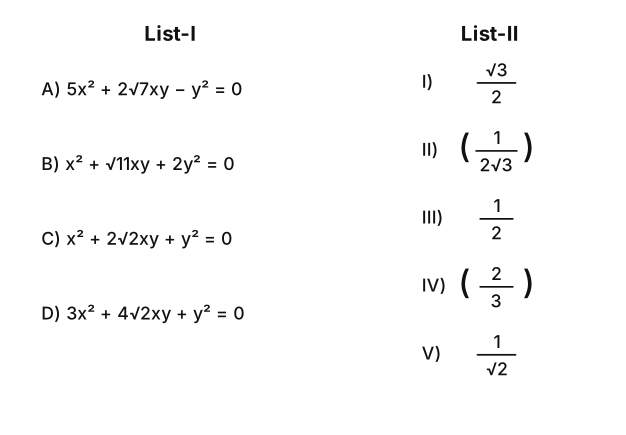
›Reveal solutionSolution
Apply cosθ=(a−b)2+4h2∣a+b∣ to each pair: 21, 23, 21, 32. That is A-III, B-I, C-V, D-IV — option (C).
The concept: angle between the lines of a homogeneous pair
The equation ax2+2hxy+by2=0 represents two straight lines through the origin. The standard result is
tanθ=a+b2h2−ab
Building the right triangle with opposite side 2h2−ab and adjacent side (a+b) gives hypotenuse
(a+b)2+4(h2−ab)=(a−b)2+4h2
so the cosine form — much more convenient here — is
cosθ=(a−b)2+4h2∣a+b∣
Careful with h: the coefficient of xy is 2h, so h is half of it.
Step 1 — Item A: 5x2+27xy−y2=0
a=5, b=−1, 2h=27⇒h=7.
cosθ=(5+1)2+4⋅7∣5−1∣=36+284=84=21⇒III
Step 2 — Item B: x2+11xy+2y2=0
a=1, b=2, 2h=11⇒4h2=11.
cosθ=(1−2)2+11∣1+2∣=123=233=23⇒I …
- TG EAPCET 2026Set eng-2026-05-11-FN1 markMCQQ.Let OA, OB, OC lying along X, Y, Z-axes respectively represent the coterminous edges of a rectangular parallelepiped. If OA=1, OB=2, OC=3 then the angle between a pair of diagonals of the parallelepiped drawn through the vertices O and A is (A) 3π (B) cos−1(75) (C) cos−1(76) (D) 4π
›Reveal solutionSolution
The angle between the space diagonals through O and A of a rectangular box is found using the dot product of their direction vectors. The correct answer is cos−1(76), option (C).
The problem gives us a rectangular parallelepiped (a box) with edges along the coordinate axes. The three coterminous edges from O are OA along X, OB along Y, and OC along Z, with lengths 1, 2, and 3 respectively.
The key idea: a rectangular box has four space diagonals. Two of them pass through O and A (opposite vertices). The angle between any pair of space diagonals can be found by writing their direction vectors and using the dot product formula.
-
Set up coordinates. Place O at the origin (0,0,0). Then:
- A is at (1,0,0) (since OA = 1 along X)
- B is at (0,2,0)
- C is at (0,0,3) The opposite vertex to O is the one with all three coordinates: (1,2,3). Call it D.
-
Identify the two diagonals through O and A. The diagonal through O goes from O to D: vector OD=(1,2,3). The diagonal through A goes from A to the vertex opposite A, which is the vertex with coordinates (0,2,3) — call it E. So the diagonal through A is AE=(0−1,2−0,3−0)=(−1,2,3).
-
Find the angle between these two diagonals. Use the dot product:
OD⋅AE=(1)(−1)+(2)(2)+(3)(3)=−1+4+9=12
Magnitudes:
∣OD∣=12+22+32=14
∣AE∣=(−1)2+22+32=14
So:
-
🎓Unlock everything free for 14 days
- ✓Full step-by-step solutions
- ✓Concept-first explanations
- ✓Methods, shortcuts & mistakes
- ✓PYQ mapping + timed mock tests
Full access for 14 days. No credit card required.