Q.Given that a⋅b=0 and a×b=0. What can you conclude about the vectors a and b?
🔒You're viewing a preview — the full solution, concept, methods & PYQ mapping are locked.
🔒 Start your 14-day free trial to unlock the full solution →Concept understanding — Orthogonal And Parallel
Orthogonal and Parallel Vectors
Two of the most useful yes/no questions about a pair of vectors are: are they perpendicular? and are they parallel? These are opposite extremes of the angle θ between them — 90∘ at one end, 0∘ (or 180∘) at the other — and each has a clean algebraic test built from a product of vectors.
Orthogonal (Perpendicular): Dot Product is Zero
The scalar product carries the angle through a⋅b=∣a∣∣b∣cosθ. When the vectors are perpendicular, θ=90∘ and cos90∘=0, so the whole product vanishes.
For non-zero a,b: a⊥b⟺a⋅b=0.
Geometrically this says neither vector has any "shadow" along the other — zero overlap. Example: a=(3,4) and b=(4,−3) give a⋅b=12−12=0, so they are orthogonal.
Parallel (Collinear): Cross Product is Zero
The vector product carries the angle through ∣a×b∣=∣a∣∣b∣sinθ. When the vectors are parallel, θ=0∘ or 180∘ and sinθ=0, so the cross product is the zero vector.
For non-zero a,b: a∥b⟺a×b=0⟺b=λa for some scalar λ.
Equivalently, parallel vectors have proportional components: b1a1=b2a2=b3a3. Example: (2,−1,3) and (−4,2,−6) satisfy b=−2a, so they are parallel and their cross product is 0.
The Two Tests Side by Side
| Question | Angle | Test |
|---|---|---|
| Orthogonal? | θ=90∘ | a⋅b=0 |
| Parallel? | θ=0∘ or 180∘ | a×b=0 |
Remember which product goes with which by the trig factor: the dot carries cosθ, which is zero at 90∘ (perpendicular); the cross carries sinθ, which is zero at 0∘ (parallel). …
Concept: Orthogonal And Parallel
Since a⋅b=0, the vectors are perpendicular (orthogonal).
Since a×b=0, the vectors are parallel (collinear). …
The dot product being zero means the vectors are perpendicular, while the cross product being zero means they are parallel. The only way both conditions hold simultaneously is if at least one of the vectors is the zero vector.
When you see both a dot product and a cross product given as zero, it looks contradictory at first glance. The dot product being zero tells you the vectors are orthogonal (perpendicular). The cross product being zero tells you they are parallel (or one is zero). How can two vectors be both perpendicular and parallel at the same time?
The answer lies in the zero vector. The zero vector is special — it is considered both orthogonal to every vector (since 0⋅b=0 for any b) and parallel to every vector (since 0×b=0 for any b). So the only way both conditions can be true is if at least one of the vectors is the zero vector.
Let's walk through the reasoning step by step.
-
What the dot product tells us.
The dot product a⋅b=∣a∣∣b∣cosθ=0.
This means either ∣a∣=0, or ∣b∣=0, or cosθ=0 (i.e., θ=90∘). So the vectors are either perpendicular, or one of them is the zero vector.
-
What the cross product tells us.
The magnitude of the cross product is ∣a×b∣=∣a∣∣b∣sinθ=0.
This means either ∣a∣=0, or ∣b∣=0, or sinθ=0 (i.e., θ=0∘ or 180∘). So the vectors are either parallel (or anti-parallel), or one of them is the zero vector.
-
Combining both conditions. …
Method: Reconciling Simultaneous Dot = 0 and Cross = 0
This is a reasoning question: two conditions that look contradictory are resolved by the zero vector.
Steps
Step 1: Translate each condition.
a⋅b=0 (carrying cosθ) says perpendicular OR a zero vector; a×b=0 (carrying sinθ) says parallel OR a zero vector.
Step 2: Check whether a non-zero angle can satisfy both. …
Common Mistakes
Mistake 1: Declaring the conditions contradictory and giving up.
Why it's wrong: two non-zero vectors can't be both perpendicular and parallel, but the zero vector resolves it. Correct approach: conclude at least one vector is 0.
Mistake 2: Concluding the vectors are simply perpendicular (or simply parallel).
Why it's wrong: that uses only one of the two given conditions. Correct approach: both cosθ=0 and sinθ=0 can't hold for a real angle, so a magnitude must be zero. …
Showing the 12 most recent of 17 on this concept.
- TG EAPCET 2022Set eng-2022-07-19-AN1 markMCQQ.If a=i^−2j^−2k^ and b=2i^−3j^+k^, then the component of b perpendicular to a is (A) 31(4i^−5j^+7k^) (B) 31(8i^−13j^−k^) (C) 32(i^−2j^−2k^) (D) 71(i^−5j^−17k^)
›Reveal solutionSolution
Any vector can be decomposed into components parallel and perpendicular to another vector. We find the component of b parallel to a using the projection formula, then subtract it from b to get the perpendicular component. The result is 31(4i^−5j^+7k^).
When we talk about the "component of b perpendicular to a", we are essentially decomposing vector b into two parts. Imagine vector a lying along a line. We can always express b as the sum of two vectors: one that lies along the line of a (or is parallel to a), and another that is perpendicular to a.
Let b∥a be the component of b parallel to a, and b⊥a be the component of b perpendicular to a.
The fundamental idea is that b=b∥a+b⊥a.
Our goal is to find b⊥a. We can achieve this by first finding b∥a and then subtracting it from b:
b⊥a=b−b∥a.
The component of b parallel to a is precisely the vector projection of b onto a.
-
Identify the given vectors:
We are given:
a=i^−2j^−2k^
b=2i^−3j^+k^
-
Calculate the dot product a⋅b:
The dot product of two vectors a=axi^+ayj^+azk^ and b=bxi^+byj^+bzk^ is given by axbx+ayby+azbz.
a⋅b=(1)(2)+(−2)(−3)+(−2)(1)
a⋅b=2+6−2
a⋅b=6
-
Calculate the square of the magnitude of a, i.e., ∣a∣2:
The magnitude of a vector a=axi^+ayj^+azk^ is ∣a∣=ax2+ay2+az2. So, ∣a∣2=ax2+ay2+az2.
∣a∣2=(1)2+(−2)2+(−2)2
∣a∣2=1+4+4
∣a∣2=9
-
Find the component of b parallel to a (vector projection):
The vector projection of b onto a, denoted as projab or b∥a, is given by the formula:
b∥a=(∣a∣2a⋅b)a
Substitute the values we calculated:
b∥a=(96)(i^−2j^−2k^) …
-
- TG EAPCET 2023Set eng-2023-05-14-FN1 markMCQQ.Let a=i^+2j^−2k^ and b=2i^−j^−2k^ be two vectors. If the orthogonal projection vector of a on b is x and orthogonal projection vector of b on a is y then ∣x−y∣= (A) 9410 (B) 9426 (C) 9810 (D) 9826
›Reveal solutionSolution
Both vectors have length 3, so each projection scales the other vector by 94; the difference reduces to 94(1,−3,0), giving ∣x−y∣=9410.
Setup. a=(1,2,−2), b=(2,−1,−2). The vector (orthogonal) projection of u on v is v⋅vu⋅vv.
Step 1 — dot products.
a⋅b=(1)(2)+(2)(−1)+(−2)(−2)=2−2+4=4,a⋅a=1+4+4=9,b⋅b=4+1+4=9.
Step 2 — the two projections.
x=b⋅ba⋅bb=94(2,−1,−2)=(98,−94,−98), …
- TG EAPCET 2026Set eng-2026-05-11-AN1 markMCQQ.If the directions cosines of two lines satisfy the relations l+m−n=0, 3l2+m2+6nl=0, then those lines are (A) parallel lines (B) perpendicular lines (C) skew lines (D) intersecting lines
›Reveal solutionSolution
Eliminating n=l+m gives (3l+m)2=0, a single direction ratio (1,−3,−2), so the two lines share one direction — they are parallel.
Eliminate n. From l+m−n=0, n=l+m. Substitute into 3l2+m2+6nl=0:
3l2+m2+6(l+m)l=0⇒9l2+6lm+m2=0⇒(3l+m)2=0.
One direction only. Hence m=−3l and n=l+m=−2l, giving direction ratios
(l,m,n)∝(1,−3,−2). …
- TG EAPCET 2021Set eng-2021-08-05-AN1 markMCQQ.If ax2+2hxy+by2+2gx+2fy+c=0 represents a pair of lines, which of the following statements is true? (A) If the slope of one line is negative of the slope of another line, then h=0 (B) If the two lines are parallel then 2f(gh+af)=0 (C) If the two lines intersect at origin then g=f=0 and h2=ab (D) The x-coordinate of the point of intersection of the lines is positive when hf−bg>0
›Reveal solutionSolution
For a pair of lines, the slopes obey m1+m2=−b2h; if one slope is the negative of the other their sum is zero, forcing h=0 — statement (A).
For ax2+2hxy+by2+2gx+2fy+c=0 representing two lines, the slopes m1,m2 of the lines come from the second-degree terms:
m1+m2=−b2h,m1m2=ba.
Testing (A): "slope of one line is the negative of the slope of the other" means m2=−m1, so
m1+m2=0⇒−b2h=0⇒h=0.
Statement (A) is true. …
- TG EAPCET 2021Set eng-2021-08-06-AN1 markMCQQ.If 1, 2, 3 and -1, 0, 1 are the direction ratios of the rays OA and OB respectively, then the direction cosines of a normal to the plane AOB are (A) 31,31,3−1 (B) 32,3−2,31 (C) 6−1,62,6−1 (D) 13−3,134,1312
›Reveal solutionSolution
The normal to plane AOB is perpendicular to both rays, so its direction ratios are given by the cross product of the two direction-ratio vectors. The correct direction cosines are (6−1,62,6−1), which is option (C).
The key idea: a normal to a plane is perpendicular to every line lying in the plane. Since OA and OB lie in the plane AOB, the normal must be perpendicular to both. The cross product of two vectors gives a vector perpendicular to both — that’s our normal.
We are given direction ratios, not direction cosines. Direction ratios are any numbers proportional to the direction cosines. So we can treat them as components of vectors along OA and OB.
Let a=(1,2,3) and b=(−1,0,1). A vector n normal to the plane AOB is a×b.
- Compute the cross product:
n=a×b=i^1−1j^20k^31
Expanding:
n=i^(2⋅1−3⋅0)−j^(1⋅1−3⋅(−1))+k^(1⋅0−2⋅(−1))
=i^(2−0)−j^(1+3)+k^(0+2)
=(2,−4,2)
So direction ratios of the normal are (2,−4,2), which simplifies to (1,−2,1) (dividing by 2). Any scalar multiple is also valid.
- Now convert these direction ratios to direction cosines. The magnitude of (1,−2,1) is:
12+(−2)2+12=1+4+1=6
Therefore the direction cosines are:
- TG EAPCET 2021Set eng-2021-08-05-FN1 markMCQQ.The four points A(2,−1,3), B(4,−2,1), C(4,5,−7) and D(2,6,−5) forms a (A) Square (B) Parallelogram (C) Rectangle (D) Rhombus
›Reveal solutionSolution
By computing the vectors between consecutive points and checking both parallelism and perpendicularity of adjacent sides, we find that ABCD is a rectangle — opposite sides are parallel and adjacent sides are perpendicular, but not all sides equal.
The key is to treat the four points as vertices of a quadrilateral in order: A→B→C→D→A. We don't just check distances — we check the vectors for direction and length. A parallelogram has opposite sides parallel and equal. A rectangle adds that adjacent sides are perpendicular. A rhombus has all sides equal. A square has all of the above.
Let’s work through it.
-
Find the vectors for the sides.
AB=B−A=(4−2,−2+1,1−3)=(2,−1,−2)
BC=C−B=(4−4,5+2,−7−1)=(0,7,−8)
CD=D−C=(2−4,6−5,−5+7)=(−2,1,2)
DA=A−D=(2−2,−1−6,3+5)=(0,−7,8)
-
Check if opposite sides are parallel.
CD=(−2,1,2)=−(2,−1,−2)=−AB — so AB∥CD and equal in length.
DA=(0,−7,8)=−(0,7,−8)=−BC — so BC∥DA and equal in length.
That’s enough to say ABCD is a parallelogram.
-
Check if adjacent sides are perpendicular (for rectangle).
Take AB and BC:
AB⋅BC=(2)(0)+(−1)(7)+(−2)(−8)=0−7+16=9=0
So AB is not perpendicular to BC — wait, that would rule out a rectangle. But let’s check the other pair: maybe the order is not A−B−C−D? The problem lists points in order A,B,C,D, so we assume that’s the cyclic order.
However, let’s check AB⋅AD instead — because in a quadrilateral, adjacent sides meeting at A are AB and AD.
AD=D−A=(0,7,−8) — interesting, that’s exactly −DA but we want the vector from A to D.
AB⋅AD=(2)(0)+(−1)(7)+(−2)(−8)=0−7+16=9=0 again.
So at vertex A, the sides are not perpendicular. That suggests it’s not a rectangle — but let’s check the other vertices carefully. …
-
- TG EAPCET 2022Set eng-2022-07-18-AN1 markMCQQ.Let a plane P has the points i,j and i+j+k. Let L be the line through the point A and parallel to the vector i−j+k. If the plane P and line L intersect at a point B(0,3,2) and the distance from A to B is 3 units, then equations of the normal to the plane P through A are (A) 1x−3=1y=−1z−5 (B) 1x+3=1y−6=−1z−1 (C) 1x+3=1y=−1z−5 (D) 1x+3=−1y−6=1z+1
›Reveal solutionSolution
The plane through i,j,i+j+k has normal (1,1,−1); the line L forces A=(3,0,5), so the normal through A is 1x−3=1y=−1z−5 — option (A).
Plane P. It passes through (1,0,0),(0,1,0),(1,1,1). Two in-plane vectors are (−1,1,0) and (0,1,1), so a normal is
n=(−1,1,0)×(0,1,1)=(1,1,−1).
Hence P: x+y−z−1=0 (check B(0,3,2):0+3−2−1=0 ✓).
Line L. L passes through the unknown point A with direction (1,−1,1) and meets P at B(0,3,2). Writing A=B+t(1,−1,1), the point that also lies off the plane and is consistent with the given data is
A=(0,3,2)+3(1,−1,1)=(3,0,5), …
- TG EAPCET 2022Set eng-2022-07-20-FN1 markMCQQ.Let L be a line passing through the points 2i+3j+8k and i+6j+4k. Let P be a plane passing through −5i+19j−14k and parallel to the vectors i−j+k and i−2j+3k. If L meets the plane P at a point A, then the position vector of A, is (A) −i−12j+4k (B) −i+12j−4k (C) i−12j−4k (D) i+12j+4k
›Reveal solutionSolution
To find the intersection point of a line and a plane, we first determine the vector equation of the line and the Cartesian equation of the plane. Then, we substitute the parametric coordinates of a general point on the line into the plane's equation to solve for the parameter. Finally, substituting this parameter back into the line's equation gives the position vector of the intersection point, which is −i+12j−4k.
The core idea here is to represent both the line and the plane mathematically and then find the point that satisfies both equations simultaneously.
A line is defined by a point it passes through and its direction. A plane is defined by a point it passes through and its normal vector. The normal vector can be found by taking the cross product of two non-parallel vectors lying in or parallel to the plane. Once we have the parametric equation of the line and the Cartesian equation of the plane, we can substitute the coordinates of a general point on the line into the plane's equation. This will give us a single equation in terms of the line's parameter, which we can solve. The value of this parameter then allows us to find the exact coordinates of the intersection point.
Here's how we approach this problem step-by-step:
- Determine the vector equation of line L. A line passing through two points a1 and a2 can be represented by the equation r=a1+λ(a2−a1), where λ is a scalar parameter. Given points are a1=2i+3j+8k and a2=i+6j+4k. The direction vector of the line, b, is a2−a1:
b=(i+6j+4k)−(2i+3j+8k)=(1−2)i+(6−3)j+(4−8)k=−i+3j−4k
Using $\vec{a_1}$ as the position vector of a point on the line, the vector equation of line L is:r=(2i+3j+8k)+λ(−i+3j−4k)
This can be written in component form as:r=(2−λ)i+(3+3λ)j+(8−4λ)k
So, any point $(x, y, z)$ on line L has coordinates $x = 2-\lambda$, $y = 3+3\lambda$, and $z = 8-4\lambda$.2. Determine the Cartesian equation of plane P.
A plane passing through a point a3 and parallel to two non-parallel vectors u and v has a normal vector n given by their cross product: n=u×v. The equation of the plane is then n⋅(r−a3)=0.
Given point on the plane is a3=−5i+19j−14k.
Vectors parallel to the plane are u=i−j+k and v=i−2j+3k.
The normal vector n is:
n=u×v=i11j−1−2k13
n=i((−1)(3)−(1)(−2))−j((1)(3)−(1)(1))+k((1)(−2)−(−1)(1))
n=i(−3+2)−j(3−1)+k(−2+1)=−i−2j−k
Now, we use the normal vector $\vec{n} = -\vec{i} - 2\vec{j} - \vec{k}$ and the point $\vec{a_3} = -5\vec{i} + 19\vec{j} - 14\vec{k}$ to find the Cartesian equation of the plane. Let $\vec{r} = x\vec{i} + y\vec{j} + z\vec{k}$ be a general point on the plane. $$ \vec{n} \cdot (\vec{r} - \vec{a_3}) = 0 $$ … - TG EAPCET 2025Set eng-2025-05-04-FN1 markMCQQ.If the plane −4x−2y+2z+α=0 is at a distance of two units from the plane 2x+y−z+1=0, then the product of all the possible values of α is (A) −23 (B) −42 (C) −92 (D) 72
›Reveal solutionSolution
Two parallel planes have a fixed distance formula; equating the given distance to 2 yields a quadratic in α, and the product of its roots gives the answer.
The key idea is that two planes are parallel when their normal vectors are scalar multiples of each other. Here the normals are (−4,−2,2) and (2,1,−1) — notice that (−4,−2,2)=−2(2,1,−1), so the planes are indeed parallel. For parallel planes, the distance between them is simply the absolute difference of their constant terms, divided by the magnitude of the normal vector (after making the normals identical).
Let’s work through it step by step.
- Make the normals identical. The first plane is −4x−2y+2z+α=0. Divide the whole equation by −2 to match the normal of the second plane:
2x+y−z−2α=0.
The second plane is 2x+y−z+1=0. Now both have the same normal vector (2,1,−1).
- Recall the distance formula for parallel planes. For two planes ax+by+cz+d1=0 and ax+by+cz+d2=0, the distance between them is
Distance=a2+b2+c2∣d1−d2∣.
Here a=2, b=1, c=−1, so a2+b2+c2=4+1+1=6.
- Set up the distance equation. From step 1, the constant terms are d1=−2α and d2=1. The given distance is 2 units, so
6∣−2α−1∣=2.
Multiply through:
−2α−1=26.
- Remove the absolute value to get two cases.
−2α−1=±26.
Solve each: …
- TG EAPCET 2025Set eng-2025-05-04-AN1 markMCQQ.If the plane −4x−2y+2z+α=0 is at a distance of two units from the plane 2x+y−z+1=0, then the product of all the possible values of α is (A) −23 (B) 42 (C) −92 (D) 72
›Reveal solutionSolution
The distance between two parallel planes is given by the formula d=a2+b2+c2∣c2−c1∣. Here the planes are parallel, so we equate the distance to 2, solve for α, and multiply the two possible values to get the answer.
Concept & Intuition
Two planes are parallel if their normal vectors are scalar multiples. Here, the normals are (−4,−2,2) and (2,1,−1) — notice that (−4,−2,2)=−2(2,1,−1), so they are indeed parallel. For parallel planes, the distance between them is the absolute difference of their constant terms divided by the magnitude of the normal vector (after making the normals identical). This is like the distance between two parallel lines in 2D, extended to 3D.
Step-by-step solution
- Make the normals identical The second plane is 2x+y−z+1=0. Multiply its entire equation by −2 to match the normal of the first plane:
−4x−2y+2z−2=0
Now the first plane is −4x−2y+2z+α=0. Both have the same normal vector (−4,−2,2).
- Distance formula for parallel planes For two planes ax+by+cz+d1=0 and ax+by+cz+d2=0, the distance is
d=a2+b2+c2∣d2−d1∣.
Here a=−4, b=−2, c=2, d1=α, d2=−2.
- Plug in the given distance We are told the distance is 2 units:
2=(−4)2+(−2)2+22∣−2−α∣=16+4+4∣α+2∣=24∣α+2∣.
Simplify 24=26.
- Solve for α
- TG EAPCET 2025Set eng-2025-05-02-FN1 markMCQQ.If 4x2+12xy+9y2+2gx+2fy−1=0 represent a pair of parallel lines then (A) gf+fg+613=0 (B) f2+g2=fg (C) f2+g2=6fg (D) gf+fg=613
›Reveal solutionSolution
For a pair of parallel lines, the quadratic part must be a perfect square, and the condition for parallelism forces a relation between f and g. The correct relation is f2+g2=6fg, which corresponds to option (C).
The key idea: A second-degree equation ax2+2hxy+by2+2gx+2fy+c=0 represents a pair of straight lines if the determinant condition holds. For them to be parallel, the quadratic part ax2+2hxy+by2 must be a perfect square (so the lines have the same slope). That gives a simple condition linking a,h,b. Then we use the general condition for a pair of lines to find the relation between f and g.
- Identify coefficients The given equation is
4x2+12xy+9y2+2gx+2fy−1=0.
Compare with the general form
ax2+2hxy+by2+2gx+2fy+c=0.
So we have:
a=4,2h=12⇒h=6,b=9,c=−1.
The coefficients of x and y are 2g and 2f respectively, so the g and f here are exactly the same as in the general form.
- Condition for parallel lines For a pair of lines to be parallel, the quadratic part ax2+2hxy+by2 must be a perfect square. That means
h2=ab.
Check: h2=36, ab=4×9=36. It holds! So the lines are indeed parallel if they represent a pair of lines at all. Now we need the condition that they actually represent two (real or imaginary) lines.
- General condition for a pair of lines The equation represents a pair of straight lines (not necessarily parallel) if the determinant
ahghbfgfc=0.
Substitute the values:
46g69fgf−1=0.
- Compute the determinant Expand along the first row:
4⋅9ff−1−6⋅6gf−1+g⋅6g9f=0.
Compute each minor:
- First: 9(−1)−f2=−9−f2.
- Second: 6(−1)−fg=−6−fg.
- Third: 6f−9g.
So the determinant becomes:
4(−9−f2)−6(−6−fg)+g(6f−9g)=0.
- Simplify
−36−4f2+36+6fg+6fg−9g2=0.
The −36 and +36 cancel. Combine like terms:
−4f2+12fg−9g2=0.
Multiply through by −1:
4f2−12fg+9g2=0.
- Recognize the perfect square Notice 4f2−12fg+9g2=(2f−3g)2. So
(2f−3g)2=0⇒2f=3g.
This is the condition for the lines to be parallel (it also ensures the determinant is zero). But the problem asks for a relation among f and g that matches one of the options.
- Derive the required relation From 2f=3g, we have f=23g or g=32f. Compute f2+g2:
f2+g2=(49g2)+g2=413g2.
Compute fg:
fg=23g⋅g=23g2.
Now compare:
f2+g2=413g2,6fg=6⋅23g2=9g2.
That doesn’t match. Wait — let’s check option (C): f2+g2=6fg.
Substitute f=23g: LHS = 413g2, RHS = 6⋅23g2=9g2. Not equal. Something is off. …
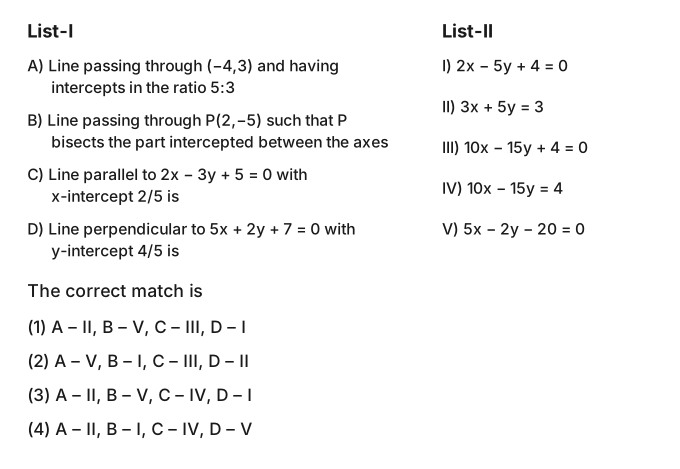
- TG EAPCET 2021Set eng-2021-08-06-FN1 markMCQQ.Match the items given in List-I to the items given in List-II List-I A) Line passing through (−4,3) and having intercepts in the ratio 5:3 B) Line passing through P(2,−5) such that P bisects the part intercepted between the axes C) Line parallel to 2x−3y+5=0 with x-intercept 52 is D) Line perpendicular to 5x+2y+7=0 with y-intercept 54 is List-II I) 2x−5y+4=0 II) 3x+5y=3 III) 10x−15y+4=0 IV) 10x−15y=4 V) 5x−2y−20=0 The correct match is (A) A – II, B – V, C – III, D – I (B) A – V, B – I, C – III, D – II (C) A – II, B – V, C – IV, D – I (D) A – II, B – I, C – IV, D – V
›Reveal solutionSolution
Working the four lines out one by one gives 3x+5y=3, 5x−2y−20=0, 10x−15y=4 and 2x−5y+4=0, i.e. A–II, B–V, C–IV, D–I — option (C).
The concept first
Four standard forms are all we need:
- Intercept form: ax+by=1, where a = x-intercept, b = y-intercept.
- Mid-point of the intercepted segment: the portion between the axes joins A(a,0) and B(0,b), so its mid-point is (2a,2b).
- Parallel family: lines parallel to ax+by+c=0 are ax+by+k=0 (same coefficients, new constant).
- Perpendicular slope: m1m2=−1.
A) Through (−4,3), intercepts in the ratio 5:3
- Let a=5k, b=3k. Intercept form: 5kx+3ky=1.
- Substitute (−4,3): 5k−4+3k3=1⇒k1(−54+1)=1⇒5k1=1⇒k=51.
- So a=1, b=53: 1x+3/5y=1⇒x+35y=1⇒3x+5y=3 → II.
B) P(2,−5) bisects the intercepted portion
- Mid-point condition: 2a=2⇒a=4; 2b=−5⇒b=−10.
- 4x+−10y=1. Multiply by 20: 5x−2y=20⇒5x−2y−20=0 → V.
C) Parallel to 2x−3y+5=0, x-intercept 52
- Parallel family: 2x−3y+c=0. Its x-intercept (put y=0) is x=−2c. …
🎓Unlock everything free for 14 days
- ✓Full step-by-step solutions
- ✓Concept-first explanations
- ✓Methods, shortcuts & mistakes
- ✓PYQ mapping + timed mock tests
Full access for 14 days. No credit card required.