Physics · Ch 5 — Laws of Motion
Equilibrium of a Particle
Equilibrium of a Particle
Equilibrium of a Particle
A particle is said to be in equilibrium when the net external force acting on it is zero. This is the most fundamental condition — if the vector sum of all forces vanishes, the particle's state of motion does not change. It may be at rest, or it may be moving with constant velocity; in either case, its acceleration is zero.
Equilibrium does not mean the particle is stationary. It means the particle has zero acceleration. A body sliding on a frictionless surface at constant speed is in equilibrium just as much as a book lying on a table.
The condition is written as:
where is the vector sum of all forces acting on the particle. Because force is a vector, this single equation is equivalent to three scalar equations in three dimensions:
Each component of the net force must separately be zero. If any one component is non-zero, the particle will accelerate in that direction.
Lami's Theorem — A Special Case for Three Forces
When exactly three forces act on a particle in equilibrium, a particularly elegant relationship holds. Consider three forces , , and acting at a point, with the particle in equilibrium. Because the vector sum is zero, the three force vectors, when placed head-to-tail, form a closed triangle.
Lami's Theorem: If three concurrent forces , , keep a particle in equilibrium, then
where is the angle opposite to force , is the angle opposite to , and is the angle opposite to .
The angles are measured between the other two forces. For example, is the angle between and .
›Proof
Proof of Lami's Theorem
Since the three forces are in equilibrium, . This means the three vectors, when drawn tip-to-tail, form a closed triangle. In this triangle, the side lengths are proportional to the magnitudes , , .
Now, look at the angles of this triangle. The angle inside the triangle opposite the side is not — it is , because is the angle between and outside the triangle. By the law of sines for any triangle:
Since , we obtain:
This completes the proof.
A common mistake is to take as the angle between and another force. In Lami's theorem, is always the angle opposite to — that is, the angle between the other two forces ( and ). Draw the triangle carefully.
Solving Equilibrium Problems — The General Approach
When a particle is in equilibrium under any number of forces, the method is always the same:
- Identify all forces acting on the particle. Include gravity, tension, normal reaction, friction, applied forces — everything.
- Choose a coordinate system. Usually, align one axis along the direction of an unknown force or along the direction of motion (even if motion is zero).
- Resolve each force into components along the chosen axes.
- Apply the equilibrium conditions: and (and if three-dimensional).
- Solve the resulting equations for the unknowns.
When a body is on an inclined plane, it is almost always easiest to take the x-axis along the incline and the y-axis perpendicular to it. This makes the normal force appear only in the y-equation and the component of weight along the incline appear only in the x-equation.
Example: A Block on a Smooth Inclined Plane …
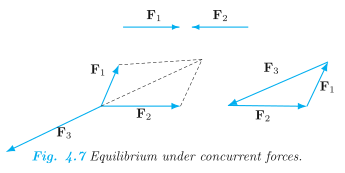
Drawn by us to help you understand the concept clearly, and verified to make sure it's accurate. For exams, practice from your textbook's own diagram.
Fig. 4.7 is a three-part diagram that builds the core idea of equilibrium for a particle. The first part shows two forces, and , acting on a single point. They are drawn head-to-head — that is, both arrows point toward the same point from opposite directions. The caption calls them "equal opposite forces," so the arrows are the same length and point in exactly opposite directions. This is the simplest case: if only these two forces acted, the particle would be in equilibrium because they cancel each other exactly.
The second part of the figure introduces a third force, . Here the diagram shows a parallelogram constructed from and . The diagonal of that parallelogram is the resultant of and — call it . Then is drawn equal in length to but pointing in the opposite direction. So is exactly the force needed to balance the combined effect of and . The physical idea is that a particle is in equilibrium when the net force on it is zero. If two forces produce a resultant , a third force equal and opposite to will bring the particle to equilibrium.
The third part of the figure strips away the parallelogram and shows just the three forces arranged as a closed triangle. The vectors , , and are placed tip-to-tail in order, and they form a triangle with no gap — the tail of the first vector meets the tip of the last. This is the geometric condition for equilibrium: when three concurrent forces are in equilibrium, their vector sum is zero, and they form a closed triangle when drawn head-to-tail.
Here each is a vector. The equation says the vector sum of all forces acting on the particle is zero. For the special case of two forces, equilibrium requires , meaning they are equal in magnitude and opposite in direction. For three forces, the closed triangle condition is equivalent to this vector equation.
The key insight the figure teaches is that equilibrium is a vector condition, not just a scalar one. Two forces can be equal in magnitude but if they are not exactly opposite, they will not cancel. The parallelogram construction shows how to find the single force that balances any pair, and the closed triangle shows that any set of three forces in equilibrium must obey the same geometric rule. This idea extends directly to problems where you resolve forces into components — the condition means the sum of components in any direction is also zero. …