Q.At a depth of 1000 m in an ocean
🔒You're viewing a preview — the full solution, concept, methods & PYQ mapping are locked.
🔒 Start your 14-day free trial to unlock the full solution →Concept understanding — Hydrostatic Pressure Balance
Hydrostatic Pressure Balance
Imagine you're standing at the bottom of a swimming pool. You feel pressure on your ears — and the deeper you go, the more intense that pressure becomes. Now think about a column of water above you: every kilogram of that water is being pulled down by gravity. That weight has to be supported by the water below it. The deeper you go, the more water is stacked above you, so the greater the weight pressing down.
That's the core intuition: pressure in a fluid at rest increases with depth because the fluid above has to be supported by the fluid below.
The Precise Statement
Hydrostatic pressure balance is the condition that holds for any fluid at rest in a uniform gravitational field. It says:
Pbelow=Pabove+ρgh
where:
- Pbelow is the pressure at a lower point,
- Pabove is the pressure at a higher point,
- ρ is the density of the fluid (assumed constant),
- g is the acceleration due to gravity,
- h is the vertical depth between the two points.
Equivalently, the pressure gradient in the vertical direction is:
dzdP=−ρg
where z increases upward. The minus sign tells you pressure decreases as you go up.
Why This Makes Sense
Take a thin horizontal slab of fluid of area A, thickness dz, at some depth. Its weight is dW=ρgAdz. For the slab to be in equilibrium (not accelerating), the net upward force from pressure must exactly balance this weight.
The upward force on the slab's bottom face is P(z)A, and the downward force on its top face is P(z+dz)A. The net upward force is:
P(z)A−P(z+dz)A=−dzdPAdz
Setting this equal to the weight ρgAdz gives:
−dzdP=ρg
which is exactly the differential form above.
This balance assumes the fluid is static — no flow, no acceleration. If the fluid moves, additional terms (like viscous forces or inertial effects) appear.
Key Implications
-
Pressure depends only on depth, not on the shape of the container. A tall thin tube and a wide shallow tank give the same pressure at the same depth — because only the vertical height of fluid above matters.
-
Pressure is the same at all points on the same horizontal level. If you move sideways at constant depth, ρgh doesn't change, so P doesn't change.
-
Gases are compressible, so ρ is not constant. For air, the density changes with pressure itself, leading to an exponential decrease — but the same principle applies locally.
A Common Mistake …
Concept: Hydrostatic Pressure — pressure increases with depth in a fluid at rest according to P=P0+ρgh, where P0 is the atmospheric pressure at the surface.
- Absolute pressure at depth h=1000 m:
Take P0=1.013×10⁵ Pa, ρ=1.03×10³ kg m−3, g=10 m s−2.
Pabs=P0+ρgh
So Pabs=1.013×10⁵+1.03×107=1.04013×10⁷ Pa.ρgh=(1.03×10³)(10)(1000)=1.03×10⁷ Pa
- Gauge pressure is the excess over atmospheric: Pgauge=ρgh=1.03×10⁷ Pa …
Using P=P0+ρgh:
- absolute pressure ≈1.04×10⁷ Pa.
- gauge pressure =ρgh=1.03×10⁷ Pa.
- net force on the window =Pgauge×A=4.12×10⁵ N.
Pressure in a fluid rises linearly with depth because of the weight of the water column above. The absolute pressure is the atmospheric pressure at the surface plus the pressure of that column; the gauge pressure is the excess over atmospheric. The submarine window feels only the pressure difference between outside and inside, and since the interior is held at sea-level atmospheric pressure, that difference is exactly the gauge pressure.
Given: h=1000 m, ρ=1.03×10³ kg m−3, g=10 m s−2, P0=1.01×10⁵ Pa.
- Absolute pressure
Pabs=P0+ρgh=1.01×10⁵+(1.03×10³)(10)(1000)
Pabs=1.01×10⁵+1.03×107=1.04×10⁷ Pa
- Gauge pressure …
Step 1: P_abs=P0+rhogh with rho=1.03e3, h=1000m => rhogh=1.03e7 Pa, P_abs~=1.04e7 Pa. Step 2: P_gauge=rhogh=1.03e7 Pa (excess over atmospheric). Step 3: interior kept at P0 …
- TG EAPCET 2026Set eng-2026-05-11-AN1 markMCQQ.In a uniform U-tube containing water, if a liquid of density 800 kg m−3 is poured into one of its limbs to a height of 25 cm column of liquid, then the rise in water level in the other limb of the tube is (A) 25 cm (B) 20 cm (C) 10 cm (D) 40 cm
›Reveal solutionSolution
The key idea is that the pressure at the same horizontal level in a connected fluid must be equal. The lighter liquid column is balanced by a water column of different height; the rise in the other limb is 10 cm.
Concept & Intuition
In a U-tube, the pressure at any horizontal level in a connected liquid is the same. When we pour a lighter liquid (density 800 kg/m³) into one limb, it sits on top of the water. The water level in that limb is pushed down, and the water in the other limb rises. The pressure at the bottom of the lighter liquid column (where it meets water) must equal the pressure at the same depth in the other limb — but that other limb contains only water. So we equate the hydrostatic pressures.
Step-by-step solution
-
Identify the densities and heights
Density of water, ρw=1000 kg/m3
Density of the poured liquid, ρl=800 kg/m3
Height of the poured liquid column, hl=25 cm=0.25 m
-
Understand the water level changes
When the lighter liquid is poured into the left limb, the water level in that limb falls by some amount x, and the water level in the right limb rises by the same x (since the total volume of water is unchanged). So the difference in water levels between the two limbs is 2x. The poured liquid sits above the water in the left limb.
-
Choose a reference level for pressure equality
Consider the horizontal line that passes through the interface between the lighter liquid and water in the left limb. At that depth in the right limb, there is only water. The pressure on both sides must be equal.
-
Write the pressure equation
On the left side: pressure = pressure due to the lighter liquid column of height hl
On the right side: pressure = pressure due to a water column of height equal to the vertical distance from the reference level to the water surface in the right limb.
That vertical distance is: the rise in the right limb (x) plus the fall in the left limb (x) = 2x.
So:
-
- TG EAPCET 2026Set ap-2026-05-04-FN1 markMCQQ.Water is flowing steadily with certain initial velocity vertically down from a tap of area of cross-section 1.8cm2. At a distance 25cm below the tap, area of cross-section of the stream of the water is 1.2cm2. The mass of the water flowing from the tap in a time of 10s is (Acceleration due to gravity =10ms−2) (A) 4.8kg (B) 1.2kg (C) 3.6kg (D) 7.2kg
›Reveal solutionSolution
This problem combines the principles of mass conservation (continuity equation) and energy conservation (Bernoulli's principle) for fluid flow to determine the initial velocity of water, which then allows us to calculate the total mass of water flowing in a given time. The mass of water flowing from the tap in 10s is 3.6kg.
The flow of water from a tap is an excellent example of steady, incompressible fluid flow. To solve this problem, we rely on two fundamental principles of fluid dynamics:
- Conservation of Mass (Continuity Equation): For an incompressible fluid flowing steadily through a pipe or stream, the mass flow rate must be constant. This means the product of the cross-sectional area and the fluid velocity remains constant along a streamline. As the water falls, its velocity increases due to gravity, and consequently, its cross-sectional area must decrease to maintain a constant volume flow rate.
- Conservation of Energy (Bernoulli's Principle): This principle states that for an ideal fluid in steady flow, the sum of the pressure energy, kinetic energy per unit volume, and potential energy per unit volume is constant along a streamline. It's essentially an application of the work-energy theorem to fluid flow.
We will use these two principles together to find the initial velocity of the water, then calculate the mass flow rate, and finally the total mass.
Step-by-step Derivations
-
Identify Given Parameters and Convert Units:
First, let's list the given values and convert them to SI units for consistency in calculations.
- Initial area of cross-section, A1=1.8cm2=1.8×10⁻⁴m2.
- Area of cross-section at 25cm below, A2=1.2cm2=1.2×10⁻⁴m2.
- Vertical distance, h=25cm=0.25m.
- Time duration, t=10s.
- Acceleration due to gravity, g=10ms−2.
- Density of water, ρ=1000kgm−3 (standard value for water).
-
Apply the Continuity Equation:
Let v1 be the velocity of water at the tap (point 1) and v2 be the velocity at 25cm below (point 2). According to the continuity equation, the volume flow rate (Q=Av) is constant:
A1v1=A2v2
Substituting the given areas:
1.8×10⁻⁴m2×v1=1.2×10⁻⁴m2×v2
1.8v1=1.2v2
v2=1.21.8v1=1.5v1
This equation relates the two velocities. As expected, since the area decreases, the velocity must increase.
-
Apply Bernoulli's Principle:
We apply Bernoulli's principle between point 1 (at the tap) and point 2 (at 25cm below).
P1+21ρv12+ρgh1=P2+21ρv22+ρgh2
- Both points are exposed to the atmosphere, so the pressure at both points is atmospheric pressure. Thus, P1=P2=Patm. These terms cancel out.
- Let's set the reference level for potential energy (h=0) at point 2 (the lower cross-section). Then h2=0 and h1=h=0.25m.
The Bernoulli equation simplifies to:
21ρv12+ρgh=21ρv22+ρg(0)
Divide by ρ:
21v12+gh=21v22
Rearranging to solve for v22−v12:
v22−v12=2gh …
- TG EAPCET 2026Set ap-2026-05-05-FN1 markMCQQ.In an open tube manometer, the volume of the gas enclosed in the bulb is 250 cc and the difference in the heights of the liquid levels in the manometer is 125 cm. The density of the liquid in the manometer is (Acceleration due to gravity =10 ms−2 and atmospheric pressure =100 kPa) (A) 12.5 kgm−3 (B) 0.16 kgm−3 (C) 4.8 kgm−3 (D) 8×10³ kgm−3
›Reveal solutionSolution
The excess pressure balanced by the liquid column equals atmospheric pressure, so ρ=ghPatm=8×10³ kgm−3.
In an open-tube manometer the pressure difference read by the instrument is
ΔP=ρgh
where h is the difference in the liquid levels. Here the manometer reads a difference equal to atmospheric pressure (ΔP=Patm=100 kPa=1×10⁵ Pa), with
h=125 cm=1.25 m,g=10 ms−2.
Solving for the density of the manometer liquid: …
- TG EAPCET 2025Set eng-2025-05-04-AN1 markMCQQ.The maximum length of water column that can stay without falling in a vertically held capillary tube of diameter 1mm and open at both the ends is (Acceleration due to gravity =10 ms−2 and surface tension of water =0.07 Nm−1) (A) 2.8 cm (B) 5.6 cm (C) 1.4 cm (D) 0 cm
›Reveal solutionSolution
The maximum length of a water column that can stay suspended in a vertically held capillary tube open at both ends is determined by balancing the upward force from surface tension against the weight of the column. The result is 5.6 cm, corresponding to option (B).
Concept and Intuition
When a capillary tube is open at both ends and held vertically, water can be held inside it only if the surface tension forces at the two menisci (top and bottom) can support the weight of the water column. At the top meniscus, surface tension pulls upward; at the bottom meniscus, it also pulls upward (since the water is hanging, the bottom meniscus is concave upward). So both ends contribute to supporting the column. The maximum height occurs when the weight of the water exactly equals the total upward force from surface tension at both ends. If the column is any longer, it will fall.
Step-by-Step Solution
- Identify the forces The water column is cylindrical, of height h and radius r=0.5 mm=5×10⁻⁴ m. Weight of the column:
W=ρgh⋅(πr2)
where ρ=1000 kg/m3 (density of water), g=10 m/s2.
- Surface tension force at each meniscus For a water-air interface, surface tension acts along the circumference. The vertical component of the force at a meniscus is:
FST=(2πr)⋅T⋅cosθ
where T=0.07 N/m and θ is the contact angle. For water in a clean glass tube, θ≈0∘, so cosθ=1.
Thus each meniscus contributes:
FST=2πrT
- Both ends pull upward Since the tube is open at both ends and held vertically, the top meniscus pulls the water up, and the bottom meniscus also pulls the water up (it is concave upward because the water is hanging). So total upward force:
Ftotal=2×(2πrT)=4πrT
- Set upward force equal to weight …
- TG EAPCET 2024Set eng-2024-05-09-AN1 markMCQQ.The excess pressure inside a soap bubble of radius 0.5 cm is balanced by the pressure due to an oil column of height 4 mm. If the density of the oil is 900kg m−3, then the surface tension of the soap solution is (Acceleration due to gravity =10ms−2) (A) 9×10⁻² Nm−1 (B) 2.25×10⁻² Nm−1 (C) 4.5×10⁻² Nm−1 (D) 7×10⁻² Nm−1
›Reveal solutionSolution
The excess pressure inside a soap bubble is given by R4T, and it is balanced by the hydrostatic pressure ρgh of the oil column. Equating these and solving gives T=4.5×10⁻² Nm−1, so the correct option is (C).
Concept & Intuition
A soap bubble has two liquid-air interfaces (inner and outer), so the excess pressure inside is twice that of a simple liquid droplet: ΔP=R4T. This pressure pushes outward and is balanced here by the hydrostatic pressure of an oil column. Hydrostatic pressure depends only on height, density, and gravity: P=ρgh. Setting them equal lets us solve for surface tension T.
Step-by-step solution
- Write the excess pressure inside a soap bubble For a soap bubble of radius R, surface tension T produces an excess pressure
ΔPbubble=R4T.
Here R=0.5 cm=0.5×10⁻² m=5×10⁻³ m.
- Write the hydrostatic pressure of the oil column The pressure due to a column of liquid of height h, density ρ, under gravity g is
Poil=ρgh.
Given h=4 mm=4×10⁻³ m, ρ=900 kg m−3, g=10 m s−2.
- Equate the two pressures The problem states the bubble’s excess pressure is balanced by the oil column’s pressure, so
R4T=ρgh.
- Solve for T
T=4ρghR.
Substitute the values:
T=4900×10×(4×10−3)×(5×10−3).
- Simplify step by step First, numerator: 900×10=9000. …
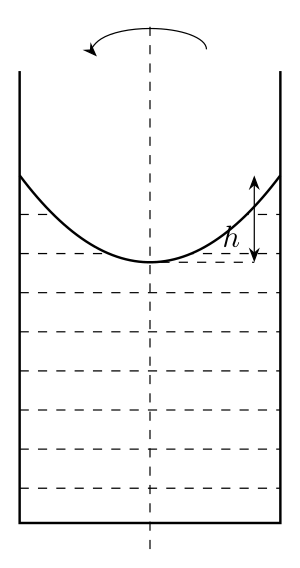
- TG EAPCET 2023Set eng-2023-05-13-FN1 markMCQQ.A liquid is taken in a long vertical cylindrical vessel and the cylinder is rotated about its vertical axis as shown in the figure. During rotation, the liquid rises along its sides. If the radius of vessel is 0.05 m and speed of rotation is 10 rad s−1, then the height difference between the liquid at the centre of the vessel and its sides is (g=10 ms−2) [FIGURE] (A) 125×10−4 m (B) 100×10−4 m (C) 50×10−4 m (D) 25×10−4 m
›Reveal solutionSolution
The rotating liquid forms a parabolic free surface; the height difference between the centre and the wall is given by Δh=2gω2R2, which yields 125×10−4 m, so the correct option is (A).
Concept & Intuition
When a cylindrical vessel containing liquid is rotated steadily about its vertical axis, the liquid is forced outward by centrifugal acceleration. The free surface is no longer flat — it becomes a paraboloid of revolution. At the centre, the liquid is depressed; at the walls, it rises. The key is that every point on the free surface has the same pressure (atmospheric), so the sum of gravitational potential energy and centrifugal potential energy is constant along the surface. This leads directly to a simple formula for the height difference.
-
Set up the rotating frame
In a frame rotating with the cylinder, the liquid is at rest relative to the container. A fluid particle at radius r experiences a centrifugal acceleration ω2r outward. The effective gravity in this frame has components: vertically downward g, and radially outward ω2r.
-
Condition for the free surface
The free surface is an equipotential surface of the effective potential. The gravitational potential is gz (taking z=0 at the bottom of the vessel, but we only care about differences). The centrifugal potential is −21ω2r2 (since its gradient gives −ω2r outward). So the total effective potential is
Φ=gz−21ω2r2.
On the free surface, Φ is constant. Let that constant be C.
- Find the shape of the surface At the centre (r=0), let the height be z0. Then
gz0=C.
At a general radius r,
gz(r)−21ω2r2=gz0.
Hence
z(r)=z0+2gω2r2.
This is a parabola — the surface rises quadratically with radius.
- Height difference The height at the wall (r=R) is z(R)=z0+2gω2R2. …
-
- TG EAPCET 2022Set eng-2022-07-18-AN1 markMCQQ.A hollow spherical body of outer and inner radii of 4cm and 2cm respectively floats half submerged in a liquid of density 2.0g/cm3. The density of the material of the sphere is (A) 1.02g/cm3 (B) 1.14g/cm3 (C) 1.18g/cm3 (D) 1.24g/cm3
›Reveal solutionSolution
The key idea is to equate the weight of the sphere to the buoyant force on the submerged portion. Using the given radii and liquid density, the material density comes out to be 1.14 g/cm³, which is option (B).
When a body floats, the net vertical force is zero: the downward pull of gravity (weight) is exactly balanced by the upward push of the fluid (buoyant force). Archimedes’ principle tells us that the buoyant force equals the weight of the fluid displaced. For a floating object that is only partly submerged, the displaced volume is just the volume of the part that sits below the surface.
Here the sphere is hollow, so its total weight depends on the volume of the shell material only — the empty cavity inside contributes nothing to the weight. The buoyant force, however, depends on the external volume of the sphere (the whole outer shape), because that’s what pushes fluid aside. And we are told the sphere is exactly half submerged, so the displaced volume is half of that outer volume.
Let’s work through the numbers.
- Find the volume of the shell material. Outer radius R=4cm, inner radius r=2cm. Volume of the material = volume of outer sphere minus volume of inner cavity:
Vmaterial=34πR3−34πr3=34π(43−23)=34π(64−8)=34π×56
So Vmaterial=3224πcm3.
- Find the volume of the displaced liquid. The sphere floats half submerged, so the submerged volume is half the outer volume:
Vsub=21×34πR3=21×34π×64=3128πcm3.
- Apply the floating condition. Weight of sphere = buoyant force:
- TG EAPCET 2022Set ap-2022-07-31-AN1 markMCQQ.A cylindrical container of cross sectional area 10 cm2 contains a liquid of density 1.2 g/cm3 upto a certain level. A piece of ice having mass 9 g (density =0.9 g/cm3) is floating in this liquid. If the ice melts completely, the change in level is (A) 0.15 cm (B) 0.25 cm (C) 0.35 cm (D) 0.45 cm
›Reveal solutionSolution
When floating ice melts, the volume of meltwater equals the volume of liquid displaced by the ice. Since the liquid is denser than water, the meltwater occupies less volume than the displaced liquid, so the level drops by 0.15 cm.
Why the level changes
When ice floats, it displaces a volume of liquid whose weight equals the weight of the ice (Archimedes' principle). When the ice melts, it becomes water with its own density. The key insight: if the surrounding liquid is denser than water, the meltwater will occupy less volume than the ice originally displaced, causing the level to fall.
Let's track the volumes carefully.
Step-by-step solution
-
Find the volume of liquid displaced by the floating ice
The ice has mass m=9 g. For it to float in equilibrium:
Weight of ice=Weight of displaced liquid
m⋅g=Vdisplaced⋅ρliquid⋅g
So the volume displaced is:
Vdisplaced=ρliquidm=1.29=7.5 cm3
-
Find the volume of water after the ice melts
Ice melts into water. The mass is conserved (9 g), but now it's liquid water with density ρwater=1 g/cm3:
Vwater=ρwaterm=19=9 cm3
-
Calculate the net change in liquid volume
Initially, the ice displaced 7.5 cm3 of the liquid (this volume was "pushed up" into the column). After melting, the ice contributes 9 cm3 of water to the liquid.
The net change in total liquid volume is:
ΔV=Vwater−Vdisplaced=9−7.5=1.5 cm3 …
-
- TG EAPCET 2021Set eng-2021-08-04-FN1 markMCQQ.A U-shaped tube is partially filled with an incompressible liquid of density 1.2 g/cm3. Oil which does not mix with the liquid is next poured into left side of the U-tube until the liquid rises by 15 cm on the right side of U-tube. If the density of the oil is 0.9 g/cm3, the oil level will stand higher than the liquid level of right side of U-tube by (A) 15 cm (B) 10 cm (C) 12 cm (D) 9 cm
›Reveal solutionSolution
The key idea is that the pressure at the same horizontal level in a connected static fluid must be equal. Using this, the oil column’s extra height above the right-side liquid level is found to be 10 cm.
The problem is about a U-tube manometer with two immiscible fluids. When oil is poured on one side, it pushes the liquid down on that side and up on the other. The liquid on the right rises by 15 cm, meaning the interface on the left has dropped by the same amount (since the liquid is incompressible and the tube has uniform cross-section). The oil column sits above the left-side liquid, and we need to find how much higher the top of the oil column is compared to the top of the liquid column on the right.
The central concept is pressure equality at the same horizontal level in a static fluid. Pick a horizontal line through the interface between oil and liquid on the left side. At that depth, the pressure due to the oil column above must equal the pressure due to the liquid column above on the right side (at the same level). That gives a direct relation between heights and densities.
Let’s work it through step by step.
-
Set up the geometry.
Let the original liquid level be the reference. When oil is poured on the left, the liquid on the right rises by h=15 cm. Because the liquid is incompressible and the tube has constant cross-section, the liquid level on the left falls by the same h=15 cm from its original position. So the vertical distance between the left and right liquid surfaces is 2h=30 cm.
-
Identify the key horizontal level for pressure balance.
Choose the horizontal plane that passes through the interface between oil and liquid on the left side. On the left, above this plane there is only oil (of height H, say). On the right, at the same horizontal level, there is only the liquid (of height 2h=30 cm above that plane, because the right-side liquid surface is 30 cm above the interface level).
-
Apply pressure equality.
Pressure at the interface on the left = pressure at the same depth on the right.
ρoilgH=ρliquidg(2h)
Cancel g and substitute densities: ρoil=0.9 g/cm3, ρliquid=1.2 g/cm3, h=15 cm.
0.9H=1.2×30
-
🎓Unlock everything free for 14 days
- ✓Full step-by-step solutions
- ✓Concept-first explanations
- ✓Methods, shortcuts & mistakes
- ✓PYQ mapping + timed mock tests
Full access for 14 days. No credit card required.