Physics · Ch 4 — Motion in a Plane
Uniform Circular Motion
Uniform Circular Motion
Uniform Circular Motion
When an object moves along a circular path at a constant speed, we call this uniform circular motion. The word "uniform" here refers strictly to the speed — the magnitude of the velocity does not change. However, because the direction of the velocity is continuously changing as the object goes around the circle, the object is always accelerating. This is a crucial point: a change in velocity (even without a change in speed) means there is acceleration.
Consider an object moving with constant speed in a circle of radius . At any instant, its velocity vector is tangent to the circle at that point. Since the direction of this tangent changes from point to point, the velocity is not constant. Our task is to find both the magnitude and the direction of the resulting acceleration.
Direction of Acceleration
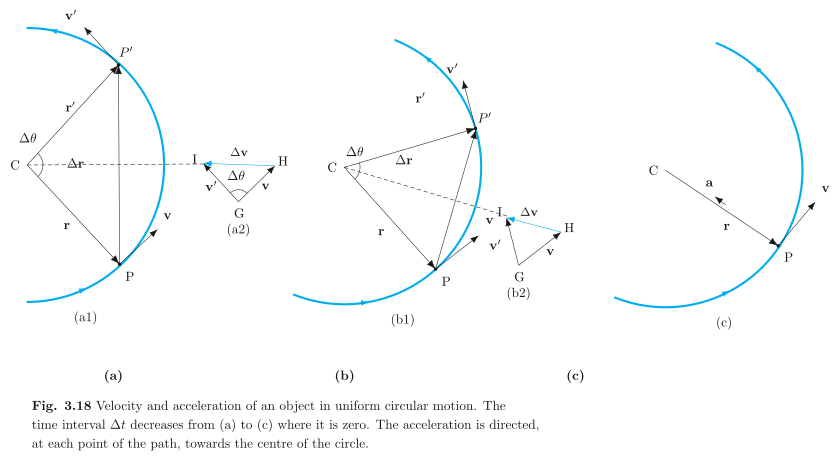
Let the object be at point at time , with position vector , and at point at time , with position vector . The corresponding velocities are (tangent at ) and (tangent at ). The change in velocity, , is found using the triangle law of vector addition.
Because the path is circular, is perpendicular to , and is perpendicular to . This geometric fact leads to a key result: is perpendicular to (where ). Since average acceleration is , the average acceleration is also perpendicular to .
If we examine the geometry for a very small time interval (as ), becomes perpendicular to itself. In that limit, becomes perpendicular to , and therefore points directly toward the centre of the circle. This is the instantaneous acceleration. Thus, the acceleration of an object in uniform circular motion is always directed towards the centre of the circle. This is called centripetal acceleration (from the Greek for "centre-seeking").
The acceleration in uniform circular motion is always directed towards the centre of the circle. It is never tangential.
Magnitude of Centripetal Acceleration
Let the angle between the position vectors and be . Because the velocity vectors are always perpendicular to the position vectors, the angle between and is also .
Now, consider the triangle formed by the position vectors (with sides , , and ) and the triangle formed by the velocity vectors , , and (with sides , , and ). These two triangles are similar (both are isosceles with the same vertex angle ).
From similarity, the ratio of the base to the equal side is the same for both triangles:
Rearranging:
The magnitude of the instantaneous acceleration is:
For small , the arc length is approximately equal to the chord length . The arc length is , so:
Therefore:
Substituting this into the expression for acceleration gives:
This is the magnitude of the centripetal acceleration. It depends only on the speed and the radius of the circle. Since and are constant in uniform circular motion, the magnitude of the acceleration is also constant. However, because its direction is always changing (always pointing towards the centre), the acceleration vector itself is not constant.
A constant magnitude does not mean a constant vector. The centripetal acceleration vector changes direction continuously, so it is a variable vector.
Angular Speed
There is another useful way to describe uniform circular motion. As the object moves from to in time , the line from the centre to the object turns through an angle . This angle is called the angular displacement. We define the angular speed (Greek letter omega) as the rate of change of angular displacement:
If the distance travelled along the arc during is , then the linear speed is . But , so:
This gives a direct relationship between linear speed and angular speed.
We can now express centripetal acceleration in terms of :
Time Period and Frequency
The time period is the time taken to complete one full revolution. The frequency (nu) is the number of revolutions per second. They are related by .
In one revolution, the object travels a distance equal to the circumference of the circle, . Therefore:
Using , we also get:
And for centripetal acceleration:
…
Drawn by us to help you understand the concept clearly, and verified to make sure it's accurate. For exams, practice from your textbook's own diagram.
The figure is a three-panel sequence that builds the idea of centripetal acceleration from scratch. In panel (a), you see a circle with centre C. Two position vectors, and , are drawn from C to two nearby points P and P' on the circle. The angle between them is , and the chord joining P to P' is labelled . At each point, the velocity vectors and are drawn tangent to the circle — they have the same magnitude but different directions. Off to the side, a separate velocity triangle shows these two vectors placed tail-to-tail; the vector from the tip of to the tip of is , the change in velocity over the short time .
Panel (b) repeats the same idea but with a smaller — the points are closer together, the chord is shorter, and the velocity triangle is narrower. The key visual point is that as shrinks, points more and more nearly toward the centre C.
Panel (c) is the limit . The chord becomes the instantaneous tangent velocity at P, and the acceleration is drawn as an arrow from P directly toward C. The velocity remains tangent to the circle; the acceleration points radially inward.
The central lesson of the figure is that in uniform circular motion, the acceleration is always directed toward the centre, even though the speed never changes. The velocity changes only in direction, not magnitude, and that directional change requires an inward (centripetal) acceleration.
The textbook uses this geometric reasoning to derive the magnitude of centripetal acceleration. From the velocity triangle, when is small, the chord length . Since the particle moves through an arc length , we have . Substituting:
Dividing by and taking the limit gives the instantaneous acceleration:
where is the constant speed of the particle and is the radius of the circular path. The direction of is toward the centre, perpendicular to . …