Q.The length of a second's pendulum on the surface of Earth is 1m. What will be the length of a second's pendulum on the moon?
🔒You're viewing a preview — the full solution, concept, methods & PYQ mapping are locked.
🔒 Start your 14-day free trial to unlock the full solution →Concept understanding — Simple Pendulum Period
Simple Pendulum Period: From Intuition to Formula
Imagine tying a small weight to a string, holding the other end fixed, and giving it a gentle push. It swings back and forth — that’s a simple pendulum. The question is: what determines how fast it swings? Does a heavier bob swing faster? Does a longer string make it slower?
Let’s start with what you already feel. If you hold a short string (say 20 cm) and swing it, the bob zips back and forth quickly. If you use a long string (say 1 m), the swing is noticeably slower. So length matters — longer means slower.
What about the weight? Try a light plastic bob and a heavy metal one of the same size, on the same string. You’ll find they swing at the same speed. That’s surprising — heavier things don’t fall faster, and here they don’t swing faster either. So mass does not affect the period (the time for one complete back-and-forth swing).
What about how hard you push? If you give a big push, the bob swings wider, but does it take more time? For small swings (small angles, say less than about 15°), the period is almost the same regardless of amplitude. That’s the key: for small oscillations, the pendulum is isochronous — its period is independent of amplitude.
This is only true for small angles. If you pull the bob to 60° and let go, the period becomes noticeably longer. In most exam problems, you assume “small oscillations” (usually < 10°).
The Precise Statement
For a simple pendulum of length L (measured from pivot to centre of bob), swinging with small amplitude in a uniform gravitational field g, the time period T (time for one complete oscillation) is:
T=2πgL
That’s it. No mass term. No amplitude term (for small angles).
T=2πgL
Why does this formula make sense?
- L in numerator: longer string → larger T (slower swing). Doubling L multiplies T by 2≈1.4.
- g in denominator: stronger gravity (larger g) → smaller T (faster swing). On the Moon (g≈1.6 m/s²), the same pendulum swings much slower.
- 2π: comes from the mathematics of simple harmonic motion — the pendulum’s motion is approximately sinusoidal for small angles.
To remember: the formula is identical to that of a mass on a spring (T=2πm/k), but here the “restoring force per unit displacement” is mg/L, so the effective “k” is mg/L, giving T=2πL/g.
Common exam pitfalls
- Don’t confuse L with amplitude. L is the string length, not how far you pull it. …
Length of a Second's Pendulum on the Moon
Concept: The period of a simple pendulum is T=2πgL, where L is length and g is acceleration due to gravity.
A second's pendulum has period T=2s (one second each way). On Earth, with gE=10m/s2 and LE=1m:
T=2π101=2s
On the Moon, gravity is gM=6gE=610m/s2. For the same period T=2s: …
A second's pendulum has a period of 2 s. Since the period depends on gL, reducing gravity by a factor of 6 (Earth to Moon) requires reducing length by the same factor to maintain the period. The length on the Moon is 61 m ≈ 0.167 m.
Why the period of a pendulum depends on gravity
A simple pendulum swings because gravity provides the restoring force. The period—the time for one complete oscillation—is given by
T=2πgL
where L is the length and g is the acceleration due to gravity. This formula tells us that a longer pendulum swings more slowly (larger T), and stronger gravity makes it swing faster (smaller T).
A "second's pendulum" is defined as one whose half-period is exactly one second, so its full period is T=2 s. On Earth, with gEarth≈9.8 m/s2, this requires L=1 m.
When we move to the Moon, gravity is weaker—about 61 of Earth's value. To keep the same 2 s period, we must adjust the length.
Finding the length on the Moon
-
Write the period equation for Earth.
On Earth, the second's pendulum has:
T=2πgEarthLEarth=2 s
with LEarth=1 m.
-
Write the period equation for the Moon.
On the Moon, we want the same period T=2 s, so:
T=2πgMoonLMoon=2 s
-
Equate the two expressions.
Since both equal 2 s:
2πgEarthLEarth=2πgMoonLMoon
Cancel 2π:
gEarthLEarth=gMoonLMoon
- Square both sides and rearrange. …
Step 1: Period of a simple pendulum: T=2πL/g. A "second's pendulum" has T=2s (each half-swing takes 1 s).
Step 2: On Earth: 2=2πLE/gE with LE=1m (given), consistent with gE≈9.8m/s2.
Step 3: On the Moon, the same period is required: 2=2πLM/gM. Equating the Earth and Moon expressions and cancelling gives LE/gE=LM/gM⇒LM=LE⋅(gM/gE). …
- TG EAPCET 2026Set eng-2026-05-10-FN1 markMCQQ.Two particles A and B are executing simple harmonic motion with amplitudes 10 cm and 20 cm respectively. If the time periods of two particles A and B are 8 s and 12 s respectively, then the ratio of the times taken by the particles A and B to complete 81th oscillation starting from their extreme positions is (A) 1:2 (B) 1:1 (C) 3:4 (D) 2:3
›Reveal solutionSolution
One-eighth of an oscillation takes 8T for each particle, so the ratio is TA:TB=8:12=2:3 — option (D).
Key idea. "81 of an oscillation" is a fixed fraction of the full cycle, so the time each particle needs is 8T, independent of amplitude. The amplitudes (10 cm, 20 cm) do not affect the time for a given fraction of the pe …
- TG EAPCET 2026Set ap-2026-05-04-AN1 markMCQQ.A cubical block of cork of side 10 cm is floating in water. When the cork is depressed slightly and then released, if it oscillates with a time period of 0.5 s, then the mass of the block is nearly (Acceleration due to gravity =10ms−2) (A) 500 g (B) 625 g (C) 250 g (D) 175 g
›Reveal solutionSolution
The cork executes simple harmonic motion because the buoyant force provides a linear restoring force. Using the formula for the time period of SHM in a fluid, T=2πρAgm, the mass comes out to be approximately 625 g.
The key here is to recognise that a floating object, when displaced vertically, experiences a net restoring force proportional to the displacement — exactly like a spring. This is because the extra volume submerged (or unsubmerged) changes the buoyant force linearly with depth.
Let’s work through it.
-
Set up the physics of the oscillation
The cork is floating in equilibrium. When you push it down by a small distance x, an extra volume Ax of water is displaced, where A is the cross-sectional area of the cube. The additional buoyant force upward is ρwater⋅(Ax)⋅g. This force opposes the displacement, so the net restoring force is F=−(ρAg)x.
This is exactly Hooke’s law, F=−kx, with effective spring constant k=ρAg.
-
Relate time period to mass
For SHM, the time period is T=2πkm. Substituting k:
T=2πρAgm
- Plug in the numbers Side of cube = 10 cm = 0.1 m, so A=(0.1)2=0.01m2. Density of water ρ=1000kg/m3, g=10m/s2, and T=0.5s. Square both sides:
T2=4π2ρAgm
m=4π2T2ρAg
Substitute: …
-
- TG EAPCET 2026Set ap-2026-05-04-FN1 markMCQQ.The equation for the displacement(x) of a particle executing simple harmonic motion is x=18sin(2πt+2π) cm, where ‘t’ is time in second. The minimum time after t = 0 when the velocity of the particle becomes maximum is (A) 0.5 s (B) 0.25 s (C) 1.25 s (D) 0.75 s
›Reveal solutionSolution
In SHM, velocity is maximum at the mean position. The given equation is a cosine in disguise, starting at the extreme position. The first time it reaches the mean is one-quarter of a period, giving t=0.25 s.
The problem gives x=18sin(2πt+2π) cm. The first thing to notice is that sin(θ+π/2)=cosθ. So the displacement is actually x=18cos(2πt) cm. That means at t=0, x=18 cm — the particle starts at the positive extreme position.
In simple harmonic motion, velocity is maximum when the particle passes through the mean position (x=0). So we need the smallest positive time after t=0 when x=0.
-
Find the period. The angular frequency ω=2π rad/s. The time period T=ω2π=2π2π=1 s.
-
Locate the first zero. Starting from the extreme (x=18 at t=0), the particle moves toward the mean. It reaches x=0 for the first time after one-quarter of a period. Why? Because in SHM, starting from an extreme, the motion to the mean takes T/4.
-
Compute the time. t=4T=41=0.25 s. …
-
- TG EAPCET 2024Set eng-2024-05-09-AN1 markMCQQ.A 20 ton truck is travelling along a curved path of radius 240 m. If the center of gravity of the truck above the ground is 2 m and the distance between its wheels is 1.5 m, the maximum speed of the truck with which it can travel without toppling over is (Acceleration due to gravity =10ms−2) (A) 43ms−1 (B) 40ms−1 (C) 38ms−1 (D) 30ms−1
›Reveal solutionSolution
The truck topples when the torque from the centrifugal force about the outer wheel exceeds the torque from gravity. Setting the torques equal gives the maximum speed: about 30 m/s, so option (D).
The key idea is that a vehicle topples when the net torque about the pivot point (the outer wheel) becomes unbalanced. As the truck goes around a curve, the centrifugal force (apparent outward force in the truck’s frame) tries to tip it outward, while gravity tries to keep it upright. The maximum safe speed is when these two torques are exactly equal — any faster and the truck will start to lift its inner wheels.
-
Identify the pivot and the forces
When the truck is about to topple, the inner wheels lose contact with the ground. The entire weight acts through the center of gravity (CG), and the pivot is the outer wheel. The relevant forces are:
- Weight mg acting downward at the CG.
- Centrifugal force rmv2 acting horizontally outward at the CG (in the rotating frame).
-
Set up the torque balance about the outer wheel
Take torques about the point where the outer wheel touches the ground.
- The weight creates a torque that tries to restore the truck to upright: its lever arm is half the wheel track, 21.5=0.75 m.
τgravity=mg×0.75
- The centrifugal force tries to topple the truck: its lever arm is the height of the CG above ground, 2 m.
τcentrifugal=rmv2×2
- Equate the torques at the tipping point At the maximum speed without toppling, these torques are equal: mg×0.75=rmv2×2 …
-
- TG EAPCET 2024Set eng-2024-05-09-AN1 markMCQQ.A thin uniform wire of mass ‘m’ and linear mass density ‘ρ’ is bent in the form of a circular loop. The moment of inertia of the loop about its diameter is (A) 4π2ρ2m2 (B) 4ρ2m3 (C) 8π2ρ2m3 (D) 8ρ2m3
›Reveal solutionSolution
The moment of inertia of a thin circular loop about a diameter is 21mR2. Using m=2πRρ to eliminate R gives I=8π2ρ2m3, which corresponds to option (C).
The key idea is to recall the standard result for a circular loop’s moment of inertia about a diameter, then express the radius in terms of the given mass and linear density.
Why this works:
For a thin uniform wire bent into a circle, every bit of mass lies at the same distance R from the center. The moment of inertia about a diameter is a classic result: because the mass is distributed symmetrically, the perpendicular-axis theorem gives Idiameter=21Iaxis through center perpendicular to plane, and Iperpendicular=mR2. So Idiameter=21mR2. The only twist is that the problem gives linear mass density ρ, not the radius directly — so we must relate R to m and ρ.
Step-by-step:
-
Relate mass, length, and radius.
The wire is bent into a circle, so its total length is the circumference 2πR. Linear mass density ρ means mass per unit length: ρ=lengthm=2πRm.
Hence, R=2πρm.
-
Use the known moment of inertia for a loop about a diameter.
For a thin circular loop of mass m and radius R, the moment of inertia about any diameter is I=21mR2. (This follows from the perpendicular-axis theorem: Iz=mR2, and by symmetry Ix=Iy, so Ix+Iy=Iz gives 2Ix=mR2, hence Ix=21mR2.)
-
Substitute R from step 1 into I. …
-
- TG EAPCET 2024Set ap-2024-05-07-FN1 markMCQQ.A body of mass ‘m’ tied to one end of a string is whirled in a vertical circle of radius ‘R’ with zero tension in the string at its highest point. The angle made by the string with the vertical when the kinetic energy of the body becomes half of its maximum kinetic energy is (A) θ=cos−1(41) (B) θ=sin−1(41) (C) θ=tan−1(41) (D) θ=cos−1(21)
›Reveal solutionSolution
With zero tension at the top, vtop2=gR; the maximum KE (at the bottom) is 25mgR. Half of this is reached where cosθ=41 measured from the (upward) vertical. Option (A).
- Speed at the highest point. Zero tension means gravity alone supplies the centripetal force:
mg=Rmvtop2⇒vtop2=gR.
- Maximum kinetic energy (at the lowest point). Using energy conservation over the diameter 2R:
vbottom2=vtop2+2g(2R)=gR+4gR=5gR,
KEmax=21mvbottom2=25mgR.
- Where KE is half of maximum. Let θ be the angle of the string from the upward vertical (measured at the top). Height of that point above the lowest point is R(1+cosθ). Energy conservation from the bottom: KE(θ)=KEmax−mgR(1+cosθ). …
- TG EAPCET 2024Set eng-2024-05-11-FN1 markMCQQ.A simple pendulum is made of a metal wire of length ‘L’, area of cross-section ‘A’, material of Young’s modulus ‘Y’ and a bob of mass ‘m’. This pendulum is hung in a bus moving with a uniform speed ‘V’ on a horizontal circular road of radius ‘R’. The elongation in the wire is (A) RAYmLg2R2+V4 (B) AYmgL (C) RAYmLV2 (D) AYLmg+RmV2
›Reveal solutionSolution
The pendulum bob experiences both gravity and the centrifugal pseudo-force due to the bus’s circular motion; the net effective force determines the tension, and elongation follows from Hooke’s law. The correct elongation is RAYmLg2R2+V4, which is option (A).
Concept & Intuition
A pendulum in a bus moving uniformly on a horizontal circular road is not an inertial frame — the bus is accelerating toward the center of the circle. From the bus’s perspective, the bob feels a centrifugal pseudo-force outward, horizontal and of magnitude mV2/R. This combines with gravity to give an effective weight. The wire’s tension equals the magnitude of this effective weight, and the elongation is given by ΔL=AYTL (Hooke’s law for a wire under tension). The key is to find the net force on the bob correctly.
Step-by-step reasoning
-
Identify the forces in the bus’s frame
In the non-inertial frame of the bus, the bob is at rest relative to the bus. The real forces are gravity (mg downward) and tension (T along the wire). The pseudo-force is the centrifugal force: Fc=RmV2, directed radially outward from the center of the circular path. This force is horizontal and perpendicular to the vertical.
-
Resultant effective force on the bob
The bob is in equilibrium in the bus frame, so tension must balance the vector sum of gravity and centrifugal force. These two forces are perpendicular:
- Vertical: mg
- Horizontal: RmV2 The magnitude of the resultant (effective weight) is
Feff=(mg)2+(RmV2)2=mg2+R2V4.
- Tension in the wire equals this effective force Since the bob is stationary in the bus frame, the tension T must exactly oppose Feff, so
T=mg2+R2V4.
- Apply Hooke’s law for elongation For a wire of length L, cross-sectional area A, and Young’s modulus Y, the elongation ΔL is ΔL=AYTL. …
-
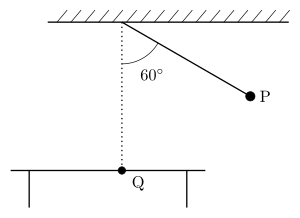
- TG EAPCET 2023Set ap-2023-05-11-FN1 markMCQQ.The bob P of a simple pendulum of length L released from 60∘ to the vertical hits the bob Q of another pendulum of same length which is at rest on a smooth table top as shown in figure. If the masses of P and Q are same and collision is elastic, then the height to which the bob Q rises after collision is (neglect the sizes of the bobs) [FIGURE] (A) 2L (B) 4L (C) 8L (D) Zero
›Reveal solutionSolution
P arrives at the bottom with speed gL. Because the bobs have equal mass and the collision is elastic, the velocities are exchanged: P halts and Q flies off with gL, so Q rises to h′=v2/2g=L/2. This is option (A).
The concept first
Two separate ideas meet here, and it pays to keep them apart.
Idea 1 — the swing is just energy conversion. A pendulum bob released from an angle θ has no engine; gravity converts its lost height into speed, and on the way up the reverse happens. Nothing else matters — not the mass, not the path — only the vertical drop.
Idea 2 — the elastic equal-mass collision is the cleanest result in all of mechanics. Solve momentum + kinetic-energy conservation for a head-on elastic collision of masses m1,m2 and you get
v1′=m1+m2m1−m2u1,v2′=m1+m22m1u1.
Put m1=m2=m: the first bracket is zero and the second is one. The incoming bob stops; the struck bob inherits the entire velocity. This is what you see in a Newton's-cradle.
Step-by-step
- Height P falls. With the string of length L making 60∘ with the vertical, the bob starts a vertical distance Lcos60∘ below the support, and ends (at the lowest point) a distance L below it. So the drop is
h=L−Lcos60∘=L(1−cos60∘)=L(1−21)=2L.
- Speed of P just before impact. The string tension does no work (it is always perpendicular to the motion), so mechanical energy is conserved:
21mv2=mgh⇒v=2gh=2g⋅2L=gL.
- The collision. Masses are equal and the collision is elastic, so from the boxed result above
vP′=0,vQ′=v=gL.
Q is set moving horizontally with speed gL; P is left hanging at rest. …
- TG EAPCET 2022Set eng-2022-07-19-FN1 markMCQQ.A simple pendulum of length 1 m and having a bob of mass 100 g is suspended in a car, moving on a circular track of radius 100 m with uniform speed 10 m/s. If the pendulum makes small oscillation in a radial direction about its equilibrium position, then its time period can be given by T=2π/α1/4. The value of α is [Take g=10 m/s2] (A) 11 (B) 110 (C) 101 (D) 1100
›Reveal solutionSolution
The pendulum’s effective gravity is the vector sum of actual gravity and the centrifugal acceleration from the car’s circular motion. The time period formula for small radial oscillations gives α=101, so the answer is (C).
The key idea is that when the car moves on a circular track, the bob experiences a centrifugal acceleration outward (in the rotating frame of the car). For small oscillations in the radial direction, the pendulum’s equilibrium is tilted, and the restoring force depends on the net effective gravity — the vector sum of g downward and the centrifugal acceleration v2/r horizontally outward.
The problem gives the time period as T=2π/α1/4. For a simple pendulum, the standard formula is T=2πL/geff. So we must find geff and match the form.
- Find the centrifugal acceleration. The car’s speed is v=10 m/s and the track radius is R=100 m. The centrifugal acceleration (in the car’s frame) is
ac=Rv2=100102=1 m/s2.
This acts radially outward, perpendicular to gravity g=10 m/s2 downward.
- Determine the effective gravity. The bob’s equilibrium is along the direction of the vector sum of g and ac. The magnitude of the effective gravity is
geff=g2+ac2=102+12=101 m/s2.
- Write the time period for small radial oscillations. For a pendulum of length L=1 m oscillating about this tilted equilibrium, the small-angle period is …
- TG EAPCET 2022Set eng-2022-07-18-FN1 markMCQQ.A body starting at t=0 from origin and oscillates simple harmonically with a period of 4 s. After what time will its kinetic energy be 75% of its total energy (A) 1/2 s (B) 1/3 s (C) 1/4 s (D) 1 s
›Reveal solutionSolution
The key idea is that kinetic energy is 75% of total energy when the displacement is half the amplitude. For SHM with period 4 s, the time from the mean position to half-amplitude is one-sixth of the period, giving t=31 s. The correct option is (B).
We start with the physics: In simple harmonic motion, total energy E is constant, split between kinetic energy K and potential energy U. When K=0.75E, then U=0.25E. Since potential energy in SHM is proportional to the square of displacement (U=21kx2), and total energy is E=21kA2 (where A is amplitude), we have:
21kx2=0.25×21kA2⇒x2=0.25A2⇒x=±2A.
So the question reduces to: starting from the mean position (x=0) at t=0, how long does it take to reach x=A/2 for the first time?
-
Write the equation of motion. For SHM starting from the mean position moving in the positive direction, we use x=Asin(ωt). Here ω=T2π, and T=4 s, so ω=42π=2π rad/s.
-
Set displacement to half the amplitude. We want x=2A, so:
2A=Asin(2πt)⇒sin(2πt)=21. …
-
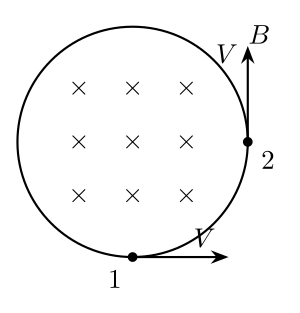
- TG EAPCET 2021Set ap-2021-08-09-AN1 markMCQQ.A particle of charge q and mass m moves in an uniform magnetic field B with a speed V. The average acceleration for 90∘ turn as it moves from point 1 to 2 as shown in figure is (mqVB). The value of α is: (A) 0 (B) π22 (C) 2π1 (D) 2π1
›Reveal solutionSolution
The average acceleration over a 90∘ arc in a uniform magnetic field is the change in velocity divided by the time taken. The magnitude of the change in velocity is 2V, the time is 2qBπm, so the average acceleration is π22mqVB, meaning α=π22.
The key idea: average acceleration is defined as aavg=ΔtΔv. In a uniform magnetic field, the particle moves in a circular arc at constant speed V, so the magnitude of the velocity change over a 90∘ turn is easy to find geometrically, and the time is just a fraction of the full cyclotron period.
Why this works:
The magnetic force is always perpendicular to velocity, so speed is constant. The path is a circle of radius R=qBmV. Over a 90∘ arc, the velocity vector rotates by 90∘, so the magnitude of the change in velocity is ∣Δv∣=V2+V2=2V. The time to cover a quarter-circle is one-quarter of the period T=qB2πm, so Δt=4T=2qBπm. Dividing gives the average acceleration.
- Find the change in velocity Δv. At point 1, velocity is, say, v1=Vi^. After a 90∘ turn to point 2, velocity is v2=Vj^ (or some perpendicular direction). The vector difference is v2−v1=Vj^−Vi^, whose magnitude is
∣Δv∣=V2+V2=V2.
- Find the time Δt for the 90∘ turn. In a uniform magnetic field, the cyclotron period is T=qB2πm. A 90∘ turn is one-quarter of a full circle, so
Δt=4T=2qBπm.
- Compute the average acceleration magnitude.
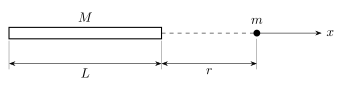
- TG EAPCET 2021Set eng-2021-08-05-AN1 markMCQQ.A point mass ‘m’ is located at a distance r from a uniform thin rod of mass M and length L as shown in the figure. The magnitude of gravitational force of attraction is (A) r2GMm (B) (r+L)2GMm (C) r(r+L)GMm (D) (r+2L)2GMm
›Reveal solutionSolution
The gravitational force between a point mass and a uniform rod is found by integrating the contributions from each infinitesimal mass element along the rod. The result is r(r+L)GMm, which corresponds to option (C).
The key insight is that you cannot treat the rod as a point mass because the distance from the point mass to different parts of the rod varies. The rod is extended, so each tiny piece of it exerts a slightly different gravitational pull. To get the total force, we must add up (integrate) the contributions from all these pieces.
Why the simple formulas fail
- Option (A) r2GMm would be correct only if the entire rod's mass were concentrated at its nearest end — but the rest of the rod is farther away, so the actual force is smaller.
- Option (B) (r+L)2GMm would be correct if the mass were at the far end — but that underestimates the force because much of the rod is closer.
- Option (D) (r+L/2)2GMm treats the rod as a point mass at its center. This is a common approximation, but it is exact only for a sphere or when r≫L. For a rod at close range, the distribution matters.
So we must integrate.
Step-by-step derivation
-
Set up coordinates
Place the rod along the x-axis from x=0 to x=L. Let the point mass m be on the same line at x=−r (so the distance from m to the near end of the rod is r).
Then a small piece of the rod at position x (where 0≤x≤L) has length dx and mass dM=LMdx (linear mass density λ=M/L).
-
Distance from point mass to the piece
The distance from m (at x=−r) to the piece at x is x−(−r)=x+r.
-
Gravitational force from one piece
By Newton’s law of gravitation, the magnitude of the force between m and this infinitesimal mass dM is
dF=G(x+r)2mdM=G(x+r)2m(M/L)dx.
- Integrate over the whole rod The total force is the sum of all these contributions:
F=∫0LGLmM(x+r)2dx.
The constants G, m, M, and L come out:
F=LGmM∫0L(x+r)2dx. …
🎓Unlock everything free for 14 days
- ✓Full step-by-step solutions
- ✓Concept-first explanations
- ✓Methods, shortcuts & mistakes
- ✓PYQ mapping + timed mock tests
Full access for 14 days. No credit card required.