Q.The triple points of neon and carbon dioxide are 24.57 K and 216.55 K respectively. Express these temperatures on the Celsius and Fahrenheit scales.
Concept understanding — Temperature Scale Conversion
Temperature Scale Conversion
You already know temperature as a measure of hotness or coldness. But here's the thing: different countries and different scientific fields measure that same hotness using different numbers. Water boils at 100 on the Celsius scale, but at 212 on the Fahrenheit scale. That's not because the water is different — it's because the rulers are different.
The core idea
A temperature scale is just a number line someone decided to draw on the same physical reality. Converting between scales means finding the number on one number line that corresponds to the same physical hotness as a given number on another number line.
Think of it like this: if you measure a table's length in feet and get 6, and I measure it in metres and get 1.83, we're both describing the same table. Temperature conversion works exactly the same way — same physical state, different numbers.
The three main scales you'll meet
| Scale | Freezing point of water | Boiling point of water | Used by |
|---|---|---|---|
| Celsius (°C) | 0 | 100 | Most of the world, science |
| Fahrenheit (°F) | 32 | 212 | USA, a few other countries |
| Kelvin (K) | 273.15 | 373.15 | All scientific work |
Notice something: Celsius and Kelvin have the same step size — a change of 1°C is exactly a change of 1 K. They just start at different places. Fahrenheit has a smaller step size (180 steps between freezing and boiling, instead of 100).
The conversion formulas
°F=59(°C)+32
°C=95(°F−32)
K=°C+273.15
These aren't magic. Each one comes from the simple idea of matching two number lines.
Why the formulas look like that
Between freezing and boiling water:
- Celsius has 100 steps (0 to 100)
- Fahrenheit has 180 steps (32 to 212)
So one Celsius step is 100180=59 Fahrenheit steps. That's the 59 factor. The +32 just shifts the starting point — because 0°C doesn't correspond to 0°F, it corresponds to 32°F.
For Kelvin: since the step size is identical to Celsius, you just add the offset. The 273.15 comes from the fact that absolute zero (the coldest possible temperature) is 0 K, which is −273.15°C.
A worked example
Convert 25°C to Fahrenheit.
Step 1: Multiply by 59.
25×59=25×1.8=45
Step 2: Add 32.
45+32=77
So 25°C = 77°F. A warm spring day in Celsius terms is 77°F — same weather, different number.
For quick mental estimates: double the Celsius and add 30. It's not exact (you get 80 instead of 77 here), but it's close enough for everyday "should I wear a jacket?" decisions.
The one thing students mess up
Never just add or subtract without the factor. "It's 30°C outside, so it must be 30 + 32 = 62°F" is wrong. You must multiply by 59 first. The 32 is a shift after scaling, not before.
Why Kelvin matters
Kelvin is the scientist's scale because it starts at absolute zero — the point where particles have minimum possible thermal motion. This makes all gas laws and thermodynamic equations simple. You'll never see a negative Kelvin temperature in normal physics; 0 K is the floor.
When a problem gives you Celsius and the formula uses Kelvin (like the ideal gas law PV=nRT), you must convert: K=°C+273.15.
The big picture
Temperature scale conversion is just relabelling the same physical reality. The formulas are linear — multiply to adjust step size, add to adjust zero point. Once you see that, every conversion is just arithmetic.
For quick revision, remember that Temperature Scale Conversion is drawn directly from the Thermal Properties of Matter coverage of the NCERT/CBSE Class 11 Physics syllabus and recurs often in JEE Main and NEET papers, which is exactly why "Temperature Scale Conversion important questions" shows up so often in Physics question banks. The clearest way to build exam confidence here is to combine this explanation with the NCERT Physics textbook's own solved examples and chapter-end questions.
Use TC=TK−273.15 and TF=59TC+32.
Neon (24.57 K): TC=24.57−273.15=−248.58∘C; TF=59(−248.58)+32=−415.44∘F.
Carbon dioxide (216.55 K): TC=216.55−273.15=−56.60∘C; TF=59(−56.60)+32=−69.88∘F.
Neon: −248.58∘C, −415.44∘F. Carbon dioxide: −56.60∘C, −69.88∘F.
Converting Kelvin to Celsius using TC=TK−273.15, then to Fahrenheit using TF=59TC+32: neon's triple point is −248.58∘C (−415.44∘F), and carbon dioxide's is −56.60∘C (−69.88∘F).
All three temperature scales measure the same physical hotness, just with different zero points and step sizes. Kelvin and Celsius have the same step size (a change of 1 K equals a change of 1∘C), differing only by an offset of 273.15. Fahrenheit has a smaller step size, related to Celsius by TF=59TC+32.
Neon: TK=24.57 K
To Celsius:
TC=24.57−273.15=−248.58 ∘C.
To Fahrenheit:
TF=59(−248.58)+32=−447.44+32=−415.44 ∘F.
This extreme cold matches neon's role as a noble gas with very weak intermolecular attraction - it stays gaseous down to almost absolute zero.
Carbon dioxide: TK=216.55 K
To Celsius:
TC=216.55−273.15=−56.60 ∘C.
To Fahrenheit:
TF=59(−56.60)+32=−101.88+32=−69.88 ∘F.
This is well below room temperature - consistent with CO2 subliming directly from solid to gas ("dry ice") at ordinary atmospheric pressure rather than melting.
| Substance | Kelvin | Celsius | Fahrenheit |
|---|---|---|---|
| Neon | 24.57 K | −248.58∘C | −415.44∘F |
| Carbon dioxide | 216.55 K | −56.60∘C | −69.88∘F |
Use the precise offset 273.15, not the rounded 273 - small in most problems, but it's good practice to keep the full precision here.
Neon: −248.58∘C and −415.44∘F. Carbon dioxide: −56.60∘C and −69.88∘F.
Since both conversions trace back to the same Kelvin value, you can skip the intermediate Celsius step and go from Kelvin straight to Fahrenheit in one formula: TF=59(TK−273.15)+32. For neon, TF=59(24.57−273.15)+32=−415.44∘F; for CO2, TF=59(216.55−273.15)+32=−69.88∘F — same results, one algebra step shorter. The physical gut-check worth remembering: an entire 273.15 K offset is 'used up' just reaching 0∘C, so neon's triple point, barely 25 K above absolute zero, is bound to land at an extreme negative Fahrenheit value — the huge negative numbers are a sign the physics is right, not an arithmetic slip.
- TG EAPCET 2025Set eng-2025-05-03-AN1 markMCQQ.The temperature at which the reading on Fahrenheit scale becomes 90% more than the reading on Celsius scale is (A) 280 ∘F (B) 580 ∘F (C) 608 ∘F (D) 320 ∘F
›Reveal solutionSolution
The key idea is to set up the relationship between Fahrenheit and Celsius using the standard conversion formula, then impose the condition that the Fahrenheit reading is 90% more than the Celsius reading. Solving yields 608 °F, so the correct option is (C).
Concept and Intuition
The Fahrenheit and Celsius scales are linearly related: F=59C+32. The phrase “90% more than” means the Fahrenheit value is 190% of the Celsius value (i.e., F=1.9C). We equate these two expressions for F and solve for C, then find F. The trick is to avoid misinterpreting “90% more” as simply F=C+0.9C — which is exactly what we do, but we must be careful with the constant 32.
Step-by-step solution
- Write the standard conversion The relationship between Fahrenheit (F) and Celsius (C) is:
F=59C+32.
- Translate the condition “Fahrenheit reading is 90% more than the Celsius reading” means:
F=C+0.9C=1.9C.
(If something is 90% more, you add 90% of itself, so it becomes 190% of the original.)
- Set the two expressions equal
1.9C=59C+32.
Note that 59=1.8. So:
1.9C=1.8C+32.
- Solve for C Subtract 1.8C from both sides:
0.1C=32⇒C=320.
So the Celsius temperature is 320∘C.
- Find the corresponding Fahrenheit Using F=1.9C:
F=1.9×320=608.
Alternatively, using the conversion formula:
F=59(320)+32=576+32=608.
Both give 608∘F.
Watch outA common mistake is to think “90% more” means F=C+0.9×32 or to forget the +32 offset entirely. Always write the condition as F=1.9C and then use the full conversion formula.
TipNotice that 1.9=1019 and 59=1018, so the difference is 101C=32. This makes the algebra clean and avoids decimals.
✓Final answerThe correct option is (C).
ANSWER: C
- TG EAPCET 2025Set eng-2025-05-03-FN1 markMCQQ.The temperature at which the reading on Fahrenheit scale becomes 90% more than the reading on Celsius scale is (A) 608 ∘F (B) 320 ∘F (C) 580 ∘F (D) 280 ∘F
›Reveal solutionSolution
The key idea is to set up the relation F=C+0.9C=1.9C and then use the standard conversion formula F=59C+32 to solve for C, then find F. The result is F=608∘F, so option (A) is correct.
Concept and intuition:
The problem asks for a temperature where the Fahrenheit reading is 90% more than the Celsius reading. That means Fahrenheit is not just 90% of Celsius, but Celsius plus 90% of Celsius, i.e., F=C+0.9C=1.9C. We also know the standard linear relationship between the two scales: F=59C+32. Equating these two expressions for F lets us solve for the Celsius temperature, and then find the corresponding Fahrenheit.
Step-by-step solution:
- Translate the condition into an equation. "90% more than the reading on Celsius scale" means:
F=C+0.9C=1.9C
This is the first relation.
- Write the standard conversion formula. The relationship between Fahrenheit and Celsius is:
F=59C+32
This is the second relation.
- Set the two expressions for F equal. Since both represent the same Fahrenheit temperature, we have:
1.9C=59C+32
- Solve for C. Convert 59 to decimal: 59=1.8. Then:
1.9C=1.8C+32
Subtract 1.8C from both sides:
0.1C=32
Divide by 0.1:
C=320
So the Celsius reading is 320∘C.
- Find the Fahrenheit reading. Use either relation. Using F=1.9C:
F=1.9×320=608
So the Fahrenheit reading is 608∘F.
TipA common shortcut: once you have 0.1C=32, you immediately see C=320. Then F=1.9×320=608. No need to plug into the conversion formula again.
Watch outA classic mistake is to interpret "90% more" as F=0.9C instead of F=1.9C. That would give a different (and incorrect) answer. Always read "more than" as adding the percentage to the original.
✓Final answerThe correct option is (A).
ANSWER: A
- TG EAPCET 2024Set ap-2024-05-08-FN1 markMCQQ.The coefficient of performance of a refrigerator is 5. If it is placed in a room at a temperature of 39∘C, the temperature inside the refrigerator is (A) 13∘C (B) 32.5∘C (C) −13∘C (D) −32.5∘C
›Reveal solutionSolution
The coefficient of performance (COP) of a refrigerator relates the heat extracted from the cold reservoir to the work input. For an ideal (Carnot) refrigerator, COP = Tc/(Th−Tc). Using COP = 5 and Th=39∘C=312K, we solve for Tc and convert to Celsius, getting −13∘C.
The key idea is that the coefficient of performance of a refrigerator is defined as the ratio of the heat removed from the cold space to the work supplied. For an ideal refrigerator operating on a Carnot cycle, this COP depends only on the absolute temperatures of the hot and cold reservoirs. The problem gives the COP and the room temperature (hot reservoir), so we can find the inside temperature (cold reservoir) — but only if we assume the refrigerator is ideal. In practice, real refrigerators have lower COP, but exam problems always treat the given COP as the Carnot COP unless stated otherwise.
Let’s work through it step by step.
-
Convert temperatures to Kelvin.
The room temperature is 39∘C.
Th=39+273=312K.
The inside temperature Tc is unknown, in Kelvin.
-
Recall the formula for COP of a Carnot refrigerator.
For a refrigerator,
COP=WQc=Th−TcTc
where Tc and Th are absolute temperatures. This formula comes from the fact that for a Carnot cycle, Qc/Tc=Qh/Th and W=Qh−Qc, leading directly to the expression above.
- Plug in the given values. We have COP = 5 and Th=312K. So
5=312−TcTc
- Solve for Tc. Multiply both sides by (312−Tc):
5(312−Tc)=Tc
1560−5Tc=Tc
1560=6Tc
Tc=61560=260K
- Convert back to Celsius. Tc=260−273=−13∘C.
Watch outA common mistake is to use temperatures in Celsius directly in the formula. The COP formula Tc/(Th−Tc) is derived from the Kelvin scale because it comes from the ratio of absolute temperatures in the Carnot cycle. Using Celsius would give a wrong answer — for instance, 39−(−13)=52 in Celsius, but the Kelvin difference is 312−260=52 as well (since the difference is the same), but the numerator Tc in Celsius would be −13, leading to a nonsensical negative COP. Always convert to Kelvin for the numerator.
TipNotice that the temperature difference Th−Tc is the same in Celsius and Kelvin (since both scales have the same size degree). So you could solve for the difference first: from COP = Tc/(ΔT), with Tc=Th−ΔT, you get ΔT=Th/(COP+1)=312/6=52K. Then Tc=312−52=260K=−13∘C. This shortcut avoids solving the equation explicitly.
✓Final answerThe temperature inside the refrigerator is −13∘C, which corresponds to option (C).
-
- TG EAPCET 2024Set eng-2024-05-09-FN1 markMCQQ.The temperature on a Fahrenheit temperature scale that is twice the temperature on a Celsius temperature scale is (A) 160 ∘F (B) 240 ∘F (C) 320 ∘F (D) 480 ∘F
›Reveal solutionSolution
The key idea is to set up the relationship between Fahrenheit and Celsius using the conversion formula, then impose the condition that the Fahrenheit reading is twice the Celsius reading. Solving gives 320∘F, so the correct option is (C).
The problem asks for a Fahrenheit temperature that is exactly twice the corresponding Celsius temperature. This is a classic linear relationship problem: the two scales are linked by the formula F=59C+32. The trick is not to guess but to translate the English condition into algebra.
- Set up the condition We want the Fahrenheit reading to be twice the Celsius reading:
F=2C
- Use the conversion formula The standard conversion from Celsius to Fahrenheit is:
F=59C+32
- Substitute and solve Replace F in the conversion formula with 2C:
2C=59C+32
Subtract 59C from both sides:
2C−59C=32
Write 2C as 510C:
510C−59C=32⇒51C=32
Multiply both sides by 5:
C=160
- Find the Fahrenheit temperature Since F=2C, we have F=2×160=320∘F.
TipA common shortcut: once you have C=160, you can directly compute F=59(160)+32=288+32=320, confirming the result.
Watch outA classic mistake is to forget the +32 offset and simply set 59C=2C, which gives C=0 and F=0 — but that’s the only point where the scales numerically match, not where one is double the other. The offset is crucial.
✓Final answerThe correct option is (C).
ANSWER: C
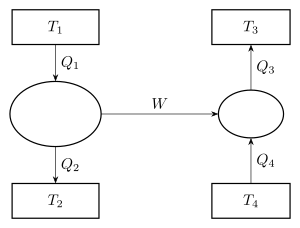
- TG EAPCET 2021Set eng-2021-08-05-AN1 markMCQQ.The following figure shows a Carnot engine that works between temperatures T1=400K and T2=200K and drives a Carnot refrigeration that works between temperatures T3=350K and T4=250K. The quantity Q1Q3 will be (A) 1.5 (B) 2.0 (C) 2.25 (D) 1.75
›Reveal solutionSolution
The engine's work drives the refrigerator. Relating the heat flows through the shared work with the Carnot relation Qhot/Qcold=Thot/Tcold gives Q1Q3=1.75, so the correct option is (D).
An ideal Carnot engine operates between T1=400K and T2=200K; its work output drives a Carnot refrigerator operating between T3=350K (hot) and T4=250K (cold). Here Q1 is the heat the engine absorbs from its hot reservoir, and Q3 is the heat the refrigerator rejects at T3.
1. Engine. For a Carnot engine, Q1Q2=T1T2=400200=0.5, so the work is
W=Q1−Q2=0.5Q1.
2. Refrigerator. For the Carnot refrigerator, Q4Q3=T4T3=250350=1.4. With W=Q3−Q4 and Q4=Q3/1.4:
W=Q3(1−1.41)=Q3⋅1.40.4=72Q3⇒Q3=3.5W.
3. Combine. Q3=3.5×0.5Q1=1.75Q1, so
Q1Q3=1.75.
✓Final answerThe correct option is (D).
ANSWER: D
🎓Unlock everything free for 14 days
- ✓Full step-by-step solutions
- ✓Concept-first explanations
- ✓Methods, shortcuts & mistakes
- ✓PYQ mapping + timed mock tests
Full access for 14 days. No credit card required.