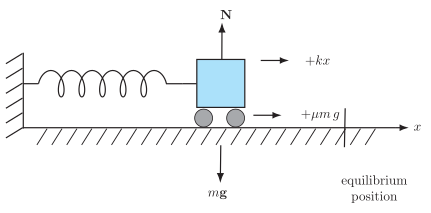
Q.Consider Example 5.8 taking the coefficient of friction, μ, to be 0.5 and calculate the maximum compression of the spring.
🔒You're viewing a preview — the full solution, concept, methods & PYQ mapping are locked.
🔒 Start your 14-day free trial to unlock the full solution →Concept understanding — Work Energy Theorem
The Work-Energy Theorem: From Intuition to Precision
Imagine pushing a heavy box across the floor. The harder you push and the farther it slides, the faster it moves when you let go. That connection — the push (force) over a distance (displacement) changing the box's speed — is exactly what the Work-Energy Theorem captures.
The Intuition First
Think of work as the "currency" that buys motion. When you do work on an object, you transfer energy to it. That energy shows up as kinetic energy — the energy of motion. The more work you do, the more the object's kinetic energy changes.
If you push a stationary ball, it starts moving. If you push a moving ball in the same direction, it speeds up. If you push against its motion, it slows down. In every case, the work done equals the change in the ball's kinetic energy.
Work is done by a force on an object. The object's kinetic energy changes by exactly that amount (assuming no other forces do work).
The Precise Statement
Wnet=ΔK=Kf−Ki
Where:
- Wnet is the net work done on the object (the total work from all forces combined)
- Kf is the final kinetic energy
- Ki is the initial kinetic energy
And kinetic energy is defined as:
K=21mv2
So the theorem can also be written as:
Wnet=21mvf2−21mvi2
Why "Net" Work Matters
This is the most common point of confusion. The theorem uses net work — the work done by the net force (the vector sum of all forces). If you push a box and friction opposes it, the net work is the work you do minus the work friction does. Only that net amount changes the kinetic energy.
If you push a box at constant speed, your work is positive, but friction does equal negative work. The net work is zero, so kinetic energy doesn't change — the box keeps moving at the same speed. Your work didn't "disappear"; it was dissipated as heat by friction.
A Simple Derivation (for constant force)
Consider a constant net force Fnet acting on an object of mass m over a displacement s. From Newton's second law:
Fnet=ma
From kinematics (constant acceleration):
vf2=vi2+2as
Multiply both sides by 21m:
21mvf2=21mvi2+mas
But mas=Fnets=Wnet, so:
21mvf2=21mvi2+Wnet
Rearranging:
Wnet=21mvf2−21mvi2=ΔK
The theorem holds even for variable forces and curved paths — the derivation uses calculus then, but the result is the same.
What It Tells You (and What It Doesn't) …
Concept: Conservation of Mechanical Energy (with work done against friction)
Data reused from the previous spring-collision example (Q. "Examples 5.9"): a car of mass m=1000kg, moving at v=18.0km/h=5.00m/s, collides with a horizontally mounted spring of spring constant k=5.25×10³N m−1. (Check: frictionless, this gives the compression x0=vm/k=5.001000/5250≈2.18m — matching the previous example, confirming these are the right values to carry forward.)
Step 1 — Energy balance with friction
Now the road has friction, with coefficient μ=0.5, acting over the compression distance x. The car's initial kinetic energy is used up by (a) friction, which does negative work −μmgx, and (b) the spring, which stores 21kx2 at maximum compression (where the car is momentarily at rest):
21mv2=21kx2+μmgx
Step 2 — Substitute values (using g=9.8m/s2):
21(1000)(5.00)2=21(5.25×103)x2+(0.5)(1000)(9.8)x
12500=2625x2+4900x⇒2625x2+4900x−12500=0
Step 3 — Solve the quadratic …
Using the data from the previous spring-collision example (m=1000kg, v=18.0km/h=5.00m/s, spring constant k=5.25×10³N/m, on a horizontal road) with friction μ=0.5 added, energy conservation with friction's work gives a maximum spring compression of x≈1.44m.
Recovering the referenced example's data
This question asks us to redo the previous spring-collision example with friction added, so we must first pin down what that example gives: a car of mass m=1000kg moving at speed v=18.0km/h=5.00m/s on a horizontal, smooth road, colliding with a spring of spring constant k=5.25×10³N/m. As a sanity check, the frictionless answer to that example is
x0=vkm=5.0052501000≈2.18m,
which matches the previous example's result — confirming these are the correct values to carry forward.
Setting up the energy equation with friction
Now the road has friction, with coefficient μ=0.5. As the car slides forward and compresses the spring, two things remove its kinetic energy: the spring (which stores it as elastic potential energy) and friction (which removes it permanently as heat). At the point of maximum compression x, the car is momentarily at rest, so all its initial kinetic energy has gone into these two channels:
21mv2=21kx2+μmgx
The left side is the car's initial kinetic energy. The right side is the elastic potential energy stored in the spring plus the energy dissipated by friction over the distance x that the car travels while compressing the spring.
A common mistake is to forget that friction acts over the entire compression distance x, not just up to the point the spring is first touched. As long as the car keeps moving into the spring, friction keeps doing negative work on it.
Step-by-step solution
1. Write down the known quantities
- m=1000kg
- v=18.0km/h=5.00m/s
- k=5.25×10³N/m
- μ=0.5
- g=9.8m/s2
2. Substitute into the energy equation
21(1000)(5.00)2=21(5.25×103)x2+(0.5)(1000)(9.8)x
12500=2625x2+4900x
3. Rearrange into standard quadratic form …
Concept: Energy Conservation with Non-Conservative Friction (Work-Energy + Spring PE)
Step 1: Reuse the previous spring-collision example's data, now with friction added.
m=1000kg, v=5.00m/s (from 18.0km/h), k=5.25×10³N/m, μ=0.5, g=9.8m/s2.
Step 2: Write the energy balance at maximum compression x (car momentarily at rest).
Kinetic energy is split between the spring's stored PE and the energy dissipated by friction over distance x:
21mv2=21kx2+μmgx
Step 3: Substitute the numbers and simplify. …
Showing the 12 most recent of 16 on this concept.
- TG EAPCET 2026Set eng-2026-05-09-AN1 markMCQQ.The energy required to transfer a satellite of mass ‘m’ from an orbit of height 0.5R from the surface of the earth to an orbit of height 2R from the surface of the earth is (g - acceleration due to gravity on the surface of the earth and R - radius of the earth) (A) 4mgR (B) 2mgR (C) 6mgR (D) 3mgR
›Reveal solutionSolution
The energy required is the difference in total mechanical energy between the two orbits. For a satellite in a circular orbit, total energy = −2rGMm. Using g=GM/R2, the answer simplifies to 6mgR.
The key idea here is that a satellite in a circular orbit has a total mechanical energy that is negative and exactly half its gravitational potential energy. To move from one orbit to another, you must supply the difference in these total energies — that’s the work needed, regardless of the path taken.
Why half? Because the satellite’s kinetic energy is positive and exactly half the magnitude of its negative potential energy, giving a neat cancellation. This is a direct consequence of the centripetal force condition for a circular orbit.
Let’s work it through.
- Write the total energy for a circular orbit. For a satellite of mass m orbiting Earth (mass M) at a distance r from the centre, the gravitational force provides the centripetal force:
r2GMm=rmv2
So kinetic energy K=21mv2=2rGMm.
Potential energy U=−rGMm.
Total mechanical energy:
E=K+U=2rGMm−rGMm=−2rGMm
This is a central formula to remember.
Eorbit=−2rGMm
-
Find the orbital radii from the given heights.
Height is measured from Earth’s surface. Radius of Earth = R.
- For height 0.5R: orbital radius r1=R+0.5R=1.5R=23R
- For height 2R: orbital radius r2=R+2R=3R
-
Compute the total energy in each orbit.
E1=−2r1GMm=−2⋅23RGMm=−3RGMm
E2=−2r2GMm=−2⋅3RGMm=−6RGMm
- Energy required = difference in total energy. …
- TG EAPCET 2026Set eng-2026-05-11-AN1 markMCQQ.If the work done to double the velocity of a body from 15 ms−1 is K times the work done to double its velocity from 10 ms−1, then the value of K is (A) 2.75 (B) 2.25 (C) 3.25 (D) 3.75
›Reveal solutionSolution
The work done equals the change in kinetic energy. Doubling the velocity from 15 m/s gives a larger kinetic-energy increase than from 10 m/s, and the ratio K is found to be 2.25, corresponding to option (B).
Concept & Intuition
Work–energy theorem: the work done on a body equals its change in kinetic energy.
Kinetic energy is KE=21mv2.
When we “double the velocity” from an initial speed u to 2u, the change in kinetic energy is
ΔKE=21m(2u)2−21mu2=21m(4u2−u2)=21m(3u2).
So the work needed is proportional to u2. The problem asks for the ratio of work when u=15 to work when u=10 — that ratio is simply (152)/(102)=225/100=2.25. No mass needed; it cancels.
Step-by-step reasoning
- Work done = change in kinetic energy For a body of mass m, the work W to change its speed from vi to vf is
W=21mvf2−21mvi2.
- Case 1: doubling from 10 m/s Initial speed u1=10, final speed 2u1=20.
W1=21m(202−102)=21m(400−100)=21m(300).
- Case 2: doubling from 15 m/s Initial speed u2=15, final speed 2u2=30.
W2=21m(302−152)=21m(900−225)=21m(675).
- Find K=W2/W1
- TG EAPCET 2026Set ap-2026-05-05-FN1 markMCQQ.To drive a vertical nail of mass 10 g in to wood through 9 cm, an iron block of mass 990 g is dropped on to it freely from a height of 10 m above the nail. If the collision between the nail and the block is perfectly inelastic, then the force of resistance offered by wood is (Acceleration due to gravity =10ms−2) (A) 898 N (B) 989 N (C) 1089 N (D) 1198 N
›Reveal solutionSolution
The block reaches 200 m s−1, the inelastic collision leaves ≈98 J of kinetic energy in the nail+block, and dissipating it over 9 cm needs a resistance of ≈1089 N.
1. Speed of the block on reaching the nail (free fall through h=10 m):
v=2gh=2(10)(10)=200=14.14 m s−1.
2. Perfectly inelastic collision (M=0.99 kg block, m=0.01 kg nail). Conserving momentum:
V=M+mMv=1.00.99200=14.0 m s−1.
3. Kinetic energy of the combined mass just after impact: …
- TG EAPCET 2026Set ap-2026-05-05-FN1 markMCQQ.Two identical rain drops are falling through air each with a terminal velocity ‘V’. If the two drops coalesce to form a single big drop, then the terminal velocity of the big drop is (A) 22/3V (B) 22/3V (C) 21/3V (D) 21/3V
›Reveal solutionSolution
When a body falls through a viscous medium, it reaches a constant terminal velocity when the gravitational force is balanced by the buoyant force and the viscous drag. For a spherical drop, this terminal velocity is proportional to the square of its radius. When two identical drops coalesce, the total volume is conserved, leading to a larger radius for the new drop. This larger radius results in a higher terminal velocity, specifically 22/3 times the original velocity. The final answer is 22/3V.
The problem asks us to find the terminal velocity of a large drop formed by the coalescence of two identical smaller raindrops, each falling with a terminal velocity V. To solve this, we need to understand what terminal velocity is and how it depends on the physical properties of the drop, especially its size.
Concept: Terminal Velocity
When an object falls through a fluid (like air), it experiences three main forces:
- Gravitational Force (Fg): Acting downwards, due to the object's mass.
- Buoyant Force (Fb): Acting upwards, due to the displacement of the fluid.
- Viscous Drag Force (Fv): Acting upwards, opposing the motion, due to the fluid's resistance.
Initially, as the object starts falling, its speed increases, and so does the viscous drag force. Eventually, the upward forces (buoyant force + viscous drag) become equal to the downward gravitational force. At this point, the net force on the object is zero, and it stops accelerating, continuing to fall at a constant maximum velocity called the terminal velocity (vt).
For a small spherical object of radius r falling through a fluid of viscosity η, the viscous drag force is given by Stokes' Law:
Fv=6πηrvt
The gravitational force on the drop is Fg=mg, where m is the mass of the drop. If ρw is the density of water (the drop) and Vd is its volume, then m=ρwVd. For a sphere, Vd=34πr3. So, Fg=34πr3ρwg.
The buoyant force is Fb=ρaVdg, where ρa is the density of air (the fluid). So, Fb=34πr3ρag.
At terminal velocity, the forces balance:
Fg=Fb+Fv
34πr3ρwg=34πr3ρag+6πηrvt
Rearranging to solve for vt:
6πηrvt=34πr3(ρw−ρa)g
vt=3⋅6πηr4πr3(ρw−ρa)g
vt=9η2r2(ρw−ρa)g
The terminal velocity vt of a spherical drop of radius r is given by:
vt=9η2r2(ρw−ρa)g
where ρw is the density of the drop, ρa is the density of the fluid (air), g is the acceleration due to gravity, and η is the coefficient of viscosity of the fluid.
From this formula, we can see that for a given fluid and drop material, the terminal velocity is directly proportional to the square of the drop's radius:
vt∝r2
This relationship is key to solving the problem.
Here's how we solve the problem step-by-step:
-
Express the terminal velocity of a single small drop:
Let r be the radius of each small raindrop. The terminal velocity of each small drop is given as V.
From the formula derived above, we can write:
V=kr2
where k=9η2(ρw−ρa)g is a constant that depends on the properties of water, air, and gravity, but not on the size of the drop.
-
Determine the radius of the big drop after coalescence:
When two identical raindrops coalesce, their total volume is conserved. …
- TG EAPCET 2025Set eng-2025-05-03-AN1 markMCQQ.Due to the presence of air resistance, if a body dropped from a height of 20 m reaches the ground with a speed of 18ms−1, then the time taken by the body to reach the ground is nearly (A) 1.8s (B) 2.2s (C) 2s (D) 2.5s
›Reveal solutionSolution
The key idea is that with air resistance, the motion is not uniformly accelerated, so we cannot use constant‑acceleration formulas directly. Instead, we use the average velocity concept: for any motion, distance = average velocity × time. The average velocity is (initial speed + final speed)/2 only if acceleration is constant, but here we must approximate because the problem gives no details about the drag law. Using the given data, the simplest reasonable estimate gives time ≈ 2.2 s, which matches option (B).
Concept and intuition
When a body falls under gravity with air resistance, its acceleration is not constant — it starts at g and decreases as speed increases, eventually approaching zero if the fall is long enough. That means the usual kinematic equations (s=ut+21at2, v2=u2+2as) do not apply.
However, we still have the fundamental definition:
average velocity=total timetotal displacement.
If we can estimate the average velocity, we can find the time. For a fall from rest (u=0) with a known final speed v=18 m/s, the average velocity lies somewhere between 0 and 18. In constant acceleration it would be exactly (0+18)/2=9 m/s. With air resistance, the body spends more time at lower speeds early on, so the average velocity is less than 9 m/s. That means the time will be greater than the constant‑acceleration time. Let’s quantify.
Step‑by‑step reasoning
- Constant‑acceleration baseline (no air resistance) If there were no air resistance, the fall from 20 m with u=0 would satisfy
v2=2gh⇒v=2×9.8×20≈392≈19.8 m/s.
The actual final speed is only 18 m/s, so air resistance has reduced it. The time without resistance would be
tno drag=gv=9.819.8≈2.02 s.
This is close to option (C) 2 s, but that’s the no‑drag case — not our answer.
- Using average velocity with the given data For any motion,
t=vavgs.
We know s=20 m. We need vavg.
With air resistance, the speed‑time graph is concave down (increasing but at a decreasing rate). The average value is less than the arithmetic mean of initial and final speeds. A common approximation (used when the exact drag law is unknown) is to take
vavg≈2vforvavg≈kvf
with k>2. But we can do better: we know the final speed is 18 m/s, and the initial is 0. For a body that starts from rest and experiences a resistive force proportional to speed (linear drag), the average velocity is exactly
vavg=ln(vf−gtvf)vf(not simple).
However, the problem expects a quick estimate. Notice that the constant‑acceleration time (2.02 s) gives a final speed of ~19.8 m/s, but we have only 18 m/s. The reduction in speed is modest, so the time should be only slightly larger than 2.02 s. Among the options, 2.2 s is the next reasonable value.
- A more precise estimate using the work‑energy idea The work done by air resistance equals the loss in kinetic energy compared to the no‑drag case: Loss in KE=21m(19.82−182)≈21m(392−324)=34m. …
- TG EAPCET 2025Set eng-2025-05-03-FN1 markMCQQ.Due to the presence of air resistance, if a body dropped from a height of 20m reaches the ground with a speed of 18ms−1, then the time taken by the body to reach the ground is nearly (A) 2.2s (B) 2.5s (C) 1.8s (D) 2s
›Reveal solutionSolution
The key idea is to treat the motion under constant air resistance as having a constant effective acceleration, found from the work–energy relation, then use that acceleration to compute the time. The computed time is approximately 2.2 s, so option (A) is correct.
Concept and intuition
In free fall without air resistance, an object dropped from 20 m would hit the ground at about 2gh≈2⋅9.8⋅20≈19.8 m/s. Here the final speed is only 18 m/s, so air resistance has done negative work, reducing the kinetic energy.
If we assume the resistive force is constant (a common simplification for such problems), then the net downward acceleration is constant but smaller than g. We can find that effective acceleration from the work–energy theorem, then use kinematics to get the time.
Step‑by‑step solution
- Set up the work–energy relation The work done by gravity is mgh. The work done by air resistance is −Fairh (negative because it opposes motion). The net work equals the change in kinetic energy:
mgh−Fairh=21mv2−0
where h=20 m, v=18 m/s, and g=9.8 m/s2.
- Solve for the net acceleration Divide through by m:
gh−mFairh=21v2
The net downward acceleration is a=g−mFair. So:
ah=21v2⇒a=2hv2
Plug numbers:
a=2⋅20182=40324=8.1 m/s2
This is the constant effective acceleration.
- Use kinematics to find time For constant acceleration from rest:
h=21at2⇒t=a2h
Substitute:
- TG EAPCET 2024Set eng-2024-05-09-AN1 markMCQQ.A block of mass ‘m’ with an initial kinetic energy ‘E’ moves up an inclined plane of inclination ‘θ’. If ‘μ’ is the coefficient of friction between the plane and the body, the work done against friction before coming to rest is (A) μEcosθ (B) sinθ−μcosθμEcosθ (C) cosθ+sinθEμcosθ (D) sinθ+μcosθμEcosθ
›Reveal solutionSolution
The work done against friction equals the initial kinetic energy times the ratio of the frictional force to the net retarding force along the incline. The correct expression is sinθ+μcosθμEcosθ, which corresponds to option (D).
Concept & Intuition
When a block slides up an incline, two forces oppose its motion: the component of gravity down the plane (mgsinθ) and kinetic friction (μmgcosθ). Both do negative work, draining the block’s initial kinetic energy E until it stops. The work done against friction is just the part of that energy loss due to friction alone. Since both forces act over the same distance d, the fraction of E that goes into friction equals the ratio of the frictional force to the total retarding force.
Step-by-step reasoning
- Identify the forces doing work As the block moves up the incline, the net force opposing motion is
Fnet=mgsinθ+μmgcosθ.
The first term is gravity’s component down the plane; the second is kinetic friction. Both act opposite to the displacement.
- Relate work and distance The total work done by these opposing forces equals the change in kinetic energy (from E to 0):
(mgsinθ+μmgcosθ)d=E,
where d is the distance traveled along the incline before stopping.
Solve for d:
d=mg(sinθ+μcosθ)E.
- Work done against friction Friction alone does work Wf=(μmgcosθ)d (the force times distance). Substitute d:
Wf=μmgcosθ⋅mg(sinθ+μcosθ)E=sinθ+μcosθμEcosθ.
- Interpret the result …
- TG EAPCET 2024Set eng-2024-05-10-FN1 markMCQQ.A body thrown vertically upwards from the ground reaches a maximum height ‘h’. The ratio of the kinetic and potential energies of the body at a height 40% of h from the ground is (A) 2:3 (B) 3:2 (C) 1:1 (D) 4:9
›Reveal solutionSolution
Using conservation of mechanical energy, at 40% of the maximum height the kinetic energy is 60% of the initial energy, so the ratio KE:PE = 60:40 = 3:2, making the correct option (B).
Concept and Intuition
When a body is thrown vertically upward, its total mechanical energy (kinetic + potential) remains constant if we ignore air resistance. At the ground, all energy is kinetic. At the maximum height h, all energy is potential. At any intermediate height, the sum is the same. So if we know the fraction of the height, we know the fraction of potential energy, and the rest must be kinetic. The ratio follows directly.
Step-by-step solution
- Define the total energy Let the mass of the body be m and the initial speed at ground be u. At the ground, potential energy is zero, so total mechanical energy E=21mu2. At the maximum height h, the speed is zero, so E=mgh. Hence
21mu2=mgh.
- Energy at height 0.4h At a height y=0.4h, the potential energy is
PE=mgy=mg(0.4h)=0.4mgh.
Since total energy E=mgh, the kinetic energy at that height is
KE=E−PE=mgh−0.4mgh=0.6mgh.
- Find the ratio
- TG EAPCET 2024Set eng-2024-05-11-FN1 markMCQQ.A constant force of (8i−2j+6k) N acting on a body of mass 2 kg displaces the body from (2i+3j−4k) m to (4i−3j+6k) m. The work done in the process is (A) 72 J (B) 88 J (C) 44 J (D) 36 J
›Reveal solutionSolution
Work done by a constant force is the dot product of the force vector and the displacement vector. Here, the displacement is (2i−6j+10k) m, and the dot product with (8i−2j+6k) N gives 88 J. The correct option is (B).
Concept & Intuition
Work done by a constant force is defined as the scalar product (dot product) of the force vector and the displacement vector. This is because only the component of force in the direction of displacement actually does work. The dot product automatically picks out that component. So we don’t need to worry about angles or components separately — just compute F⋅d.
Step-by-step solution
- Find the displacement vector Displacement d = final position − initial position. Initial position: ri=2i+3j−4k Final position: rf=4i−3j+6k So
d=(4−2)i+(−3−3)j+(6−(−4))k=2i−6j+10k
-
Recall the work formula
For a constant force F, work done W=F⋅d.
-
Compute the dot product …
- TG EAPCET 2023Set eng-2023-05-13-AN1 markMCQQ.A body of mass 3kg is moving under the action of a force which causes a displacement of (3t3)m, where ‘t’ is time in seconds. The work done by the force in first 2 seconds is (A) 2J (B) 3.8J (C) 5.2J (D) 24J
›Reveal solutionSolution
Work done equals the change in kinetic energy. By finding velocity from the given displacement, then computing kinetic energy at t = 2 s, we get 24 J. The correct option is (D).
Concept & Intuition
The problem gives displacement as a function of time: s(t)=3t3. Work done by a force is the integral of force over displacement, but a far simpler route uses the work–energy theorem: the net work done equals the change in kinetic energy. Since the body starts from rest (implied at t = 0, displacement is zero), the work done in the first 2 seconds is simply the kinetic energy at t = 2 s. We just need the velocity at that instant.
Step-by-step solution
- Find velocity as a function of time Velocity is the derivative of displacement with respect to time:
v(t)=dtds=dtd(3t3)=t2
So at any time t, the speed is v=t2 m/s.
- Compute velocity at t = 2 s
v(2)=(2)2=4 m/s
- Apply the work–energy theorem Work done = change in kinetic energy. Initial kinetic energy (at t = 0) is zero because v(0)=0. W=ΔKE=21mv2−0=21×3×(4)2 …
- TG EAPCET 2023Set eng-2023-05-14-FN1 markMCQQ.An engine is dragging a mass of 5000kg with a velocity of 5ms−1 along a smooth inclined plane of inclination 1 in 50. Then the power of the engine is (A) 5kW (B) 2.5kW (C) 10kW (D) 25kW
›Reveal solutionSolution
The engine must supply power to overcome the gravitational component along the incline at constant speed. The power is P=mgvsinθ, giving P=5000×9.8×5×501=4900W≈5kW, so the correct option is (A).
Concept & Intuition
When an object moves at constant velocity along a smooth (frictionless) incline, the only force the engine must overcome is the component of gravity pulling it back down the slope. Power is the rate at which work is done against this force. Since the plane is smooth, there is no friction to worry about — the engine’s entire output goes into lifting the mass against gravity at a steady rate.
Step-by-step reasoning
-
Identify the slope angle
The incline is given as “1 in 50”, meaning for every 50 metres along the slope, the vertical rise is 1 metre. Hence sinθ=501.
-
Force the engine must exert
The gravitational force down the incline is mgsinθ. To keep the mass moving at constant velocity (no acceleration), the engine must pull with an equal and opposite force:
F=mgsinθ=5000×9.8×501
(We use g=9.8m/s2 unless stated otherwise.)
- Calculate that force
F=5000×9.8×0.02=5000×0.196=980N
- Power formula For a constant force in the direction of motion, power is P=Fv, where v is the speed. …
-
- TG EAPCET 2022Set eng-2022-07-19-AN1 markMCQQ.A rocket moves straight upward with zero initial velocity and with an acceleration 20 m/s2. It runs out of fuel and stops accelerating at the end of 5th sec. It reaches a maximum height and falls back to the earth. The speed when it hits the ground is (Take g=10 m/s2) (A) 1002 m/s (B) 1503 m/s (C) 506 m/s (D) 75 m/s
›Reveal solutionSolution
The rocket's motion is divided into three phases: initial acceleration, upward motion under gravity, and free fall. We calculate the velocity and height at the end of each phase to find the final speed when it hits the ground. The speed when it hits the ground is 506 m/s.
The problem describes the motion of a rocket in three distinct phases, each with a different constant acceleration. To solve this, we need to analyze each phase separately using the equations of motion for constant acceleration. The key idea is that the final velocity and position of one phase become the initial velocity and position for the next phase.
Here's the breakdown of the rocket's journey:
- Phase 1: Accelerated motion (0 to 5 seconds) The rocket moves upward with a constant acceleration of 20 m/s2.
- Phase 2: Upward motion under gravity (after 5 seconds until maximum height) After 5 seconds, the fuel runs out, so the rocket stops accelerating due to its engine. From this point, only gravity acts on it, causing it to decelerate as it continues to move upward until its velocity becomes zero at the maximum height.
- Phase 3: Free fall (from maximum height to the ground) Once it reaches its maximum height, the rocket starts falling back to Earth under the influence of gravity. We need to find its speed just before it hits the ground.
We will use the standard kinematic equations for constant acceleration:
v=u+at
s=ut+21at2
v2=u2+2as
where u is initial velocity, v is final velocity, a is acceleration, t is time, and s is displacement. We will take the upward direction as positive for the first two phases and then adjust for the third phase.
Let's calculate the motion step-by-step:
-
Phase 1: Rocket accelerating upwards (from t=0 to t=5 s)
The rocket starts from rest, so its initial velocity is u1=0 m/s. It accelerates upward at a1=20 m/s2 for t1=5 s.
We first find the velocity of the rocket at the end of this phase:
v1=u1+a1t1
v1=0+(20 m/s2)(5 s)
v1=100 m/s (upward)
Next, we find the height reached during this phase:
h1=u1t1+21a1t12
h1=(0)(5 s)+21(20 m/s2)(5 s)2
h1=0+21(20)(25) m
h1=10×25 m
h1=250 m
-
Phase 2: Rocket moving upwards under gravity (after t=5 s until maximum height)
At t=5 s, the rocket's engine stops, but it has an upward velocity of 100 m/s. From this point, the only acceleration acting on it is due to gravity, which is g=10 m/s2 downward. So, the acceleration for this phase is a2=−10 m/s2 (taking upward as positive). The rocket will continue to move upward until its final velocity becomes v2=0 m/s at the maximum height.
Using the equation v2=u2+2as: …
🎓Unlock everything free for 14 days
- ✓Full step-by-step solutions
- ✓Concept-first explanations
- ✓Methods, shortcuts & mistakes
- ✓PYQ mapping + timed mock tests
Full access for 14 days. No credit card required.