Q.The potential energy function for a particle executing linear simple harmonic motion is given by V(x)=kx2/2, where k is the force constant of the oscillator. For k=0.5 N m−1, the graph of V(x) versus x is shown in Fig. 5.12. Show that a particle of total energy 1 J moving under this potential must 'turn back' when it reaches x=±2 m.
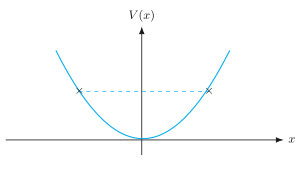
🔒You're viewing a preview — the full solution, concept, methods & PYQ mapping are locked.
🔒 Start your 14-day free trial to unlock the full solution →Concept understanding — Classical Turning Points
Classical Turning Points
Picture a pendulum bob swung to one side, or a block on a spring pulled to its farthest stretch. At that extreme position, the object is momentarily still before it reverses direction. That instant — and that position — is what physicists call a classical turning point.
Where Turning Points Occur in SHM
For a particle executing simple harmonic motion (SHM) with amplitude A, the two turning points are the extreme positions:
x=+Aandx=−A
These are the farthest points the particle reaches on either side of the mean (equilibrium) position, x=0.
At a turning point, the particle's velocity is exactly zero, and it is about to reverse the direction of its motion.
Why "Turning" — The Velocity Condition
For SHM, the velocity as a function of displacement is:
v(x)=ωA2−x2
At x=±A, the term under the square root becomes zero, so v=0. The particle cannot move past x=A (or below x=−A) — doing so would make A2−x2 negative, which is impossible for a real velocity. This is why x=±A are hard boundaries for the motion.
The Energy Picture
Turning points are easiest to understand through energy. For SHM, total mechanical energy is conserved:
E=K+U=21mω2A2(constant)
where K=21mω2(A2−x2) is kinetic energy and U=21mω2x2 is potential energy.
At a turning point (x=±A): K=0 and U=E. All the energy is potential; none is kinetic.
This is the opposite of what happens at the mean position (x=0), where K=E (maximum speed) and U=0.
The Restoring Force Is Maximum Here
Even though velocity is zero at a turning point, the particle is not in equilibrium. The restoring force F=−kx (and acceleration a=−ω2x) reach their maximum magnitude exactly at x=±A, which is precisely why the particle doesn't stay there — it is pulled straight back toward the centre.
Why "Classical"?
The word "classical" distinguishes this boundary from quantum mechanics. In classical mechanics, a particle governed by SHM can never be found beyond x=±A, because that would require negative kinetic energy — physically impossible. The region beyond the turning points is called the "classically forbidden region." (In quantum mechanics a particle's wavefunction can extend slightly beyond this boundary — tunnelling — but that lies outside the Class 11 syllabus.) …
The key idea is that at a classical turning point, the particle’s kinetic energy becomes zero, so its total energy equals the potential energy.
Step 1: Write the condition for a turning point:
E=V(x).
Step 2: Substitute the given values:
E=1 J, k=0.5 N m−1, and V(x)=21kx2.
Step 3: Solve for x:
1=21(0.5)x2=0.25x2 …
For a particle in SHM, the turning points occur where kinetic energy becomes zero — i.e., where total energy equals potential energy. Setting E=V(x) gives 1=21kx2, and with k=0.5 N/m, solving yields x=±2 m.
The idea is simple: a particle moving under a conservative force has a fixed total energy E, which is the sum of kinetic energy K and potential energy V(x). As the particle moves, energy sloshes between these two forms. At a turning point, the particle momentarily stops and reverses direction — so its kinetic energy is exactly zero. That means all the energy is potential.
So the condition for a turning point is:
E=V(x)
Here, V(x)=21kx2, with k=0.5 N/m, and E=1 J.
- Write the turning-point equation:
1=21×0.5×x2
- Simplify the constant:
21×0.5=0.25
So:
1=0.25x2
- Solve for x2:
x2=0.251=4
- Take the square root: x=±2 m …
Concept: Turning Points of Motion in a Potential — E=V(x)
Step 1: State the turning-point condition.
At a turning point the particle momentarily stops, so K=0 and all energy is potential: E=V(x).
Step 2: Substitute the SHM potential V(x)=21kx2. …
- TG EAPCET 2026Set eng-2026-05-10-AN1 markMCQQ.The total energy of a particle executing simple harmonic motion with 2 cm amplitude is 160 mJ. The force acting on the particle at a point where the ratio of the potential and kinetic energies of the particle becomes 1 : 15 is (A) 16 N (B) 12 N (C) 8 N (D) 4 N
›Reveal solutionSolution
PE:KE=1:15 means PE is 161 of the total, so x=A/4; then F=kx=4 N (D).
Step 1 — Locate the point.
Total energy E=PE+KE. With PE:KE=1:15,
EPE=161
Since PE=21kx2 and E=21kA2,
A2x2=161⇒x=4A=42=0.5 cm=5×10⁻³ m
Step 2 — Find the spring constant k. …
- TG EAPCET 2026Set eng-2026-05-10-FN1 markMCQQ.The force acting on a particle in x-direction is (3+2x) N, where ‘x’ is displacement of the particle in metre. The work to be done in displacing the particle from x=1.5 m to x=3.5 m is (A) 24 J (B) 32 J (C) 16 J (D) 8 J
›Reveal solutionSolution
Work is the integral of force over displacement. For a variable force F(x)=3+2x, the work from x=1.5 m to x=3.5 m is ∫1.53.5(3+2x)dx=16 J, so the correct option is (C).
The key idea here is that when a force varies with position, you cannot simply multiply force by displacement — you must integrate. The work done by a variable force in one dimension is the area under the force vs. displacement curve. Since the force is linear in x, the area is a trapezoid, but integration gives the exact result.
Let’s work through it step by step.
- Recall the definition of work for a variable force When the force F depends on position x, the work done in moving from x1 to x2 is
W=∫x1x2F(x)dx.
Here F(x)=3+2x (in newtons), x1=1.5 m, x2=3.5 m.
- Set up the integral
W=∫1.53.5(3+2x)dx.
- Integrate term by term The antiderivative of 3 is 3x, and the antiderivative of 2x is x2 (since ∫2xdx=x2). So
W=[3x+x2]1.53.5.
- Evaluate at the limits At x=3.5:
3(3.5)+(3.5)2=10.5+12.25=22.75.
At x=1.5:
3(1.5)+(1.5)2=4.5+2.25=6.75.
- Subtract to find the work
W=22.75−6.75=16.
So the work done is 16 joules. …
- TG EAPCET 2025Set eng-2025-05-02-FN1 markMCQQ.The amplitude of a particle executing simple harmonic motion is 6 cm. The distance of the point from the mean position at which the ratio of the potential and kinetic energies of the particle becomes 4:5 is (A) 6 cm (B) 4 cm (C) 3 cm (D) 2 cm
›Reveal solutionSolution
In SHM, energy conservation gives E=K+U. Setting U/K=4/5 leads to U=94E. Since U=21kx2 and E=21kA2, we get x=32A=4 cm. The correct option is (B).
Concept & Intuition
In simple harmonic motion, total mechanical energy E is constant and splits between kinetic energy K and potential energy U. The ratio U:K tells us how far the particle is from equilibrium: at the extremes (x=±A), all energy is potential; at the mean position (x=0), all energy is kinetic. For any intermediate position, the fraction of energy that is potential is proportional to x2. So given a ratio, we can directly solve for x in terms of amplitude A.
Step-by-step solution
- Write the energy expressions For a particle in SHM with amplitude A=6 cm, spring constant k, and displacement x from mean position:
U=21kx2,K=21k(A2−x2),E=21kA2.
(This uses v2=ω2(A2−x2) and K=21mv2, with ω2=k/m.)
- Set up the given ratio The problem states U:K=4:5, so
KU=54.
Substitute the expressions:
21k(A2−x2)21kx2=A2−x2x2=54.
- Solve for x2 Cross-multiply:
5x2=4(A2−x2)⇒5x2=4A2−4x2.
Bring terms together:
5x2+4x2=4A2⇒9x2=4A2.
Hence
x2=94A2⇒x=32A.… - TG EAPCET 2025Set ap-2025-04-29-AN1 markMCQQ.A particle is executing simple harmonic motion with an amplitude of 10 cm. If the kinetic energy of the particle at a distance of 6 cm from the mean position is 100 J, then the kinetic energy of the particle at a distance of 2 cm from the mean position is (A) 225 J (B) 300 J (C) 150 J (D) 75 J
›Reveal solutionSolution
Using KE=21mω2(A2−x2): from KE(6)=100 J we get KE(2)=100×100−36100−4=150 J; option (C).
In SHM the kinetic energy at displacement x is
KE=21mω2(A2−x2),A=10 cm. …
- TG EAPCET 2022Set eng-2022-07-18-AN1 markMCQQ.A block is placed on a parabolic shape ramp given by equation y=20x2. If the coefficient of static friction (μs) is 0.5, then what is the maximum height above the ground at which the block can be placed without slipping? (A) 2.5 m (B) 1.25 m (C) 0.5 m (D) 0.25 m
›Reveal solutionSolution
The block will not slip as long as the slope angle θ satisfies tanθ≤μs. For the parabola y=x2/20, the maximum height is found by setting tanθ=dy/dx=x/10 equal to 0.5, giving x=5 m, and then y=52/20=1.25 m. The answer is (B).
The key idea is that a block placed on a curved surface will start to slip when the component of gravity pulling it down the slope exceeds the maximum static friction. On any curve, the slope at a point is given by the derivative dy/dx, which equals tanθ, where θ is the angle the tangent makes with the horizontal. The condition for no slipping is simply tanθ≤μs.
For the parabola y=x2/20, the slope increases as you move away from the vertex (the lowest point). So the block can be placed safely up to the point where the slope is just steep enough to make it slip. Beyond that, friction can't hold it.
- Find the slope of the parabola. Differentiate:
dxdy=202x=10x.
This is tanθ at any point (x,y).
- Apply the no-slip condition. The block stays put if
tanθ≤μs.
With μs=0.5, we have
10x≤0.5⇒x≤5.
So the maximum x coordinate is 5 m (the parabola is symmetric, so we consider positive x).
- Find the corresponding height y. Substitute x=5 into the parabola equation: …
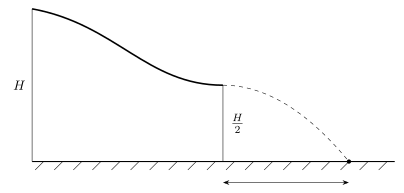
- TG EAPCET 2022Set eng-2022-07-18-AN1 markMCQQ.A small object slides down with initial velocity equal to zero from the top of a smooth hill of height H. The other end of the hill is horizontal and is at height 2H as shown in the figure. The horizontal distance covered by the object from the end of the hill to the ground is (A) 2H (B) H (C) 2H (D) 23H
›Reveal solutionSolution
The object slides down a frictionless hill, then becomes a projectile from a height H/2 with a horizontal speed found via energy conservation. The range is H, so the correct option is (B).
We start by recognizing that the hill is smooth, meaning no friction. That lets us use conservation of mechanical energy to find the speed at the end of the hill. After that, the object leaves horizontally and falls under gravity — a classic projectile motion problem. The key is to connect the two stages cleanly.
1. Find the speed at the end of the hill
The object starts from rest at height H. At the end of the hill, its height is H/2.
By conservation of energy:
Loss in gravitational potential energy=Gain in kinetic energy
mg(H−2H)=21mv2
mg⋅2H=21mv2
Cancel m and multiply both sides by 2:
gH=v2⇒v=gH
TipNotice the mass cancels — the speed depends only on the height difference and g, not on the shape of the hill.
2. Analyze the projectile motion
At the end of the hill, the object moves horizontally with speed v=gH from a height y0=H/2 above the ground.
We set up coordinates:
- Initial vertical position: y0=H/2
- Initial vertical velocity: vy0=0
- Acceleration: ay=−g (downward)
The time t to fall to the ground (y=0) is found from:
- TG EAPCET 2022Set eng-2022-07-20-AN1 markMCQQ.A block is in simple harmonic motion (S.H.M) on the end of the spring with position given by x=(5)cos(ωt+4π) cm. If the total mechanical energy used is 100 J to achieve maximum displacement, then the potential energy at time t=0 is (A) 20 J (B) 80 J (C) 75 J (D) 50 J
›Reveal solutionSolution
The phase constant shifts the starting point of the motion; at t=0 the block is not at the extreme position, so the potential energy is a fraction of the total energy. The answer is 50 J.
The key idea is that in SHM, total mechanical energy E is constant and equals the maximum potential energy (when displacement equals amplitude). At any other position, potential energy is U=21kx2, and since E=21kA2, we have U=E⋅A2x2. So if we find the displacement at t=0, we can directly get the potential energy as a fraction of E.
-
Identify amplitude and phase.
The position is x=5cos(ωt+4π) cm.
The amplitude is A=5 cm. The phase constant is ϕ=4π.
-
Find displacement at t=0.
At t=0:
x(0)=5cos(4π)=5⋅22=252 cm.
- Relate potential energy to total energy. Total mechanical energy E=100 J is the energy at maximum displacement x=A:
E=21kA2.
Potential energy at any x is U=21kx2.
So
U=E⋅A2x2.
- Plug in the numbers. …
-
🎓Unlock everything free for 14 days
- ✓Full step-by-step solutions
- ✓Concept-first explanations
- ✓Methods, shortcuts & mistakes
- ✓PYQ mapping + timed mock tests
Full access for 14 days. No credit card required.