Q.Common name of some animals are given in Column A, write their scientific name in Column B.
Column A: a. Tiger b. Peacock c. Housefly
Column B: ________________ (for each)
🔒You're viewing a preview — the full solution, concept, methods & PYQ mapping are locked.
🔒 Start your 14-day free trial to unlock the full solution →Concept understanding — Animal Classification
Imagine walking into a vast library with more than a million books and no shelves, no catalogue, and no order at all. Finding anything, or even understanding what the collection contains, would be hopeless. The animal kingdom presents the same challenge: biologists have already described more than a million animal species. On that scale, a systematic way of grouping animals is not a mere convenience but a necessity.
Animal classification is the orderly grouping of animals so we can make sense of their enormous variety. It lets us do three things: make sense of the sheer diversity, study a few representative types instead of every single species, and give each newly discovered animal a definite, systematic position alongside its relatives. Crucially, the grouping is not arbitrary. Although animals differ enormously in outward shape and form, they share certain deep, fundamental features, and classification is built on these shared features rather than on superficial appearances.
The fundamental characters used as the basis of classification are:
- The level of organisation of the cells (cellular, tissue, organ, or organ-system).
- The body symmetry — whether, and in how many planes, the body divides into matching halves (asymmetry, radial, or bilateral).
- The number of germ layers in the embryo (diploblastic or triploblastic).
- The nature of the coelom, or body cavity — absent, false, or a true mesoderm-lined cavity (acoelomate, pseudocoelomate, or coelomate).
- The presence of segmentation of the body.
- The presence or absence of a notochord (chordate or non-chordate).
The patterns of the digestive, circulatory, and reproductive systems are compared as well. …
The scientific (binomial) names of the animals listed are as follows.
- Tiger — Panthera tigris
- Peacock — Pavo cristatus
- Housefly — Musca domestica
Each of these is written as a two-part Latin binomial name, consisting of a genus name followed by a species name, following the standard convention used to scientificall …
The scientific binomial names of the animals are Panthera tigris for the tiger, Pavo cristatus for the peacock, and Musca domestica for the housefly.
Every organism recognised in biology is given a formal two-part scientific name, called a binomial name, consisting of the genus it belongs to followed by its specific species name. These names are used internationally, regardless of the common or local name an animal might have in different languages, so that there is no ambiguity about which organism is being referred to. …
Method: Recalling binomial (scientific) names for commonly cited organisms
For "give the scientific name" questions, the reliable approach is to recall the binomial naming convention itself first — genus name (capitalised) followed by a species name (lowercase), always written in italics in print. This structure helps you sanity-check any name you recall: if what comes to mind isn't a two-word Genus-species pair, you likely have the common name or a partial fact instead. …
- TG EAPCET 2026Set ap-2026-05-04-AN1 markMCQQ.Study the following and choose the correct combinations
S.No Larva Phylum Example I Auricularia Echinodermata Mytilus II Glochidium Mollusca Unio III Trochophore Arthropoda Nereis IV Planula Cnidaria Obelia (A) II, IV (B) I, III (C) I, II (D) III, IV ›Reveal solutionSolution
This question tests your knowledge of larval forms and their correct phylum–example matches. The correct combinations are II (Glochidium – Mollusca – Unio) and IV (Planula – Cnidaria – Obelia).
The key here is to recall the characteristic larval stages of major animal phyla. Each phylum often has a distinct larval form that is used in classification and evolutionary studies. A common mistake is to confuse the larva of one phylum with another, or to mismatch the example organism.
Let’s examine each row carefully.
-
Row I: Auricularia – Echinodermata – Mytilus
The auricularia larva is indeed found in echinoderms (like starfish and sea cucumbers). However, Mytilus is a bivalve mollusc (the common mussel), not an echinoderm. The example is wrong. So this combination is incorrect.
-
Row II: Glochidium – Mollusca – Unio
The glochidium is a parasitic larva of freshwater bivalves, specifically of the genus Unio (a freshwater mussel). Both the phylum (Mollusca) and the example (Unio) are correct. This combination is correct.
-
Row III: Trochophore – Arthropoda – Nereis
The trochophore larva is characteristic of annelids (like Nereis, a polychaete worm) and some molluscs, not arthropods. Arthropoda typically have nauplius or other larvae. So the phylum is wrong here. This combination is incorrect. …
-
- TG EAPCET 2026Set ap-2026-05-05-FN1 markMCQQ.Study the following and pick up the incorrect combinations S.No Phylum Peculiar cells Examples I Porifera Choanocytes Chalina II Cnidaria Lasso cells Hydra III Ctenophora Cnidoblasts Pleurobrachia IV Platyhelminthes Flame cells Echinococcus (A) I, II (B) III, IV (C) I, IV (D) II, III
›Reveal solutionSolution
The question tests knowledge of characteristic cell types in different phyla. Cnidaria has cnidoblasts (not lasso cells), and Ctenophora has colloblasts (not cnidoblasts). The incorrect combinations are II and III.
Each animal phylum has evolved specialized cells that define its biology. Recognizing these signature cell types is fundamental to classification and understanding how these organisms feed, defend themselves, or maintain homeostasis. The question asks us to spot mismatches between phyla and their characteristic cells.
Let me examine each combination:
- Porifera – Choanocytes – Chalina
Porifera (sponges) are defined by their choanocytes, or collar cells. These flagellated cells line the internal chambers and create water currents while trapping food particles. Chalina is indeed a genus of sponges. This combination is correct.
- Cnidaria – Lasso cells – Hydra
Cnidaria (jellyfish, corals, hydras) are characterized by cnidoblasts (also called cnidocytes or nematocysts), specialized stinging cells used for prey capture and defense. The term "lasso cells" is not the standard name for cnidarian cells; it refers to colloblasts found in Ctenophora. Hydra is correctly a cnidarian, but the cell type is wrong. This combination is incorrect.
- Ctenophora – Cnidoblasts – Pleurobrachia
Ctenophora (comb jellies) possess colloblasts (also called lasso cells or adhesive cells), which are sticky cells used to capture prey. They do not have cnidoblasts—that's the defining feature of Cnidaria. Pleurobrachia is correctly a ctenophore, but the cell type is wrong. This combination is incorrect. …
- TG EAPCET 2025Set ap-2025-04-29-AN1 markMCQQ.Study the following and choose the incorrect combinations
Sl. No Phylum Special cells Example I Porifera Lasso cells Spongilla II Cnidaria Stinging cells Hydra III Ctenophora Choanocytes Pleurobrachia IV Platyhelminthes Flame cells Fasciola (A) I, III (B) II, IV (C) I, IV (D) II, III ›Reveal solutionSolution
Each phylum has characteristic cell types: Porifera has choanocytes (not lasso cells), and Ctenophora has colloblasts (not choanocytes). The incorrect combinations are I and III.
The question tests your knowledge of diagnostic cellular features across different animal phyla. Each phylum has evolved specialized cells that perform unique functions, and recognizing these is essential for classification.
Let me examine each combination systematically:
-
Porifera (Sponges) – "Lasso cells" – Spongilla
Porifera are characterized by choanocytes (collar cells), which create water currents and capture food particles. These flagellated cells line the internal chambers and are the defining feature of sponges. "Lasso cells" is not a recognized cell type in Porifera. The example Spongilla (a freshwater sponge) is correct for the phylum.
This combination is incorrect.
-
Cnidaria – Stinging cells – Hydra
Cnidarians possess cnidocytes (also called nematocysts or stinging cells), which contain coiled threads that can inject toxins. These are the hallmark of the phylum and are used for defense and prey capture. Hydra is indeed a classic cnidarian example.
This combination is correct.
-
Ctenophora (Comb jellies) – Choanocytes – Pleurobrachia
Ctenophores have colloblasts (adhesive cells or lasso cells), not choanocytes. Colloblasts secrete a sticky substance to capture prey, quite different from the filtering choanocytes of sponges. Pleurobrachia is a valid ctenophore example.
This combination is incorrect.
-
Platyhelminthes (Flatworms) – Flame cells – Fasciola …
-
- TG EAPCET 2025Set ap-2025-04-29-FN1 markMCQQ.Study the following and choose the correct combinations:(A) I only (B) I and II only (C) I, II and III only (D) I, II, III and IV
S.No Group Characteristic feature Example I Nematoda Renette gland Ancylostoma II Crustacea Green gland Palaemon III Cephalopoda Ink gland Sepia IV Echinoidea Aristotle's lantern Echinus ›Reveal solutionSolution
All four combinations of animal group, characteristic feature, and example are correctly matched. The final answer is (D).
Understanding the unique features and representative examples of different animal groups is fundamental to animal classification. Each group often possesses specific anatomical or physiological adaptations that distinguish it from others. This question tests your knowledge of such characteristic features and their corresponding examples across various invertebrate phyla and classes.
Here's a step-by-step evaluation of each combination:
-
Evaluating Combination I: Nematoda, Renette gland, Ancylostoma
- Group: Nematoda are roundworms, a diverse phylum of unsegmented worms.
- Characteristic feature: Many nematodes possess specialized excretory organs called renette glands. These are typically large, H-shaped glandular cells that open to the exterior via an excretory pore, responsible for osmoregulation and excretion of nitrogenous waste.
- Example: Ancylostoma duodenale is commonly known as the Old World hookworm, a parasitic nematode that infects humans.
- Conclusion: This combination is correct.
-
Evaluating Combination II: Crustacea, Green gland, Palaemon
- Group: Crustacea is a large subphylum of arthropods, including crabs, lobsters, shrimp, and barnacles.
- Characteristic feature: Crustaceans typically possess a pair of excretory organs known as antennal glands or green glands (due to their greenish color in some species). These glands are located in the head region, near the antennae, and are crucial for osmoregulation and waste removal.
- Example: Palaemon is a genus of freshwater prawns, which are classic examples of crustaceans.
- Conclusion: This combination is correct.
-
Evaluating Combination III: Cephalopoda, Ink gland, Sepia
- Group: Cephalopoda is a class of molluscs that includes octopuses, squids, and cuttlefish. They are characterized by a prominent head and a set of arms or tentacles.
- Characteristic feature: A distinctive feature of most cephalopods is the presence of an ink gland. This gland produces a dark pigment (melanin) that is released as a cloud of ink when the animal feels threatened, serving as a defense mechanism to confuse predators and facilitate escape. …
-
- TG EAPCET 2024Set ap-2024-05-08-FN1 markMCQQ.Study the following and pick up the correct combinations:
S. No Phylum Larva Example I Annelida Trochophore Nereis II Mollusca Veliger Periplaneta III Hemichordata Tornaria Balanoglossus IV Ctenophora Dipleurula Asterias (A) I, II (B) II, III (C) I, III (D) II, IV ›Reveal solutionSolution
Only combinations I (Annelida–Trochophore–Nereis) and III (Hemichordata–Tornaria–Balanoglossus) are correctly matched.
Check each row for the correct phylum–larva–example match:
- I. Annelida – Trochophore – Nereis — the trochophore is a characteristic larva of annelids (and molluscs), and Nereis is an annelid. ✓ Correct.
- II. Mollusca – Veliger – Periplaneta — the veliger is a molluscan larva, but Periplaneta (cockroach) is an arthropod, not a mollusc. ✗ Wrong example.
- III. Hemichordata – Tornaria – Balanoglossus — the tornaria larva belongs to Hemichordata, and Balanoglossus is a hemichordate. ✓ Correct. …
- TG EAPCET 2024Set ap-2024-05-07-AN1 markMCQQ.Study the following and pick up the correct combinations:
S.No Phylum Characteristic feature Example I. Porifera Choanocytes Physalia II. Cnidaria Stinging cells Euspongia III. Ctenophora Lasso cells Pleurobrachia IV. Platyhelminthes Flame cells Fasciola (A) I, II (B) II, III (C) III, IV (D) I, III 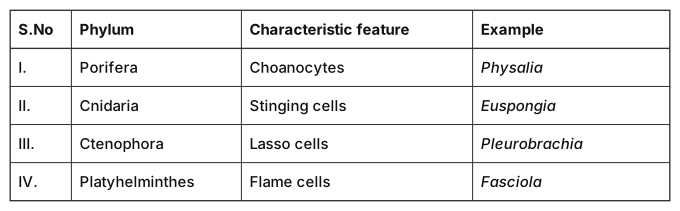
›Reveal solutionSolution
Match each phylum with its defining feature and representative organism. Only Ctenophora–lasso cells–Pleurobrachia and Platyhelminthes–flame cells–Fasciola are correctly paired; the answer is (C).
The question tests whether you can connect three pieces of information: the phylum name, a diagnostic cellular or structural feature unique to that group, and a representative animal. The trap lies in swapping examples between closely related groups—Porifera and Cnidaria are both radially symmetrical diploblasts, so their examples are easy to confuse if you memorize carelessly.
Let's verify each row against what defines these phyla.
Checking each combination
-
Row I: Porifera – Choanocytes – Physalia
Porifera are the sponges. Their hallmark cells are choanocytes (collar cells), which create water currents and capture food particles. That part is correct.
But Physalia (the Portuguese man o' war) is a cnidarian, a colonial hydrozoan famous for its painful nematocyst-laden tentacles. The correct sponge example would be Euspongia (bath sponge) or Spongilla.
Row I is incorrect.
-
Row II: Cnidaria – Stinging cells – Euspongia
Cnidaria (jellyfish, corals, sea anemones, hydras) are defined by cnidocytes (stinging cells) that house nematocysts—harpoon-like organelles for prey capture and defense. The feature is right.
Yet Euspongia is a sponge (Porifera), not a cnidarian. A correct cnidarian example is Physalia, Hydra, Aurelia (moon jelly), or Adamsia (sea anemone).
Row II is incorrect.
Watch outPhysalia and Euspongia have been deliberately swapped between rows I and II. Always anchor the example to the phylum's defining feature: choanocytes mean sponge, nematocysts mean cnidarian.
- Row III: Ctenophora – Lasso cells – Pleurobrachia Ctenophora are the comb jellies, transparent marine animals that swim with eight rows of ciliated comb plates. Their unique feature is colloblasts (lasso cells or glue cells)—sticky cells on tentacles used to snare plankton, entirely different from cnidarian nematocysts. Pleurobrachia (sea gooseberry) is indeed a ctenophore. Row III is correct. …
-
- TG EAPCET 2024Set ap-2024-05-07-FN1 markMCQQ.Study the following and pick up the correct combinations
S.No Class Character Example I. Anthozoa Only polypoid form Adamsia II. Cestoda Bifurcated intestine Taenia III. Polychaeta Botryoidal tissue Nereis IV. Crustacea Green glands Palaemon (A) I, II (B) II, III (C) III, IV (D) I, IV ›Reveal solutionSolution
Rows I and IV are internally consistent (Anthozoa are polyp-only and Adamsia is a sea anemone; green glands are crustacean excretory organs and Palaemon is a prawn). Rows II and III attach the wrong character to the right animal — the bifurcated intestine belongs to Trematoda, and botryoidal tissue to leeches. Option (D).
The concept first: how to audit a three-column table
Each row of this table asserts two independent claims:
- That the example really belongs to the named class, and
- That the character really is a feature of that class.
A row is correct only if both hold. Examiners love to build rows where the example is perfectly placed (so the row feels right) but the character has been quietly stolen from a neighbouring class. That is exactly what has been done in rows II and III here — so read each row with suspicion, and check the character column hardest.
Row-by-row analysis
Row I — Anthozoa | Only polypoid form | Adamsia.
Within the phylum Cnidaria, the three classes are distinguished chiefly by which body form they show:
- Hydrozoa — polyp and medusa (e.g. Obelia, Physalia); Hydra is polyp-only but is the exception within the class.
- Scyphozoa — the medusa dominates (the true jellyfish, Aurelia).
- Anthozoa — only the polyp form exists; the medusa stage is completely absent.
Adamsia, the sea anemone, is a textbook anthozoan (famous for its commensal partnership with the hermit crab). Both claims hold.
Row I is CORRECT. ✓
Row II — Cestoda | Bifurcated intestine | Taenia.
The example is fine — Taenia solium, the pork tapeworm, is certainly a cestode. But now check the character, and here the row collapses.
Tapeworms are endoparasites of the intestine, bathed in host food that is already digested. Evolution has therefore done something spectacular: the entire digestive system has been lost. A cestode has no mouth, no pharynx, no gut at all — it absorbs nutrients directly across its tegument (its body surface, which bears microtriches to increase absorptive area). Claiming a cestode has a "bifurcated intestine" contradicts its single most famous adaptation.
So where does the bifurcated (two-branched) intestine actually belong? To class Trematoda — the flukes, e.g. Fasciola hepatica (the liver fluke), whose gut divides into two long blind-ending caeca. That is the character the examiner has lifted and mis-planted.
Row II is WRONG. ✗ (Right example, character stolen from Trematoda.)
Row III — Polychaeta | Botryoidal tissue | Nereis.
Again the example is correct: Nereis, the clam worm / sand worm, is a classic polychaete — it has numerous setae on parapodia, a well-developed head with eyes and tentacles, and it is dioecious with a free-swimming trochophore larva.
But botryoidal tissue does not belong to polychaetes. Botryoidal tissue is a loose, pigmented, grape-cluster-like connective tissue that fills the reduced coelom of leeches — class Hirudinea (e.g. Hirudinaria, the cattle leech). In leeches the coelom is largely obliterated and reduced to a system of channels running through exactly this botryoidal tissue; it is a hallmark of the class. A polychaete, by contrast, has a large, well-developed, septate coelom — the very opposite condition.
Row III is WRONG. ✗ (Right example, character stolen from Hirudinea.)
Row IV — Crustacea | Green glands | Palaemon.
Excretory organs are a beautiful diagnostic across Arthropoda: …
- TG EAPCET 2023Set ap-2023-05-10-AN1 markMCQQ.Study the following and pick up the correct combinations S.No. Phylum Salient feature Example I Porifera Cnidoblasts Sycon II Cnidaria Tissue level organisation Adamsia III Annelida Malpighian tubules Nereis IV Echinodermata Water vascular system Antedon (A) I, II (B) III, IV (C) I, III (D) II, IV
›Reveal solutionSolution
Match each phylum with its defining feature and representative organism. Only Cnidaria (tissue-level organisation, Adamsia) and Echinodermata (water vascular system, Antedon) are correctly paired; the answer is (D).
The question tests whether you can identify the hallmark anatomical or organisational features that define each major animal phylum and recognize their representative organisms. Each phylum evolved a signature innovation—Porifera their cellular simplicity, Cnidaria their stinging cells and tissue layers, Annelida their segmented body plan, Echinodermata their unique hydraulic locomotion—and matching these correctly separates memorization from understanding.
Let's examine each statement:
I. Porifera – Cnidoblasts – Sycon
Sycon is indeed a sponge (Porifera), but the salient feature is wrong. Cnidoblasts (or cnidocytes) are the stinging cells characteristic of Cnidaria (jellyfish, sea anemones, corals), not sponges. Porifera are defined by:
- Cellular-level organisation (no true tissues)
- Porous body with ostia and osculum
- Choanocytes (collar cells) for feeding
Watch outCnidoblasts belong to Cnidaria, not Porifera. Sponges lack specialised stinging cells entirely.
Statement I is incorrect.
II. Cnidaria – Tissue-level organisation – Adamsia
Adamsia is a sea anemone, firmly in phylum Cnidaria. The feature "tissue-level organisation" is correct: cnidarians were the first animals to evolve true tissues (ectoderm and endoderm forming distinct layers), though they lack organs. Their defining features include:
- Diploblastic body plan (two germ layers)
- Radial symmetry
- Cnidocytes with nematocysts
- Gastrovascular cavity
Statement II is correct.
III. Annelida – Malpighian tubules – Nereis …
- TG EAPCET 2023Set ap-2023-05-10-AN1 markMCQQ.Statement I : Cestodes lack digestive system Statement II : Arachnids have green glands for excretion (A) Both statement I and statement II are correct (B) Both statement I and statement II are false (C) Statement I is correct. But statement II is false (D) Statement I is false. But statement II is correct
›Reveal solutionSolution
Cestodes (tapeworms) are parasitic flatworms that absorb nutrients directly through their body surface, so they truly lack a digestive system. Arachnids (spiders, scorpions) excrete via Malpighian tubules or coxal glands, not green glands — those belong to crustaceans. So Statement I is correct, Statement II is false.
The concept: matching animal groups to their characteristic excretory and digestive adaptations.
Cestodes are tapeworms — endoparasites living in the vertebrate gut. They have no need for a digestive tract because they are bathed in already-digested food. Their entire body surface (tegument) is specialized for absorption. This is a classic example of evolutionary reduction: a structure that is not needed is lost.
Arachnids belong to the phylum Arthropoda, subphylum Chelicerata. Their excretory organs are Malpighian tubules (in spiders, scorpions) or coxal glands (in some primitive forms). Green glands (also called antennal glands) are found in crustaceans like prawns and crabs — a completely different group. This is a common mix-up in exams.
Let’s check each statement.
-
Statement I: "Cestodes lack digestive system"
Cestodes (e.g., Taenia solium, the pork tapeworm) have no mouth, no gut, no anus. They absorb nutrients through their tegument. This is a defining feature of the class Cestoda.
→ Statement I is correct.
-
Statement II: "Arachnids have green glands for excretion" …
-
🎓Unlock everything free for 14 days
- ✓Full step-by-step solutions
- ✓Concept-first explanations
- ✓Methods, shortcuts & mistakes
- ✓PYQ mapping + timed mock tests
Full access for 14 days. No credit card required.