Economics · Ch 2 — Demography and Human Resource Development
India's Population — Size, Growth, Density and Distribution
India's Population — Size, Growth, Density and Distribution
Size of India's Population
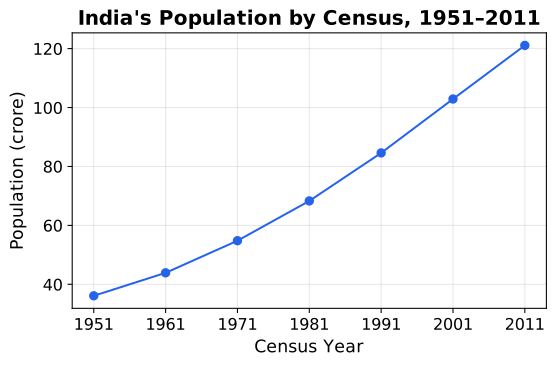
India is the most populous country in the world today, a position confirmed by United Nations population estimates in the early 2020s, after having been the second-most populous (behind China) for most of the twentieth century. The Census of India 2011 — the last full decadal Census conducted so far — recorded India's population at approximately 121 crore (1.21 billion), up from about 102.87 crore in 2001. This makes India home to roughly one-sixth of the world's population living on about 2.4% of the world's land area.
Growth Rate of Population
India's population growth rate has followed a clear historical pattern: very slow growth before 1921 (often called the Year of the Great Divide, because death rates were extremely high due to famines and epidemics), followed by steadily rising growth from the 1920s to the 1980s as death rates fell faster than birth rates, and then a gradual slowing of the growth rate from the 1990s onward — the decadal growth rate fell from about 21.5% in 1991–2001 to about 17.7% in 2001–2011, even though the population still grew by more than 18 crore in that decade.
Density of Population
Population density means the number of persons living per square kilometre of area. As per Census 2011, India's population density was 382 persons per sq. km, up from 325 in 2001 — a high density for a country of India's size, though still well below some very densely populated smaller nations. Density varies enormously within the country: states like Bihar and West Bengal are among the most densely populated, while hill and desert regions have much lower density.
Distribution of Population
Population distribution refers to how the population is spread across regions — it is highly uneven in India:
- The Indo-Gangetic plains (Uttar Pradesh, Bihar, West Bengal) carry a very large share of India's population because of fertile soil, water availability, and a long urban history.
- Hilly, desert, and forested regions (parts of the North-East, Rajasthan's desert belt, and hill states) are sparsely populated. …
The number of persons living per square kilometre of geographical area; Census 2011 recorded India's density at 38 …
The pattern of how a country's population is spread across its regions, states, and ru …