Botany · Ch 3 — Photosynthesis in Higher Plants
Cyclic and Non-cyclic Photo-phosphorylation
Cyclic and Non-cyclic Photo-phosphorylation
Living organisms have the capability of extracting energy from oxidisable substances and storing it in the form of bond energy. Special substances like ATP carry this energy in their chemical bonds. The synthesis of ATP by cells — in mitochondria and in chloroplasts — is named phosphorylation. Photophosphorylation is the synthesis of ATP from ADP and inorganic phosphate in the presence of light.
Non-cyclic photophosphorylation
- When the two photosystems work in a series — first PS II and then PS I — the process is called non-cyclic photo-phosphorylation.
- The two photosystems are connected through an electron transport chain, exactly as seen in the Z scheme.
- Both ATP and NADPH + H+ are synthesised by this kind of electron flow, because the electrons flow one way (from water through both photosystems to NADP+) and are not returned.
Cyclic photophosphorylation
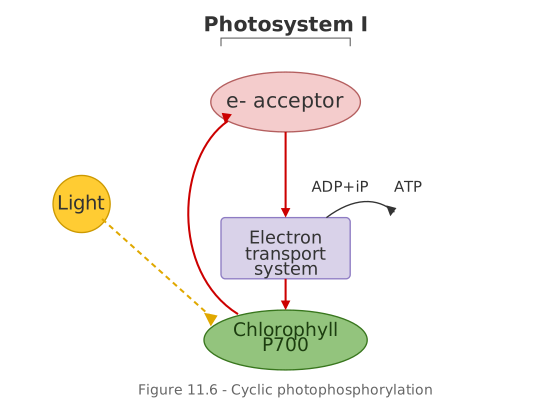
- When only PS I is functional, the electron is circulated within the photosystem and phosphorylation occurs due to a cyclic flow of electrons.
- A possible location for this is the stroma lamellae. While the grana membranes have both PS I and PS II, the stroma lamellae membranes lack PS II as well as the NADP reductase enzyme.
- The excited electron does not pass on to NADP+ but is cycled back to the PS I complex through the electron transport chain. …
Drawn by us to help you understand the concept clearly, and verified to make sure it's accurate. For exams, practice from your textbook's own diagram.
This figure shows cyclic photophosphorylation, which involves only Photosystem I. Light excites an electron in the reaction centre chlorophyll P700, and the electron passes to an electron acceptor. Instead of moving on to NADP+, the electron is passed to the electron transport system and is cycled back to the P700 complex, completing a closed loop. As the electron travels down the transport chain it drives the synthesis of ATP from ADP and inorganic phosphate. Because the electron returns to PS I, this cyclic flow produces only ATP and no NADPH. It is thought to occur in th …