Chemistry · Ch 7 — Alcohols, Phenols and Ethers
Preparation of Phenols
Preparation of Phenols
Phenol was first isolated in the early nineteenth century from coal tar, where it was known as carbolic acid. Today it is produced synthetically on an industrial scale. In the laboratory, phenols are typically built up from benzene derivatives by one of four routes.
1. From Haloarenes
Chlorobenzene is fused with sodium hydroxide under forcing conditions — around 623 K and a pressure of roughly 320 atmospheres. Because the C–Cl bond of a haloarene is normally very unreactive toward nucleophilic substitution (the lone pair on chlorine is delocalised into the ring, and the ring itself resists nucleophilic attack), only such extreme temperature and pressure can drive the hydroxide ion in to displace chloride. This gives sodium phenoxide, which is then acidified to liberate phenol.
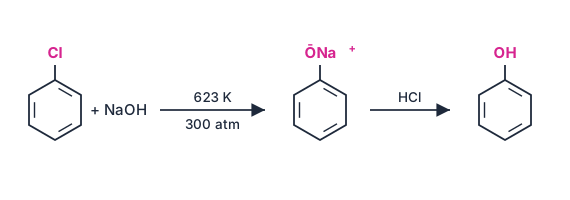
Drawn by us to help you understand the concept clearly, and verified to make sure it's accurate. For exams, practice from your textbook's own diagram.
Redrawn from the NCERT page with the structures, printed labels (Cl, ŌNa⁺, OH) and reagent placement exactly as the …
2. From Benzenesulphonic Acid
Benzene is first sulphonated with oleum to give benzenesulphonic acid. This is converted to sodium phenoxide by fusing it with molten sodium hydroxide, and acidifying the resulting sodium salt then gives phenol.
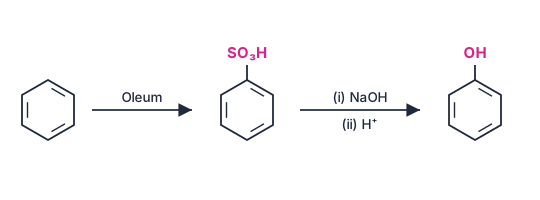
Drawn by us to help you understand the concept clearly, and verified to make sure it's accurate. For exams, practice from your textbook's own diagram.
Redrawn from the NCERT page with the structures, printed labels (SO3H, OH) and reagent placement exactly as the t …
3. From Diazonium Salts
An aromatic primary amine, such as aniline, is treated with nitrous acid (generated in situ from and HCl) at a low temperature of 273–278 K to form a diazonium salt. Warming this diazonium salt with water — or treating it with dilute acid — hydrolyses it to a phenol, with loss of nitrogen gas.
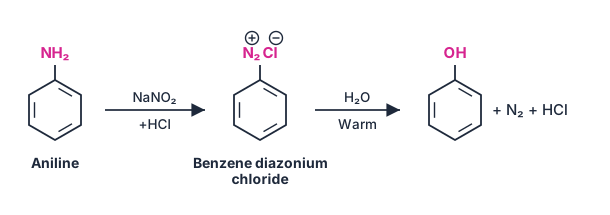
Drawn by us to help you understand the concept clearly, and verified to make sure it's accurate. For exams, practice from your textbook's own diagram.
Redrawn from the NCERT page with the structures, printed labels (NH2, N2⁺Cl⁻, OH) and reagent placement exactly as the …
The low-temperature diazotisation step is essential — the diazonium salt is only stable when cold, and the same salt is what undergoes hydrolysis to the phenol once warmed.
4. From Cumene (The Cumene Process)
Most of the world's phenol is manufactured today not by any of the three laboratory routes above, but by a large-scale industrial sequence built around cumene (isopropylbenzene).
Step 1 — making cumene. Cumene itself is obtained by alkylating benzene with propene under Friedel–Crafts conditions (an acid catalyst such as anhydrous or a solid-acid catalyst), which attaches an isopropyl group directly onto the benzene ring.
Step 2 — air oxidation to the hydroperoxide. Cumene is then oxidised with air (oxygen) under controlled conditions. Oxidation occurs selectively at the benzylic C–H bond, since the resulting radical is stabilised by the adjacent aromatic ring, and the product is cumene hydroperoxide.
Step 3 — acid-catalysed rearrangement and cleavage. Treating cumene hydroperoxide with dilute acid triggers a rearrangement: the O–O bond is protonated and cleaved, and the phenyl group migrates from carbon to the adjacent electron-deficient oxygen almost simultaneously with the loss of water. The resulting oxocarbenium species is then captured by water and fragments to give phenol and acetone directly.
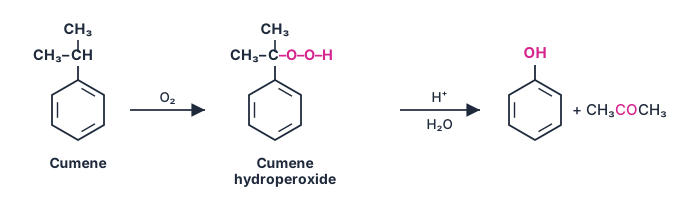
Drawn by us to help you understand the concept clearly, and verified to make sure it's accurate. For exams, practice from your textbook's own diagram.
Redrawn from the NCERT page with the structures, printed labels (CH3, –CH, –C, –O, –H, OH) and reagent placement exactly as th …
…