Q.How is 1-propoxypropane synthesised from propan-1-ol? Write mechanism of this reaction.
🔒You're viewing a preview — the full solution, concept, methods & PYQ mapping are locked.
🔒 Start your 14-day free trial to unlock the full solution →Concept understanding — Williamson Ether Synthesis
Williamson Ether Synthesis: From Intuition to Mechanism
Imagine you want to build a simple bridge between two carbon chains — an oxygen atom linking them together. That bridge is an ether (R−O−R′). The Williamson ether synthesis is the most reliable way to build that bridge in a lab.
The Core Idea
You have two pieces: an alkoxide ion (RO−) and an alkyl halide (R′X). The alkoxide is a strong nucleophile — it loves positive charge. The alkyl halide has a carbon attached to a halogen (like Cl, Br, I) that is slightly positive because the halogen pulls electrons away.
When you mix them, the alkoxide attacks that slightly positive carbon, kicks out the halide ion, and forms a new C−O bond. The result? An ether.
R−O−+R′−X⟶R−O−R′+X−
That's the entire reaction in one line. But the devil is in the details — especially which alkyl halide you choose.
The Mechanism (SN2)
This is a classic SN2 reaction — one step, no intermediates. The alkoxide approaches the carbon from the opposite side of the halogen. As the C−O bond forms, the C−X bond breaks. The halide leaves as a stable anion.
Because it's SN2, the reaction is sensitive to steric hindrance. The carbon being attacked must be accessible.
If the alkyl halide is tertiary (3°), the reaction will not work via SN2. The bulky carbon blocks the backside attack. Instead, the alkoxide will act as a base and cause elimination (forming an alkene). You'll get no ether.
The Practical Rule
| Alkyl halide | Works? | Why |
|---|---|---|
| Methyl (CH3X) | Yes | Least hindered, fastest SN2 |
| Primary (1°) | Yes | Clean SN2 |
| Secondary (2°) | Sometimes | Works if not too bulky; elimination competes |
| Tertiary (3°) | No | Elimination dominates |
| Aryl (e.g., bromobenzene) | No | SN2 impossible on sp2 carbon |
To make an ether like R−O−R′, always use the less hindered alkyl halide and the more hindered alkoxide. For example, to make CH3CH2−O−CH(CH3)2, use CH3CH2O− (primary alkoxide) + (CH3)2CHBr (secondary halide) — not the other way around.
How to Choose the Alkoxide
You can't just buy alkoxide ions in a bottle. You make them by reacting an alcohol with a strong base like sodium hydride (NaH) or sodium metal.
ROH+NaH⟶RO−Na++H2
The alkoxide is then used immediately with the alkyl halide.
A Common Exam Trap …
Why this formula?
Williamson Ether Synthesis: Why the Key Principles Hold
The Williamson Ether Synthesis is a classic method to prepare ethers. The core reaction is:
R-O−+R’-X→R-O-R’+X−
Where:
- R-O− is an alkoxide ion (strong nucleophile)
- R’-X is an alkyl halide (electrophile)
- X− is a halide ion (leaving group)
Let's break down why this works — the reasoning behind the key principles.
1. Why an Alkoxide (Not an Alcohol) is Needed
The Problem with Alcohols
Alcohols (R-OH) are weak nucleophiles. The oxygen has a partial negative charge, but the O–H bond is strong. If you mix an alcohol with an alkyl halide, the reaction is extremely slow or doesn't happen at all.
The Solution: Deprotonation
By treating the alcohol with a strong base (like NaH, Na, or KOH), you remove the proton:
R-OH+NaH→R-O−Na++H2
The alkoxide ion (R-O−) has a full negative charge on oxygen. This makes it:
- A much stronger nucleophile (higher electron density)
- More reactive toward the electrophilic carbon in the alkyl halide
Key takeaway: The alkoxide's full negative charge is what drives the reaction — it's not just about having oxygen, but about having a charged, electron-rich oxygen.
2. Why the Alkyl Halide Must Be Primary (or Methyl)
The Mechanism: SN2 is the Only Path
The Williamson synthesis proceeds exclusively via an SN2 mechanism (bimolecular nucleophilic substitution). This means:
- The nucleophile attacks the carbon from the backside
- The leaving group departs from the opposite side
- The reaction is concerted (one step, no intermediates)
Why Primary Halides Work Best
In SN2 reactions, the rate depends on steric hindrance:
| Alkyl Halide Type | Steric Hindrance | SN2 Reactivity |
|---|---|---|
| Methyl (CH3X) | Minimal | Very fast |
| Primary (RCH2X) | Low | Fast |
| Secondary (R2CHX) | Moderate | Slow |
| Tertiary (R3CX) | High | Does not occur |
Why Tertiary Halides Fail
With a tertiary halide, the bulky alkyl groups block the backside attack. Instead, the alkoxide (a strong base) will eliminate a proton from the halide, forming an alkene:
R-O−+R’3C-X→R-OH+alkene+X−
This is an E2 elimination — not the desired ether formation.
Key takeaway: The Williamson synthesis works only when the alkyl halide is primary or methyl because SN2 requires an unhindered backside.
3. Why the Leaving Group Must Be Good
The Role of the Halide
The halide (X−) must be a good leaving group — meaning it can stabilize the negative charge after departure.
| Halide | Leaving Group Ability | Reason |
|---|---|---|
| I− | Excellent | Large, polarizable, weak base |
| Br− | Good | Moderate size, weak base |
| Cl− | Fair | Smaller, stronger base |
| F− | Poor | Small, strong base, holds tightly |
Why Fluoride Fails
Fluoride is a strong base and a poor leaving group. The C–F bond is very strong, and F− does not depart easily. So alkyl fluorides are unreactive in Williamson synthesis.
Key takeaway: The leaving group must be weakly basic and polarizable — iodide and bromide are ideal.
--- …
The key idea is the Williamson ether synthesis, where an alkoxide ion attacks a primary alkyl halide in an SN2 reaction.
Step 1 – Form the alkoxide: Treat propan-1-ol with a strong base like sodium hydride (NaH) or sodium metal. This deprotonates the alcohol, giving the propoxide ion.
CH3CH2CH2OH+NaH→CH3CH2CH2O−Na++H2
Step 2 – SN2 alkylation: The propoxide ion acts as a nucleophile and attacks the electrophilic carbon of another molecule of 1-bromopropane (or 1-chloropropane). This displaces the halide ion in a backside attack.
CH3CH2CH2O−+Br−CH2CH2CH3→CH3CH2CH2−O−CH2CH2CH3+Br− …
1-Propoxypropane (dipropyl ether) is synthesised from propan-1-ol via Williamson Ether Synthesis — reacting sodium propoxide (from propan-1-ol and Na) with 1-bromopropane. The final product is CH3CH2CH2OCH2CH2CH3.
The Williamson Ether Synthesis is the most reliable laboratory method for making unsymmetrical ethers. The key idea: you need an alkoxide ion (a strong nucleophile) and a primary alkyl halide (a good electrophile). The alkoxide attacks the halide in an SN2 reaction, forming the ether.
Why does this work so well for 1-propoxypropane? Because both the alkoxide and the alkyl halide are derived from the same alcohol — propan-1-ol. You just need to convert half the alcohol into the nucleophile and the other half into the electrophile.
Here’s the step-by-step:
- Form the alkoxide: Treat propan-1-ol with a strong base like sodium metal (Na) or sodium hydride (NaH). The base deprotonates the alcohol, giving sodium propoxide (CH3CH2CH2O−Na+) and hydrogen gas (if using Na).
CH3CH2CH2OH+Na→CH3CH2CH2O−Na++21H2
- Prepare the alkyl halide: Convert another portion of propan-1-ol into 1-bromopropane. This is typically done using PBr3 or HBr (with H2SO4). The reaction follows an SN2 mechanism because propan-1-ol is primary.
CH3CH2CH2OH+HBrH2SO4CH3CH2CH2Br+H2O
- Perform the Williamson synthesis: Mix the sodium propoxide (from step 1) with 1-bromopropane (from step 2). The propoxide ion acts as a strong nucleophile and attacks the electrophilic carbon of the alkyl halide in an SN2 displacement. The bromide ion leaves, and the ether forms.
CH3CH2CH2O−+CH3CH2CH2Br→CH3CH2CH2OCH2CH2CH3+Br−
A common mistake is to try using propan-2-ol (isopropyl alcohol) or a secondary/tertiory halide. Secondary halides give significant elimination (alkene) instead of substitution, and tertiary halides almost exclusively eliminate. Always use a primary alkyl halide for the SN2 step.
Mechanism of the Williamson step (the key reaction): …
Williamson Ether Synthesis — Method & Mechanism
Method: Williamson Ether Synthesis
This is an SN2 reaction between an alkoxide ion and a primary alkyl halide (or tosylate).
Steps to synthesise 1-propoxypropane from propan-1-ol
- Deprotonate propan-1-ol Treat propan-1-ol (CH3CH2CH2OH) with a strong base like NaH or Na metal to form the sodium propoxide ion:
CH3CH2CH2OH+NaH→CH3CH2CH2O−Na++H2
- Prepare the electrophile Convert another molecule of propan-1-ol into 1-bromopropane (or 1-chloropropane) using PBr3 or HBr:
CH3CH2CH2OH+PBr3→CH3CH2CH2Br
- Perform SN2 reaction Mix the sodium propoxide with 1-bromopropane. The alkoxide attacks the primary carbon, displacing bromide:
CH3CH2CH2O−+BrCH2CH2CH3→CH3CH2CH2OCH2CH2CH3+Br−
Final product: 1-propoxypropane (dipropyl ether)
Mechanism (step-by-step)
Step 1 — Formation of alkoxide
Propan-1-ol reacts with NaH (strong base). The base abstracts the acidic proton of the alcohol:
CH3CH2CH2OH+H−→CH3CH2CH2O−+H2
Step 2 — SN2 attack
The alkoxide ion acts as a nucleophile. It attacks the electrophilic carbon of 1-bromopropane from the back side (SN2 stereochemistry):
CH3CH2CH2O−attacksBr−CH2CH2CH3 …
Here are the common mistakes students make in Williamson Ether Synthesis (specifically for making 1-propoxypropane from propan-1-ol) and how to avoid each.
1. Choosing the Wrong Halide/Alcohol Pair (The "Symmetry Trap")
The Mistake: Students often try to react two molecules of propan-1-ol directly with each other (e.g., CH3CH2CH2OH+CH3CH2CH2OH→ ether). This does not work under Williamson conditions.
Why it's wrong: The Williamson synthesis requires an alkoxide ion (strong nucleophile) and an alkyl halide (electrophile). Two neutral alcohols cannot react to form an ether without a strong base to deprotonate one of them first.
How to Avoid: Always identify the two fragments:
- Alkoxide: Comes from the less hindered alcohol (usually the one with the smaller alkyl group or the one you deprotonate).
- Alkyl halide: Comes from the other alcohol (converted to a halide, e.g., using PBr3 or SOCl2).
For 1-propoxypropane (CH3CH2CH2−O−CH2CH2CH3), both sides are identical. The correct approach:
- Convert one molecule of propan-1-ol to propyl bromide (CH3CH2CH2Br).
- Deprotonate the other molecule of propan-1-ol with a strong base (e.g., NaH) to get sodium propoxide (CH3CH2CH2O−Na+).
- React them: CH3CH2CH2O−Na++CH3CH2CH2Br→CH3CH2CH2−O−CH2CH2CH3+NaBr.
2. Using the Wrong Base (or No Base at All)
The Mistake: Using a weak base like NaOH or K2CO3 in water, or forgetting to add a base entirely.
Why it's wrong: Propan-1-ol is a weak acid (pKa≈16). To form the alkoxide ion (RO−), you need a base strong enough to deprotonate it. NaOH in water is not strong enough because water is a stronger acid (pKa≈15.7) than the alcohol — the equilibrium lies with the alcohol, not the alkoxide.
How to Avoid: Use a strong, non-nucleophilic base in an anhydrous (dry) solvent:
- Best choices: NaH (sodium hydride), Na metal, or KOH in dry ethanol (if the alcohol is the solvent).
- Avoid: Aqueous bases (water will protonate the alkoxide back to alcohol).
Correct step: CH3CH2CH2OH+NaH→CH3CH2CH2O−Na++H2↑
3. Forgetting the SN2 Mechanism Details (Especially Stereochemistry)
The Mistake: Drawing the mechanism as a simple "swap" without showing the backside attack of the alkoxide on the alkyl halide, or ignoring that it's an SN2 reaction.
Why it's wrong: The Williamson synthesis is a classic SN2 reaction. If you draw it as a one-step bond-breaking/bond-forming without showing the nucleophile approaching from the opposite side of the leaving group, you lose marks. Also, if the alkyl halide is secondary or tertiary, elimination (E2) will dominate, and you won't get the ether.
How to Avoid:
- Draw the curved arrow from the alkoxide oxygen lone pair to the carbon attached to the halogen (the α-carbon).
- Show the leaving group (Br− or I−) departing simultaneously.
- Use a primary alkyl halide (like propyl bromide) to ensure SN2 is fast and elimination is minimal.
Mechanism (correct):
CH3CH2CH2O−backside attackCH3CH2CH2-O-CH2CH2CH3+Br−
(Show the Br leaving as the C-O bond forms.)
4. Ignoring the "Elimination vs. Substitution" Competition
The Mistake: Using a secondary or tertiary alkyl halide (e.g., 2-bromopropane or 2-bromo-2-methylpropane) with a strong alkoxide base.
Why it's wrong: Strong bases (like alkoxides) are also strong bases. With secondary or tertiary halides, E2 elimination is much faster than SN2 substitution. You'll get an alkene instead of the ether.
How to Avoid: Always use a primary alkyl halide (like CH3CH2CH2Br) for the electrophile. If you must use a secondary halide, use a weaker base (like silver oxide, Ag2O) or a different method (e.g., alkoxymercuration).
For 1-propoxypropane: Both fragments are primary — safe.
5. Writing the Mechanism Without Showing the Deprotonation Step …
Showing the 12 most recent of 27 on this concept.
- TG EAPCET 2026Set eng-2026-05-09-AN1 markMCQQ.Which of the following statements are correct? I. Liquid sodium metal is used as coolant in fast breeder nuclear reactor II. LiCl is deliquescent III. LiF and CsI have low solubility in water (A) I, III only (B) II, III only (C) I, II only (D) I, II, III
›Reveal solutionSolution
All three statements are correct: liquid sodium is used as a coolant in fast breeder reactors, LiCl is deliquescent, and both LiF and CsI have low solubility in water. The correct option is (D).
The question asks us to identify the correct statements regarding properties of alkali metals and their compounds. We will evaluate each statement based on fundamental chemical principles.
Concept and Intuition
- Coolants in Nuclear Reactors: A good coolant needs to efficiently transfer heat, remain liquid over a wide temperature range, and ideally have a low neutron absorption cross-section in certain reactor types.
- Deliquescence: This property describes a substance that absorbs moisture from the atmosphere until it dissolves in the absorbed water to form a solution. It is related to hygroscopy (absorbing moisture) and the ability to form stable hydrates.
- Solubility in Water: The solubility of an ionic compound in water is determined by the balance between its lattice energy (energy required to break the ionic lattice) and its hydration energy (energy released when ions are surrounded by water molecules). For a compound to dissolve, the hydration energy must be sufficient to overcome the lattice energy.
Step-by-Step Evaluation
1. Statement I: Liquid sodium metal is used as coolant in fast breeder nuclear reactor
- Reasoning: Fast breeder reactors operate at very high temperatures and require a coolant that can efficiently remove heat without moderating (slowing down) the fast neutrons. Liquid sodium is an excellent choice for this purpose due to several key properties:
- High Thermal Conductivity: It can transfer heat very efficiently.
- Wide Liquid Range: Sodium has a relatively low melting point (97.8∘C) and a very high boiling point (883∘C), allowing it to remain liquid over a broad and useful temperature range for reactor operation.
- Low Neutron Absorption Cross-section: It does not significantly absorb neutrons, which is crucial for maintaining the neutron economy in a fast breeder reactor.
- Low Viscosity: This allows for easy pumping and circulation.
- Conclusion: Statement I is correct.
2. Statement II: LiCl is deliquescent
- Reasoning: Deliquescence is the property of a substance to absorb moisture from the atmosphere and dissolve in it. This property is strongly linked to the hygroscopic nature of a compound and its ability to form stable hydrates.
- Lithium chloride (LiCl) is known to be highly hygroscopic and readily forms hydrates, such as LiCl⋅H2O, LiCl⋅2H2O, and LiCl⋅3H2O.
- The small size and high charge density of the Li+ ion lead to a very high hydration energy. This strong interaction with water molecules drives the absorption of moisture from the air.
- Among the alkali metal chlorides, LiCl is the most deliquescent.
- Conclusion: Statement II is correct.
3. Statement III: LiF and CsI have low solubility in water
- Reasoning: The solubility of an ionic compound in water depends on the relative magnitudes of its lattice energy and hydration energy.
- For LiF:
- Li+ is the smallest alkali metal ion, and F− is the smallest halide ion. …
- For LiF:
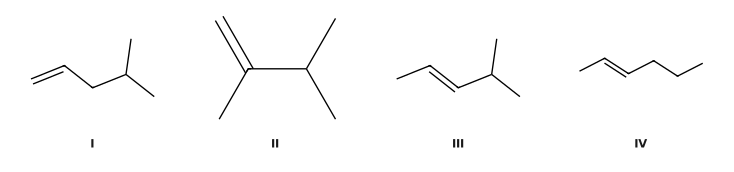
- TG EAPCET 2026Set eng-2026-05-09-AN1 markMCQQ.Which of the following are Position isomers? [FIGURE] (A) I, III (B) II, IV (C) II, III (D) I, IV
›Reveal solutionSolution
Among these C6H12 alkenes, only I (4-methylpent-1-ene) and III (4-methylpent-2-ene) have the same carbon skeleton with the double bond in different places — option (A).
The concept first
All four compounds are C6H12, so they are all isomers of one another. The question is which kind. Two structural isomers are:
- Chain (skeletal) isomers if the carbon framework itself differs (branching pattern, length of the main chain);
- Position isomers if the framework is identical and only the location of the functional group (here the C=C) changes.
So the working method is mechanical: hydrogenate each structure in your head (i.e. ignore the double bond and look only at the carbon skeleton). Any two that collapse to the same alkane are position isomers; ones that collapse to different alkanes are chain isomers.
Step-by-step
- Reduce each to its skeleton.
- I: (CH3)2CH−CH2−CH=CH2→ 2-methylpentane skeleton (5-carbon chain, methyl branch on the carbon next to one end).
- II: CH2=C(CH3)−CH(CH3)2→ 2,3-dimethylbutane skeleton (4-carbon chain, two methyl branches).
- III: (CH3)2CH−CH=CH−CH3→ 2-methylpentane skeleton — same as I.
- IV: unbranched hexene → n-hexane skeleton (no branch).
- Group by skeleton. …
- TG EAPCET 2026Set eng-2026-05-09-AN1 markMCQQ.What are X, Y, Z respectively in the following set of reactions? (A) [benzene ring]-Br ; [ethanol] ; [benzene ring]-O-[ethyl group]-Br (B) [benzene ring]-OH ; [ethyl bromide] ; [benzene ring]-O-[ethyl group]-Br (C) [benzene ring]-OH ; [ethyl bromide] ; [benzene ring]-(Br)2-O-[ethyl group] (D) [benzene ring]-Br ; [ethyl bromide] ; [benzene ring]-O-[ethyl group]-Br
›Reveal solutionSolution
The reaction sequence is the Williamson ether synthesis: phenol (X) reacts with ethyl bromide (Y) in the presence of a base to give phenetole, which then undergoes bromination at the para position to yield p-bromophenetole (Z). The correct option is (B).
The question presents a set of reactions where three unknown compounds X, Y, and Z are to be identified. The key is to recognize the classic Williamson ether synthesis followed by electrophilic aromatic substitution. Let's walk through the logic.
-
Identify the first reaction: X + NaOH → sodium phenoxide
The product after treatment with NaOH is a sodium salt of an aromatic alcohol. This is a characteristic reaction of phenol (C6H5OH). Phenol reacts with NaOH to form sodium phenoxide (C6H5ONa). So X must be phenol, not bromobenzene (which does not react with NaOH under these conditions). This immediately eliminates options (A) and (D), which list X as bromobenzene.
-
Identify the second reaction: sodium phenoxide + Y → an ether
Sodium phenoxide is a strong nucleophile. It reacts with an alkyl halide in an SN2 reaction to form an ether — this is the Williamson ether synthesis. The product shown is an aromatic ether with an ethyl group attached to the oxygen. Therefore Y must be ethyl bromide (C2H5Br). The product is ethyl phenyl ether, commonly called phenetole (C6H5OC2H5).
-
Identify the third reaction: phenetole + Br2 → Z …
-
- TG EAPCET 2026Set eng-2026-05-10-FN1 markMCQQ.Consider the following reactions Borax H2O A + B Borax H2O/HCl B + C Which of the following are the properties of A, B, C? I. Both A, B are strong bases II. B is a white crystalline solid with soapy touch III. C is water soluble (A) I, II, III (B) II, III only (C) I, III only (D) I, II only
›Reveal solutionSolution
Borax hydrolyses in water to give boric acid and a strong base; with HCl it gives boric acid and NaCl. The correct properties are II and III only — option (B).
The key is to understand what borax (sodium tetraborate decahydrate, Na2B4O7⋅10H2O) does in water and in acidic water. Borax is not a simple salt — it reacts with water to produce boric acid and a strong base. When you add HCl, the base gets neutralised, leaving a different set of products.
Let’s write the reactions clearly.
- Borax in pure water Borax dissolves and hydrolyses:
Na2B4O7+7H2O→2NaOH+4H3BO3
Here, A is NaOH (sodium hydroxide) and B is H3BO3 (boric acid).
So A is a strong base, B is a weak acid — not a base at all.
- Borax in water with HCl The same hydrolysis occurs, but the HCl neutralises the NaOH formed:
Na2B4O7+2HCl+5H2O→2NaCl+4H3BO3
Here, B is again H3BO3, and C is NaCl (sodium chloride).
Now evaluate each statement:
-
I. Both A, B are strong bases
A is NaOH (strong base), but B is boric acid — a very weak acid, not a base. So I is false.
-
II. B is a white crystalline solid with soapy touch …
- TG EAPCET 2026Set eng-2026-05-10-FN1 markMCQQ.Which of the following is most reactive towards SN2 reaction? (A) (CH3)3C−Br (tert-butyl bromide) (B) CH3CH2CH2CH2−Br (1-bromobutane) (C) (CH3)2CH−CH2−Br (1-bromo-2-methylpropane) (D) CH3CH2−CH(Br)−CH3 (2-bromobutane) 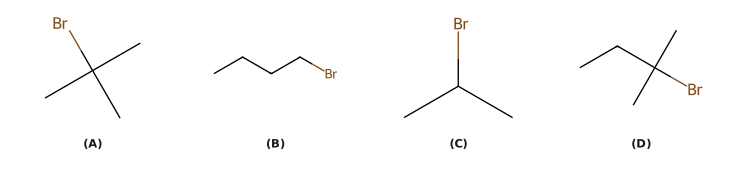
›Reveal solutionSolution
SN2 needs an unobstructed backside approach, so steric bulk kills it. The unbranched primary halide 1-bromobutane is the least hindered and therefore the most reactive — option (B).
The concept first
In the SN2 mechanism, bond-making and bond-breaking happen simultaneously in one step. The nucleophile attacks the electrophilic carbon from the side directly opposite the leaving group (backside attack), passing through a transition state in which that carbon is momentarily bonded to five groups:
Nu−+ R−Br ⟶ [Nu⋯C⋯Br]‡ ⟶ Nu−R+Br−
The carbon is sp2-like in that transition state with the three remaining groups splayed out in a plane. Every extra alkyl group attached to that carbon (or even to the carbon next to it) makes the transition state more crowded, raises its energy, and slows the reaction:
Rate: CH3X > 1∘ > 2∘ ≫ 3∘
This is the exact opposite of the SN1 order (which follows carbocation stability, 3∘>2∘>1∘). Knowing which mechanism the question names is half the battle.
Step-by-step through the options
(A) (CH3)3C−Br, tert-butyl bromide — tertiary. Three methyl groups completely block the backside of the C–Br carbon. Nucleophiles simply cannot get in; this halide reacts almost exclusively by SN1 (it forms a very stable 3∘ carbocation). Slowest for SN2. ✗
(B) CH3CH2CH2CH2−Br, 1-bromobutane — primary and unbranched. The carbon bearing Br carries only two hydrogens and one straight chain, so the backside is wide open. Fastest of the four. ✓ …
- TG EAPCET 2026Set ap-2026-05-05-FN1 markMCQQ.In the formation of photochemical smog, two oxides of nitrogen are significantly formed. The oxidation states of nitrogen in these oxides are respectively (A) +1, +4 (B) +2, +4 (C) +2, +5 (D) +1, +2
›Reveal solutionSolution
Photochemical smog forms when nitrogen oxides (NO and NO₂) from vehicle exhaust react with sunlight. The oxidation states of nitrogen in these two key oxides are +2 and +4, making option (B) correct.
The question is about the chemistry of photochemical smog — a type of air pollution that forms when sunlight triggers reactions between pollutants, especially from car engines. The two oxides of nitrogen that play the starring role here are nitric oxide (NO) and nitrogen dioxide (NO₂). They are produced in high-temperature combustion (e.g., in a car engine) when nitrogen and oxygen from the air combine.
To find the oxidation states, we apply the standard rule: oxygen almost always has an oxidation state of –2 (except in peroxides, which aren't relevant here). For a neutral molecule, the sum of oxidation states must be zero.
-
For NO: Let the oxidation state of nitrogen be x.
x+(−2)=0⟹x=+2.
So nitrogen is in the +2 oxidation state in nitric oxide.
-
For NO₂: Let the oxidation state of nitrogen be y.
y+2(−2)=0⟹y−4=0⟹y=+4.
So nitrogen is in the +4 oxidation state in nitrogen dioxide. …
-
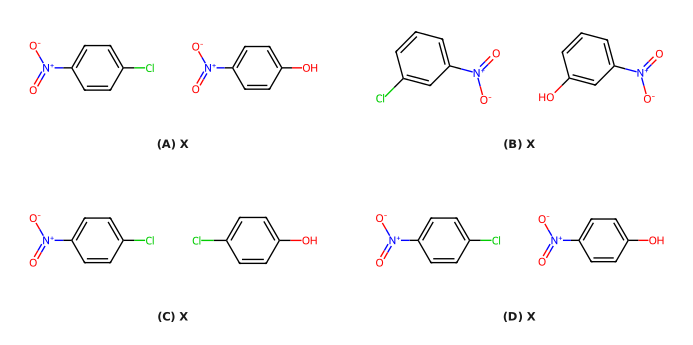
- TG EAPCET 2026Set ap-2026-05-05-FN1 markMCQQ.What are X, Y, Z respectively in the following reaction sequence? (Conc. = concentrated) Chlorobenzene HNO3conc. H2SO4XYZ (A) X = 1-chloro-4-nitrobenzene (O2N−C6H4−Cl, para) ; Y =(i) NaOH∣443 K(ii) H+ ; Z = 4-nitrophenol (O2N−C6H4−OH, para) (B) X = 1-chloro-3-nitrobenzene (Cl and NO2 meta) ; Y =(i) NaOH∣368 K(ii) H+ ; Z = 3-nitrophenol (OH and NO2 meta) (C) X = 1-chloro-4-nitrobenzene (para) ; Y =(i) NaOH∣300 K(ii) H+ ; Z = 4-chlorophenol (HO−C6H4−Cl, para) (D) X = 1-chloro-4-nitrobenzene (para) ; Y = H2O∣300 K ; Z = 4-nitrophenol (para)
›Reveal solutionSolution
Nitration of chlorobenzene gives mainly 1-chloro-4-nitrobenzene (X); the para nitro group makes the C−Cl bond susceptible to nucleophilic attack, so NaOH at 443 K followed by H+ converts it to 4-nitrophenol (Z). That is option (A).
The concept first
- Electrophilic step. Halogens are deactivating but ortho–para directing: the −I effect withdraws electron density (slowing the reaction), while the +R (lone-pair) effect places negative charge at the o and p positions, so the electrophile goes there. Steric crowding makes para the major product.
- Nucleophilic step. Aryl halides resist SN reactions (partial double-bond character of C−Cl, resonance stabilisation). Chlorobenzene itself needs 623 K/300 atm NaOH (Dow process). A strongly electron-withdrawing −NO2 at the ortho or para position changes everything: it stabilises the negatively-charged carbanion (Meisenheimer) intermediate by resonance, so the reaction now runs under much milder conditions (NaOH, 443 K). A meta nitro group gives no such stabilisation.
Step-by-step
- C6H5ClHNO3conc. H2SO4 chiefly p-nitrochlorobenzene (with a little ortho).
X=1-chloro-4-nitrobenzene
This already eliminates the meta option. …
- TG EAPCET 2025Set eng-2025-05-02-FN1 markMCQQ.The major products P and Q from the following reactions are P(i) LiAlH4(ii) H2O C6H5CONH2 Br2 / NaOHQ (A) P=C6H5NH2 ; Q=C6H5CH2NH2 (B) P=C6H5CH2NH2 ; Q=C6H5NH2 (C) P=C6H5−OH∣CH−NH2 ; Q=C6H5COONa (D) P=C6H5CN ; Q=C6H5Br
›Reveal solutionSolution
LiAlH4 reduces benzamide to benzylamine (P), while Br2/NaOH degrades it to aniline (Q), one carbon shorter. That is option (B).
The concept first
Benzamide, C6H5CONH2, has two very different fates depending on whether you attack the carbon or the nitrogen.
- LiAlH4 delivers H− to the electrophilic carbonyl carbon. The C–N bond is never broken; the oxygen leaves and the carbon ends up as a CH2 bridging the ring and the nitrogen. Amides are the only carbonyl compounds reduced all the way to an amine rather than an alcohol — that is worth remembering.
- Br2/NaOH instead brominates the nitrogen. The resulting N-bromoamide is deprotonated, loses Br− to give a nitrene-like species, and the phenyl group migrates from carbon to nitrogen. The old carbonyl carbon ends up as an isocyanate carbon and is finally hydrolysed away as Na2CO3. Hence a one-carbon shortening.
Step-by-step
- Reduction (P):
C6H5CONH2(i) LiAlH4 (ii) H2O C6H5CH2NH2
Benzylamine, a primary amine with 7 carbons (same as benzamide).
2. Hofmann degradation (Q):
C6H5CONH2+Br2+4NaOH→C6H5NH2+Na2CO3+2NaBr+2H2O
Aniline, a primary amine with 6 carbons (one less). …
- TG EAPCET 2025Set eng-2025-05-03-FN1 markMCQQ.Identify the product 'Y' in the given sequence of reactions. Chlorobenzene HNO3Conc. H2SO4 X (Major) (i) NaOH, 443 K(ii) H+ Y (A) p-Nitrophenol (benzene ring with −OH and −NO2 para to each other) (B) o-Nitrophenol (benzene ring with −OH and −NO2 ortho to each other) (C) p-Hydroxybenzenesulphonic acid (benzene ring with −OH and −SO3H para to each other) (D) 2,4-Dinitrophenol (benzene ring with −OH and −NO2 groups at positions 2 and 4)
›Reveal solutionSolution
Chlorobenzene nitrates mainly at the para position to give p-nitrochlorobenzene (X); the para −NO2 activates the C–Cl carbon, so NaOH at 443 K followed by H+ gives p-nitrophenol — option (A).
The concept first
Chlorine on a ring plays a double game. Through its −I effect it deactivates the ring, but through lone-pair +R donation it directs an incoming electrophile to the ortho and para positions. So nitration of chlorobenzene is slower than that of benzene, yet its major product is the para isomer (ortho is crowded).
The second step is the interesting one. Aryl halides are normally inert to nucleophiles — the C–Cl bond has partial double-bond character and the ring is electron-rich. Nucleophilic aromatic substitution becomes easy only when a strong electron-withdrawing group sits ortho or para to the halogen, because then the negative charge of the intermediate carbanion (the Meisenheimer complex) can be delocalised onto that group.
Step-by-step
Step 1 — nitration (X).
C6H5Cl HNO3conc. H2SO4 p-O2N-C6H4-Cl (major) + o-isomer (minor)
The electrophile is NO2+, formed as HNO3+2H2SO4→NO2++H3O++2HSO4−. So X=p-nitrochlorobenzene. Note H2SO4 acts only as the catalyst — it does not sulphonate the ring, which removes option (C). …
- TG EAPCET 2025Set eng-2025-05-03-FN1 markMCQQ.What is ‘Z’ in the given set of reactions?
[!FORMULA] C6H5OCH3XYHIX+YZn,Δ(benzene ring)C6H6Anhy. AlCl3Z
(A) \chemfig{*6(-=-(-CH_3)-=-)} (B) \chemfig{*6(-=-(-CH_2Cl)-=-)} (C) \chemfig{*6(-=-(-C_2H_5)-=-)} (D) \chemfig{*6(-=-(-Cl)-=-)}›Reveal solutionSolution
The reaction sequence converts anisole into iodobenzene and methanol, then iodobenzene reacts with benzene in a Friedel–Crafts alkylation to give diphenylmethane, which is toluene — so Z is methylbenzene, option (A).
Concept & Intuition
This problem tests your understanding of ether cleavage by HI and subsequent aromatic substitution. Anisole (C₆H₅OCH₃) is an aryl methyl ether. When treated with HI, the C–O bond breaks selectively because the aryl–O bond is stronger (partial double-bond character from resonance with the ring). The products are iodobenzene (X) and methanol (Y). Then, X (iodobenzene) is reduced by Zn dust to benzene. Meanwhile, Y (methanol) reacts with benzene in the presence of anhydrous AlCl₃ — a Friedel–Crafts alkylation — to give toluene (methylbenzene). The key insight: methanol generates a methyl carbocation under these conditions, which attacks benzene.
Step-by-step reasoning
- First reaction — Cleavage of anisole with HI Anisole (C₆H₅OCH₃) reacts with excess HI. The mechanism: protonation of the ether oxygen, then nucleophilic attack by I⁻ at the methyl carbon (since the methyl–O bond is weaker than the aryl–O bond). This yields iodobenzene (C₆H₅I) as X and methanol (CH₃OH) as Y.
C6H5OCH3+HI→C6H5I+CH3OH
- Second reaction — Reduction of iodobenzene X (iodobenzene) is treated with Zn dust and heated (Δ). Zinc reduces the C–I bond, replacing iodine with hydrogen. The product is benzene (C₆H₆).
C6H5I+ZnΔC6H6+ZnI2
- Third reaction — Friedel–Crafts alkylation of benzene Y is methanol (CH₃OH). In the presence of anhydrous AlCl₃ (a Lewis acid), methanol forms a complex that generates a methyl carbocation (CH₃⁺). This electrophile attacks benzene, yielding toluene (methylbenzene, C₆H₅CH₃).
- TG EAPCET 2025Set eng-2025-05-04-AN1 markMCQQ.What are X and Y respectively in the following reactions? (A) CH3Cl, CH3COCl (B) C2H5Cl, CH3COCl (C) CH3COCl, CH3Cl (D) C2H5COCl, CH3Cl
›Reveal solutionSolution
The first step is a Friedel–Crafts alkylation (X=CH3Cl) and the second a Friedel–Crafts acylation (Y=CH3COCl). Correct option: (A).
Both steps are carried out on the aromatic ring with anhydrous AlCl3, so each reagent is a Friedel–Crafts electrophile.
- X (alkylation). An alkyl chloride substitutes an alkyl group onto the ring:
C6H6+CH3ClAlCl3C6H5CH3+HCl.
So X=CH3Cl.
- Y (acylation). An acyl chloride introduces a –COCH3 group: …
- TG EAPCET 2025Set eng-2025-05-04-FN1 markMCQQ.In which of the following reactions, hydrogen is evolved? I. Reaction of sodium borohydride with iodine II. Oxidation of diborane III. Reaction of boron trifluoride with sodium hydride IV. Hydrolysis of diborane (A) I, II only (B) I, II, IV only (C) III, IV only (D) I, IV only
›Reveal solutionSolution
Hydrogen gas is evolved when diborane is hydrolysed and when sodium borohydride reacts with iodine — the key is to check whether the reaction produces free H2 or only hydrogen-containing byproducts. The correct set is I and IV only.
The question tests your understanding of the chemistry of boron hydrides and related hydride-transfer reactions. Hydrogen evolution means free H2 gas is released, not just that hydrogen atoms appear in a product. Many boron compounds are electron-deficient and react with protic sources or oxidising agents to liberate hydrogen, but not every reaction that involves a hydride does so.
Let’s examine each reaction carefully.
- Reaction of sodium borohydride with iodine Sodium borohydride (NaBH4) is a source of hydride ions. Iodine (I2) is a mild oxidising agent. They react to give diborane and hydrogen gas:
2NaBH4+I2→B2H6+2NaI+H2
Hydrogen is clearly evolved here. So I is correct.
- Oxidation of diborane Diborane (B2H6) burns in oxygen to form boric oxide and water:
B2H6+3O2→B2O3+3H2O
No free hydrogen is produced — the hydrogen ends up in water. So II is incorrect.
- Reaction of boron trifluoride with sodium hydride Sodium hydride (NaH) is a strong hydride donor. With BF3, it forms diborane and sodium fluoride:
2BF3+6NaH→B2H6+6NaF
All the hydrogen from NaH goes into diborane; no H2 gas is released. So III is incorrect.
- Hydrolysis of diborane Diborane reacts vigorously with water to give boric acid and hydrogen gas: B2H6+6H2O→2H3BO3+6H2 …
🎓Unlock everything free for 14 days
- ✓Full step-by-step solutions
- ✓Concept-first explanations
- ✓Methods, shortcuts & mistakes
- ✓PYQ mapping + timed mock tests
Full access for 14 days. No credit card required.