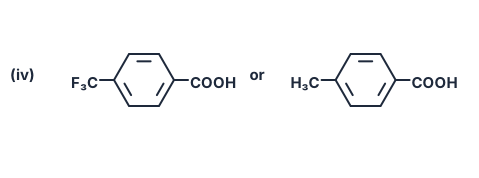
Q.Which acid of each pair shown here would you expect to be stronger?
🔒You're viewing a preview — the full solution, concept, methods & PYQ mapping are locked.
🔒 Start your 14-day free trial to unlock the full solution →Concept understanding — Inductive Effect
Inductive Effect on Acidity – From Intuition to Precision
Imagine you are holding a rope tied to a heavy box. If you pull the rope, the box moves toward you. Now imagine the rope is made of rubber bands — the pull still reaches the box, but it gets weaker the farther away you are. That is exactly how the inductive effect works inside a molecule.
The Core Intuition
An acid donates a proton (H+). After it does, the remaining part (the conjugate base) carries a negative charge. The stability of that negative charge determines how willing the molecule is to give up the proton. More stable conjugate base → stronger acid.
Now, some atoms or groups are electron-withdrawing — they pull electron density toward themselves through the sigma bonds. If such a group is attached near the acidic proton, it pulls some electron density away from the negative charge on the conjugate base. That spreads out (delocalises) the negative charge, making the conjugate base more stable. The acid becomes stronger.
Conversely, electron-donating groups push electron density toward the negative charge, concentrating it and making the conjugate base less stable. The acid becomes weaker.
The inductive effect operates through sigma bonds only. It does not involve pi bonds or resonance. It is a permanent, through-bond polarisation.
The Precise Statement
Inductive effect on acidity: The acidity of a compound increases with the presence of electron-withdrawing groups (EWGs) near the acidic site, and decreases with electron-donating groups (EDGs). The effect is strongest when the group is closest to the acidic proton, and diminishes rapidly with distance.
Mathematically, for a series of substituted carboxylic acids:
R-COOHwhere R = substituent
The acid dissociation constant Ka changes as:
- If R is electron-withdrawing (e.g., −Cl, −NO2, −CF3): Ka increases → stronger acid.
- If R is electron-donating (e.g., −CH3, −C2H5): Ka decreases → weaker acid.
Why Distance Matters
The inductive effect falls off with distance because sigma bonds are localised. Each bond attenuates the effect by roughly a factor of 2–3. For example, compare:
| Compound | pKa | Explanation |
|---|---|---|
| CH3COOH | 4.76 | Reference (no EWG) |
| ClCH2COOH | 2.86 | Cl withdraws through one bond |
| Cl2CHCOOH | 1.29 | Two Cl atoms, stronger withdrawal |
| Cl3CCOOH | 0.65 | Three Cl atoms, strongest withdrawal |
| CH3CH2COOH | 4.87 | Ethyl group is electron-donating (slightly weaker acid) |
Notice: ClCH2COOH is about 100 times stronger than acetic acid (ΔpKa≈1.9). But if the Cl is moved further away:
| Compound | pKa |
|---|---|
| ClCH2CH2COOH | 4.08 |
| ClCH2CH2CH2COOH | 4.52 |
The effect fades as the chlorine moves farther from the carboxyl group. …
Why this formula?
Inductive Effect: Why the Key Ideas Hold
The inductive effect is a fundamental concept in organic chemistry that explains how electron density shifts along a sigma (σ) bond due to differences in electronegativity. Let's break down why the key principles work — not just what they are.
1. The Core Idea: Polarization of σ Bonds
What happens?
When two atoms with different electronegativities form a σ bond, the bonding electrons are not shared equally. The more electronegative atom pulls electron density toward itself.
Why does this happen?
- Electronegativity is a measure of an atom's ability to attract shared electrons.
- The σ bond is a region of high electron density between the nuclei.
- The more electronegative atom's nucleus exerts a stronger electrostatic pull on these electrons.
- Result: The bond becomes polarized — one end becomes slightly negative (δ−), the other slightly positive (δ+).
Key formula (conceptual):
δ−←Atom A→δ+
where A is more electronegative than B.
2. Why the Effect Transmits Along a Chain
The puzzle:
If the inductive effect is about a single bond, how does it affect atoms several bonds away?
The reasoning:
- The δ+ on the less electronegative atom creates a partial positive charge.
- This partial charge polarizes the next σ bond in the chain.
- The effect is relayed through successive bonds, like a chain of dominoes.
Why does it weaken with distance?
- Each bond acts as a dielectric medium — it partially screens the charge.
- The electrostatic influence falls off with distance according to Coulomb's law:
F∝r2q1q2
- In a molecular chain, the effective distance r increases, so the induced dipole in each subsequent bond is smaller.
Key result: Inductive effect is significant only up to 3–4 bonds away.
3. The Quantitative Measure: Inductive Effect Constant (σI)
What is σI?
It's a Hammett-type constant that quantifies the electron-withdrawing or electron-donating power of a substituent through sigma bonds only.
Why does it have this form?
- The inductive effect is additive — each substituent contributes independently.
- For a substituent X attached to a carbon chain:
σI=log(Ka(CH3COOH)Ka(X-CH2COOH))
where Ka is the acid dissociation constant.
Why use acid dissociation?
- The carboxyl group (−COOH) is a sensitive probe.
- An electron-withdrawing group (EWG) stabilizes the conjugate base (R-COO−) by dispersing its negative charge.
- This increases Ka (stronger acid).
- An electron-donating group (EDG) destabilizes the conjugate base, decreasing Ka.
Key formula:
σI>0 for EWGs (e.g., −Cl, −NO2)
σI<0 for EDGs (e.g., −CH3, −C(CH3)3)
4. Why Inductive Effect is Not Resonance
Common confusion:
Students often mix inductive and resonance effects.
The critical difference:
| Property | Inductive Effect | Resonance Effect |
|---|---|---|
| Electron movement | Through σ bonds only | Through π bonds or lone pairs |
| Distance dependence | Dies off after 3–4 bonds | Can transmit over long distances in conjugated systems |
| Permanent or temporary | Permanent polarization | Can be temporary (delocalization) |
Why this matters for exam problems:
- In alkyl halides, the inductive effect of −Cl explains the δ+ on carbon.
- In benzene derivatives, the combined inductive and resonance effects determine reactivity.
--- …
Concept: Inductive Effect – electron-withdrawing groups (EWGs) like halogens stabilise the conjugate base by pulling electron density away from the carboxylate anion, making the acid stronger. The effect is stronger with more electronegative atoms and when the EWG is closer to the –COOH group.
Step 1 – Compare CH3CO2H and CH2FCO2H
Fluorine is highly electronegative and exerts a strong –I effect. Replacing a hydrogen on the α-carbon with F stabilises the conjugate base, so CH2FCO2H is the stronger acid.
Step 2 – Compare CH2FCO2H and CH2ClCO2H
Fluorine is more electronegative than chlorine, so the –I effect of F is stronger than that of Cl. Hence CH2FCO2H is stronger than CH2ClCO2H.
Step 3 – Compare CH2FCH2CH2CO2H and CH3CHFCH2CO2H
In the first acid, F is on the γ-carbon (three bonds away from –COOH); in the second, F is on the β-carbon (two bonds away). The inductive effect diminishes rapidly with distance, so the closer F makes the second acid stronger. …
The key idea is the inductive effect — electron-withdrawing groups (like halogens) stabilise the conjugate base by pulling electron density away from the carboxylate anion, making the acid stronger. The closer and more electronegative the halogen, the stronger the acid.
(i) CH2FCO2H is stronger than CH3CO2H.
(ii) CH2FCO2H is stronger than CH2ClCO2H.
(iii) CH3CHFCH2CO2H is stronger than CH2FCH2CH2CO2H.
(iv) F3C−C6H4−COOH is stronger than H3C−C6H4−COOH.
The Concept: Why Inductive Effect Decides Acidity
Acidity is about how easily a molecule gives up a proton (H+). When an acid HA loses H+, it leaves behind its conjugate base A−. The more stable that conjugate base is, the stronger the acid.
For carboxylic acids (RCO2H), the conjugate base is a carboxylate ion (RCO2−), which already has the negative charge spread over two oxygen atoms. But if the group R pulls electron density toward itself (an electron-withdrawing inductive effect), it further stabilises the negative charge on the carboxylate — making the acid stronger. If R pushes electrons away (electron-donating), it destabilises the negative charge and makes the acid weaker.
Halogens (F, Cl, Br, I) are electron-withdrawing by induction because they are more electronegative than carbon. The strength of this effect depends on two things:
- Electronegativity of the halogen (F > Cl > Br > I)
- Distance from the carboxyl group — the closer the halogen, the stronger its pull.
Now let’s apply this to each pair.
(i) CH3CO2H vs CH2FCO2H
-
In CH3CO2H, the group attached to the carboxyl is a methyl (CH3). Methyl is weakly electron-donating (it pushes electron density toward the carboxylate), which destabilises the conjugate base slightly. So acetic acid is a weak acid (pKa≈4.76).
-
In CH2FCO2H, one hydrogen on the methyl has been replaced by fluorine. Fluorine is highly electronegative — it pulls electron density away from the carboxyl group through the sigma bonds. This withdrawal stabilises the negative charge on the conjugate base, making the acid stronger.
-
The inductive effect of fluorine is strong and operates through only one carbon-carbon bond. So CH2FCO2H is significantly more acidic than CH3CO2H.
A common mistake is to think that because fluorine is small, its effect is weak. In fact, fluorine’s high electronegativity makes it the strongest inductive withdrawer among halogens — even though it has no d-orbitals for resonance, its pull through sigma bonds is powerful.
Result for (i): CH2FCO2H is stronger.
(ii) CH2FCO2H vs CH2ClCO2H
-
Both acids have a halogen on the alpha carbon (the carbon directly attached to the carboxyl). The difference is the halogen: fluorine vs chlorine.
-
Fluorine is more electronegative than chlorine (4.0 vs 3.2 on the Pauling scale). So fluorine pulls electron density more strongly than chlorine does.
-
Even though chlorine is larger and has more electrons, its inductive effect is weaker because electronegativity is the dominant factor here. The distance from the carboxyl is the same (one bond away), so the comparison is purely about how strongly each halogen withdraws.
A quick way to remember: For halogens at the same position, the order of acid-strengthening is F>Cl>Br>I, which follows electronegativity. This is the opposite of what you might guess from size alone.
Result for (ii): CH2FCO2H is stronger.
(iii) CH2FCH2CH2CO2H vs CH3CHFCH2CO2H
- Here the acids are longer-chain carboxylic acids. Both have a fluorine atom, but at different positions relative to the carboxyl group. …
Method: Inductive Effect Analysis
Concept: The strength of a carboxylic acid depends on how well it can stabilise the conjugate base (the carboxylate anion, RCOO−). Electron-withdrawing groups (EWGs) pull electron density away from the carboxylate ion, stabilising the negative charge and making the acid stronger. Electron-donating groups (EDGs) do the opposite — they destabilise the anion and make the acid weaker.
Steps for each pair
- Identify the substituent attached to the carbon chain near the −COOH group.
- Determine its inductive effect:
- More electronegative atom → stronger −I effect (withdraws electrons).
- Closer the EWG to −COOH → stronger the effect.
- Compare acid strength: stronger −I effect → stronger acid.
(i) CH3CO2H vs CH2FCO2H
- CH3CO2H: The −CH3 group is weakly electron-donating (+I effect).
- CH2FCO2H: Fluorine is highly electronegative — strong −I effect, pulling electrons away from the carboxylate anion.
- Result: CH2FCO2H is stronger than CH3CO2H.
Answer: CH2FCO2H is stronger.
(ii) CH2FCO2H vs CH2ClCO2H
- Both have a halogen at the same position (α-carbon).
- Electronegativity order: F>Cl.
- Inductive effect order: −I effect of F > −I effect of Cl.
- Result: CH2FCO2H is stronger than CH2ClCO2H.
Answer: CH2FCO2H is stronger.
(iii) CH2FCH2CH2CO2H vs CH3CHFCH2CO2H
- First acid: Fluorine is on the γ-carbon (3 bonds away from −COOH).
- Second acid: Fluorine is on the β-carbon (2 bonds away from −COOH).
- Key principle: Inductive effect decreases rapidly with distance. The closer the EWG, the stronger its stabilising effect.
- Result: CH3CHFCH2CO2H (F at β-position) is stronger than CH2FCH2CH2CO2H (F at γ-position).
Answer: CH3CHFCH2CO2H is stronger.
Pair (iv): F3C−C6H4−COOH vs H3C−C6H4−COOH …
Here are the common mistakes students make when comparing acid strength using the Inductive Effect, along with how to avoid each.
Mistake 1: Forgetting that the Inductive Effect is distance-dependent
The error:
In pair (iii), students often think CH2FCH2CH2CO2H is stronger because it has a fluorine atom — ignoring where the fluorine is placed.
Why it’s wrong:
The inductive effect weakens rapidly as the number of bonds between the electronegative atom and the acidic proton increases. Fluorine on the γ-carbon (3 bonds away) has almost no effect. In CH3CHFCH2CO2H, fluorine is on the β-carbon (2 bonds away), so it still stabilises the conjugate base noticeably.
How to avoid:
Always count the bonds from the electronegative atom to the carboxyl carbon.
- 1 bond away → strong effect
- 2 bonds away → moderate effect
- 3 bonds away → very weak effect
Correct answer for (iii): CH3CHFCH2CO2H is stronger.
Mistake 2: Confusing electronegativity with acid strength order directly
The error:
In pair (ii), some students recall the haloALKANE reactivity order or the polarisability of larger halogens and conclude CH2ClCO2H must be the stronger acid.
Why it’s wrong:
Acid strength here is controlled by the inductive (−I) effect on the carboxylate, and fluorine — the most electronegative element — withdraws electron density most strongly, stabilising the conjugate base best. Real pKa values agree: fluoroacetic acid ≈ 2.59 vs chloroacetic acid ≈ 2.87 — CH2FCO2H is the stronger acid.
How to avoid:
Remember the trend for α-halo acids:
Order of acid strength: F>Cl>Br>I (follows electronegativity — the −I inductive effect dominates)
This is exactly the order the electronegativity series predicts; there is no inversion for α-halo carboxylic acids.
Correct answer for (ii): CH2FCO2H is stronger.
Mistake 3: Ignoring the number of electronegative atoms or substituent position
The error:
In pair (i), some students think both acids are similar because both have a —COOH group.
Why it’s wrong:
CH2FCO2H has a fluorine atom directly on the α-carbon. This strongly withdraws electron density via the inductive effect, stabilising the conjugate base much more than the methyl group in CH3CO2H, which is electron-donating.
How to avoid:
- Compare the substituent attached to the α-carbon.
- Electron-withdrawing groups (EWG) like F, Cl, Br, I, NO₂, CN increase acidity.
- Electron-donating groups (EDG) like CH₃, C₂H₅ decrease acidity.
Correct answer for (i): CH2FCO2H is stronger.
Mistake 4: Applying the Inductive Effect to meta/para positions incorrectly
The error:
Students treat every pair identically — or skip the aromatic pair entirely.
Why it’s wrong: …
Showing the 12 most recent of 39 on this concept.
- TG EAPCET 2026Set eng-2026-05-09-AN1 markMCQQ.Match the following List-1 (Order) A Fe > Cr > Mn B Co > Fe > Mn C Ti > V > Cr D Cr > V > Mn List-2 (Property) I Melting point II Metallic Radius III Enthalpy of atomization IV Density (A) A – III, B – II, C – I, D – IV (B) A – II, B – I, C – IV, D – III (C) A – IV, B – III, C – II, D – I (D) A – III, B – IV, C – II, D – I
›Reveal solutionSolution
This question tests the understanding of periodic trends for metallic radius, density, enthalpy of atomization, and melting point across the first transition series. The correct match is A – III, B – IV, C – II, D – I.
The properties of transition elements show distinct trends across the period, primarily influenced by increasing nuclear charge, electron shielding, and the number of unpaired d-electrons. Let's analyze each property and match it to the given orders.
Concept and Intuition
- Metallic Radius: Generally decreases across a period due to increasing effective nuclear charge pulling the electrons closer to the nucleus.
- Density: Generally increases across a period because atomic mass increases while atomic volume (related to radius) generally decreases.
- Enthalpy of Atomization: This property reflects the strength of metallic bonding. It generally increases with the number of unpaired d-electrons available for bonding, peaking around the middle of the series (e.g., V or Cr), and then decreases. Elements with stable half-filled (d5) or fully-filled (d10) configurations (like Mn and Zn) often show lower values due to weaker metallic bonding.
- Melting Point: Similar to enthalpy of atomization, melting point depends on the strength of metallic bonding. It generally follows a similar trend, increasing to a maximum around the middle of the series and then decreasing. Anomalies exist, particularly for Mn, due to its stable half-filled d5 configuration.
Let's match the given orders to their properties:
-
Analyze Property II (Metallic Radius)
- Trend: Metallic radius generally decreases across the 3d series from left to right due to increasing effective nuclear charge.
- Values (pm): Ti (147) > V (134) > Cr (128) > Mn (127) > Fe (126) > Co (125).
- List-1 C (Ti > V > Cr): This order perfectly matches the decreasing trend of metallic radii. Titanium has the largest radius, followed by Vanadium, and then Chromium.
- Match: C – II
-
Analyze Property IV (Density)
- Trend: Density generally increases across the 3d series. This is because atomic mass increases, and atomic volume (related to radius) generally decreases, leading to a higher mass packed into a smaller volume.
- Values (g/cm3): Co (8.9) > Fe (7.87) > Mn (7.21) > Cr (7.19) > V (6.11) > Ti (4.51).
- List-1 B (Co > Fe > Mn): This order correctly reflects the increasing density trend. Cobalt is denser than Iron, which is denser than Manganese.
- Match: B – IV
-
Analyze Property III (Enthalpy of Atomization)
- Concept: Enthalpy of atomization is directly related to the strength of metallic bonding, which in turn depends on the number of unpaired electrons available for bonding. It generally increases up to the middle of the series.
- Anomaly of Mn: Manganese (3d54s2) has a stable half-filled d-subshell. The electrons in the d-orbitals are strongly held and are less available for metallic bonding, leading to weaker metallic bonds and a lower enthalpy of atomization than expected.
- Values (kJ/mol): V (515) > Ti (473) > Ni (430) > Co (425) > Fe (416) > Cr (397) > Cu (339) > Mn (281). …
- TG EAPCET 2026Set eng-2026-05-10-AN1 markMCQQ.What is Z in the given sequence of reactions? Propyne H2/Pd-C, Quinolone X H2O/H+ Y Conc. H2SO4,443K Z (A) Ether (B) Aldehyde (C) Carboxylic Acid (D) Alkene
›Reveal solutionSolution
The sequence converts propyne first to propene (via partial hydrogenation), then to propan-2-ol (via acid-catalyzed hydration), and finally to propene again (via acid-catalyzed dehydration). The final product Z is an alkene, so the correct option is (D).
Concept & Intuition
This problem tests your understanding of three classic organic reactions in sequence:
- Partial hydrogenation of an alkyne – using Lindlar’s catalyst (Pd-C with quinoline) stops at the cis-alkene.
- Acid-catalyzed hydration of an alkene – follows Markovnikov’s rule, giving the more stable carbocation intermediate, leading to an alcohol.
- Acid-catalyzed dehydration of an alcohol – at high temperature (443 K) with conc. H₂SO₄, it eliminates water to form an alkene (the most substituted, stable alkene via Zaitsev’s rule).
The key insight: the first step turns a triple bond into a double bond, the second adds water across that double bond, and the third removes water to re-form a double bond. The net effect is that the starting alkyne and final alkene are isomers, but the alcohol intermediate is essential.
Step-by-step reasoning
- Step 1: Propyne → X Propyne is CHX3−C≡CH. Hydrogenation over Pd-C poisoned with quinoline (Lindlar’s catalyst) reduces the triple bond to a cis-double bond without further reduction to an alkane.
CHX3−C≡CH+HX2Pd/C,quinolineCHX3−CH=CHX2
Product X is propene (an alkene).
- Step 2: X → Y Propene undergoes acid-catalyzed hydration (HX2O/HX+). The reaction proceeds via a carbocation intermediate: protonation of the double bond gives the more stable secondary carbocation (Markovnikov’s rule), which then reacts with water.
CHX3−CH=CHX2+HX2OHX+CHX3−CH(OH)−CHX3
Product Y is propan-2-ol (isopropyl alcohol), a secondary alcohol.
- Step 3: Y → Z Heating propan-2-ol with concentrated HX2SOX4 at 443 K causes dehydration (elimination of water). The reaction follows an E1 mechanism: protonation of the –OH group, loss of water to form a secondary carbocation, then loss of a proton to give the most substituted alkene (Zaitsev’s product).
- TG EAPCET 2026Set eng-2026-05-10-FN1 markMCQQ.The correct orders of second ionization enthalpies of the given elements are I. Li > B > Be > Mg II. P > Mg > Al > Na III. O > F > N > C The correct answer is (A) I, II, III (B) II, III only (C) I, III only (D) I, II only
›Reveal solutionSolution
Second ionization enthalpy depends on the stability of the +1 cation and the electronic configuration after the first electron is removed. The correct orders are I and II only, making option (D) the answer.
The second ionization enthalpy (ΔiH2) is the energy required to remove an electron from a gaseous, singly positive ion. This is not simply a scaled-up version of the first ionization enthalpy — it is governed by the electronic configuration of the monocation and how stable that configuration is. A monocation with a noble-gas configuration (like MgX+: 1s22s22p63s1) is relatively stable, so removing a second electron from it is harder than from a monocation that already has a half-filled or filled subshell. The key is to think about what the +1 ion looks like, not the neutral atom.
Let’s examine each order one by one.
-
Order I: Li > B > Be > Mg
- LiX+ has the configuration of helium (1s2), a full shell. Removing an electron from this is extremely difficult — the second ionization enthalpy of Li is the highest among these four.
- BX+ is 1s22s2 (beryllium-like). This is a filled 2s subshell, which is fairly stable, so its ΔiH2 is high but less than Li’s.
- BeX+ is 1s22s1. Removing the lone 2s electron is relatively easy because the resulting BeX2+ has a helium configuration. So Be’s ΔiH2 is low.
- MgX+ is 1s22s22p63s1 — a single 3s electron outside a neon core. Removing it is also easy, giving MgX2+ with a neon configuration. Comparing: Li (very high) > B (high) > Be (low) > Mg (low). But note that Be and Mg are both low; however, Be’s ΔiH2 is actually slightly higher than Mg’s because the 2s electron is closer to the nucleus than the 3s electron. So the order Li > B > Be > Mg is correct.
-
Order II: P > Mg > Al > Na
- PX+ is 1s22s22p63s23p2. Removing a 3p electron from this is not too hard, but compare with the others.
- MgX+ is 3s1 — removing that 3s electron gives a noble-gas configuration, so ΔiH2 is high (about 1450 kJ/mol).
- AlX+ is 3s2 — removing a 3s electron gives 3s1, which is not especially stable, so ΔiH2 is moderate (about 1800 kJ/mol). Wait — that seems to contradict the order. Let’s check carefully. Actually, AlX+ has configuration 3s2 (like Mg atom). Removing one 3s electron from AlX+ gives AlX2+ (3s1). This is not a particularly stable configuration, so the energy required is not as high as for Mg. In fact, the second ionization enthalpy of Mg is higher than that of Al because Mg+ has a half-filled 3s? No — Mg+ is 3s1, which is not half-filled; it’s just one electron. The reason Mg’s ΔiH2 is high is that the resulting MgX2+ has a noble-gas configuration. For Al, the resulting AlX2+ does not have a noble-gas configuration, so its ΔiH2 is lower.
- NaX+ has a neon configuration (2s22p6). Removing an electron from this is extremely difficult — the second ionization enthalpy of Na is the highest of all (about 4560 kJ/mol). So the correct order should be Na > P > Mg > Al? That doesn’t match. Let’s look up actual values (conceptually):
- Na: ~4560 kJ/mol
- Mg: ~1450 kJ/mol
- Al: ~1800 kJ/mol
- P: ~1900 kJ/mol …
-
- TG EAPCET 2026Set eng-2026-05-10-FN1 markMCQQ.In which of the following, carbon uses sp3 hybrid orbital for bond formation with oxygen? (A) Formic acid (B) Urea (C) t-Butylalcohol (D) Acetaldehyde
›Reveal solutionSolution
The key is to identify the carbon atom directly bonded to oxygen and check its steric number (number of sigma bonds + lone pairs). A steric number of 4 means sp3 hybridisation. In t-Butylalcohol, the carbon attached to oxygen is sp3 hybridised, so the correct option is (C).
The question asks: in which molecule does carbon use an sp3 hybrid orbital to form a bond with oxygen? This is not about the hybridisation of the carbon atom in general, but specifically about the orbital it uses for the sigma bond to oxygen. For a carbon to use an sp3 orbital, that carbon must have a steric number of 4 — meaning it is bonded to four other atoms (or has three sigma bonds and one lone pair, though carbon rarely has lone pairs in stable organic compounds). If the carbon is sp2 or sp hybridised, it uses sp2 or sp orbitals for sigma bonding.
Let’s examine each option.
-
Formic acid (HCOOH)
The carbon in the carboxyl group is double-bonded to one oxygen and single-bonded to another oxygen (and to a hydrogen). That carbon forms three sigma bonds (one to H, one to OH, one to the other oxygen via the sigma part of the C=O) and has no lone pair — steric number 3. So it is sp2 hybridised. The sigma bond to the carbonyl oxygen uses an sp2 orbital, not sp3.
-
Urea (NH2–CO–NH2)
The carbonyl carbon is double-bonded to oxygen and single-bonded to two nitrogen atoms. Again, three sigma bonds — steric number 3 — so sp2 hybridised. The C–O sigma bond uses an sp2 orbital.
-
t-Butylalcohol ((CH3)3C–OH) …
-
- TG EAPCET 2026Set eng-2026-05-10-FN1 markMCQQ.Identify the sets from the following in which class of drugs are correctly matched with criteria for its classification I. Analgesics ----------- Pharmacological effect II. Sulphonamides ------- Target Molecules III. Antihistamines ------ drug action The correct answer is (A) I, II only (B) I, III only (C) II, III only (D) I, II, III
›Reveal solutionSolution
Analgesics → pharmacological effect (✓) and Antihistamines → drug action (✓) are correct; Sulphonamides are classified by chemical structure, not target molecules — so I and III only.
Drugs are classified on four bases: pharmacological effect, drug action, chemical structure, and molecular targets.
- I. Analgesics — Pharmacological effect: grouped by their therapeutic (pharmacological) effect, relief of pain. Correctly matched. …
- TG EAPCET 2026Set eng-2026-05-11-AN1 markMCQQ.Which of the following set/s of reagents convert benzoic acid (X) to primary amine (Y) with one carbon atom more than in X? I. NH3/Δ; Br2∣OH− II. NH3/Δ; LiAlH4, H2O III. LiAlH4, H2O; NaBr/H2SO4; KCN; H2∣Ni Correct answer is (only) (A) I, II only (B) II, III only (C) III only (D) II only
›Reveal solutionSolution
A one-carbon-longer primary amine demands a cyanide (nitrile) step, because CN− is the carbon that gets added. Only route III does this — option (C).
The concept first
The question is really about carbon bookkeeping. Benzoic acid has 7 carbons; the product Y must be a primary amine with 8 carbons. Ask: which reactions change the carbon count?
- LiAlH4 reduction — no change (it swaps O for H).
- Amide formation with NH3 — no change.
- Hofmann bromamide degradation (Br2/OH− on an amide) — the carbonyl carbon is lost as carbonate: the amine has one carbon fewer. This is a descending series.
- Nitrile route (R−X+KCN→R−CN, then reduce) — the cyanide carbon is added: the amine has one carbon more. This is the ascending series.
So the moment the question says "one carbon atom more", you should be hunting for KCN followed by reduction. Any route lacking it cannot possibly work.
Step-by-step
- Fix the target. X=C6H5COOH (7 C). Y = primary amine with 8 C = C6H5CH2CH2NH2 (2-phenylethan-1-amine).
- Route I: NH3/Δ; then Br2/OH−.
C6H5COOHNH3,ΔC6H5CONH2Br2/OH−C6H5NH2
Aniline: primary ✓ but only 6 carbons — one less. Rejected.
3. Route II: NH3/Δ; then LiAlH4,H2O.
C6H5COOHNH3,ΔC6H5CONH2LiAlH4C6H5CH2NH2 …
- TG EAPCET 2026Set ap-2026-05-04-AN1 markMCQQ.Which one of the following carboxylic acids has the highest pKa value? (A) C6H5COOH (benzoic acid) (B) C6H5CH2COOH (phenylacetic acid) (C) CH3COOH (D) CH3CH2COOH 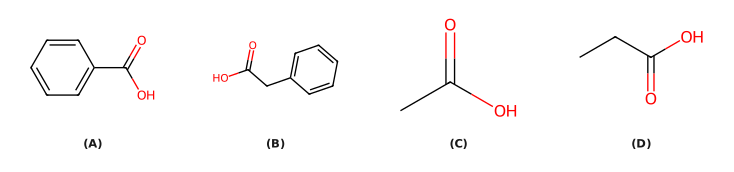
›Reveal solutionSolution
The highest pKa belongs to the weakest acid. The bigger the electron-releasing alkyl group, the weaker the acid — so propanoic acid, CH3CH2COOH (pKa≈4.87), wins. Option (D).
The concept first: what actually controls acid strength
A carboxylic acid ionises as
RCOOH⇌RCOO−+H+,Ka=[RCOOH][RCOO−][H+],pKa=−logKa
Read the scale correctly — this is where marks are usually lost:
- large Ka ⇒ small pKa ⇒ STRONG acid
- small Ka ⇒ large pKa ⇒ WEAK acid
So "highest pKa" is simply asking: which is the weakest acid?
What makes an acid weak? Anything that destabilises the carboxylate anion RCOO−, because an unstable anion means the equilibrium sits to the left.
- Electron-withdrawing groups (–I) pull the negative charge away from the carboxylate, spreading it out and stabilising the anion ⇒ stronger acid (e.g. ClCH2COOH).
- Electron-releasing groups (+I, alkyl) push electron density towards the already negative carboxylate, intensifying the charge and destabilising the anion ⇒ weaker acid.
- And the +I effect grows with the size of the alkyl group: CH3CH2−>CH3−.
Step-by-step comparison of the four acids
Step 1 — separate the aryl acids from the alkyl acids.
A phenyl group, unlike an alkyl group, is electron-withdrawing (its sp2 carbons are more electronegative, a –I effect). So attaching a ring makes an acid stronger, not weaker.
- (A) Benzoic acid, C6H5COOH: the ring is attached directly to −COOH, so its –I effect acts at full strength. Strongest of the four. pKa≈4.19.
- (B) Phenylacetic acid, C6H5CH2COOH: the ring is one CH2 away, so its –I effect is damped by distance; it is a little weaker than benzoic but still stronger than the plain aliphatic acids. pKa≈4.31. …
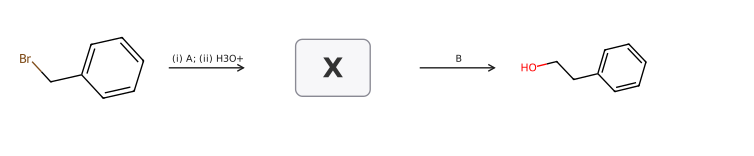
- TG EAPCET 2026Set ap-2026-05-04-FN1 markMCQQ.Consider the following reaction sequence given below C6H5CH2Br(i) A (ii) H3O+XBC6H5CH2CH2OH Identify the pair of sets from the following in which A and B are present in order I. AgCN ; H2 | Pt II. AgCN ; LiAlH4, H2O III. KCN ; LiAlH4, H2O IV. KCN ; B2H6 (A) I, II only (B) II, III only (C) III, IV only (D) I, IV only 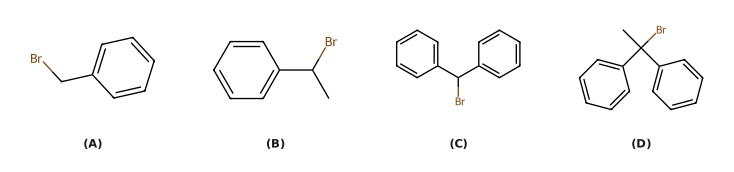
›Reveal solutionSolution
SXN1 speed tracks carbocation stability. Option (D) ionises to a cation flanked by two phenyl rings plus a methyl — the most stabilised of the four — so it is the most reactive.
The concept first
The SXN1 mechanism has two steps:
R−BrslowRX++BrX−fast,NuX−R−Nu
The rate-determining step is the ionisation, so the rate depends on how easily the carbocation forms — i.e. on how stable that carbocation is. Two effects stabilise it:
- Resonance: an adjacent benzene ring delocalises the positive charge into the ring (π system). Each extra phenyl adds more delocalisation.
- Inductive/hyperconjugative release: alkyl groups push electron density toward the cationic carbon.
Order of stability: methyl<1∘<2∘<3∘, and benzylic beats them all at the same substitution level; diphenyl (benzhydryl) beats mono-benzylic; triphenyl (trityl) beats everything.
Step 1 — Draw the cation from each option
Option Cation formed Stabilising features (A) CX6HX5CHX2Br CX6HX5−C+HX2 1 phenyl (primary benzylic) (B) CX6HX5CH(Br)CHX3 CX6HX5−C+H−CHX3 1 phenyl + 1 methyl (secondary benzylic) (C) CX6HX5CH(Br)CX6HX5 CX6HX5−C+H−CX6HX5 2 phenyls (benzhydryl) (D) CX6HX5C(Br)(CHX3)CX6HX5 CX6HX5−C+(CHX3)−CX6HX5 2 phenyls + 1 methyl (tertiary, doubly benzylic) Step 2 — Rank them …
- TG EAPCET 2025Set eng-2025-05-03-AN1 markMCQQ.Arrange the following in decreasing order of their boiling points (A) 2 – Methylbutane (B) 2,2 – Dimethylpropane (C) Pentane (D) Hexane (A) D > C > A > B (B) B > A > C > D (C) D > A > C > B (D) B > C > A > D
›Reveal solutionSolution
Boiling points of alkanes increase with molecular mass and decrease with increased branching. Hexane has the highest boiling point due to its larger molecular mass, followed by the C5H12 isomers in order of decreasing branching: pentane, 2-methylbutane, and 2,2-dimethylpropane. The final order is D > C > A > B.
The boiling point of a substance is the temperature at which its vapor pressure equals the surrounding atmospheric pressure. For a liquid to boil, its molecules must gain enough kinetic energy to overcome the attractive forces holding them together in the liquid phase. In the case of hydrocarbons like alkanes, the primary intermolecular forces are London Dispersion Forces (LDFs).
Concept and Intuition
London Dispersion Forces (LDFs) are temporary attractive forces that arise from the instantaneous dipoles created by the momentary uneven distribution of electrons in a molecule. These forces are present in all molecules, but they are the only intermolecular forces in nonpolar molecules like alkanes. The strength of LDFs depends on two main factors:
-
Molecular Size and Number of Electrons: Larger molecules have more electrons, which means their electron clouds are more polarizable (more easily distorted). This leads to stronger instantaneous dipoles and thus stronger LDFs. Consequently, as the molecular mass of an alkane increases, its boiling point generally increases.
-
Molecular Shape and Surface Area: The extent of contact between neighboring molecules influences the strength of LDFs. Molecules with larger surface areas can have more points of contact, leading to stronger overall LDFs. Conversely, molecules that are more compact or spherical have smaller effective surface areas for intermolecular contact. This reduces the number of points where LDFs can act, leading to weaker overall LDFs and a lower boiling point. Increased branching in an alkane makes the molecule more compact and spherical, thereby reducing its surface area and lowering its boiling point.
Let's apply these principles to the given compounds.
Step-by-step Solution
-
Determine the molecular formula for each compound.
- (A) 2-Methylbutane: This is an isomer of pentane. It has 5 carbon atoms. Its molecular formula is C5H12.
- (B) 2,2-Dimethylpropane: This is also an isomer of pentane. It has 5 carbon atoms. Its molecular formula is C5H12.
- (C) Pentane (n-pentane): This is a straight-chain alkane with 5 carbon atoms. Its molecular formula is C5H12.
- (D) Hexane (n-hexane): This is a straight-chain alkane with 6 carbon atoms. Its molecular formula is C6H14.
-
Compare compounds based on molecular mass.
- Compounds (A), (B), and (C) are all isomers of pentane, having the molecular formula C5H12. They have the same molecular mass.
- Compound (D), hexane, has the molecular formula C6H14. It has a higher molecular mass than the pentane isomers.
- Since hexane has more carbon atoms and a higher molecular mass, it has a larger electron cloud, leading to stronger London Dispersion Forces compared to the C5H12 isomers.
- Therefore, Hexane (D) will have the highest boiling point.
-
Compare the C5H12 isomers based on branching.
Now we need to arrange pentane, 2-methylbutane, and 2,2-dimethylpropane in decreasing order of their boiling points. All three have the same molecular formula (C5H12), so their boiling points will be determined by their molecular shapes and the extent of branching.
- Pentane (C): This is a straight-chain alkane. It has the largest surface area for intermolecular contact among the three isomers. This allows for the most extensive London Dispersion Forces. …
-
- TG EAPCET 2025Set eng-2025-05-03-FN1 markMCQQ.Arrange the following in decreasing order of their boiling points (A) 2 – Methylbutane (B) 2,2 – Dimethylpropane (C) Pentane (D) Hexane (A) D > A > C > B (B) B > A > C > D (C) D > C > A > B (D) B > C > A > D
›Reveal solutionSolution
Boiling points of alkanes increase with chain length and decrease with branching. The correct decreasing order is Hexane > Pentane > 2-Methylbutane > 2,2-Dimethylpropane, which corresponds to option (C).
The boiling point of an alkane depends on the strength of intermolecular forces — specifically, London dispersion forces. These forces arise from temporary dipoles and increase with the surface area of the molecule. A longer, unbranched chain has a larger surface area for neighbouring molecules to "touch", so dispersion forces are stronger and more energy (higher temperature) is needed to overcome them. Branching reduces the surface area by making the molecule more compact, which weakens the dispersion forces and lowers the boiling point.
So the key idea is simple: longer chain → higher boiling point; more branching → lower boiling point (for the same number of carbons).
Let’s identify each compound:
- Hexane — 6 carbons, straight chain. Longest chain here, so the strongest dispersion forces. Highest boiling point.
- Pentane — 5 carbons, straight chain. Shorter than hexane, so lower boiling point than hexane, but higher than any branched C5 isomer.
- 2-Methylbutane — also 5 carbons, but with one methyl branch. Less surface area than pentane, so lower boiling point than pentane. …
🎓Unlock everything free for 14 days
- ✓Full step-by-step solutions
- ✓Concept-first explanations
- ✓Methods, shortcuts & mistakes
- ✓PYQ mapping + timed mock tests
Full access for 14 days. No credit card required.