Chemistry · Ch 2 — Electrochemistry
Corrosion
Corrosion
What Corrosion Is
Corrosion is the slow, spontaneous eating away of a metal's surface by the formation of oxides or other salts of that metal. Everyday examples include iron rusting, silver tarnishing, and copper or bronze developing a green surface coating. Left unchecked, corrosion damages buildings, bridges, ships, and metal structures generally, and iron is the metal most affected — the yearly economic loss it causes runs into crores of rupees.
At its core, corrosion is a metal losing electrons (getting oxidised) to atmospheric oxygen and turning into an oxide. Rusting of iron — the everyday name for iron's corrosion — needs both moisture and air to proceed, and although the overall chemistry looks complicated, it can be understood as an electrochemical process, much like the working of a galvanic cell.
Rusting as a Tiny Electrochemical Cell
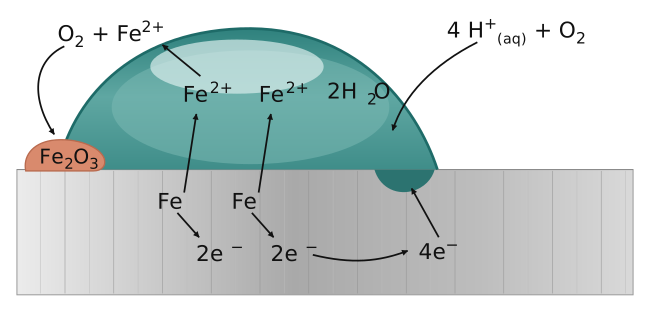
On the surface of an iron object, one small region behaves as the anode and a neighbouring region behaves as the cathode, so the object effectively sets up a miniature galvanic cell on itself (illustrated in Fig. 2.13).
Drawn by us to help you understand the concept clearly, and verified to make sure it's accurate. For exams, practice from your textbook's own diagram.
What the Figure Shows
The figure is a schematic of the rusting of iron, depicted as an electrochemical cell. A grey block of iron is shown with a water drop resting on its surface. Within the drop, two distinct spots are labelled:
- Anodic spot: Here, iron metal oxidises:
- Cathodic spot: Electrons travel through the iron to this region, where oxygen is reduced in the presence of acid:
The released electrons flow through the metal from the anodic to the cathodic spot. Near the surface of the water drop, the ions are further oxidised by atmospheric oxygen to form rust (), shown as a red-brown deposit. The three key reactions—oxidation, reduction, and atmospheric oxidation—are the ones NCERT prints beneath its own diagram (the book's label carries NCERT's own 'Atomospheric' spelling); they are described in this card.
Physical Idea Taught
Rusting is not a simple direct reaction of iron with oxygen. Instead, it is an electrochemical process that requires:
- A conducting medium (water with dissolved ions, e.g., from in air forming carbonic acid, providing )
- An electrical circuit through the metal (electron flow)
- Separate anodic and cathodic sites on the metal surface
The figure illustrates how a spontaneous redox reaction is set up, with iron acting as both anode and cathode at different spots. This explains why rusting accelerates in moist, acidic, or salty environments—they enhance the ionic conductivity of the water film.
Key Formula Developed with This Figure
The textbook uses this corrosion cell to show how the two spots on the same iron object behave as the electrodes of a genuine electrochemical cell, each with its own standard electrode potential. For the anodic reaction:
The Nernst equation at 298 K is:
where:
- = electrode potential under non-standard conditions (V)
- = standard electrode potential ( for )
- = number of electrons transferred ()
- = concentration of ferrous ions in solution (mol/L) …
At the anodic spot, iron atoms are oxidised to ferrous ions, releasing electrons:
These electrons do not stay put — they travel through the metal itself to a different spot on the same object, where they are used to reduce dissolved oxygen.
At the cathodic spot, atmospheric oxygen is reduced, but this reduction needs H⁺ ions to go to completion. These H⁺ ions are thought to come mainly from carbonic acid, , which forms when atmospheric carbon dioxide dissolves in the water film on the metal surface (dissolution of other acidic oxides from the air can add to the H⁺ supply too):
Adding the anode and cathode processes gives the overall cell reaction taking place on the iron surface:
The sizeable positive shows why this reaction proceeds so readily on its own once iron, water, and air are all present together.
From Fe²⁺ to Rust
The ferrous ions () produced at the anodic spot do not remain in that form. Atmospheric oxygen oxidises them further, this time all the way to the ferric state, and this second oxidation regenerates H⁺ ions in the process:
The ferric oxide formed here does not stay anhydrous; it picks up water of hydration and separates out as rust, written as (a hydrated iron(III) oxide, with the amount of associated water, , being variable). The H⁺ ions regenerated in this step can go on to feed the cathodic reduction of oxygen again, which is part of why rusting keeps progressing once it starts.