Q.Give the uses of freon 12, DDT, carbon tetrachloride and iodoform.
🔒You're viewing a preview — the full solution, concept, methods & PYQ mapping are locked.
🔒 Start your 14-day free trial to unlock the full solution →Concept understanding — Organic Compound Applications
Organic Compound Applications: From Everyday Life to Industry
Imagine you wake up in the morning. The plastic of your toothbrush, the polyester in your shirt, the paracetamol you take for a headache, the LPG that cooks your breakfast, the soap you wash your hands with — every single one of these is an organic compound. You are literally surrounded by them.
The word "organic" here has nothing to do with food labels. In chemistry, an organic compound is any compound whose molecules contain carbon, almost always bonded to hydrogen, and often to oxygen, nitrogen, and other elements. The reason carbon is special is that it can form four stable bonds, allowing it to build chains, rings, and complex structures — millions of them. This is why organic compounds are the basis of life and of modern materials.
The Core Idea: Structure Determines Function
The entire field of organic chemistry rests on one principle: the way atoms are arranged in a molecule determines what that molecule does.
A small change in structure can completely change a compound's properties. For example:
- Ethanol (C2H5OH) — the alcohol in drinks — is a liquid that mixes with water and is consumed by humans.
- Dimethyl ether (CH3OCH3) — same atoms, same formula (C2H6O), but arranged differently — is a gas used as a refrigerant and is toxic if inhaled.
This is called structural isomerism, and it's why organic chemistry is so rich and why applications are so diverse.
The Precise Statement
Organic compounds are carbon-based molecules (excluding simple oxides, carbonates, and carbides) whose applications arise directly from their molecular structure — specifically, the functional groups they contain and the size/shape of their carbon skeleton.
A functional group is a specific atom or group of atoms within a molecule that gives it characteristic chemical behaviour. For instance:
- The –OH group (alcohol) makes a compound able to dissolve in water and act as a disinfectant.
- The –COOH group (carboxylic acid) makes it acidic and able to form esters (fragrances, plastics).
- The –NH₂ group (amine) makes it basic and crucial for dyes and medicines.
How Applications Flow from Structure
Let's see this in action with real examples you'll encounter in exams:
| Functional Group | Example Compound | Application | Why? |
|---|---|---|---|
| –OH (alcohol) | Ethanol | Fuel, solvent, antiseptic | Small polar molecule; burns cleanly; kills bacteria by denaturing proteins |
| –COOH (carboxylic acid) | Acetic acid | Vinegar (food preservative) | Weak acid kills microbes; sour taste |
| –COO– (ester) | Ethyl acetate | Nail polish remover, fruit flavour | Pleasant smell; volatile (evaporates quickly) |
| –CONH– (amide) | Nylon-66 | Fibres for clothing, ropes | Strong hydrogen bonds between chains give tensile strength |
| –C₆H₅ (benzene ring) | Paracetamol | Pain reliever | Ring structure fits into enzyme active sites in the body |
In Indian exams (JEE, NEET, board exams), you are often asked to match a compound with its application or explain why a particular functional group leads to a specific use. The key is to connect the functional group's chemical property (polarity, acidity, reactivity) to the real-world need.
The Three Big Application Domains
1. Pharmaceuticals and Medicine
Most drugs are organic compounds. The structure is designed to interact with a specific biological target (enzyme, receptor) in your body. For example:
- Aspirin (acetylsalicylic acid) has an ester and a carboxylic acid group — the ester is hydrolysed in the body to release the active salicylic acid.
- Chloroquine (antimalarial) has a quinoline ring and an amine side chain — the ring mimics natural molecules, allowing it to enter cells.
2. Polymers and Plastics
Long chains of repeating organic units (monomers) give materials with specific properties:
- Polyethylene (−CH2−CH2−)n — simple chain, flexible, used in bags and bottles.
- Teflon (−CF2−CF2−)n — fluorine atoms replace hydrogen, making it non-stick and chemically inert.
3. Fuels and Energy
Hydrocarbons (only C and H) are the simplest organic compounds. Their combustion releases energy:
- Methane (CH4) — natural gas, cleanest burning. …
Why this formula?
Organic Compound Applications: Understanding the Why Behind the Key Ideas
In organic chemistry, applications often revolve around reaction mechanisms, functional group transformations, and physical property trends. The "formulae" here are not always mathematical — they are conceptual frameworks and reaction patterns that explain why a compound behaves a certain way.
Let’s break down the core reasoning behind the most important applications.
1. Why Do Functional Groups Determine Reactivity?
Key idea: The functional group is the reactive site — the rest of the molecule (the carbon skeleton) is mostly a spectator.
Reasoning:
- Electron density distribution is uneven in a functional group.
- Example: In a carbonyl group (C=O), oxygen is more electronegative than carbon.
- This creates a partial positive charge on carbon (δ+) and a partial negative charge on oxygen (δ−).
- Nucleophiles (electron-rich species) attack the δ+ carbon.
- Electrophiles (electron-deficient species) attack the δ− oxygen or lone pairs.
Why this matters: This explains why aldehydes undergo nucleophilic addition, while alkenes undergo electrophilic addition — the type of charge separation dictates the reaction.
2. Why Do Boiling Points Follow a Trend?
Key formula (conceptual):
Boiling point ∝ (molecular mass) + (intermolecular force strength)
Reasoning:
- Van der Waals forces increase with molecular size (more electrons → more temporary dipoles).
- Hydrogen bonding (in alcohols, carboxylic acids, amines) adds a strong intermolecular force — much stronger than dipole-dipole or London forces.
- Branching reduces surface area → weaker London forces → lower boiling point.
Example comparison:
| Compound | Type | Boiling point (°C) | Why? |
|---|---|---|---|
| Butane (CX4HX10) | Alkane | -0.5 | Only London forces |
| Propanol (CX3HX7OH) | Alcohol | 97 | H-bonding dominates |
| Acetone (CX3HX6O) | Ketone | 56 | Dipole-dipole only |
Takeaway: The type of intermolecular force matters more than molecular mass alone.
3. Why Do Substitution Reactions Follow SN1 or SN2?
Key formula (rate law):
- SN2: Rate =k[RX][Nu−]
- SN1: Rate =k[RX]
Reasoning (the why):
- SN2 is a one-step process: nucleophile attacks from the back while the leaving group departs.
- Requires no carbocation intermediate.
- Favored by primary alkyl halides (less steric hindrance).
- SN1 is a two-step process:
- Leaving group leaves → forms a carbocation (slow, rate-determining step).
- Nucleophile attacks the carbocation (fast).
- Favored by tertiary alkyl halides (carbocation is more stable due to hyperconjugation and inductive effects).
Why this matters: The structure of the alkyl halide determines which pathway dominates — this is why tertiary halides react via SN1 (no backside attack possible) and primary halides via SN2.
4. Why Do Aromatic Compounds Resist Addition?
Key concept: Aromaticity — the delocalized π-electron cloud stabilizes the ring.
Reasoning:
- Benzene (CX6HX6) has 6 π-electrons in a cyclic, planar, conjugated system.
- Hückel's rule: Aromatic if 4n+2 π-electrons (here n=1).
- Addition would break the aromatic ring → lose the resonance stabilization energy (~150 kJ/mol for benzene).
- Instead, electrophilic substitution occurs — the ring keeps its aromaticity.
Why this matters: This explains why benzene undergoes nitration, halogenation, etc., but not addition reactions like alkenes do.
5. Why Do Carboxylic Acids Have Higher Acidity Than Alcohols? …
Concept: Organic Compound Applications — each compound has a specific use tied to its chemical properties (stability, toxicity, reactivity).
Reasoning:
- Freon 12 (CCl2F2) is a non-toxic, non-flammable chlorofluorocarbon with a low boiling point, making it ideal as a refrigerant in air conditioners and refrigerators.
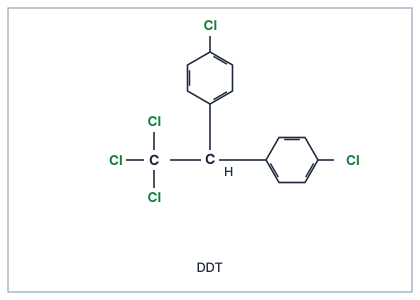
- DDT (C14H9Cl5) is a persistent insecticide that disrupts nerve function in insects; it was widely used in agriculture and for malaria control.
- Carbon tetrachloride (CCl4) is a dense, non-flammable solvent that dissolves oils and fats, used in dry cleaning and as a fire extinguisher (now restricted due to toxicity). …
This question asks for the uses of four important organic compounds — freon 12, DDT, carbon tetrachloride, and iodoform. Each has a distinct application: freon 12 as a refrigerant, DDT as an insecticide, carbon tetrachloride as a solvent and fire extinguisher, and iodoform as an antiseptic.
The key to answering such questions in exams is to recall the specific, well-known uses of each compound — not just general properties. Let's go through them one by one, with the reasoning behind each use.
1. Freon 12 (Dichlorodifluoromethane, CCl2F2)
Freon 12 is a chlorofluorocarbon (CFC). Its uses stem from its unique physical properties: it is a gas at room temperature but easily liquefies under pressure, it is non-toxic, non-flammable, and chemically stable.
- Refrigerant in air conditioners and refrigerators: Because it can absorb heat when it evaporates and release it when compressed, it was widely used in cooling systems.
- Propellant in aerosol sprays: Its low boiling point and inertness made it ideal for dispensing products like deodorants and paints.
- Foam-blowing agent: Used in manufacturing insulating foams.
Freon 12 is now banned under the Montreal Protocol because it depletes the ozone layer. In modern exams, you may be asked about its environmental impact alongside its uses.
2. DDT (Dichlorodiphenyltrichloroethane, C14H9Cl5)
DDT is an organochlorine compound. Its primary use is as an insecticide, but its story is complex.
- Insecticide in agriculture: It was massively used after World War II to control crop pests like mosquitoes, beetles, and moths.
- Disease vector control: It was sprayed to kill mosquitoes that transmit malaria and typhus, saving millions of lives.
- Household pest control: Used in powders and sprays for flies, cockroaches, and lice.
DDT is persistent in the environment and accumulates in food chains, causing harm to wildlife (especially birds). It is now banned in most countries, but is still used in some regions for malaria control under strict guidelines.
3. Carbon Tetrachloride (CCl4)
Carbon tetrachloride is a dense, non-flammable liquid. Its uses are based on its ability to dissolve oils and fats, and its fire-suppressing property.
- Solvent for oils, fats, and greases: Used in dry cleaning and as a degreasing agent in industries.
- Fire extinguisher (under the name Pyrene): Its non-flammable nature and ability to form a heavy vapour that smothers flames made it a common fire extinguisher for electrical fires. …
Here is a clear, concept-first solution method for this type of question.
Method: Functional Group & Property Mapping
This method works by linking the chemical structure (specifically the functional group or key element) of a compound to its physical/chemical properties, and then mapping those properties to a real-world application.
Core Concept: A compound's use is almost always a direct consequence of one of its dominant properties (e.g., non-flammability, toxicity to insects, antiseptic action).
Steps to Solve
Step 1: Identify the Key Structural Feature
Look at the compound's formula or name and identify the atom or group that makes it special.
- Freon 12 (CCl2F2): Contains Chlorine (Cl) and Fluorine (F) atoms. It is a halogenated hydrocarbon (a CFC).
- DDT (C14H9Cl5): Contains multiple Chlorine (Cl) atoms attached to two benzene rings. It is a polychlorinated hydrocarbon.
- Carbon tetrachloride (CCl4): Contains four Chlorine (Cl) atoms. It is a non-polar, dense liquid.
- Iodoform (CHI3): Contains Iodine (I) atoms. It is a trihalomethane.
Step 2: Link Structure to a Dominant Property
Connect the structural feature to its most important chemical or physical behavior.
- Freon 12: The C-F and C-Cl bonds are very strong and stable. This makes the compound non-toxic, non-flammable, and a good heat transfer agent (it evaporates easily, absorbing heat).
- DDT: The chlorine atoms make the molecule highly stable (persistent) and toxic to the nervous system of insects.
- Carbon tetrachloride: It is a non-polar solvent (dissolves oils, fats, grease) and is non-flammable. It is also denser than water.
- Iodoform: The iodine atom is easily released. Iodine is a powerful antiseptic (kills bacteria).
Step 3: Map Property to Application
Match the dominant property to a real-world need.
- Freon 12 (Property: Non-toxic, non-flammable, good heat transfer) …
Here are the common mistakes students make when answering questions on the applications of freon 12, DDT, carbon tetrachloride, and iodoform, along with clear strategies to avoid them.
1. Freon 12 (Dichlorodifluoromethane, CCl2F2)
Common Mistake:
- Writing that Freon 12 is used as a fuel or solvent.
- Confusing it with Freon 11 or other CFCs.
Why it happens:
Students often memorise "CFCs are refrigerants" but don't distinguish between specific numbers. They also confuse "refrigerant" with "fuel" because both involve gases.
How to avoid:
- Remember: Freon 12 is a chlorofluorocarbon (CFC). Its primary use is as a refrigerant in air conditioners and refrigerators.
- It is non-flammable and non-toxic, so it was ideal for cooling — never a fuel.
- Key exam point: It is also used as a propellant in aerosol sprays (though now banned in many countries due to ozone depletion).
Correct use: Refrigerant and aerosol propellant.
2. DDT (Dichlorodiphenyltrichloroethane)
Common Mistake:
- Writing that DDT is used as a medicine or insecticide for crops (without mentioning its ban).
- Forgetting to mention its environmental impact (bioaccumulation).
Why it happens:
Students recall "DDT kills insects" but don't read the question carefully — many exam questions expect you to note its historical use and current status.
How to avoid:
- Always mention: DDT is an insecticide used to control malaria-carrying mosquitoes and agricultural pests.
- Crucial addition: It is banned in many countries because it is non-biodegradable and causes bioaccumulation in food chains.
- Do not say it is used as a medicine — it is not a drug.
Correct use: Insecticide (now restricted/banned due to environmental persistence).
3. Carbon Tetrachloride (CCl4)
Common Mistake:
- Writing that it is used as a fire extinguisher (without noting the danger).
- Saying it is used as a cleaning agent without mentioning toxicity.
Why it happens:
Students remember "carbon tetrachloride puts out fires" but forget that it produces phosgene gas (COCl2) when heated, which is highly toxic.
How to avoid:
- Correct use: It was used as a solvent for oils, fats, and as a dry cleaning agent.
- Fire extinguisher use: Mention it was formerly used in fire extinguishers, but now avoided because it forms toxic phosgene gas on contact with hot surfaces.
- Key exam point: It is non-flammable but toxic — never say it is safe.
Correct use: Solvent, dry cleaning agent, formerly in fire extinguishers (now discontinued due to toxicity).
4. Iodoform (CHI3)
Common Mistake:
- Writing that it is used as a general antiseptic (without specifying its limited use).
- Confusing it with iodine (I2) or tincture of iodine.
Why it happens:
Students know "iodoform is an antiseptic" but don't realise it is not used on open wounds because it is irritating and stains.
How to avoid: …
- TG EAPCET 2025Set eng-2025-05-02-AN1 markMCQQ.The incorrect statement about chloramphenicol is (A) It is a broad spectrum antibiotic (B) It is a bacteriostatic antibiotic (C) It is a bactericidal antibiotic (D) It is used to cure pneumonia
›Reveal solutionSolution
Chloramphenicol is a bacteriostatic (not bactericidal) broad-spectrum antibiotic; the incorrect statement is that it is bactericidal.
Chloramphenicol works by binding to the 50S subunit of the bacterial ribosome, inhibiting protein synthesis. This action stops bacterial growth but does not directly kill the bacteria — that is the hallmark of a bacteriostatic agent. Bactericidal antibiotics (like penicillin) actively kill bacteria, often by disrupting cell walls or DNA replication. The key distinction: bacteriostatic drugs rely on the host immune system to clear the inhibited bacteria, while bactericidal drugs do the killing themselves.
Now, let’s examine each option:
-
Option (A): "It is a broad spectrum antibiotic"
Chloramphenicol is effective against both Gram-positive and Gram-negative bacteria, as well as some anaerobes and rickettsiae. This is correct — it is indeed broad spectrum.
-
Option (B): "It is a bacteriostatic antibiotic"
At therapeutic concentrations, chloramphenicol reversibly inhibits protein synthesis, halting bacterial multiplication. This is the correct description — it is bacteriostatic.
-
Option (C): "It is a bactericidal antibiotic" …
-
- TG EAPCET 2025Set eng-2025-05-03-AN1 markMCQQ.Identify the pair of drugs which act as antihistamines. (A) Dimetapp, Seldane (B) Iproniazid, Nardil (C) Veronal, Valium (D) Heroin, Codeine
›Reveal solutionSolution
Antihistamines block histamine receptors to treat allergies; Dimetapp and Seldane are both antihistamines, making (A) the correct pair.
Concept & Intuition
Antihistamines are drugs that counteract the effects of histamine, a chemical released during allergic reactions. They work by blocking histamine receptors (mainly H₁ receptors) in the body, reducing symptoms like sneezing, itching, and runny nose. Common over-the-counter antihistamines include diphenhydramine (Benadryl), loratadine (Claritin), and cetirizine (Zyrtec). In the options, we need to identify which pair consists solely of drugs that act as antihistamines.
Step-by-step reasoning
-
Examine option (A): Dimetapp and Seldane
- Dimetapp is a brand name for a combination of brompheniramine (an antihistamine) and a decongestant.
- Seldane (terfenadine) was a widely used non-sedating antihistamine (now withdrawn in many countries due to cardiac risks).
- Both are antihistamines. This pair fits.
-
Examine option (B): Iproniazid and Nardil
- Iproniazid and Nardil (phenelzine) are monoamine oxidase inhibitors (MAOIs), used as antidepressants.
- They have no antihistamine action. This pair is incorrect.
-
Examine option (C): Veronal and Valium
- Veronal (barbital) is a barbiturate sedative-hypnotic.
- Valium (diazepam) is a benzodiazepine anxiolytic.
- Neither is an antihistamine. This pair is incorrect. …
-
- TG EAPCET 2023Set eng-2023-05-12-AN1 markMCQQ.The medicine used in controlling depression and hyper tension is (A) Ranitidine (B) Paracetamol (C) Equanil (D) Chloramphenicol
›Reveal solutionSolution
The question asks which medicine is used for depression and hypertension. Equanil (meprobamate) is a tranquilizer that treats anxiety, tension, and hypertension, making (C) the correct answer.
This is a straightforward classification question from medicinal chemistry. The key is to know the therapeutic class of each drug: antihistamines, analgesics, tranquilizers, and antibiotics. Depression and hypertension are not treated by the same drug unless it’s a tranquilizer that also lowers blood pressure — that’s exactly what Equanil does.
-
Identify the drug classes
- Ranitidine is an H₂-receptor antagonist (antihistamine) used for gastric ulcers and acid reflux — not for depression or hypertension.
- Paracetamol (acetaminophen) is an analgesic and antipyretic (pain reliever and fever reducer) — no effect on mood or blood pressure.
- Equanil (generic name: meprobamate) is a tranquilizer — it reduces anxiety, tension, and can lower blood pressure by calming the central nervous system.
- Chloramphenicol is a broad-spectrum antibiotic — used for bacterial infections, not mental health or hypertension.
-
Match the description
The question says “controlling depression and hypertension.” While Equanil is primarily an anti-anxiety drug (not a first-line antidepressant), it is historically used for mild anxiety and tension that can accompany depression, and it has a mild hypotensive effect. Among the options, it is the only one that fits both conditions.
-
Eliminate the others …
-
- TG EAPCET 2022Set ap-2022-07-30-FN1 markMCQQ.When two halogen atoms are attached to the same carbon atom, then it is called (A) Vicinal dihalide (B) Geminal dihalide (C) α,γ-Dihalide (D) α,β-Dihalide
›Reveal solutionSolution
The question asks for the name of a dihalide where both halogen atoms are attached to the same carbon. The correct term is geminal dihalide, so the answer is option (B).
The key concept here is nomenclature of organic dihalides — specifically, how the positions of two halogen atoms on a carbon chain are described. The prefixes "vicinal" and "geminal" come from Latin: vicinus meaning "neighbor" and geminus meaning "twin." This immediately tells you the spatial relationship.
-
Understand the definitions
- A vicinal dihalide has the two halogen atoms on adjacent carbon atoms (e.g., 1,2-dibromoethane).
- A geminal dihalide has both halogen atoms on the same carbon atom (e.g., dichloromethane, CH₂Cl₂).
- Terms like α,β- or α,γ-dihalide refer to positions relative to a functional group (often a carbonyl), not to the general case of two halogens on the same carbon.
-
Apply to the given condition
The problem states: "When two halogen atoms are attached to the same carbon atom." This matches the definition of geminal (from Latin gemini = twins). No other option fits:
- (A) Vicinal → adjacent carbons. …
-
- TG EAPCET 2021Set eng-2021-08-06-FN1 markMCQQ.Identify the incorrect statement regarding acetic acid (A) Acetic acid is obtained when calcium acetate is distilled in the presence of calcium formate (B) Acetic acid is used in curing meat and fish (C) Anhydrous acetic acid is known as glacial acetic acid because it forms ice like solid below 16.6∘C (D) The catalyst used in the conversion of acetic acid to trichloroacetic acid is red phosphorous
›Reveal solutionSolution
The key idea is to check each statement against known chemical facts about acetic acid — its preparation, uses, physical property of freezing, and the catalyst for chlorination. The incorrect statement is (A).
Let’s go through each option carefully.
- Option (A): Distillation of calcium acetate with calcium formate When a calcium salt of a carboxylic acid is dry distilled, it typically gives a ketone. For example, calcium acetate alone yields acetone:
(CH3COO)2CaΔCH3COCH3+CaCO3
If calcium formate is mixed with calcium acetate, the reaction produces a mixture of aldehydes and ketones. Specifically, calcium formate gives formaldehyde, and the mixed distillation yields acetaldehyde and acetone — not acetic acid. Acetic acid is not obtained this way. So this statement is false.
-
Option (B): Use in curing meat and fish
Acetic acid (as vinegar) is indeed used as a preservative in pickling and curing meat and fish. Its acidic environment inhibits bacterial growth. This statement is correct.
-
Option (C): Glacial acetic acid
Pure (anhydrous) acetic acid freezes at 16.6∘C, forming ice-like crystals. Hence the name "glacial". This is a standard fact. Correct. …
🎓Unlock everything free for 14 days
- ✓Full step-by-step solutions
- ✓Concept-first explanations
- ✓Methods, shortcuts & mistakes
- ✓PYQ mapping + timed mock tests
Full access for 14 days. No credit card required.