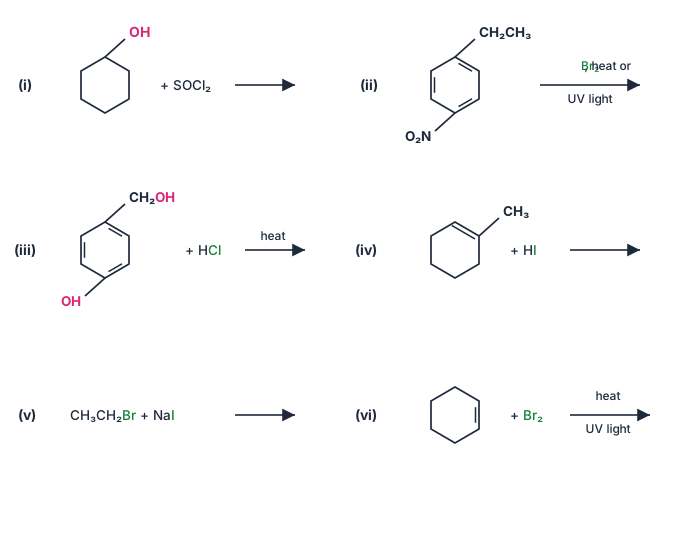
Q.Draw the structures of major monohalo products in each of the following reactions:
🔒You're viewing a preview — the full solution, concept, methods & PYQ mapping are locked.
🔒 Start your 14-day free trial to unlock the full solution →Concept understanding — Markovnikov Addition
The Intuition First
Imagine you have an alkene — a carbon-carbon double bond. That double bond is like a crowded room with two doors. When a molecule like HBr comes along, it wants to break that double bond and add across it. The question is: which carbon gets the hydrogen, and which gets the bromine?
You might think it doesn't matter — after all, the two carbons look similar. But they aren't. One carbon usually has more alkyl groups (methyl, ethyl, etc.) attached to it than the other. That carbon is more "electron-rich" — it has more friends pushing electrons toward it.
The hydrogen, being small and positively charged, is picky. It goes to the carbon that already has more hydrogens. Why? Because that carbon is less crowded and can stabilise the positive charge that forms temporarily during the reaction. The bromine, being large and negatively charged, goes to the other carbon — the one with more alkyl groups.
That's the intuition: the rich get richer. The carbon with more hydrogens gets another hydrogen. The carbon with more alkyl groups gets the halogen.
The Precise Statement
Markovnikov's Rule: When an unsymmetrical reagent (like HX, H₂O, etc.) adds to an unsymmetrical alkene, the hydrogen atom attaches to the carbon of the double bond that already has the greater number of hydrogen atoms.
In other words, for an alkene like CH3CH=CH2 (propene) reacting with HBr:
- Carbon 1 (the CH₂ end) has 2 hydrogens.
- Carbon 2 (the CH end) has 1 hydrogen.
- The H goes to carbon 1 (more hydrogens).
- The Br goes to carbon 2 (fewer hydrogens).
So the product is CH3CHBrCH3 (2-bromopropane), not CH3CH2CH2Br (1-bromopropane).
Why Does This Happen? The Real Chemistry
The reaction proceeds through a carbocation intermediate. When the H⁺ attacks the double bond, it can form one of two possible carbocations:
- A primary carbocation (if H⁺ goes to the more substituted carbon) — unstable.
- A secondary carbocation (if H⁺ goes to the less substituted carbon) — more stable.
The reaction chooses the path that gives the more stable carbocation. Alkyl groups stabilise carbocations through hyperconjugation and inductive effect — they donate electron density to the positively charged carbon.
The stability order of carbocations is: tertiary > secondary > primary > methyl. Markovnikov addition always proceeds through the most stable carbocation possible.
A Common Misconception
Many students think Markovnikov's rule means "hydrogen goes to the carbon with more hydrogens" because that carbon already has more hydrogens. That's backwards. The hydrogen goes there because that path leads to a more stable carbocation — the number of hydrogens is just a convenient way to predict the outcome, not the cause.
The One Big Exception …
Why this formula?
Markovnikov Addition: Why the Rule Holds
Markovnikov's rule is not a formula in the algebraic sense — it's a predictive principle for electrophilic addition to unsymmetrical alkenes. The "why" comes from carbocation stability and reaction mechanism.
The Rule in Words
When H–X adds to an unsymmetrical alkene, the hydrogen attaches to the carbon with more hydrogen atoms already attached, and the halogen (or X group) attaches to the carbon with fewer hydrogen atoms.
Example:
Propene (CHX3−CH=CHX2) + HBr → 2-bromopropane (major product), not 1-bromopropane.
Why This Happens: The Step-by-Step Reasoning
1. The Mechanism (Electrophilic Addition)
The reaction proceeds in two steps:
- Slow step (rate-determining): The alkene's π bond attacks the electrophilic HX+ from H–X, forming a carbocation intermediate.
- Fast step: The carbocation is attacked by the nucleophilic XX−.
2. The Key: Carbocation Stability
The more stable carbocation intermediate forms faster and determines the major product.
| Carbocation Type | Stability Order | Reason |
|---|---|---|
| Tertiary (3∘) | Most stable | +3 alkyl groups donate electron density via hyperconjugation and inductive effect |
| Secondary (2∘) | Intermediate | +2 alkyl groups |
| Primary (1∘) | Least stable | +1 alkyl group |
| Methyl (CHX3X+) | Unstable | No alkyl stabilization |
3. Applying to Propene + HBr
Propene: CHX3−CH=CHX2
Two possible protonation sites:
- Path A (Markovnikov): HX+ adds to CHX2 (terminal carbon) → forms secondary carbocation:
CHX3−CHX+−CHX3(2∘)
- Path B (Anti-Markovnikov): HX+ adds to CH (middle carbon) → forms primary carbocation:
CHX3−CHX2−CHX2X+(1∘)
Result: The secondary carbocation is more stable (by ~25–30 kJ/mol), so Path A is faster. The BrX− then attacks the positively charged carbon, giving 2-bromopropane.
The "Formula" — A Stability-Based Prediction
There is no algebraic formula, but a decision rule:
Major product=Product from the more stable carbocation
For alkenes with alkyl substituents, the stability order is:
Tertiary>Secondary>Primary>Methyl …
- Cyclohexanol + SOCl₂ →
SOCl₂ converts alcohols to alkyl chlorides. With pyridine the reaction follows an SN₂-type path (inversion of configuration); without pyridine it proceeds through the SNi mechanism (internal nucleophilic substitution, retention of configuration). The major product is chlorocyclohexane.
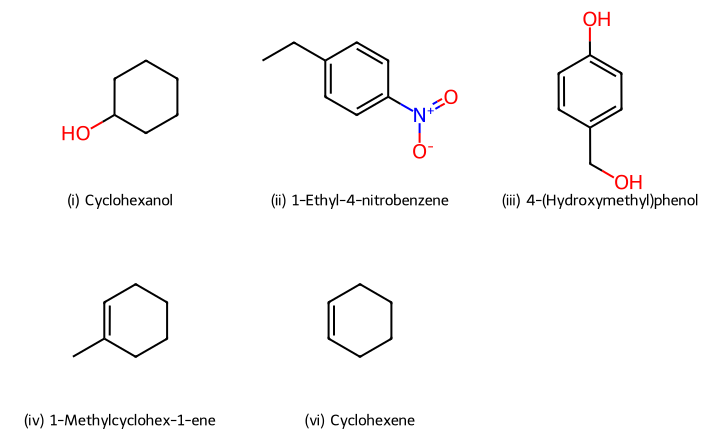
Ring structures for Intext Q6.5's five ring-based starting materials - 1-Ethyl-4-nitrobenzene + Br₂ → heat/UV Heat/UV light promotes free-radical benzylic bromination. The benzylic C–H bond (CH₂ group) is selectively brominated. Major product: 1-(1-bromoethyl)-4-nitrobenzene (p-O2NC6H4CHBrCH3).
- 4-(Hydroxymethyl)phenol + HCl → heat The benzylic –OH is more reactive than the phenolic –OH. Under acidic conditions, the benzylic alcohol undergoes SN₁ to give the benzylic chloride. Major product: 4-(chloromethyl)phenol (p-HOC6H4CH2Cl).
- 1-Methylcyclohex-1-ene + HI → Concept: Markovnikov Addition — the proton adds to the less substituted carbon of the double bond, placing the iodide on the more substituted carbon. The tertiary carbocation intermediate is more stable. Major product: 1-iodo-1-methylcyclohexane.
- CH₃CH₂Br + NaI → NaI in acetone drives an SN₂ reaction (Finkelstein reaction). Iodide is a better nucleophile and more soluble in acetone. Major product: CH₃CH₂I (ethyl iodide).
- Cyclohexene + Br₂ → heat/UV light …
Identify the reactive site in each substrate and apply the correct mechanism (SNi/SN2, free-radical substitution, Markovnikov addition, or halogen exchange) to predict the major monohalo product. Structures for the ring-containing products are drawn below.
(i) Cyclohexanol + SOCl2→
Thionyl chloride converts an alcohol's −OH into a chloride. With no pyridine present (as here), the reaction proceeds through the SNi (internal nucleophilic substitution) pathway: the alcohol first forms a chlorosulfite ester, and the chloride ion that is released stays associated with the same face of the carbon it left from, delivering the chlorine back to that same face — giving retention of configuration. (With pyridine added, the freed chloride ion instead attacks from the opposite face for a clean SN2-style inversion.) Since cyclohexanol's C1 is not a stereocentre, retention or inversion makes no visible difference to the product here — either way the product is chlorocyclohexane.
(ii) 1-Ethyl-4-nitrobenzene (p-O2NC6H4CH2CH3) + Br2heat or UV light
Heat/UV light homolyses Br2 into bromine radicals, favouring free-radical substitution at the most stabilised C–H bond. The benzylic C–H (on the ethyl group's carbon directly attached to the ring) gives a radical stabilised by resonance into the ring, so bromination occurs there rather than anywhere else on the chain. The nitro group's directing effect governs electrophilic aromatic substitution, not this radical pathway, so it plays no role in where the Br ends up. Major product: 1-(1-bromoethyl)-4-nitrobenzene.
(iii) 4-(Hydroxymethyl)phenol (p-HOC6H4CH2OH) + HClheat
Two −OH groups are present: a phenolic −OH directly on the ring, and a benzylic −CH2OH on the side chain. The phenolic C–O bond has partial double-bond character from resonance with the ring and resists substitution under these mild conditions. The benzylic alcohol, by contrast, readily protonates and loses water to form a benzylic carbocation (stabilised by the ring), which chloride then attacks. Major product: 4-(chloromethyl)phenol — the phenolic −OH is untouched.
(iv) 1-Methylcyclohex-1-ene + HI→ …
Here is the solution method for each reaction, following the concept-first approach.
Method: Functional Group Transformation & Regioselectivity Analysis
This method involves identifying the functional group, predicting the reaction mechanism (SN1, SN2, E2, electrophilic addition, free radical substitution), and applying the relevant rule (Markovnikov, anti-Markovnikov, Zaitsev, etc.) to determine the major product.
(i) Cyclohexanol + SOCl2→
- Step 1: Identify the functional group. Alcohol (−OH).
- Step 2: Identify the reagent. SOCl2 (thionyl chloride) is a classic reagent for converting alcohols to alkyl chlorides.
- Step 3: Determine the mechanism. This proceeds via an SN2 mechanism (with inversion of configuration if the carbon is chiral). For cyclohexanol, the OH is on a secondary carbon.
- Step 4: Draw the product. The OH is replaced by Cl.
- Major product: Chlorocyclohexane
(ii) 1-Ethyl-4-nitrobenzene + Br2heat or UV light
- Step 1: Identify the functional group. Alkyl side chain (ethyl group) attached to an aromatic ring with a nitro (−NO2) group.
- Step 2: Identify the reagent and conditions. Br2 with heat or UV light indicates free radical substitution (not electrophilic aromatic substitution).
- Step 3: Determine the site of reaction. The reaction occurs on the benzylic carbon (the carbon directly attached to the benzene ring) because the benzylic radical is highly stabilized by resonance with the ring.
- Step 4: Draw the product. One hydrogen on the benzylic carbon is replaced by bromine.
- Major product: 1-Bromo-1-(4-nitrophenyl)ethane (p-O2NC6H4CHBrCH3)
(iii) 4-(Hydroxymethyl)phenol + HClheat
- Step 1: Identify the functional groups. Two OH groups: one is phenolic (on the ring), one is benzylic (on the side chain).
- Step 2: Identify the reagent and conditions. HCl with heat.
- Step 3: Determine reactivity. The benzylic alcohol is much more reactive than the phenolic OH. The benzylic carbocation is highly stabilized by resonance with the ring, making it an excellent candidate for SN1 reaction.
- Step 4: Draw the product. The benzylic OH is replaced by Cl. The phenolic OH remains unchanged.
- Major product: 4-(Chloromethyl)phenol (p-HOC6H4CH2Cl)
(iv) 1-Methylcyclohex-1-ene + HI→
- Step 1: Identify the functional group. Alkene (C=C).
- Step 2: Identify the reagent. HI (hydrogen halide).
- Step 3: Apply Markovnikov's rule. In the addition of HX to an unsymmetrical alkene, the hydrogen atom adds to the carbon with the greater number of hydrogen atoms, and the halogen adds to the carbon with the fewer hydrogen atoms.
- Step 4: Determine the product. The double bond is between C1 (with a methyl group, no H) and C2 (with one H). H adds to C2, I adds to C1.
- Major product: 1-Iodo-1-methylcyclohexane
(v) CH3CH2Br+NaI→
- Step 1: Identify the functional group. Alkyl halide (bromide).
- Step 2: Identify the reagent. NaI (sodium iodide) in acetone.
- Step 3: Determine the mechanism. This is a classic Finkelstein reaction, an SN2 process. Iodide is a good nucleophile and a good leaving group. Acetone is a polar aprotic solvent that favors SN2.
- Step 4: Draw the product. Bromine is replaced by iodine.
- Major product: Iodoethane (CH3CH2I)
--- …
This set of reactions tests your ability to distinguish between substitution, addition, and free-radical mechanisms. The most common mistakes come from misidentifying the reaction type or misapplying Markovnikov’s rule.
Here’s a breakdown of each reaction, the typical errors, and how to avoid them.
(i) Cyclohexanol + SOCl2→
Common mistake:
Students treat this as an elimination or oxidation. They draw cyclohexene or cyclohexanone.
Why it happens:
SOCl2 is often associated with dehydration or chlorination, but the exact mechanism matters.
Correct approach:
SOCl2 converts alcohols to alkyl chlorides. Without pyridine, the reaction proceeds through the internal SNi pathway (the alcohol forms a chlorosulfite ester, and the released chloride delivers the chlorine back to the SAME face it left from — retention of configuration). With pyridine present, the freed chloride instead attacks from the opposite face, giving a clean SN2-style inversion.
- Product: Chlorocyclohexane
- Since C1 of cyclohexanol is not a stereocentre, retention vs. inversion makes no visible difference to the product here — either pathway gives the same chlorocyclohexane.
How to avoid the mistake:
- Memorize: SOCl2 + alcohol → alkyl chloride, via SNi (retention, no pyridine) or an SN2-style inversion (with pyridine).
- Do not assume elimination unless a strong base is present.
(ii) 1-Ethyl-4-nitrobenzene + Br2heat or UV light
Common mistake:
Students draw electrophilic aromatic substitution (bromination on the ring).
Why it happens:
Br2 with a catalyst (FeBr3) gives ring bromination. But here, heat/UV light changes the mechanism.
Correct approach:
- Heat/UV light initiates free-radical substitution at the benzylic position (the carbon next to the ring).
- The nitro group is meta-directing and deactivates the ring, but that is irrelevant here — the reaction is not on the ring.
- Product: 1-(1-Bromoethyl)-4-nitrobenzene (p-O2NC6H4CHBrCH3)
How to avoid the mistake:
- Always check the reaction conditions:
- Br2 + catalyst → aromatic substitution
- Br2 + heat/UV → free-radical at benzylic or allylic position
- The benzylic radical is highly stabilized, so it is the preferred site.
(iii) 4-(Hydroxymethyl)phenol + HClheat
Common mistake:
Students replace the phenolic −OH with Cl, or replace both −OH groups.
Why it happens:
Phenol −OH does not undergo substitution easily because of resonance stabilization.
Correct approach:
- The benzylic alcohol (−CH2OH) reacts via SN1 (benzylic carbocation is stable).
- The phenolic −OH remains unchanged.
- Product: 4-(Chloromethyl)phenol (p-HOC6H4CH2Cl)
How to avoid the mistake:
- Remember: Phenolic −OH is not a good leaving group under acidic conditions.
- Only the side-chain −OH (alcoholic) reacts.
(iv) 1-Methylcyclohex-1-ene + HI→
Common mistake:
Students add H and I randomly, or place I on the less substituted carbon.
Why it happens:
Misapplication of Markovnikov’s rule — they think “H goes to the carbon with more H’s” but forget that the more substituted carbon gets the positive charge.
Correct approach:
- Markovnikov addition: H+ adds to the less substituted alkene carbon (to form the more stable tertiary carbocation).
- I− then attacks the carbocation.
- Product: 1-Iodo-1-methylcyclohexane
How to avoid the mistake:
- Always draw the carbocation intermediate.
- The more stable carbocation (tertiary > secondary > primary) determines where the nucleophile (I−) goes.
(v) CH3CH2Br+NaI→
Common mistake:
Students think no reaction occurs, or draw elimination.
Why it happens:
NaI is a weak base, so elimination is unlikely. But students sometimes forget the Finkelstein reaction.
Correct approach:
- This is an SN2 reaction: I− displaces Br− (iodide is a better nucleophile).
- Product: CH3CH2I (ethyl iodide) + NaBr …
Showing the 12 most recent of 51 on this concept.
- TG EAPCET 2026Set eng-2026-05-09-AN1 markMCQQ.Observe the following I and II reactions Rate determining step in the reactions I, II respectively is (A) Cleavage of C–Cl bond in both I, II (B) Cleavage of C–Cl bond in I, attack of OH− in II (C) Attack of OH− in I, C–Cl bond cleavage in II (D) Attack of OH− in both I and II
›Reveal solutionSolution
The key is identifying the rate-determining step (RDS) from the reaction mechanism. In I (SN1), the RDS is the cleavage of the C–Cl bond; in II (SN2), the RDS is the attack of OH⁻. The correct option is (B).
The question asks you to compare the rate-determining steps in two reactions, labelled I and II. Without seeing the exact structures, the pattern is unmistakable: Reaction I follows an SN1 mechanism (tertiary alkyl halide, polar protic solvent, etc.), while Reaction II follows an SN2 mechanism (primary alkyl halide, strong nucleophile, etc.). The rate-determining step in each case is the slowest step — the one that determines the overall rate law.
-
Reaction I — SN1 mechanism
In an SN1 reaction, the first step is the ionization of the alkyl halide: the C–Cl bond breaks heterolytically to form a carbocation and a chloride ion. This step is slow because it involves bond breaking and charge separation. The subsequent attack of OH⁻ on the carbocation is fast.
Hence, the rate-determining step is the cleavage of the C–Cl bond.
-
Reaction II — SN2 mechanism
In an SN2 reaction, the nucleophile (OH⁻) attacks the carbon centre from the back side simultaneously as the leaving group (Cl⁻) departs. This is a single, concerted step. The rate depends on the concentrations of both the alkyl halide and OH⁻. …
-
- TG EAPCET 2026Set eng-2026-05-09-AN1 markMCQQ.Observe the statements given about C6H5N2BF4 (X) I. Reaction of X with NaF gave C6H5F II. Heating X with NaNO2 | Cu yielded C6H5NO2 III. Heating X gave C6H5F IV. Reaction of X with HNO3 gave C6H5NO2 Correct statements are (only) (A) I, II only (B) II, III only (C) I, IV only (D) III, IV only
›Reveal solutionSolution
C6H5N2BF4 gives fluorobenzene on simple heating (Balz–Schiemann, statement III) and nitrobenzene with NaNO2/Cu (statement II). Statements I and IV are wrong — option (B).
The concept first
A diazonium group, −N+≡N, is the finest leaving group in aromatic chemistry: it departs as nitrogen gas, which is thermodynamically irresistible. That is why the diazonium salt is the master intermediate for putting almost any group onto a benzene ring — you first make Ar−N2+, then let a nucleophile trap the aryl cation/radical.
But fluorine is the awkward case. Ordinary Sandmeyer chemistry (CuCl, CuBr, KI) fails for F−, because fluoride is a poor nucleophile in these conditions. The trick is to build the fluorine into the counter-ion: precipitate the diazonium salt as its tetrafluoroborate, then heat the dry solid. Fluoride is delivered intramolecularly from BF4− — this is the Balz–Schiemann reaction. So the whole point of using BF4− is that no external fluoride source is needed.
Step-by-step
- Statement III — heating X gives C6H5F.
C6H5N2+BF4− Δ C6H5F+N2↑+BF3
This is precisely the Balz–Schiemann reaction. TRUE.
2. Statement I — X + NaF gives C6H5F. Adding NaF is neither necessary nor effective; free fluoride does not substitute the diazonium group (that failure is the very reason the fluoroborate route exists). FALSE. …
- TG EAPCET 2026Set eng-2026-05-10-AN1 markMCQQ.CX6HX5NX2ClCu|HClX(i) NaOHY 673K,300atm (ii) HX3OX+ The incorrect statement about X and Y is (A) X undergoes Fittig reaction (B) Y gives o-hydroxybenzaldehyde with CHCl3 and NaOH (C) Y forms salt with NaHCO3 solution (D) X is chemically inert at room temperature
›Reveal solutionSolution
The reaction sequence is the Sandmeyer reaction (conversion of diazonium salt to chlorobenzene, X) followed by high‑pressure/high‑temperature hydrolysis to phenol (Y). The incorrect statement is (C) because phenol does not react with NaHCO₃.
Concept & Intuition
This problem tests your knowledge of two classic organic transformations:
- Sandmeyer reaction – replacing a diazonium group with chlorine using CuCl/HCl.
- High‑temperature, high‑pressure hydrolysis – converting chlorobenzene to phenol under drastic conditions (NaOH, 673 K, 300 atm).
Once you identify X and Y, you evaluate each statement about their chemical behavior. The trick is remembering that phenol is a weaker acid than carbonic acid, so it does not liberate CO₂ from NaHCO₃ – a common pitfall.
Step‑by‑step reasoning
- Identify X
- Starting material: benzenediazonium chloride (CX6HX5NX2Cl).
- Reagent: CuCl/HCl (Sandmeyer conditions).
- The diazonium group is replaced by chlorine:
CX6HX5NX2ClCuCl/HClCX6HX5Cl+NX2
So **X = chlorobenzene**.2. Identify Y
- Chlorobenzene is treated with NaOH at 673 K and 300 atm (the Dow process).
- The chlorine is displaced by hydroxide, forming sodium phenoxide.
- Acidification with HX3OX+ gives phenol:
CX6HX5ClNaOH,673K,300atmCX6HX5ONaHX3OX+CX6HX5OH
So **Y = phenol**.3. Evaluate statement (A): “X undergoes Fittig reaction”
- The Fittig reaction is a coupling of two aryl halides with sodium metal to give a biaryl.
- Chlorobenzene (X) does undergo this reaction (e.g., with Na in dry ether to give biphenyl).
- True.
-
Evaluate statement (B): “Y gives o‑hydroxybenzaldehyde with CHCl₃ and NaOH”
- This is the Reimer–Tiemann reaction of phenol with chloroform in base.
- The major product is indeed salicylaldehyde (o‑hydroxybenzaldehyde).
- True.
-
Evaluate statement (C): “Y forms salt with NaHCO₃ solution”
- Phenol is acidic (pKa ≈ 10) but weaker than carbonic acid (pKa₁ ≈ 6.4).
- NaHCO₃ is a weaker base; it can only deprotonate acids stronger than H₂CO₃. …
- TG EAPCET 2026Set eng-2026-05-11-FN1 markMCQQ.What is the end product P in the given sequence of reactions? (A) p-Hydroxybenzaldehyde (B) m-Hydroxybenzaldehyde (C) o-Hydroxybenzaldehyde (D) o-Hydroxybenzoic acid
›Reveal solutionSolution
The reaction sequence is a classic Reimer–Tiemann reaction on phenol followed by a Cannizzaro-type workup; the final product is o-hydroxybenzaldehyde, so the correct option is (C).
The key concept here is the Reimer–Tiemann reaction, which introduces a formyl group (–CHO) ortho to the –OH group on phenol. The reaction uses chloroform (CHCl₃) in the presence of a strong base (like NaOH) to generate a dichlorocarbene (:CCl₂) intermediate. This carbene attacks the electron-rich ortho position of the phenoxide ion, leading to an aldehyde after hydrolysis. The para product is also possible but is usually minor due to steric hindrance; the ortho product is the major one.
Now, let’s walk through the sequence step by step:
-
Step 1: Phenol + NaOH
Phenol (C₆H₅OH) reacts with NaOH to form the phenoxide ion (C₆H₅O⁻). This ion is much more nucleophilic than phenol itself, especially at the ortho and para positions, because the negative charge on oxygen donates electron density into the ring.
-
Step 2: Reimer–Tiemann reaction (CHCl₃ + NaOH, heat)
Chloroform (CHCl₃) in the presence of strong base generates dichlorocarbene (:CCl₂). This highly reactive electrophile attacks the ortho position of the phenoxide ion (the para position is also attacked but less favored). The intermediate then undergoes hydrolysis to give an aldehyde group at the ortho position. The product after this step is salicylaldehyde (o-hydroxybenzaldehyde).
-
Step 3: Dilute H₂SO₄ workup …
-
- TG EAPCET 2026Set eng-2026-05-11-AN1 markMCQQ.An alkene, X (C5H10) exhibits cis/trans isomerism. Bromination of 'X' followed by reaction with reagent/s (Y) gave the product 'Z'. What are 'Y' and 'Z'? (A) NaNH2 ; (CH3)2CHC≡CH (B) KOH (aq) ; CH3CH2CH2C≡CH (C) alc.KOH,NaNH2 ; CH3CH2C≡CCH3 (D) alc.KOH,NaNH2 ; CH3CH2CH2C≡CH
›Reveal solutionSolution
The alkene X must be pent-2-ene (the only C₅H₁₀ alkene with cis/trans isomerism). Bromination gives a vicinal dibromide; double dehydrohalogenation with alc. KOH then NaNH₂ yields pent-2-yne. The correct option is (C).
Concept & Intuition
The key is to identify the alkene first. For an alkene C₅H₁₀ to show cis/trans isomerism, each doubly bonded carbon must have two different substituents. The only straight-chain pentene satisfying this is pent-2-ene (CH₃–CH=CH–CH₂–CH₃). (Pent-1-ene has a terminal =CH₂ group, so no cis/trans; branched isomers like 2-methylbut-2-ene have a carbon with two identical methyl groups, also no cis/trans.)
Bromination adds Br₂ across the double bond, giving a vicinal dibromide. To get an alkyne, we need two successive eliminations of HBr. The first elimination (with a strong base like alc. KOH) gives a bromoalkene; the second elimination (with a stronger base like NaNH₂) gives the alkyne. The product is pent-2-yne, not pent-1-yne, because the triple bond forms where the original double bond was.
Step-by-step reasoning
-
Identify alkene X
- Formula C₅H₁₀, must be an alkene (one degree of unsaturation).
- For cis/trans isomerism, each sp² carbon must have two different groups.
- Pent-1-ene (CH₂=CH–CH₂–CH₂–CH₃): one sp² carbon has two H’s → no cis/trans.
- 2-Methylbut-1-ene (CH₂=C(CH₃)–CH₂–CH₃): terminal =CH₂ → no cis/trans.
- 2-Methylbut-2-ene ((CH₃)₂C=CH–CH₃): one sp² carbon has two methyls → no cis/trans.
- Pent-2-ene (CH₃–CH=CH–CH₂–CH₃): each sp² carbon has H and an alkyl group → cis/trans possible.
- Hence X = pent-2-ene.
-
Bromination of X
- Br₂ adds across the double bond:
CH3CH=CHCH2CH3+Br2→CH3CHBrCHBrCH2CH3
This is a vicinal dibromide (2,3-dibromopentane).3. First elimination (reagent Y part 1: alc. KOH)
- Alcoholic KOH is a strong base that promotes dehydrohalogenation.
- The vicinal dibromide undergoes elimination of one HBr to give a bromoalkene. The more substituted alkene (Saytzeff rule) is favoured:
CH3CHBrCHBrCH2CH3alc. KOHCH3CBr=CHCH2CH3
(The double bond forms between C2 and C3, with Br on the more substituted carbon.)4. Second elimination (reagent Y part 2: NaNH₂)
- NaNH₂ is a very strong base (amide ion) needed to remove the second HBr from a bromoalkene.
- This gives an alkyne:
-
- TG EAPCET 2026Set eng-2026-05-11-AN1 markMCQQ.What are X and Y respectively in the following reaction sequence? Y (i) Br2∣Fe(ii) KMnO4∣OH−, H3O+ Ethylbenzene (C6H5−C2H5) $\xrightarrow[\text{(ii) Mg | dry ether ;(iii) CO}_2,\ \mathrm{H_3O^+}]{\text{(i) Br}_2,|,h\nu}X(A)\mathrm{C_6H_5-CH_2CH_2-COOH}(3−phenylpropanoicacid);4−bromophenylaceticacid(\mathrm{Br-C_6H_4-CH_2-COOH})(B)\mathrm{C_6H_5-CH(CH_3)-COOH}(2−phenylpropanoicacid);p−bromobenzoicacid(\mathrm{Br-C_6H_4-COOH})(C)p−Ethylbenzoicacid(\mathrm{C_2H_5-C_6H_4-COOH});\mathrm{C_6H_5-CH(Br)-COOH}(2−bromo−2−phenylaceticacid)(D)m−Ethylbenzoicacid(\mathrm{C_2H_5-C_6H_4-COOH},meta);p−bromobenzoicacid(\mathrm{Br-C_6H_4-COOH}$)
›Reveal solutionSolution
Light-induced bromination hits the benzylic carbon (giving, after Grignard carboxylation, 2-phenylpropanoic acid = X), while Br2/Fe hits the ring para and KMnO4 then burns the ethyl group down to −COOH (giving p-bromobenzoic acid = Y). Option (B).
The concept first
Three separate rules are being combined.
1. Br2/hν versus Br2/Fe — the single most useful contrast in aromatic chemistry.
- hν (light/heat, no catalyst) ⇒ a free-radical chain reaction that attacks the side chain, specifically the benzylic C–H, because the benzyl radical is resonance-stabilised by the ring.
- Fe / FeBr3 (a Lewis acid) ⇒ an electrophilic substitution on the ring.
2. Side-chain oxidation by KMnO4. Alkaline KMnO4 (then acid work-up) oxidises any alkyl side chain that possesses a benzylic hydrogen right back to a single −COOH group, however long the chain:
C6H5−CH2CH3 KMnO4/OH−H3O+ C6H5−COOH
3. Grignard carboxylation adds exactly one carbon.
R−Br Mg, dry ether R−MgBr CO2 R−COOMgBr H3O+ R−COOH
Step-by-step — the right-hand branch (X)
Step 1 — benzylic bromination. Ethylbenzene is C6H5−CH2−CH3. Under Br2/hν, a bromine radical abstracts the benzylic hydrogen (the one on the CH2 next to the ring), because the radical formed there is delocalised into the ring:
C6H5CH2CH3 Br2,hν C6H5−CH(Br)−CH3(1-bromo-1-phenylethane)
Step 2 — make the Grignard.
C6H5CH(Br)CH3 Mg, dry ether C6H5CH(MgBr)CH3
Step 3 — carboxylate it. The carbanion-like carbon attacks CO2; acid work-up liberates the acid:
C6H5CH(MgBr)CH3 CO2H3O+ C6H5−CH(CH3)−COOH
X=2-phenylpropanoic acid
The carboxyl group lands exactly where the bromine was — on the benzylic carbon — so the branch point is retained.
Step-by-step — the left-hand branch (Y) …
- TG EAPCET 2026Set ap-2026-05-04-FN1 markMCQQ.Identify the reactions, in which products are correctly given I. IBrH2OHI+HOBr II. ClF3H2OHF+HOClO III. IF5H2OHF+HIO3 The correct answer is (A) I, II only (B) II, III only (C) I, III only (D) I, II, III
›Reveal solutionSolution
Hydrolysis of interhalogen compounds involves the more electronegative halogen forming a hydrohalic acid and the less electronegative halogen forming an oxyacid, retaining its oxidation state. Based on this, reactions II and III are correctly given. The correct option is (B).
The hydrolysis of interhalogen compounds is a reaction with water where the compound breaks down. The key principle governing these reactions is the difference in electronegativity between the two halogens. The more electronegative halogen will form a hydrohalic acid (HX), while the less electronegative halogen will form an oxyacid (HXOn). The oxidation state of the less electronegative halogen in the interhalogen compound is typically preserved in the resulting oxyacid.
Let's analyze each reaction:
-
Reaction I: IBrH2OHI+HOBr
- Concept: In the interhalogen compound IBr, bromine (Br) is more electronegative than iodine (I). Therefore, upon hydrolysis, bromine should form hydrobromic acid (HBr), and iodine should form an oxyacid.
- Oxidation States: In IBr, iodine has an oxidation state of +1, and bromine has an oxidation state of −1.
- Expected Products: The more electronegative bromine forms HBr. The less electronegative iodine, retaining its +1 oxidation state, forms hypoiodous acid (HOI).
- Comparison: The given products are HI and HOBr. In HI, iodine is in the −1 oxidation state, and in HOBr, bromine is in the +1 oxidation state. This implies that iodine is more electronegative than bromine, which is incorrect. The roles of the halogens are swapped in the given products.
- Conclusion: Reaction I is incorrect. The correct products would be HBr+HOI.
-
Reaction II: ClF3H2OHF+HOClO
- Concept: In ClF3, fluorine (F) is more electronegative than chlorine (Cl). Thus, fluorine should form hydrofluoric acid (HF), and chlorine should form an oxyacid.
- Oxidation States: In ClF3, chlorine has an oxidation state of +3, and fluorine has an oxidation state of −1.
- Expected Products: The more electronegative fluorine forms HF. The less electronegative chlorine, retaining its +3 oxidation state, forms chlorous acid (HClO2). …
-
- TG EAPCET 2025Set eng-2025-05-02-FN1 markMCQQ.Consider the following reaction sequence. (A) and (C) are \ce{CH3CHO} \xrightarrow{\text{(i) CH3MgBr}} \xrightarrow{\text{(ii) H2O / H^+}} (\text{A}) \xrightarrow{\text{H2SO4, } \Delta} (\text{B}) \xrightarrow{\text{(i) B2H6}} \xrightarrow{\text{(ii) H2O, H2O2 \mid OH^-}} (\text{C}) (A) Functional isomers (B) Metamers (C) Optical isomers (D) Position isomers
›Reveal solutionSolution
The reaction sequence converts acetaldehyde to 2-butanol via a Grignard addition and then hydroboration-oxidation; the starting material and final product are structural isomers that differ in the position of the hydroxyl group, making them position isomers.
The key here is to identify the structures of (A), (B), and (C) step by step, then compare the starting material (acetaldehyde) with the final product (C) to determine the type of isomerism.
- First step: Grignard reaction on acetaldehyde
Acetaldehyde (CHX3CHO) reacts with CHX3MgBr (methylmagnesium bromide). The Grignard reagent adds to the carbonyl carbon, forming an alkoxide after the nucleophilic attack. Upon workup with HX2O/HX+, the alkoxide is protonated to give a secondary alcohol.
- The reaction:
CHX3CHO+CHX3MgBrCHX3CH(OMgBr)CHX3HX2O/HX+CHX3CH(OH)CHX3
- So (A) is 2-propanol (isopropyl alcohol), CHX3CH(OH)CHX3.
- Second step: Dehydration of (A) to form (B)
Heating 2-propanol with concentrated HX2SOX4 causes elimination of water (dehydration), yielding an alkene. Since it’s a secondary alcohol, the major product follows Zaitsev’s rule: the more substituted alkene is favored.
- Dehydration:
CHX3CH(OH)CHX3HX2SOX4,ΔCHX3CH=CHX2+HX2O
- So (B) is propene, CHX3CH=CHX2.
- Third step: Hydroboration-oxidation of (B)
Propene undergoes hydroboration with BX2HX6 (diborane), followed by oxidation with HX2OX2/OHX−. This reaction adds water across the double bond in an anti-Markovnikov fashion — the hydroxyl group ends up on the less substituted carbon.
- For propene: CHX3CH=CHX2 → the boron adds to the terminal carbon (less hindered), so after oxidation, the OH is on the terminal carbon.
- Product:
CHX3CH=CHX21⋅BX2HX62⋅HX2OX2/OHX−CHX3CHX2CHX2OH
- So (C) is 1-propanol (n-propyl alcohol), CHX3CHX2CHX2OH.
- Comparing starting material and final product
The question asks about the relationship between (A) and (C). Wait — careful: The problem states “(A) and (C) are” followed by the isomer types. So we compare (A) = 2-propanol and (C) = 1-propanol.
- Both have the molecular formula CX3HX8O (same molecular weight, same atoms).
- They differ in the position of the hydroxyl group: on carbon 2 vs. carbon 1. …
- First step: Grignard reaction on acetaldehyde
Acetaldehyde (CHX3CHO) reacts with CHX3MgBr (methylmagnesium bromide). The Grignard reagent adds to the carbonyl carbon, forming an alkoxide after the nucleophilic attack. Upon workup with HX2O/HX+, the alkoxide is protonated to give a secondary alcohol.
- TG EAPCET 2025Set eng-2025-05-02-AN1 markMCQQ.Which of the following is an example of electrophilic substitution reaction? (A) CH3CHO+HCN→CH3CH(OH)CN (B) (CH3)3CX+H2O→(CH3)3C−OH+HX (C) C6H6+CH3COClAlCl3C6H5(COCH3)+HCl (D) BrCH2CH2Br+ZnΔalcoholCH2=CH2+ZnBr2
›Reveal solutionSolution
The key idea is that electrophilic substitution involves an electrophile replacing a hydrogen on an aromatic ring; only reaction (C) fits this pattern, making it the correct answer.
Concept and Intuition
Electrophilic substitution reactions are characteristic of aromatic compounds like benzene. In these reactions, an electron‑deficient species (an electrophile) attacks the electron‑rich aromatic ring, replacing one of the hydrogen atoms. The other options represent different reaction types: nucleophilic addition (A), nucleophilic substitution (B), and elimination (D). Recognizing the hallmark of aromatic substitution—a benzene ring reacting with an electrophile in the presence of a Lewis acid catalyst—immediately points to option (C).
Step‑by‑Step Reasoning
-
Identify the reaction type in (A)
CH3CHO+HCN→CH3CH(OH)CN
Here, the carbonyl carbon of acetaldehyde is attacked by the cyanide ion (a nucleophile). This is a nucleophilic addition reaction, not electrophilic substitution.
-
Identify the reaction type in (B)
(CH3)3CX+H2O→(CH3)3C−OH+HX
A tertiary alkyl halide reacts with water to form an alcohol. The leaving group (X⁻) departs, and water acts as a nucleophile. This is an S_N1 nucleophilic substitution (or, less commonly, E1 if elimination occurs, but here the product is an alcohol). No aromatic ring is involved.
-
Identify the reaction type in (C)
C6H6+CH3COClAlCl3C6H5(COCH3)+HCl
Benzene reacts with acetyl chloride in the presence of AlCl₃. The Lewis acid AlCl₃ generates the acylium ion (CH3CO+), a strong electrophile. This electrophile attacks the benzene ring, replacing a hydrogen atom to form acetophenone. This is the classic Friedel–Crafts acylation, a prime example of electrophilic aromatic substitution.
-
Identify the reaction type in (D) …
-
- TG EAPCET 2025Set eng-2025-05-02-AN1 markMCQQ.Identify the reaction related to Deacon’s process (A) 2H2O+2Cl2sunlight4HCl+O2 (B) 4HCl+O2CuCl2723 K2Cl2+2H2O (C) 2NaCl+H2SO4823 KNa2SO4+2HCl (D) Na2S2O3+Cl2+H2O→Na2SO4+2HCl+S
›Reveal solutionSolution
Deacon’s process is an industrial method to produce chlorine by oxidizing hydrogen chloride with oxygen over a copper(II) chloride catalyst at about 723 K. The correct reaction is option (B).
Concept & Intuition
Deacon’s process was developed in the 19th century to recover chlorine from byproduct HCl, which was abundant in the Leblanc soda process. Instead of wasting HCl, chemists found that passing it with air over a hot catalyst (CuCl₂) converts it back to chlorine gas. The key insight: this is a catalytic oxidation of HCl, not a photochemical or simple displacement reaction. The catalyst lowers the temperature needed, making the process economically viable.
Step-by-step reasoning
-
Identify the defining features of Deacon’s process
- Reactants: hydrogen chloride (HCl) and oxygen (O₂).
- Products: chlorine (Cl₂) and water (H₂O).
- Catalyst: copper(II) chloride (CuCl₂).
- Temperature: around 723 K (450 °C).
- Overall reaction: 4HCl+O2→2Cl2+2H2O.
-
Examine each option against these criteria
-
(A) 2H2O+2Cl2sunlight4HCl+O2
This is the reverse of Deacon’s process — it uses sunlight to decompose chlorine into HCl. Not correct.
-
(B) 4HCl+O2CuCl2723 K2Cl2+2H2O
Matches exactly: reactants, products, catalyst (CuCl₂), and temperature (723 K). This is the textbook Deacon process.
-
(C) 2NaCl+H2SO4823 KNa2SO4+2HCl
This is the salt-cake or Mannheim process for making HCl, not chlorine. No oxygen or catalyst involved. …
-
-
- TG EAPCET 2025Set eng-2025-05-02-AN1 markMCQQ.Identify the product 'P' in the given reaction sequence (CHX3)X2C=C(CHX3)X2(1) OX3(2) Zn/HX2OA(1) Ba(OH)X2(2) ΔP (A) (CHX3)X2C(OH)−CHX2−CO−CHX3 (4-hydroxy-4-methylpentan-2-one) (B) (CHX3)X2CH−CH(OH)−CO−CHX3 (3-hydroxy-4-methylpentan-2-one) (C) (CHX3)X2C=CH−CO−CHX3 (4-methylpent-3-en-2-one) (D) (CHX3)X2C=C(OH)−CHO
›Reveal solutionSolution
Ozonolysis gives acetone; Ba(OH)X2 then aldol-condenses it to diacetone alcohol, which on heating loses water to give mesityl oxide — option (C).
The concept first
Reductive ozonolysis (OX3, then Zn/HX2O) cuts a C=C and caps each carbon with =O, keeping every substituent. The zinc is there to destroy the HX2OX2 that would otherwise oxidise the products further.
Aldol condensation requires an α-hydrogen. A base removes it to make a carbanion/enolate, which adds to the carbonyl carbon of a second molecule (aldol addition, giving a β-hydroxy carbonyl). Warming then eliminates water to form an α,β-unsaturated carbonyl — the product is stabilised by conjugation, and that stabilisation is the driving force for the dehydration.
Step 1 — Find A
(CHX3)X2C=C(CHX3)X2(1) OX3(2) Zn/HX2O2 CHX3−CO−CHX3
A tetrasubstituted alkene cleaves symmetrically, so A = propanone (acetone).
Step 2 — Aldol addition with Ba(OH)X2
Acetone has six α-hydrogens. The base makes the enolate, which attacks the carbonyl of another acetone:
CHX3COCHX3+CHX3COCHX3Ba(OH)X2(CHX3)X2C(OH)−CHX2−CO−CHX3 …
- TG EAPCET 2025Set eng-2025-05-03-AN1 markMCQQ.The correct statements about the products B and C in the given reactions are (Anhy = anhydrous, ethanolic) CH3CH2OHHClAnhy ZnCl2Aethanolic AgCNB (Minor)+C (Major) I. B and C are functional isomers II. With H2 | Catalyst B gives 1° amine and C gives 2° amine III. B on acid hydrolysis gives formic acid and C gives C3H6O2 IV. C forms isocyanate with HgO (A) I & III (B) II & III (C) I, II & IV (D) II, III & IV
›Reveal solutionSolution
AgCN is covalent, so its nitrogen attacks: the major product C is ethyl isocyanide and the minor B is the nitrile. Checking the four statements, I, II and IV are true and III is reversed — option (C).
The concept first
The cyanide ion is ambident: it can bond through carbon (giving a nitrile, R−C≡N) or through nitrogen (giving an isocyanide, R−N≡C). Which end wins depends on the metal salt:
- KCN is ionic. The free CN− attacks through carbon (the better nucleophilic centre) → nitrile is major.
- AgCN is largely covalent. The carbon is tied up with silver, so only the nitrogen lone pair is available → isocyanide is major.
That single fact drives the whole question.
Step-by-step
- Make A. CH3CH2OH+HClanhy. ZnCl2CH3CH2Cl (Groves' process). A = ethyl chloride.
- React with ethanolic AgCN.
C2H5ClAgCNC (major)C2H5NC+B (minor)C2H5CN
- Statement I — functional isomers? Both are C3H5N. Same molecular formula, different functional group (cyanide vs isocyanide). TRUE.
- Statement II — reduction products?
- C2H5C≡NH2/catC2H5CH2NH2 (propan-1-amine): the nitrogen carries two H's → primary amine ✓ (B gives 1∘).
- C2H5−N≡CH2/catC2H5−NH−CH3 (N-methylethanamine): the nitrogen already carries the ethyl group, and the reduced carbon becomes a methyl → secondary amine ✓ (C gives 2∘). TRUE. …
🎓Unlock everything free for 14 days
- ✓Full step-by-step solutions
- ✓Concept-first explanations
- ✓Methods, shortcuts & mistakes
- ✓PYQ mapping + timed mock tests
Full access for 14 days. No credit card required.